Why Your Hybrid Branding Strategy Is an Operational Liability
Corporate rebranding projects inside growing UK professional services firms frequently stall at the architecture stage.
When a firm employing 50 to 200 people prepares for an aggressive growth phase, an acquisition, or a significant market repositioning, executives invariably hit the same wall: how to structure the relationship between the parent entity and specialised service lines.
The typical resolution is a compromise. To appease internal partners or protect legacy goodwill, leadership defaults to a hybrid brand model.
This structural choice is rarely driven by market logic. Instead, it is an architectural concession that creates significant operational friction.
Treating a mixed architecture as a soft compromise is precisely why corporate portfolios experience slow asset decay. A hybrid model is not a passive middle ground; it is a complex corporate operating framework requiring continuous governance.
Executing this model safely means moving past visual design trends and focusing on risk management.
If a firm cannot measure, isolate, and govern the operational tensions inherent in a mixed architecture, the corporate portfolio will fragment, customer acquisition costs will rise, and market equity will be diluted.
- Hybrid branding is an operationally intensive architecture, demanding continuous governance rather than a harmless compromise.
- Before switching, ensure granular financial visibility (CAC, LTV), comprehensive IP protection, and a unified corporate governance owner.
- Control five core risks: customer perception, channel conflict, operational cost, legal boundaries, and cultural alignment.
- Left unmanaged, hybrids fragment portfolios, inflate CAC, dilute market equity, and lengthen sales cycles, as Inkbot Design showed.
- Immediate task: run a structural architecture inventory; collapse into a master brand unless data justify duplicate operational overhead.
What Is a Hybrid Branding Strategy?
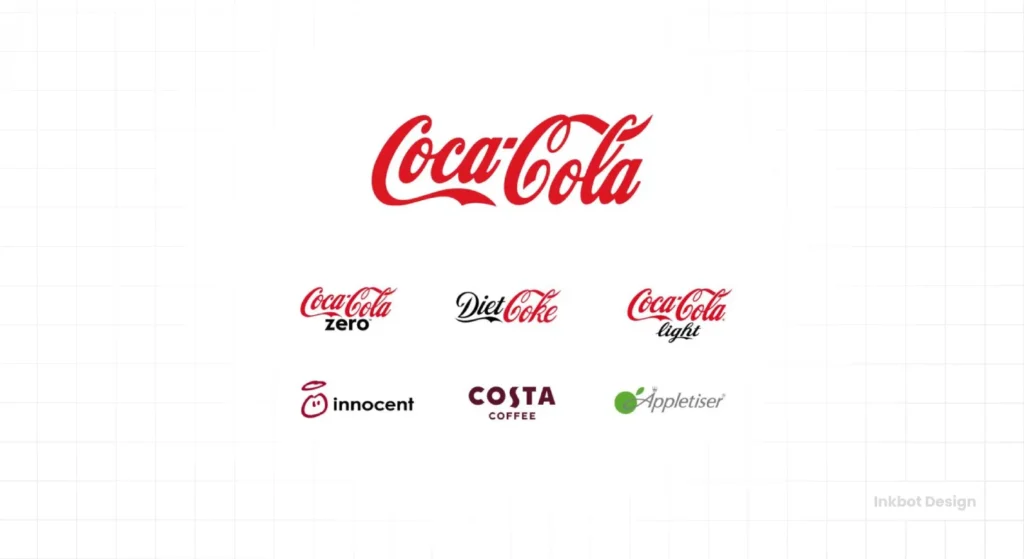
A hybrid branding strategy is a corporate architecture model that simultaneously deploys both a single master-brand identity (a branded house) and autonomous, standalone product or service brands (a house of brands) within the same organisational portfolio.
Firms utilise this framework to retain localised market equity while exploiting centralised corporate reputation.
- Taxonomic Duality: The corporate framework maintains a clear primary corporate identity while allowing specific divisions to operate under distinct naming conventions, visual systems, or value propositions.
- Strategic Flexibility: This architecture allows entities to access highly specialised market niches where the parent brand’s generalised authority lacks sufficient contextual relevance.
- Operational Complexity: The model demands distinct financial, operational, and marketing management workflows to prevent internal service lines from competing for the same target audience.
A hybrid branding strategy combines master-brand equity with independent market identities to capture distinct client segments while centralising high-cost operational infrastructure.
The Prerequisites for Portfolio Architecture Modification
Before a professional services firm alters its brand taxonomy, specific operational foundations must be verified. Modifying architecture without these entry conditions guarantees internal misalignment and wasted capital.
Absolute Financial Visibility
Firms must be able to track client acquisition costs (CAC) and customer lifetime value (LTV) at the individual service-line level. Without this granular data, it is impossible to evaluate whether a standalone brand justifies its increased operational overhead.
Legal and Trademark Clearance
The corporate entity must hold comprehensive IP protection across all relevant jurisdictions and sectors for both the parent identity and any projected sub-brands. Architecture expansion without clear legal separation invites catastrophic regulatory and trademark disputes.
Unified Corporate Governance
A centralised executive authority must own the portfolio framework. If individual practice partners maintain absolute autonomy over localised marketing assets, a hybrid model will rapidly collapse into uncoordinated visual chaos.
The 5-Stage Process to Deploy a Hybrid Branding Model

Implementing a hybrid architecture requires shifting from aesthetic consensus-building to systematic risk management. Order is critical. Misordering these evaluation stages results in structural fragmentation and market confusion.
1. Establish the Customer Perception Gate: Identify market alignment limits.
Analyse target audience behaviour across every vertical. The hybrid framework is justified only if the data indicate that a specific client segment refuses to purchase specialised services from a generalised corporate brand. If the parent entity’s market permission stretches across the new vertical, a standalone identity is an unnecessary commercial expense.
The critical failure mode at this stage is relying on internal partner assumptions instead of external client data.
2. Conduct Channel Conflict Audits: Isolate internal competition risks.
Map the digital and physical acquisition channels for every brand asset in the portfolio. Ensure that the independent service brands do not bid against the parent company for identical search terms or pitch to the same procurement panels. The governance model must enforce an absolute distinction between target customer bases.
Failure here manifests as self-inflicted margin erosion, where two internal teams drive up acquisition costs by competing for the same client.
3. Quantify the Operational Cost Cap: Establish structural baseline metrics.
Calculate the precise financial burden of maintaining separate digital ecosystems, compliance frameworks, and marketing operations. A hybrid model requires duplicated infrastructure. The firm must determine the exact revenue threshold each sub-brand must achieve to clear its localised operational overhead.
The common error is underestimating the continuous cost of managing separate website properties, independent CRM instances, and isolated content pipelines.
4. Review Legal and Intellectual Property Boundaries: Secure regulatory insulation.
Verify the operational independence of the entities from a liability perspective. If a sub-brand introduces high-risk services into the portfolio, the legal architecture must insulate the core corporate asset. Ensure that all cross-licensing agreements and brand endorsement rules are codified in the contract.
Skipping this step leaves the primary master-brand exposed to reputational fallout from an isolated service failure within a secondary sub-brand.
5. Align Institutional Culture and KPIs: Structure partner incentives.
Reconfigure internal performance metrics to match the new architecture. In a hybrid system, teams must be incentivised to route opportunities across the portfolio rather than hoarding clients within their specific brand silos. Corporate culture must prioritise the overall portfolio’s health over localised brand performance.
The definitive failure mode is maintaining legacy compensation models that penalise partners for introducing clients to other divisions within the wider group.
The Strategic Mechanics of Brand Dilution
Understanding when to mix architectural models requires an objective assessment of asset risk.
Corporate portfolios often expand organically through acquisition or opportunistic service creation, leading to severe structural inefficiencies.
As noted by McKinsey & Company, brand portfolios require active, disciplined governance because unmanaged brand proliferation naturally fragments corporate focus and drains capital.
Academic research regarding brand extension validation demonstrates that parent brand equity is not inherently damaged by entering new sectors.
Instead, asset dilution depends directly on category similarity, attribute alignment, and the perceived fit of the extension.
When a professional services firm deploys a junior brand into a highly dissimilar space without clear architectural boundaries, the risk of dilution escalates dramatically, eroding future client consideration and choice.
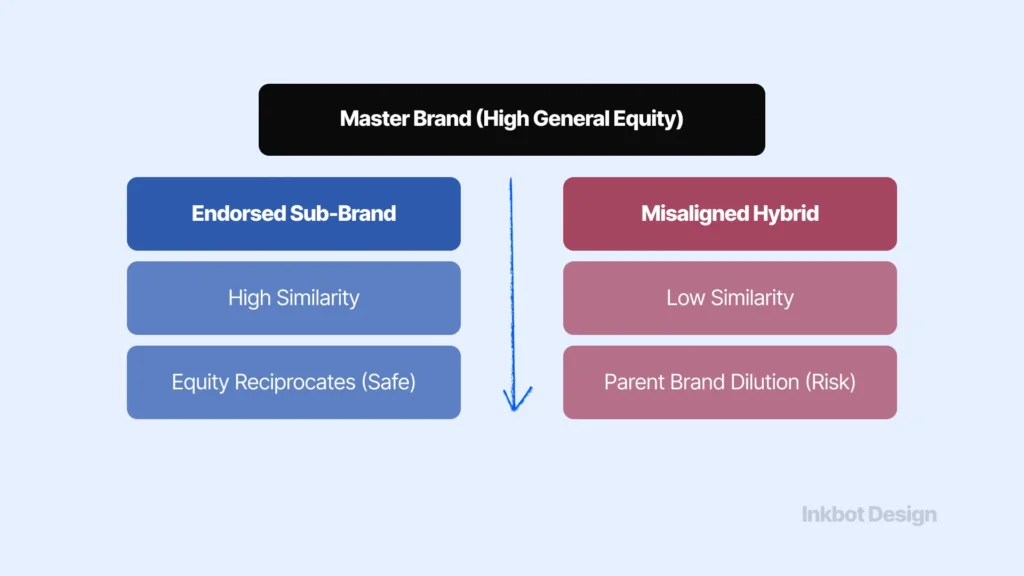
The choice of naming convention—whether deploying a unified family brand or an insulated sub-brand—fundamentally changes how the market evaluates the extension.
Ad hoc naming strategies, driven by internal politics rather than structural logic, systematically damage the primary asset’s market position.
Hybrid branding must be treated as an explicit risk-management strategy, not an aesthetic default.
The Judgement Layer: Where Rules Yield to Partner Realities
The execution of a hybrid branding strategy cannot rely solely on theoretical models. In mid-market UK professional services firms, corporate architecture must interface with human behaviour and partner equity structures.
This is where clinical marketing textbooks fail, and where senior operational experience becomes mandatory.
The primary point of tension is the preservation of the founder’s or partner’s authority.
When a firm reaches 100 people through the organic growth of distinct practices, individual partners often aggressively guard their localised reputations.
A rigid corporate directive to eliminate these sub-brands frequently triggers internal revolts or talent attrition.
“The true cost of a hybrid brand architecture is never found in the design agency’s invoice. It is found in the continuous operational friction of internal teams arguing over whose logo sits largest on a joint proposal document. If you do not codify the exact governance rules before launch, your partners will destroy the architecture from within.”
Expertise dictates that you do not force a pure-branded-house model if it breaks the firm’s client-generation engine. If a specific partner holds an unassailable personal reputation in a niche market, the architecture must accommodate that asset via a structured endorsement model.
The corporate brand provides institutional stability, while the sub-brand leverages individual authority.
The threshold for maintaining this complexity is clear: the sub-brand must command a verifiable premium in fees if the specialised identity cannot extract higher margins than the generalised parent brand; the architectural duplication must be rejected.
Restructuring Post-Merger Portfolios: A Practical Case
To understand how these architectural principles function under market conditions, consider the structural realignment of a mid-sized UK professional services firm navigating post-merger portfolio sprawl.
The Structural Challenge
A mid-sized professional services firm approached Inkbot Design following a series of regional acquisitions. The entity attempted to maintain three legacy corporate names across its digital channels and client proposals, under the mistaken assumption that this approach would preserve goodwill in local markets.
The actual outcome was severe market fragmentation. The firm split its target audience by offering overlapping service propositions, inconsistent cross-endorsement rules, and misaligned team behaviours across its primary digital assets.
Prospects routinely expressed confusion regarding which legal entity owned which specialised capability, lengthening the sales cycle and inflating client acquisition costs.
The Operational Turnaround
Inkbot Design executed a structural portfolio intervention.
The team systematically dismantled the legacy naming conventions and collapsed the fragmented architecture into a single primary corporate brand.
Highly specialised service lines were insulated as tightly controlled, endorsed sub-brands, deployed exclusively where the market demanded high distinctiveness.
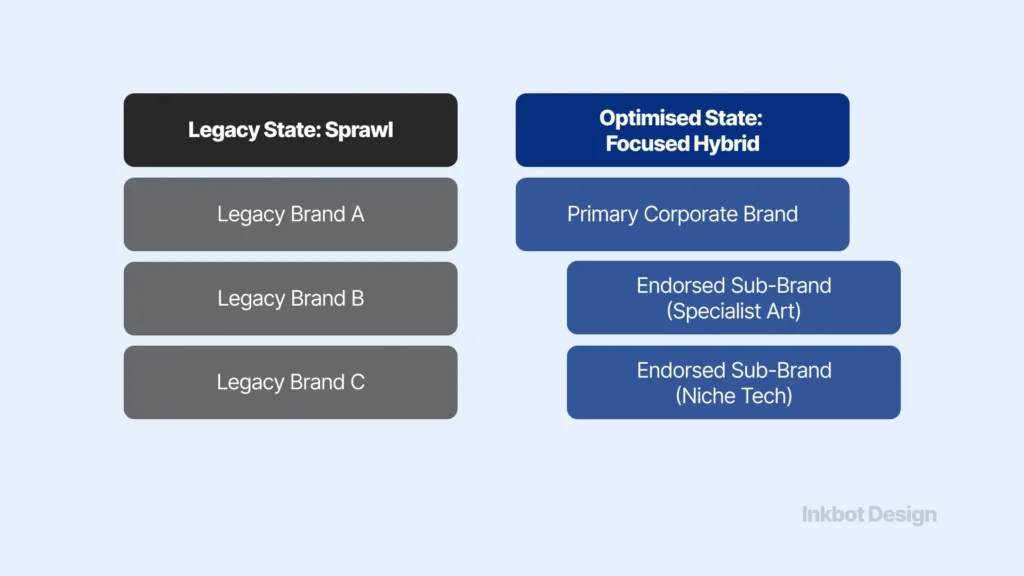
The operational modifications yielded immediate clarity:
- Duplicated service inquiries dropped significantly after the architectural consolidation.
- Internal sales teams reported fewer client questions about corporate capabilities and entity roles.
- The simplified taxonomy improved corporate brand equity without sacrificing localised legacy recognition.
By removing structural ambiguity from the portfolio, the firm reduced its sales-cycle friction and ensured that all marketing expenditures directly built equity in the primary corporate asset.
Evaluating the Operational Efficiency of Brand Architectures
Choosing the correct portfolio model requires balancing market flexibility against administrative cost.
The table below outlines how a hybrid framework compares to pure architectural structures across critical operational vectors.
| Architectural Model | Operational Overhead Cost | Client Acquisition Friction | Portfolio Scalability Limits | Equity Protection Security |
| Branded House (Unified Identity) | Low — Centralised budget, single digital asset | Low for core offers; High for extreme niches | Limited by the parent brand’s permission boundaries | High — Total capital builds a single market asset |
| House of Brands (Isolated Entities) | High — Multiplied tech stacks, distinct teams | Low across all targets; No shared cross-selling | Unlimited — New assets attach without core impact | Isolated — Failure in one branch protects the rest |
| Hybrid Model (Managed Portfolio) | Moderate to High — Requires strict governance | Low across segments; Requires clear routing | High — Allows targeted expansion via sub-brands | Conditional — Depends entirely on gate compliance |
Deploying the Modern Hybrid Mechanisms
A modern hybrid branding strategy requires deploying specific identity mechanisms to ensure structural integrity.
Research published in the Journal of the Academy of Marketing Science (2025) outlines four distinct mechanisms firms use to manage complex market positioning: selective adoption, selective distancing, juxtaposition, and integration.
These mechanisms dictate how a parent brand manages its relationship with a junior asset. A firm must carefully balance authenticity and institutional legitimacy when executing these manoeuvres to avoid hybridisation failure.
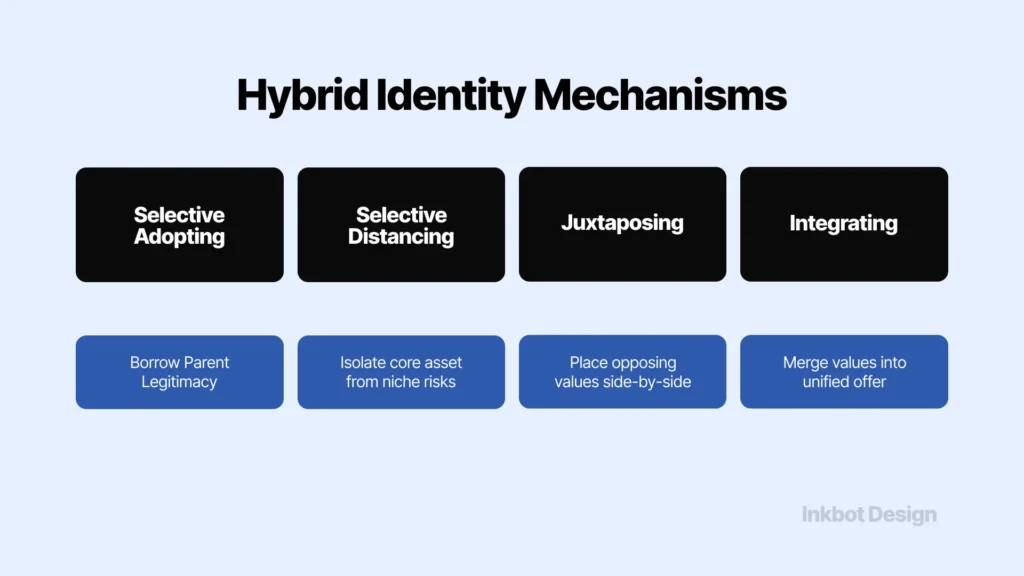
Selective Adopting
The junior brand borrows specific authoritative attributes from the corporate parent—such as regulatory compliance or operational scale—while maintaining a distinct front-facing identity. This mechanism allows a new service line to establish instant legitimacy in a highly competitive market.
Selective Distancing
The corporate entity intentionally detaches its core identity from the sub-brand’s marketing narrative. This mechanism is deployed when a firm tests high-risk innovations or enters low-margin spaces that could damage the core brand’s premium positioning.
Juxtaposing
The architecture positions contrasting brand values side by side within the same corporate ecosystem. A traditional, multi-decade UK advisory firm might deploy an aggressive, tech-first digital subsidiary, using the visual contrast to capture distinct buyer personas without fracturing the parent brand’s established identity.
Integrating
The framework completely merges disparate operational values into a single, cohesive service offering. This mechanism requires complete cultural alignment, ensuring that the parent organisation’s legacy prestige blends naturally with the acquired entity’s modern capabilities.
The Verdict
Defaulting to a hybrid branding strategy because internal stakeholders cannot agree on a single identity is an expensive corporate error.
A mixed architecture should be deployed only when a firm can actively verify and control the five core risks: customer perception, channel conflict, operational cost, legal boundaries, and cultural alignment.
If your data cannot justify the duplicate overhead of a hybrid system, collapse your portfolio into a unified master brand.
Your immediate action item today is to execute a structural architecture inventory. Review your firm’s service lines, website properties, and proposal templates. If you find overlapping identities competing for the same client attention, your architecture is actively draining your marketing efficiency.
To identify exactly where your brand architecture is losing commercial ground and discover how to structure your portfolio for profitable growth, visit Inkbot Design and request a comprehensive Brand Equity Audit™.
FAQs
What is the main benefit of a hybrid branding strategy for a professional services firm?
The primary benefit is strategic flexibility. A hybrid branding strategy allows a corporate entity to protect its institutional master-brand equity while deploying highly targeted sub-brands to capture specialised market segments that the parent brand cannot naturally reach.
How does a hybrid brand model differ from a branded house?
A branded house uses a single master identity for all corporate offerings. A hybrid brand model purposefully mixes this approach, maintaining a central master brand while simultaneously operating autonomous, distinct sub-brands for specific sectors or high-risk service lines.
When should a growing business avoid a hybrid branding strategy?
A business must avoid a hybrid branding strategy when it lacks the financial resources to maintain duplicated marketing teams, separate digital platforms, and distinct CRM ecosystems. If sub-brand margins cannot clear the operational overhead, the model must be rejected.
Can a hybrid branding strategy cause internal channel conflict?
Yes — internal channel conflict is a major risk. Without strict governance, independent sub-brands within a hybrid portfolio will frequently bid against each other for the identical digital search terms or pitch competing proposals to the same client procurement panels.
What is brand dilution in a corporate portfolio?
Brand dilution occurs when an inconsistent or misaligned service extension weakens the clarity of the primary corporate brand. This fragmentation reduces the parent entity’s market distinctiveness, erodes premium pricing capability, and confuses the core customer base.
How do the 2025 JAMS study mechanisms apply to UK service firms?
The Journal of the Academy of Marketing Science (2025) mechanisms—selective adoption, selective distancing, juxtaposition, and integration—provide explicit frameworks for UK firms to structure post-merger integration, allowing acquired entities to borrow corporate legitimacy while protecting core brand assets from operational risks.
Is a hybrid branding strategy safe for a mid-market rebrand?
No, it is not inherently safe. A hybrid branding strategy is a high-maintenance operating model. It is only safe when managed via explicit governance rules, continuous risk-gate tracking, and clear structural separation of target audiences.
How does architecture impact corporate valuation before an acquisition?
A clean, well-governed brand architecture maximises corporate valuation by demonstrating clear market permission, reduced customer acquisition friction, and scalable service-integration pipelines. Fragmented portfolios signal operational inefficiency and hidden administrative costs to potential buyers.
Should individual partners maintain distinct brands within a larger firm?
No — individual partners must not maintain uncoordinated local brands. If a partner possesses exceptional personal equity, that asset must be managed via a formal corporate endorsement rule within the master architecture to prevent structural fragmentation.
How do you measure if a hybrid branding model is succeeding?
Success is indicated when sub-brands achieve high volumes of highly qualified leads and command verifiable fee premiums within their niches. At the same time, the parent company’s customer acquisition costs remain stable or decrease due to centralised operational efficiencies.
