Corporate Brand vs Employer Brand: The Real Difference
Corporate brand and employer brand are treated as separate audience plays. For professional services firms they are not. Your employer brand is the operational truth of your corporate brand — engineered from pay, governance, and career design, not crafted as messaging. Get the order wrong and you pay twice.
 By Stuart Crawford
 Reviewed by Tabitha Ayers
Updated 12 min read
On this page12 min left
- Corporate Brand vs Employer Brand: Which Should You Fix First?
- The Criteria That Actually Decide This – and the One That Doesn't
- Corporate Brand: What It Is Genuinely Best For
- Employer Brand: What It Is Genuinely Best For
- The Decision Table: Which to Prioritise, by Scenario
- The Trap: Rebranding the Claim While the Truth Stays Broken
- The Reframe: Employer Brand Is the Operational Truth of Corporate Brand
- The Verdict: Fix the Truth, Then Tell It
- Frequently asked questions
You are about to spend money changing how the firm looks.
Before you do, decide which brand you are actually fixing – because in a professional services firm, the two are not separate budgets.
A litigation practice can win a design award for its corporate identity and still lose its three best senior associates in the same quarter to a competitor that pays better, promotes faster, and says less about it.
The corporate brand told clients one story. The employer brand told the market the truth. The truth won.
That is the real decision in front of you. Not “which audience do we address first,” but “which brand are we treating as a message, when it is actually evidence.”
For firms preparing to rebrand ahead of a growth phase or acquisition, getting this order wrong is expensive in a way that shows up twice: once in recruitment costs, once in client trust.
The two are wired together, and the wiring runs through how you actually operate, which is what the brand equity system exists to diagnose before a single visual decision is made.
Corporate Brand vs Employer Brand: Which Should You Fix First?
Corporate brand is how clients, referrers, and the market perceive your firm. Employer brand is how your firm is perceived by current and prospective staff. In professional services they are not two audiences of one brand – the employer brand is the operational proof of whether the corporate brand's promise is real, because your people are the product clients buy.
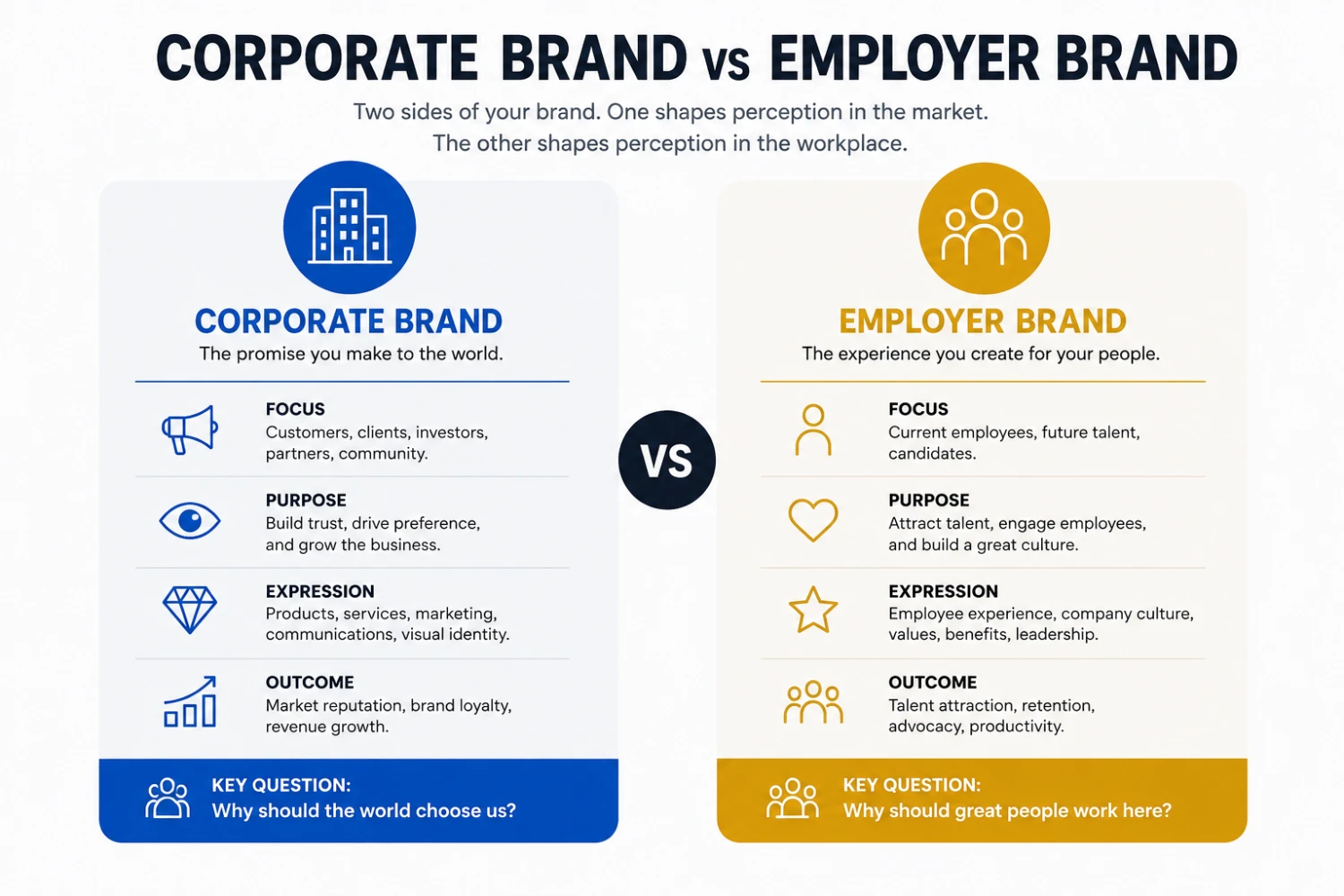
- Corporate brand makes a promise to clients; employer brand is the evidence that the people who deliver it can be recruited and kept.
- Fix employer brand first when your delivery quality or retention is slipping – no external message survives contact with high staff turnover.
- Fix corporate brand first when the work is strong, but the market misreads your positioning or fee tier.
Employer brand is the operational truth of corporate brand – the lived evidence, in pay and governance, of the promise the corporate brand makes externally.
This post is one facet of a broader brand strategy for professional services firms; the mechanics of talent perception specifically sit within employer branding as a discipline.
The Criteria That Actually Decide This – and the One That Doesn't
Most comparison articles rank corporate and employer brand by audience – customers versus candidates.
For a professional services firm, the audience is the criterion that matters least, because the same senior hire who reads your Glassdoor page today will refer you a client next year.
The criteria that predict the outcome are operational rather than communicative.
Retention economics, not recruitment messaging, is the first thing to assess
The question is not “how do we look to candidates” but “what does it cost us when someone leaves.”
Randstad's employer-brand research (2025) reports that firms prioritising employer brand see up to a 28% reduction in turnover, and LinkedIn Talent Solutions data indicates strong employer brands can cut cost-per-hire by up to 50%.
In a 120-person accountancy firm, a single senior manager's departure carries replacement, ramp, and lost-relationship costs that dwarf the entire rebrand budget.
Retention economics is where employer brand converts to P&L. Assess this before you assess a logo.
Governance and career architecture predict employer brand more than perks
What decides whether talent stays is how decisions get made and how careers progress – not the messaging around them.
HR.com's State of Employer Branding 2025 found that only around 28% of organisations have a comprehensive, consistently applied employer-branding strategy, and that ownership is typically fragmented across HR and marketing.
Fragmented ownership is the tell: it means no one has engineered the employer brand into how the firm actually runs.
A clear promotion path is the employer brand. An opaque one is also an employer brand – the negative kind.

Client-facing reputation risk is a shared criterion, not an employer-only one.
A weak employer brand does not remain confined to recruitment.
Glassdoor and CareerBuilder research (2024–25) shows large proportions of candidates – roughly 76–86% – read employer reviews before applying, and a meaningful share reject offers over poor reputation.
Those same reviews are visible to clients doing due diligence on who will actually staff their matter.
In professional services, the review that costs you a hire can cost you a pitch. This is the criterion the siloed comparisons miss entirely.
The criterion that doesn't matter: channel ownership
Firms spend disproportionate energy arguing whether HR or marketing “owns” the employer brand. The debate is a distraction.
Ownership of the channel changes nothing if the underlying operational reality – pay bands, progression, workload – contradicts the message.
Sort the operations; the channel question resolves itself.
Corporate Brand: What It Is Genuinely Best For
Corporate brand is the right lever when the constraint is external perception.
Nielsen and brand-equity research consistently link clearer market positioning to pricing power. For a professional services firm, a sharper corporate brand reduces the perceived risk a buyer feels when choosing between similar-looking firms.
That reduced-risk perception is the mechanism behind a fee premium: a clearer position makes the buyer more certain they are making the right choice, and certainty is what they pay extra for.
Where corporate brand fails is as a substitute for operational reality.
A firm can commission a beautiful identity and a confident website and still lose the associate who, on day three, reads that the confident external story does not match the internal one.
Corporate brand sets the expectation. Employer brand determines whether the expectation is met by the people who show up.
“A corporate brand is a claim about what your firm delivers. An employer brand is the receipt. In professional services, where clients buy hours of human judgment, the receipt is the only thing that clears, which is why firms that invest only in the claim end up paying for the gap in recruitment fees and lost pitches.”
Employer Brand: What It Is Genuinely Best For

Employer brand is the right lever when the constraint is the workforce – recruiting quality people, keeping them, and having them represent the firm consistently.
LinkedIn Talent Solutions research indicates that around 88% of job seekers evaluate an employer's brand before applying, and that companies with strong employer brands are up to 3x more likely to make quality hires.
For a firm whose entire margin depends on the calibre of its people, that multiplier is not a recruitment metric – it is a product-quality metric.
Employer brand fails when it is built as a communications overlay. A careers page full of stock language about “growth” and “culture” is not an employer brand; it is a claim awaiting contradiction by the first honest Glassdoor review.
The defensible version is engineered from decisions the firm has already made about pay, governance, and career design.
The firm's freshest EVP thinking should roll up from its employee value proposition – the actual give-and-get, not the aspirational version.
The Decision Table: Which to Prioritise, by Scenario
Your Situation | Prioritise | Why |
|---|---|---|
Strong delivery, but losing senior staff to competitors | Employer brand | Retention economics outweigh external perception; a rebrand won't stop the leak |
Winning fewer pitches despite good work | Corporate brand | The market is misreading your positioning or fee tier |
Merging with or acquiring another firm | Both, sequenced | Employer brand first (align two workforces), then corporate brand (present one firm) |
Glassdoor rating is dragging on recruitment and referrals | Employer brand (operational fix) | The review reflects reality; messaging can't overwrite it |
Repositioning up-market on fees | Corporate brand, backed by employer proof | Higher fees require both a clearer claim and staff who can evidence it |
Rapid headcount growth planned | Employer brand | You cannot scale a firm faster than you can recruit and retain |
The Trap: Rebranding the Claim While the Truth Stays Broken
The option most firms default to – for the wrong reason – is the corporate rebrand. It is visible, it feels decisive, and it produces artefacts that a board can approve.
The tell that you are about to make this mistake is that you are commissioning a new identity while your exit-interview themes and your Glassdoor page go unread in the same building.
In 17 years of brand work, the pattern I see most often is a firm treating the employer brand as a communications task assigned to whoever runs the careers page, while the decisions that actually shape it – pay reviews, promotion criteria, partner behaviour – sit entirely outside the brand conversation.
A sceptical reader will push back here: “We measure engagement; our internal comms are strong.” Strong internal comms about a broken promotion process is not an employer brand – it is a better-worded version of the problem.
The second objection: “Isn't this just HR's job, not branding?” No, because the output is a market perception that directly affects who you can hire and what clients believe about delivery.
That is the brand, sitting in operations.
The Reframe: Employer Brand Is the Operational Truth of Corporate Brand

Intelligent practitioners treat corporate and employer brand as parallel channels aimed at different audiences, unified by a shared core.
This is a reasonable model, and it is why the standard advice – “align your values across both” – sounds sensible.
It holds in consumer businesses, where the workforce is largely invisible to customers.
It breaks in professional services, because the workforce is the product. Here, the employer brand is not a parallel channel – it is the operational truth that either validates or falsifies the corporate brand's external claim.
The variable that predicts commercial outcomes is not audience alignment.
It is operational integrity: whether the firm's business-model decisions – pay, governance, career architecture, workload – actually produce the experience the corporate brand promises clients.
The 2025–26 evidence points the same way. Industry trend reporting from LinkedIn Talent Solutions and Gartner shows employers shifting EVP away from perks toward demonstrable skills pathways and internal-mobility data – employer brand becoming evidence of career architecture rather than an aspirational message.
Deloitte and McKinsey workforce briefs note that talent is increasingly choosing employers for resilience and future readiness, which are operational properties rather than communications.
And 2026 trend pieces on AI-generated recruitment content make the sharpest case of all. If an employer brand is merely crafted content, AI can now replicate it cheaply, and its credibility collapses.
Only operational truth – the lived reality that cannot be synthesised – sustains it.
“The only defensible employer brand is one you could not have written before you built it. If a firm's promotion process, pay logic, and governance were engineered first, the employer brand is a description of something real. If they were not, it is a forecast – and candidates now have the tools to check the weather themselves.”
Consistency across regions makes the point concrete: a single global EVP no longer suffices, and 2026 LinkedIn commentary argues for a global core plus local operational truths. You cannot message your way to that.
You have to run the offices that way first. Where the firm's internal experience must be made coherent across teams, that work belongs to internal brand alignment – the discipline of making the lived reality match across the organisation before any of it is communicated.
The replacement directive is direct: stop briefing the employer brand as a creative task.
Audit it as an operational one. Start with the three business-model decisions – how you pay, how you promote, how you govern – and treat the employer brand as their honest description.
The Verdict: Fix the Truth, Then Tell It
The comparison you came in with – corporate brand versus employer brand – is the wrong frame for a professional services firm.
It suggests two projects competing for one budget. What you actually have is one claim and its proof. The corporate brand states what the firm delivers to clients.
The employer brand is the operational evidence that the people delivering it can be recruited, kept, and trusted to represent the firm.
When the two diverge, the market believes the proof, not the claim – and the divergence surfaces as recruitment cost and lost pitches long before it surfaces in a board report.
So the sequence matters more than the split. If your delivery and retention are sound, sharpen the corporate brand and let it command the fee premium a clearer position earns.
If they are not, no external rebrand will hold – you are decorating a claim your own people will quietly contradict.
The variable to optimise is not which audience you address first. It is operational integrity: whether pay, governance, and career design actually produce the experience your corporate brand promises.
Engineer that, and the employer brand writes itself as a description of something real, which is the only version AI cannot cheaply fake.
Do one thing this week: read your exit-interview themes and your Glassdoor page side by side with your corporate brand promise, and mark every line where the proof contradicts the claim. That gap is your real brief.
To have that gap diagnosed rigorously – where the brand is losing commercial ground and what to do about it – request a free Brand Equity Audit™.
Frequently asked questions
What is the difference between corporate brand and employer brand?
Corporate brand is how clients, referrers, and the market perceive your firm. Employer brand is how current and prospective staff perceive it as a place to work. In professional services, the employer brand is the operational proof that real people can deliver the corporate brand's promise.
Which should a professional services firm build first?
Build employer brand first when delivery quality or retention is slipping, because no external message survives high staff turnover. Build a corporate brand first when the work is strong, but the market misreads your positioning or fee tier. The sequence depends on whether your constraint is internal reality or external perception.
Is it true that employer brand affects client trust?
Yes, because the employer reviews candidates' resumes, which are also visible to clients doing due diligence. Glassdoor and CareerBuilder research (2024–25) shows that most candidates read reviews before applying. In professional services, where clients buy people, a poor employer reputation signals delivery risk directly to buyers.
How is employer brand different from EVP?
Employer brand is the overall market perception of your firm as an employer. The employee value proposition (EVP) is the specific give-and-get underneath it – what staff contribute and receive in return. EVP is the substance; employer brand is how that substance is perceived externally.
Why is our employer brand weak despite strong marketing?
Because employer brand is produced by operational decisions – pay, promotion, governance – not by communications, strong marketing over a broken promotion process is a better-worded version of the same problem. Candidates verify claims against reviews, so operational reality, not messaging quality, sets the ceiling.
How do you measure employer brand ROI?
Measure it using retention and hiring KPIs: turnover rate, cost per hire, time to hire, and quality of hire. LinkedIn Talent Solutions research links strong employer brands to up to 50% lower cost per hire and 3x more quality hires. These metrics tie employer brand work directly to the P&L.
When should the employer and corporate brand be handled together?
Handle them together during a merger, acquisition, or up-market repositioning. In a merger, you align two workforces (employer brands) before presenting a single firm (corporate brand). When raising fees, you need both a clearer external claim and staff whose experience evidences it.
Does a strong corporate brand guarantee good recruitment?
No – candidates often like a firm's corporate brand without knowing anything about it as an employer. Symphony Talent and LinkedIn research note this gap directly. A recognised corporate brand opens the door, but the employer brand and EVP decide whether quality candidates apply and stay.
How much of the employer brand is HR versus marketing?
Neither owns it alone, and arguing over ownership is a distraction. The decisions that shape employer brand – pay, governance, career design – sit with leadership and operations. HR and marketing describe and distribute it. Fragmented ownership, per HR.com's 2025 research, is a symptom of employer brand not being engineered into how the firm runs.
Can AI-generated content damage an employer's brand?
Yes – 2026 industry analysis notes a rise in AI-generated recruitment content and the resulting erosion of trust. If an employer brand is merely crafted messaging, AI can replicate it cheaply, and credibility collapses. Only employer brands grounded in real operational truth, which cannot be synthesised, stay credible under this pressure.
Why does a single global EVP no longer work?
Because operational reality differs by office, and candidates in each location verify claims against local reviews. 2026 LinkedIn commentary argues for a global core plus local truths. You cannot message your way to regional consistency – you have to run each office in line with the promise first.
What is the first step to fixing a corporate and employer brand mismatch?
Read your exit-interview themes and employer reviews alongside your corporate brand promise, and mark every point where the internal proof contradicts the external claim. That gap is your brief. Fix the underlying operational decisions before commissioning any new external identity.