Endorsed Brand: What Is the Parent Actually Vouching For?
An endorsed brand keeps its own identity while a parent brand provides visible backing. For professional services firms, the decision should turn on a specific promise clients can recognise and the parent can deliver. This guide explains when endorsement helps, what to retain, and how to govern the relationship responsibly.



On this page7 min left
- What is an endorsed brand in brand architecture?
- When should a parent brand endorse an acquired practice?
- A professional services case study: retaining equity while clarifying backing
- What do real-world brand endorsements actually deliver?
- How much visual identity should an endorsed brand retain?
- Does an endorsed brand need a separate website?
- How should leadership govern and review brand endorsement?
- Define the commercial promise before approving the visual endorsement
- Questions people ask
An endorsed brand is a specialist business or product that retains its distinct name and market-facing identity while receiving visible, explicit backing from an established parent brand.
In brand architecture, endorsement establishes credibility, clarifies group capabilities, and transfers parent trust without dissolving the specialist’s recognised market identity.
For an acquired consultancy, accounting practice, or law firm, an endorsed structure allows the firm to retain the brand equity and client recognition it has spent decades building, while clearly explaining what the parent group contributes.
In strategic branding, the parent’s name must have a commercial job. When Marriott International launched Series by Marriott on 22 May 2025, it defined that job with precision: regional hotels preserve their independent identity and local character while gaining access to Marriott’s global reservation platforms, operational standards, and the Marriott Bonvoy loyalty programme. It was an operational contract, not a cosmetic logo placement.
For a professional-services firm, the strategic question is identical: what can clients reasonably expect because this specialist belongs to your group? If leadership cannot answer that question with operational specifics, the relationship must be resolved through brand architecture strategy before commissioning visual assets.
What is an endorsed brand in brand architecture?
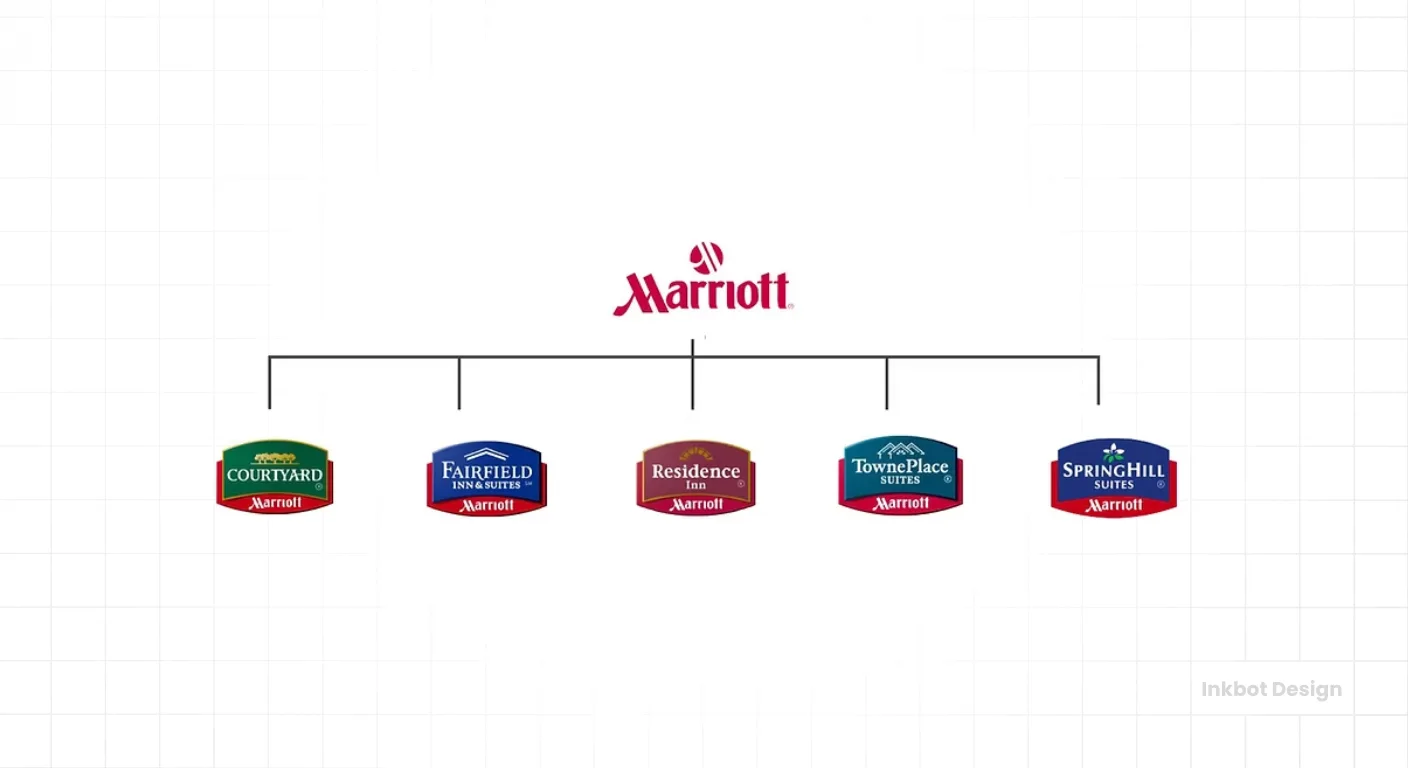
An endorsed brand occupies a specific position on the brand architecture spectrum: the specialist brand leads the client relationship, while an endorser brand provides secondary, visible backing.
Brand architecture governs how organisations structure, name, and interlink their business units, offerings, and acquired practices. To understand where an endorsed brand fits, leadership teams must distinguish it from alternative portfolio structures:
Architecture Model | Primary Brand Leading | Parent Role | Client Perception | Professional Services Example |
|---|---|---|---|---|
Branded House (Monolithic) | Parent Brand | Single identity across all services | One firm delivering all capabilities | PwC (PwC Legal, PwC Advisory) |
Sub-Brand | Parent Brand + Descriptor | Shared equity with distinct focus | A specialised division of the parent | Deloitte Digital |
Endorsed Brand | Specialist Brand | Visible endorsement/credibility stamp | An independent expert backed by group scale | Chartered Tax Advisory, a member of [Group] |
House of Brands (Pluralistic) | Independent Brand | Invisible or back-office holding company | Stand-alone specialist with no apparent parent | Procter & Gamble consumer brands |
The decisive test is client recognition. In a sub-brand relationship, the parent's reputation opens the door (e.g., "Deloitte" leads). In an endorsed relationship, the specialist’s reputation wins the referral, while the parent’s endorsement guarantees institutional governance, balance-sheet security, or international reach.
A portfolio can use different arrangements for different businesses. That broader choice belongs to hybrid brand architecture; an individual endorsement should still be intelligible without the portfolio diagram.
When should a parent brand endorse an acquired practice?
A parent brand should endorse a specialist practice only when the acquired firm possesses market equity worth retaining and the parent provides relevant reassurance that the specialist cannot credibly claim on its own.
Endorsement is a strategic governance decision, not a decorative compromise designed to comfort anxious founding partners.
Before approving an endorsement lockup, managing partners and leadership teams must evaluate four operational tests:
- Buyer Relevance (The Unanswered Concern): Does the parent address an objection that would otherwise cost the specialist revenue? For a regional corporate law boutique, parent endorsement serves as evidence of cross-border execution or regulatory breadth. If the parent merely adds scale without solving a client concern, it introduces confusion rather than confidence.
- Operational Delivery (The Delivery Mechanism): What tangible infrastructure makes the endorsement real? Backing cannot exist as an unbriefed internal directory. It requires integrated project software, unified conflict-checking protocols, or direct access to specialist practice groups.
- Commercial Accountability (The Escalation Route): Who answers when service delivery breaks down? An endorsement implies that the parent guarantees quality. If group leadership cannot name the specific partner or governance committee accountable for service failures within the specialist practice, the endorsement is hollow.
- Retained Brand Equity (The Replacement Cost): What quantifiable commercial value disappears if the acquired firm takes the parent name immediately? Leadership must audit referral volume, panel appointments, and unprompted brand recall. If equity resides solely in partner relationships rather than the firm name, a rapid migration to the parent brand is usually preferable.
A professional services case study: retaining equity while clarifying backing
Consider a mid-tier UK advisory practice with 120 staff acquiring a specialised 25-person corporate tax boutique.
The boutique generates 65% of its new instructions through direct referrals from accountants, who trust it specifically because it does not offer competing audit or general advisory services.
Rebranding the boutique under the parent’s master brand on day one would trigger an immediate "Obscurity Tax™" - the boutique’s referring accountants might view the enlarged firm as a direct competitor and redirect their instructions elsewhere. Instead, the firm implements an endorsed architecture:
"[Specialist Practice], Part of [Advisory Group]"
To prevent client confusion, the endorsement statement is defined narrowly: the specialist retains its independent instruction protocol, client-conflicts firewall, and tax team, while gaining access to the group’s international transfer pricing infrastructure and central forensic accounting support.
Conversely, if discovery reveals that the acquired firm lacks proprietary referral equity, or that its service offering directly duplicates the parent's existing department, maintaining a separate endorsed brand creates unnecessary overhead.
In such cases, full integration into the parent’s master brand avoids brand dilution and marketing waste.
What do real-world brand endorsements actually deliver?
Visibility alone cannot dictate brand architecture. A client must recognise the endorsement, but the backing must communicate a tangible operational promise.
Three corporate case studies illustrate how global groups structure endorsements:
1. Marriott International (Series by Marriott): Shared Distribution and Operational Standards
Marriott International launched Series by Marriott with a founding agreement involving Concept Hospitality Private Limited, an Indian hotel management company, and the Fern brands.
Marriott described affiliation, a small equity investment and intended franchise agreements with individual hotel owners—not an outright acquisition of Concept Hospitality.
The proposed arrangement combined regional identity with Marriott distribution, Marriott Bonvoy participation and specified operating standards.
Marriott also made clear that individual properties would join over time, subject to agreements. The announcement did not mean completed conversion.
For a professional-services leader, the transferable question is operational: which group capabilities become available, and from when?
2. IHG Hotels & Resorts (Noted Collection): Shared Commercial Infrastructure
InterContinental Hotels Group PLC, the hospitality company trading as IHG Hotels & Resorts, launched Noted Collection.
IHG described distinctive hotels that retain their individual character while connecting to commercial systems and IHG One Rewards.
Noted Collection is a collection model, so the naming structure should not be treated as identical to every “part of” endorsement.
The useful comparison is narrower. Independent character need not require independent infrastructure. A specialist consultancy could retain a distinct market position while using shared systems, provided the operating arrangement supports the claim.
3. Accor (Emblems Collection / Lucknam Park): Layered Architecture
The supplied Accor case records the debut of Lucknam Park Hotel & Spa, part of the Emblems Collection, announced in 2025. The property name remains visible alongside the collection name, with Accor behind the collection.
That illustrates layered architecture: individual identity, collection membership and corporate ownership are different relationships.
None of these examples proves that endorsement alone causes growth. The examples show what the backing is intended to contain.
How much visual identity should an endorsed brand retain?
An endorsed brand should retain only the visual assets required to preserve client recognition and convey its specialist positioning.
Endorsement does not require homogenising typography, colour systems, and design collateral across the group.
When engineering an endorsed visual identity system, audit client-facing touchpoints in strict hierarchical sequence:
- The Endorsement Lockup: The primary logo of the specialist practice leads, paired with a standardised endorsement descriptor (e.g. "A Member of [Parent Group]" or "Backed by [Parent Group]"). Standardise descriptor typography and relative scale (typically no more than 25–30% of the primary mark's visual weight) to prevent the parent from overpowering the specialist.
- Pitch and Proposal Collateral: High-stakes tender documentation must clearly explain the commercial relationship on the inside front cover. "Part of [Group]" on a cover must not casually transform into "one fully integrated firm" in the proposal text unless operational systems and liability firewalls genuinely support that claim.
- Credentials and Engagement Letters: Standardise regulatory, insurance, and legal disclosures across footers while allowing the specialist brand to front marketing materials.
Does an endorsed brand need a separate website?
An endorsed brand does not automatically require an independent domain.
Treat digital architecture as a commercial evaluation of client search behaviour, maintenance capacity, and technical SEO equity.
Architecture Route | When to Choose This Route | Technical SEO & Commercial Trade-Offs |
|---|---|---|
Independent Domain | Distinct buyer persona; high organic search equity; active editorial team; established panel rankings. | Preserves historical authority and niche topical relevance, but requires separate hosting, SSL maintenance, separate schema entity definitions, and divided link-building efforts. |
Parent Subfolder / Hub | Overlapping buyer personas; shared marketing team; specialist site has low historical search authority. | Consolidates link equity into the parent domain, simplifies governance, and prevents domain cannibalisation, but requires permanent 301 redirects and careful entity re-indexing. |
How should leadership govern and review brand endorsement?
Agree upon the operational promise before designing logos, publishing press releases, or registering domains. Without clear governance, a design decision quietly morphs into an unfulfilled client commitment.
Every endorsement relationship should be governed by a single explicit operational charter. Leadership must complete this definition:
"[Specialist Brand], endorsed by [Parent Group], guarantees clients receive [specific operational capability], delivered through [auditable mechanism], with [specific partner role] accountable for delivery failures."
If leadership can only articulate generic platitudes like "shared commitment to quality" or "enhanced client synergy", the endorsement is cosmetic.
A shared peer-review board, cross-firm technical review protocols, or dedicated client escalation channels represent verifiable operational backing.
Conduct a formal brand architecture audit under four specific operational triggers:
- Partner or Practice Departures: When the specialist team’s founding partners leave, determine whether client recognition remains with the firm or migrates with the individuals.
- Infrastructure Realignment: If shared software, group oversight, or technical resources are withdrawn, the endorsement statement must be updated immediately.
- Market Shift: If the specialist moves upmarket into larger enterprise mandates where the parent's brand carries greater institutional weight, consider transitioning toward a sub-brand or master-brand model.
- Service Discrepancies: If client feedback or complaints reveal a gap between what the endorsement implies and what the team delivers, immediately narrow the scope of the endorsement claims.
Define the commercial promise before approving the visual endorsement
The parent should appear when the parent can provide reassurance that matters to the specialist’s buyers and can stand behind the promise.
The examples show identifiable backing: platforms, standards, or membership in a collection. Your firm needs its own answer, not a hospitality imitation.
A leadership team can start with the endorsement statement above. If the promise remains disputed or the group cannot explain which identity is recognised, request Inkbot Design’s free Brand Equity Audit™. The diagnostic examines where the brand is losing commercial ground and what to address.
Before approving the next logo lock-up, write what the parent promises, how the promise is delivered and who answers for it.
Questions people ask
What is the difference between an endorsed brand and a sub-brand?
The primary distinction is which entity leads the client relationship. In an endorsed brand architecture, the specialist practice name leads the engagement, and the parent brand provides secondary backing (e.g. "[Specialist], backed by [Parent]"). In a sub-brand architecture, the parent brand leads the relationship directly, and the specialist operates as a secondary descriptor (e.g. "[Parent] Consulting").
Does an endorsed brand have to be owned by the endorser?
No, full ownership is not legally required for brand endorsement. Corporate affiliations, joint ventures, and licensing arrangements frequently use endorsement. As demonstrated in Marriott’s Series launch, affiliation agreements and minority equity holdings can support an endorsed relationship without outright acquisition. The endorsement language must accurately reflect the underlying commercial contract.
Can an endorsed brand architecture be permanent?
Yes, brand endorsement can serve as a permanent architecture model. Endorsement does not need to be a temporary stepping stone toward a full rebrand. If the specialist brand commands high referral value in its niche while the parent provides enduring institutional reassurance, maintaining both identities indefinitely is a sound commercial strategy.
When should a parent brand endorse a newly launched service?
Endorse a new service only when it targets a distinct buyer group with differing risk expectations. If the new offer targets your existing client base, launching it under the parent master brand is more efficient. Inventing a new brand requires substantial marketing spend to establish recognition that the parent already commands.
What if the parent brand is known for an entirely different specialism?
Downplay or omit the endorsement if the parent’s reputation does not solve a buyer objection in the specialist's sector. A parent company known for insolvency accounting provides zero reassurance to clients purchasing high-end technology consulting from an acquired boutique. Ownership does not equal authority; promote the parent connection only when it adds relevant credibility.