Consulting Firm Branding: What to Approve Before the Redesign
Consultancy branding deserves investment when a specific commercial problem warrants it. Start by deciding whom to serve, what to promise and which evidence supports that promise. Then scope identity, website and rollout around those choices. This guide provides decision gates, budgeting questions and a practical framework for measuring progress.



On this page9 min left
- How should consulting firm branding work?
- Do we need brand strategy, or just better marketing?
- What should a consultancy branding agency deliver before design?
- How much should a consultancy invest in branding?
- How do we get partners to agree without losing our reputation?
- Can we retain our existing name, reputation and referral equity?
- What should we prepare, and how much leadership time will this take?
- Fund the next decision before the next design
- Questions people ask
Before your consultancy approves a new logo or website, agree on what the investment needs to fix.
Consulting firm branding connects your target market, commercial promise, supporting evidence and identity. If your partners still disagree about whom the consultancy serves or why buyers choose your work, settle those questions before commissioning design.
Bain & Company, the management consultancy, separates basic purchasing requirements from other sources of B2B customer value in The B2B Elements of Value (2018). The distinction provides a useful starting point: meeting expectations and giving buyers a reason to choose are different jobs.
This guide applies B2B Consulting Brand Strategy to a practical investment decision: what should your consultancy change, and what should you leave alone?
How should consulting firm branding work?
Consulting firm branding should begin with a decision about the buyers and assignments a consultancy wants to attract. Leadership then defines a credible promise, assembles supporting evidence and translates those choices into messaging, identity and commercial materials. This is a proposed commissioning sequence, not a guarantee of improved sales.
- Diagnose the obstacle before replacing assets.
- Approve claims against evidence.
- Fund implementation alongside design.
Consulting firm branding defines a consultancy’s market position, evidence-backed promise and recognisable identity so prospective clients can assess relevance and capability.
The distinction matters when a project brief begins with outputs: “We need a new website, updated slides and a modern logo.” Those may be sensible purchases. The list does not yet explain what problem the purchases will solve.
Write the problem separately. Perhaps enterprise prospects misunderstand your implementation capability. Perhaps the website describes services you no longer want to sell. Perhaps the proposition is sound, but the proposal template is unusable.
Each diagnosis suggests different work.
Do we need brand strategy, or just better marketing?
Start by separating three questions: are you targeting the right work, communicating your capabilities accurately and reaching enough suitable prospects?
Marketing activity cannot make those questions interchangeable. Publishing more articles will not resolve a disagreement between partners over whether the consultancy serves finance directors or operations leaders. Equally, a positioning workshop will not repair a broken enquiry form.
The 2018 framework includes buyer priorities such as risk reduction, transparency and reputational assurance. Those priorities suggest useful interview questions; the framework does not tell you which priority matters most to your clients. Ask them.
Use the following distinctions as a diagnostic, not a scoring system.
What you can observe | Work to investigate first | What would change the recommendation |
|---|---|---|
Partners describe different ideal clients | Positioning and leadership decisions | Different practices may legitimately serve different buyers |
Buyers understand the proposition, but cannot find supporting work | Case studies and website structure | Evidence may be unavailable rather than poorly presented |
Messaging remains accurate, but documents are difficult to use | Identity and template refresh | The underlying offer may also have changed |
Suitable prospects rarely encounter the consultancy | Acquisition and distribution | Low engagement may reveal an unclear proposition |
A merger creates competing names and service descriptions | Brand architecture and integration | Separate brands may still serve distinct markets |
A website refresh is appropriate when the strategic choices remain valid and the main defects concern presentation or usability. A broader rebrand deserves consideration when the consultancy’s market, offer or brand structure has changed.
Do not rename a sound practice because the homepage looks old.
A useful first exercise is to ask a recent buyer to explain what the consultancy does, whom the consultancy is for and what made the shortlist possible. Compare that explanation with the homepage and the latest proposal. Investigate the differences before rewriting anything.
What should branding deliver before we redesign anything?
Approve a decision pack before approving creative concepts. The pack should explain the market choice, the promise, the proof and the implications for what the consultancy will sell.
What should a consultancy branding agency deliver before design?

Ask for a written target-client definition, a proposition linked to buyer priorities, an evidence register and a messaging hierarchy. Agree the required contents in the contract. A document called “brand strategy” may otherwise contain anything from customer research to a short creative summary.
Use four approval gates.
- Target buyer and buying situation
Name the decision-maker and the circumstances that create demand. “Mid-market businesses” is too broad to guide a pitch. A hypothetical alternative is “operations directors at UK manufacturers integrating recently acquired sites”. - Commercial promise
Explain the assignment and the intended benefit in language the buyer can assess. “Helping businesses succeed” tells a procurement team very little. “Post-acquisition operating-model integration” identifies a recognisable job, though the claim still needs proof. - Evidence and limits
List relevant engagements, methods, qualifications and approved outcomes. Record what cannot be claimed. An engagement involving a single acquired site does not establish experience in integrating a multinational group. - Practical consequences
State which opportunities deserve priority, which services need clearer explanation and which claims should disappear. Positioning earns its place when the decisions affect behaviour.
This is useful because B2B value extends beyond product performance to considerations such as ease of doing business and individual concerns. The practical implication is to ask what the buyer needs to justify internally, rather than assuming technical expertise is the entire proposition.
Build an evidence-to-claim worksheet
For each proposed claim, record:
- The buyer’s concern.
- The wording you want to publish.
- The supporting engagement or document.
- The limitation or exception.
- The person responsible for approval.
Take a hypothetical claim: “We reduce disruption during acquisition integration.”
What supports “reduce”? Compared with what? Did the consultancy measure downtime, delivery continuity or management time? If the engagement records only show that the project finished, rewrite the claim to match that evidence.
An accurate, narrower statement is preferable to an impressive sentence nobody can defend.
A new proposition does not create permission to charge more. Ask whether the proposed promise changes the scope, reduces a buyer’s uncertainty or explains a capability the buyer previously missed. If none of those changes, a higher fee remains a pricing decision without a stronger argument behind it.
Once leadership approves the strategic pack, creative work has a brief: express these choices clearly and recognisably across the materials buyers use. The adjacent work on management consultancy brand identity concerns how those choices become a usable identity system.
How much should a consultancy invest in branding?
Build the budget from the diagnosed problem and the required implementation. Revenue alone cannot tell you the appropriate fee.
A £5m consultancy retaining its name, positioning and website platform has a different project from a £5m consultancy integrating acquired practices. Treating both as “a rebrand” hides the work that determines cost.
No independently verified UK consultancy branding price dataset is supplied here. A universal price range or percentage-of-revenue recommendation would create precision without a basis.
Separate the investment into four parts
Request separate scope lines for:
- Diagnosis and strategy: interviews, evidence review, market choices and proposition.
- Identity and messaging: visual system, verbal guidance and agreed templates.
- Implementation: website production, content migration, document conversion and launch tasks.
- Internal effort: partner decisions, case-study permissions, review and training.
Ask whether third-party licences, photography, technical development and ongoing maintenance are included. Confirm the treatment of VAT. A design fee and a complete implementation budget are different figures.
Compare scopes against the same objective
Take a hypothetical £5m consultancy that wants to attract more enterprise integration assignments. Assume the consultancy has relevant delivery experience, an established name and a functioning website.
Two possible scopes deserve examination.
- Scope A: targeted changes. Retain the identity. Clarify the proposition, secure permission for relevant case studies, rewrite the service pages and replace the pitch opening.
- Scope B: full identity and digital rollout. Complete the same strategic work, then replace the visual identity, website and document system.
The revenue assumption does not decide between the scopes. The condition of the existing assets does.
If buyers already recognise the identity and can use the website, Scope A deserves investigation first. If the site cannot support the required evidence and the document system repeatedly breaks in production, Scope B may be justified.
This is a hypothetical allocation exercise, not a client result or a market-price benchmark.
Approve in gates rather than one irreversible purchase
Where the provider’s commercial model allows, separate the diagnosis from the larger implementation commitment.
The first gate asks whether the problem and target buyer are sufficiently clear. The second asks whether the proposed claims are supported. The third approves the assets required to communicate those claims.
Fixed-scope engagements can still use approval gates, but check what happens if diagnosis changes the original brief. Who can reduce scope? Who approves additional work? What has already become non-refundable?
There is a trade-off. Separate appointments may create handover costs or leave nobody accountable for execution. A single provider may offer continuity, provided the contract identifies deliverables and change controls.
Choose the arrangement you can govern.
The investment test is straightforward: for each item, complete the sentence, “We need this because the current asset prevents.” If the blank contains only “looking more modern”, decide whether modernisation is genuinely the objective.
Sometimes it is. Just name the purchase honestly.
How do we get partners to agree without losing our reputation?

Separate agreement about the market from agreement about creative taste.
Consider a hypothetical disagreement. One partner wants healthcare positioning because of an established network. Another prefers industrial clients because recent assignments produced better margins. A colour workshop cannot settle that choice.
Agree the decision criteria first: evidence of demand, ability to deliver, commercial attractiveness and permission to use relevant proof. Then name the decision owner. Consultation does not require a veto for every participant.
Can we retain our existing name, reputation and referral equity?
Yes. Retaining the consultancy’s name and recognisable identity can be the appropriate choice when the assets remain relevant, and the problem concerns the proposition or its explanation.
Audit what referrers actually recognise. Ask whether introductions use the consultancy name, a partner’s name, a specialist service or a memorable engagement. Preserve useful recognition unless the proposed change has a specific justification.
For a stronger repositioning, explain continuity directly to existing clients and referrers. State what remains available, what receives greater emphasis and who remains responsible for delivery.
Do not announce that everything has changed when your clients value what has stayed the same.
Bain & Company’s framework includes risk reduction and reputational assurance, which makes continuity a reasonable subject for buyer research. The framework does not establish how much recognition your particular name carries. That requires your own evidence.
What should we prepare, and how much leadership time will this take?
Prepare evidence before asking an agency to interpret the business.
Supply recent proposals, representative wins and losses, client feedback, service-level commercial information where appropriate, existing brand files and the current website structure. Identify documents that cannot leave the organisation and arrange a suitable review method.
Mark the status of every case study. A partner's recollection of a successful project does not mean the client has approved public use.
Ask the provider to identify each leadership decision, who must attend and what happens if approval slips. Reserve those appointments before the project begins. A nominal six-week programme is meaningless if the partners cannot review the proposition until week seven.
A provider should distinguish elapsed project time from leadership hours and implementation dependencies. Customer interviews, permissions, content approval and technical work may have different owners. Request a dependency list rather than accepting one launch date without conditions.
For rollout, inspect the buying journey rather than stopping at launch. McKinsey & Company’s 2024 B2B Pulse research examines the importance of connected interactions across channels. The research covers multiple industries and countries; it supports reviewing the journey, not a claim that matching slides and website colours increases consultancy revenue.
Apply that distinction to the assets a prospect encounters: the introduction email, partner biography, service page, case study and proposal. Align the explanation of the work, not merely the footer.
The relationship between those materials and acquisition belongs in consulting business development. A new identity cannot replace a plan for reaching suitable buyers.
Fund the next decision before the next design
The appropriate investment may be a new identity. It may also be better evidence, a clearer proposition or a usable proposal template.
Ask what prevents the buyer from assessing your consultancy, then fund the work that removes that obstacle. Keep assets that already do their job.
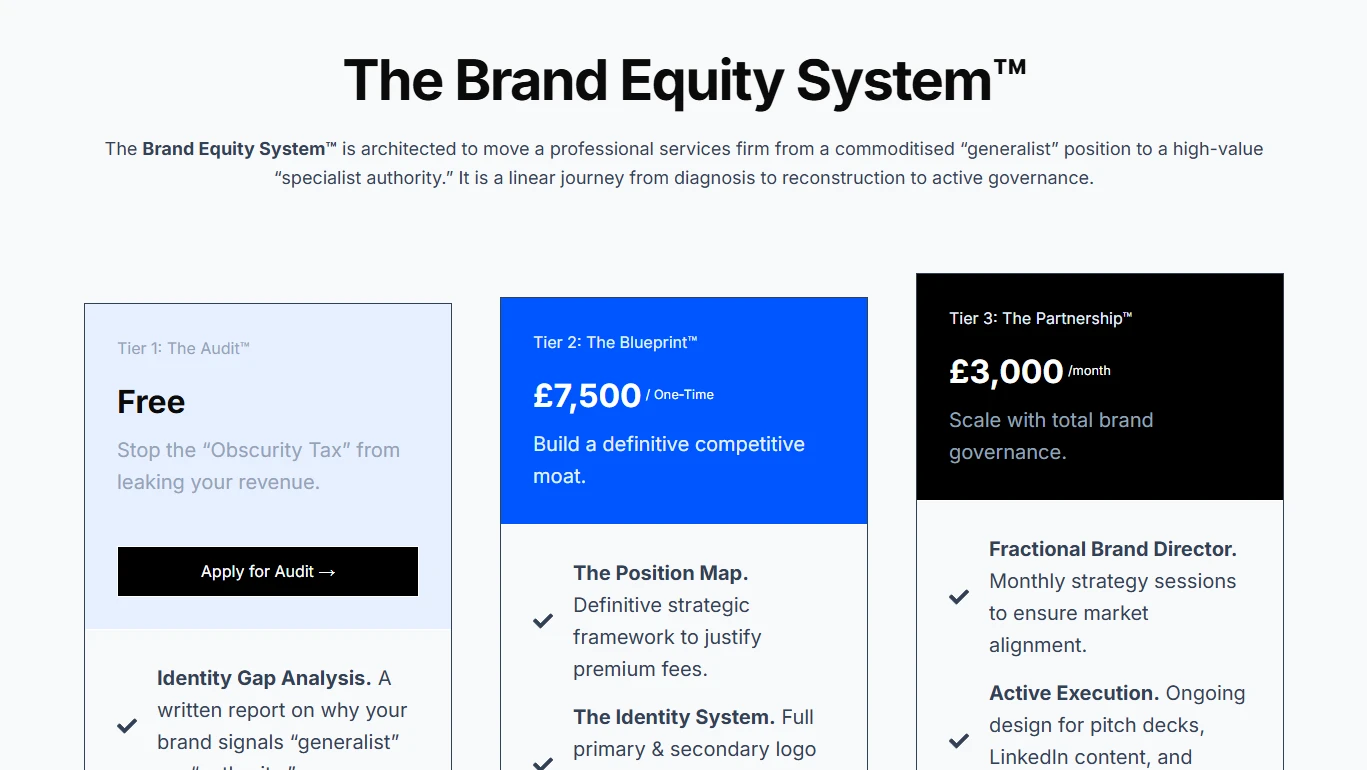
Inkbot Design offers a free, written Brand Equity Audit™ covering positioning, messaging, visual presentation and search visibility.
The diagnostic can provide a starting point for deciding what to examine next; it is not proof that a full rebrand is necessary.
Before approving design expenditure, write one sentence naming the commercial problem, the evidence for that diagnosis and the decision the project must enable.
Questions people ask
Can we keep the consultancy name but change the positioning?
Yes — a consultancy can retain its name while changing the target-client definition, proposition and messaging. Check whether the name creates confusion or conflicts with the intended market. If the name remains useful, a change in positioning does not, by itself, justify renaming the business.
Does a small consultancy need a branding agency?
No — a consultancy with agreed positioning, approved evidence, and capable internal resources may be able to improve its messaging and templates without an agency. External help becomes more relevant when leadership needs independent research, specialist design production or support in resolving decisions that internal discussions have not settled.
Should every consultancy create a new category?
No — creating a category is a separate strategic choice, not a required branding deliverable. A consultancy may be better served by describing a recognised service more precisely. Explore category design for consultancies when an existing category materially misrepresents the work and the business can support the required explanation.
How do we measure whether consultancy branding has worked?
Define the intended change before launch. Track suitable enquiries, shortlist progression, discounting and buyer explanations against a baseline, separating referral-assisted and non-referral opportunities. Compare similar assignments. A larger contract won after launch does not prove branding caused the win; buyer, scope and relationship changes may explain the result.