How to Write a Logo Design Brief: Agree on the Test Before the Designs
If you have sat through a partner’s meeting reviewing a first round of logo concepts, you’ll recognise it.
One director likes the navy option. Another says it looks like a building society. A third wants “something bolder” and can’t say what that means.
Every concept is being judged against nothing that anyone agreed in advance.
A logo design brief exists to stop that meeting from happening.
A useful brief records what the new identity has to achieve, what it must work within and how the concepts will be judged, and it does all three before a designer draws anything.
The colours, fonts and admired logos most guides tell you to list belong inside that framework as evidence. On their own, they hand the decision to whoever argues longest.
Project management research has quantified the costs of this kind of ambiguity.
The Project Management Institute (PMI), the professional body for project managers, found in its 2014 requirements-management research that 47% of unsuccessful projects failed to meet their goals because of inaccurate requirements management.
The research covered projects in general, not logos. It still describes the pattern exactly: the work gets delivered, and then the people paying for it discover they each wanted something different.
For a firm rebranding ahead of growth, a merger or a sale, the logo is the most visible output of its logo design and branding work. The brief decides whether that output gets a fair test.
- Write the test before designs: agree written criteria every approver accepts so reviews diagnose issues, not become popularity contests.
- A brief must state the identity's job, constraints it must satisfy, and measurable criteria for judging concepts.
- Provide business information not visuals: what you do, target audiences ranked, key competitors, and what must remain recognisable.
- Specify practical constraints: where the logo must work, required files and variations, AI use policy, budget and who holds veto.
- Let the designer draw solutions; they will help extract requirements. Nominate one owner and collect written input from every approver.
What a Logo Design Brief Needs to Do
A logo design brief needs to settle three things before design begins: the job the identity must do for the business, the constraints any solution must satisfy, and the criteria decision-makers will use to judge concepts. Visual preferences are useful inputs. A brief built only from preferences leaves approval to personal taste.
- Purpose: who the identity must persuade, how it must differ from named competitors, and what must stay recognisable from the current brand.
- Constraints: where the logo has to work, which files and versions are required, how generative AI may be used, and who holds a veto.
- Judgement: written criteria, agreed by every approver, that each concept is tested against in every round.
A logo design brief is a document that agrees on what a new identity must achieve, the constraints it must meet, and how concepts will be judged.
The brief is the first stage of any professional logo design service, and it shapes every later step of the logo design process.
“I Don’t Know How to Explain What I Want”
You aren’t meant to.
“Looking to hire a logo designer but not sure how to explain…” is the kind of thread people start in design forums before commissioning anything.
The honest answer is that a brief describes the business problem. Finding the visual answer is the designer’s job.
Nobody should expect you to arrive with that problem perfectly defined, either. Only 24% of organisations in PMI’s 2014 research reported doing well at recognising and developing the skills needed for effective requirements management. Defining requirements is a skill.
A competent designer helps draw them out with questions rather than waiting for a finished document.
What the designer needs from you is the information behind the design.
What the firm does, in one sentence, a stranger understands
Professional services firms often describe themselves too broadly to design for. “Full-service business advisory” fits hundreds of firms. A hypothetical alternative: “We help owner-managed engineering firms in the Midlands prepare for and complete a sale.” A designer can work with that sentence, because it names a client, a region and a moment.

Who the identity has to persuade
Name the people whose judgement matters most, in order. For a 50–200-person firm, that is rarely one audience. A hypothetical 120-person accountancy practice might need to read as credible to finance directors at private-equity-backed companies, as current to the graduates it recruits each autumn, and as stable to the bank it refinances with. Ranking those audiences indicates which trade-offs you will accept when they conflict.
How the firm differs from the three named competitors
List your three nearest competitors and describe what their identities look like. If two of them use navy serif wordmarks, that is a constraint on yours, whether or not you like navy. How you differ from them commercially matters more than how you would like to look.
What must still be recognisable after a rebrand?
A rebrand brief needs to specify what stays and what changes. Cracker Barrel, the US restaurant chain, unveiled a simplified logo on 19/08/2025 that removed its “Old Timer” figure, a man seated beside a barrel.
After a public backlash, Cracker Barrel announced the Old Timer would stay, BBC News reported on 27/08/2025. The logo change was part of a wider modernisation of Cracker Barrel’s restaurants, so the reaction was not solely about typography.
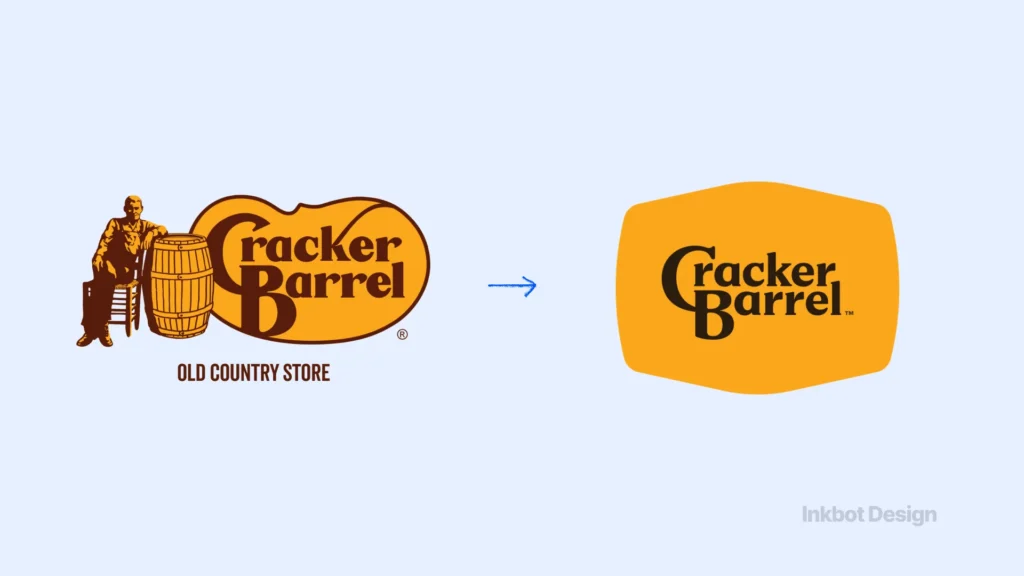
A restaurant chain is a long way from a Manchester law firm. The briefing questions still apply: which elements should be kept, explored, or removed; what evidence supports each decision; and whose reaction needs testing before rollout?
For a post-merger firm, that can mean deciding whether either legacy name survives. If you are still deciding whether to change at all, start with when to redesign your logo.
Preferences, with the reason attached
Logos and colours you like still belong in the brief, provided each is supported by a reason. “We like dark blue” tells a designer about your taste.
“We need to look established to procurement teams at FTSE 250 companies”, tells them about the job, and dark blue is one possible answer to it. Write down the reason.
The designer may find a better answer.
“Won’t the Designer Sort Out the Practical Details?”
Some of them. A designer can’t guess the constraints peculiar to your firm, and these are the details that undo approved concepts six weeks later.
Where the logo has to work
Start with the hardest conditions.
- Will the mark sit on a tender cover beside four competitors’ logos?
- Does it need to share space with an international network’s or association’s membership mark?
- Will it be printed in one colour on letterhead, shrunk to a favicon, or cropped into a circular LinkedIn profile image?
Each answer rules options in or out. A detailed monogram that works on reception signage can disappear at favicon size.
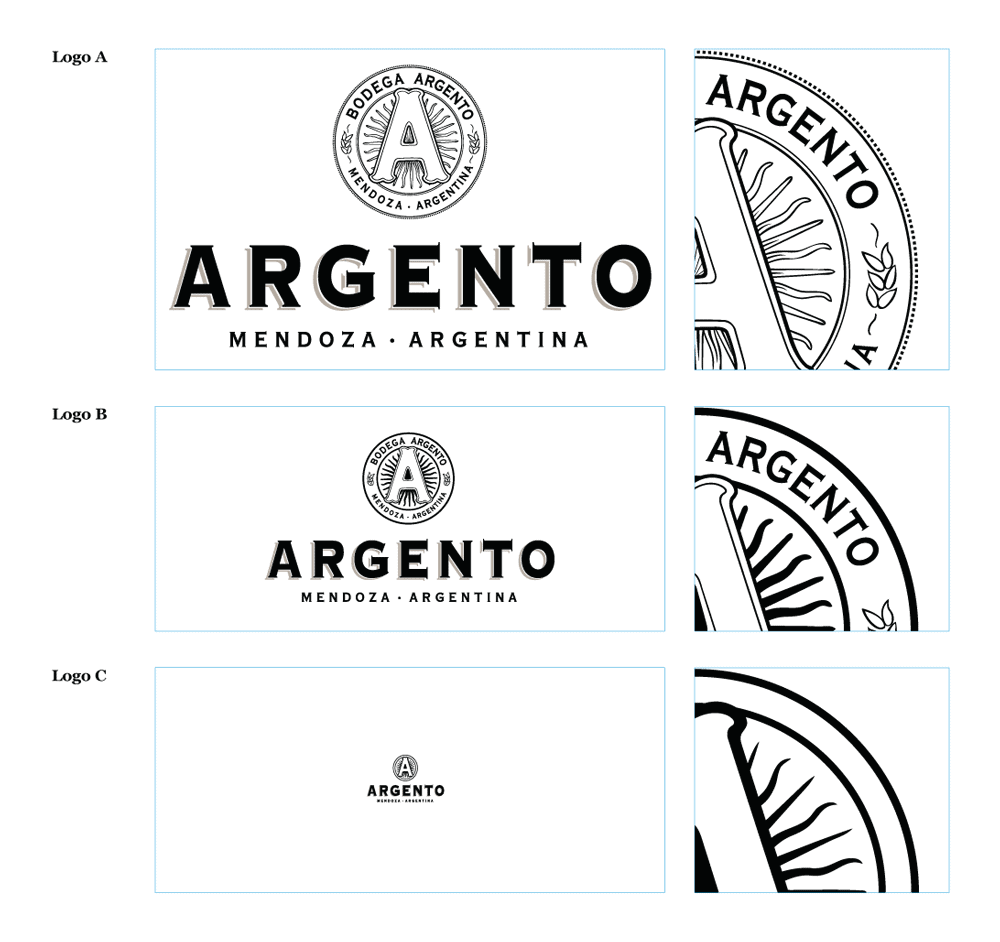
Concepts, variations and final files
Buyers often ask whether a designer “gives you variations”, and the word covers two different things.
Concepts are alternative creative directions shown early.
Variations are versions of the approved logo: horizontal, stacked, icon-only, single-colour and reversed.
Final files are the formats you receive, such as vector masters (SVG, EPS) and PNGs for digital use.
The brief should specify what you need from each, and the proposal should confirm the numbers, as they determine how much a professional logo should cost.
Files alone don’t keep an identity consistent. In Lucidpress’s State of Brand Consistency 2021 report, a vendor survey of more than 450 respondents found that 77% of companies reported dealing with off-brand content.
That survey doesn’t show that briefs cause the problem. It does show that receiving logo files and maintaining an identity are separate tasks.
Say in the brief whether you need usage guidance and templates, or whether those are out of scope.
A logo brief is not an AI prompt.
Adobe’s documentation describes Illustrator’s Text to Vector Graphic feature as generating editable vector icons and simple logo-style artwork from a text description.
Generating options is now cheap. Deciding whether an option suits a 120-person firm still needs the purpose, constraints and criteria a brief supplies.
AI also raises ownership questions worth settling in writing. On 29/01/2025, the US Copyright Office published Part 2 of its Copyright and Artificial Intelligence report, concluding that copyright protection requires sufficient human-authored expression and that prompts alone are not enough.
That is US guidance, not UK law, and it does not address trademark clearance. Add three questions to your brief: may AI be used for exploration, for final artwork, or for neither? What disclosure do you expect? What originality and rights assurances do you need?
Who holds a veto
State a budget bracket and the event behind the deadline, such as a merger completion or an office launch.
Budget also determines whether an agency, a freelancer, or an AI tool is realistic; a logo design agency vs a freelancer vs an AI generator sets out the trade-offs.
Then name every person who can say no. The next section explains why that list matters more than anything else in the brief.
“What If We Don’t Like Any of the Concepts?”
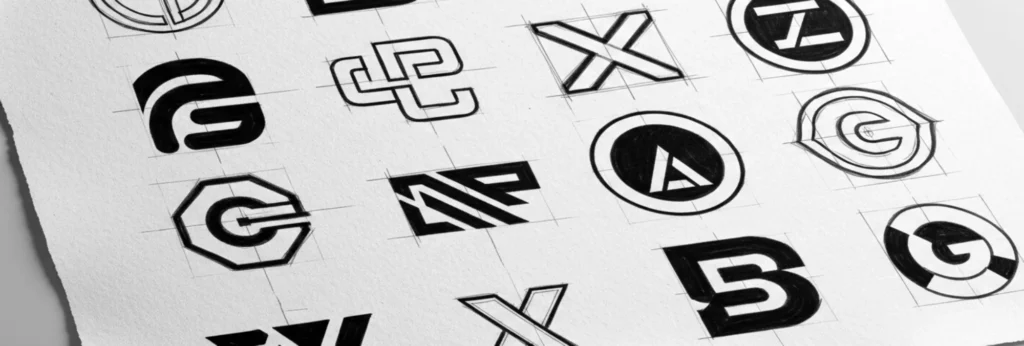
The case for “we’ll know it when we see it” is reasonable.
A logo is visual. People respond to it before they analyse it, and that first reaction is real information about how clients will respond. I’d rather a client react honestly than politely.
The trouble starts when the reaction is negative. “We don’t like any of them” can mean three different things:
- A concept fails a requirement you agreed to. That is the designer’s problem, and a revision should fix it.
- Every requirement is met, but the direction feels wrong. That points to something the brief either missed or got wrong, and it needs to be amended before the next round.
- The requirements have changed. A new partner joined, a merger was announced, or a competitor rebranded. That is a legitimate change of scope, but it should be named as one.
Without written criteria, nobody can tell which of the three you are dealing with, so all three get treated as “try again”.
PMI’s 2014 research estimated that poor requirements management wasted 5.1% of project and programme spending, or $51 million for every $1 billion spent.
That is not a logo cost estimate. Undefined requirements cost money wherever they sit.
The fix is to convert vague instructions into criteria someone can test. The rows below are illustrative:
| What the brief says | What it leaves to taste | A criterion you can test |
| “Modern but trustworthy” | Whose idea of modern | Reads as credible to a PE-backed client’s FD beside our three named competitors |
| “We like blue” | Whether blue is the point | Distinguishable from the two nearest competitors, both navy |
| “Simple” | Simple compared with what | Legible at favicon size and in single-colour print |
| “Keep the heritage” | Which parts | Retains the founding name; the existing monogram may go |
| “Appeal to younger talent” | Appeal how | Works on graduate recruitment materials and the client pitch deck |
| “Stand out” | Stand out where | Recognisable on a tender cover shortlist of five firms |
“A logo concept can only fail a test that someone wrote down. Without written criteria, “we don’t like it” is unanswerable: the designer cannot tell whether a requirement was missed, the brief was wrong, or the firm changed its mind. Write the criteria before the first concept arrives, get every approver to agree on them, and each review becomes a diagnosis instead of a vote.”
I’ve spent 17-plus years building identities for professional services firms across 21 countries, and at Inkbot Design, the people question is the one we push hardest.
Clients complete our logo design questionnaire once the commercial scope is agreed upon. It takes 15–30 minutes, and there is a Word version for anyone who prefers to work offline.
The questionnaire asks what the business does, why that matters and how it differs. It asks which preferences are flexible and which are non-negotiable, and it asks for the reasoning behind any colour or style the client favours, not a finished execution.
It also says plainly that “I don’t know” is an acceptable answer.
We ask the client to gather input from everyone with approval authority and designate one person to be responsible for the response.
A completed questionnaire is rarely a finished brief. Its value lies in showing what still needs clarifying before the designer starts.
The written answers then become the shared reference point in every review: a foundation for discussion, never a substitute for it.
Whoever you hire, get every approver’s input in writing before the first concept and nominate one owner.
Is it unreasonable to ask for a complete redesign? No, if the concepts fail the agreed brief. If your direction has changed, say so, and expect the scope (and possibly the fee) to change with it.
Write the Test Before You See the Answers
A logo brief earns its keep in the review meeting, weeks after it was written.
If it records what the identity must achieve, what it must work within and how concepts will be judged, the designer has room to surprise you, and the partners have a basis for deciding.
If it records only colours and admired logos, the decision falls to taste.
Today, write five sentences describing what a successful logo must do, and send them to every approver before you brief anyone.
If they come back agreed, a capable designer and a brief built on them may be all you need.
If the partners can’t agree on those five sentences, the problem is positioning, and a new logo won’t fix it.
That is what Inkbot Design’s free Brand Equity Audit™ is built to diagnose: where your brand is losing commercial ground, and what to do about it before any design money is spent.
Frequently Asked Questions
Can I write a logo brief if I don’t know what I want the logo to look like?
Yes. A logo brief describes the business: what it does, who it must persuade, how it differs from competitors and what must stay recognisable. Finding the visual answer is the designer’s job, and a good designer will ask questions to help you fill the gaps.
What happens if I don’t like any of the logo concepts?
Test each concept against the brief’s written criteria. If a concept fails to meet an agreed-upon requirement, the designer should revise it. If all requirements are met but the direction feels wrong, amend the brief. If your requirements have changed, treat it as a scope change and agree on the impact before the next round.
What should a logo brief say about concepts, variations and final files?
A logo brief should say how many initial creative directions (concepts) you expect, which versions of the approved logo (variations such as stacked or single-colour) you need, and which formats (final files such as SVG or PNG) you need. The proposal should then be confirmed in writing.
How long should a logo design brief be?
A logo design brief should be long enough to answer three questions clearly: what the identity must achieve, what constraints it must satisfy and how concepts will be judged. Extra length rarely helps. Clarity on those three points matters more than page count.
Who should write the logo design brief, the client or the designer?
Both. The client supplies the business information, constraints and approvers. The designer drives the questions and turns the answers into a usable brief. One named person on the client side should own the response, after gathering input from everyone who can veto the final logo.
Should a logo brief include logos we like?
Yes, provided each example includes the reason it appeals, such as its legibility, restraint, or tone. The reason is the requirement. A designer can meet it in ways you haven’t seen, whereas copying the admired logo itself only produces a weaker version of someone else’s identity.
