Branding Archetypes: Stop Choosing Yours. Let Your Buyer’s Risk Decide.
Your next client’s CFO will not hire your firm because your brand feels like a Sage.
The CFO will hire you because putting your name in front of the board carries the smallest chance of looking foolish in eighteen months.
That is the whole argument, and most advice on archetypes runs it backwards. It opens with “What personality is our brand?” and finishes with a colour palette. The buyer’s question, the one that actually decides the pitch, never enters the room.
The cost is measurable. Gartner, the research and advisory firm, surveyed 632 B2B buyers in 2025 and found that 74% of buying teams exhibit unhealthy conflict during the decision-making process.
That means conflicting objectives, disagreement on the way forward, or an outside decision-maker overruling the group. More than 40% of B2B deals are also reported to stall on internal misalignment. A committee that can’t agree doesn’t pick the most charming firm. It picks nobody, or it re-signs the incumbent.
Archetypes are one layer of meaning in a brand.
Our brand semiotics framework covers how those signs and codes are read, and this piece sits within the broader psychology of brand choice.
What follows is narrower: how a UK professional services firm should use archetypes when the person buying is senior, accountable and never alone.
- C-suite buyers choose options they can defend; they fear being visibly wrong, so brands must signal defensibility rather than personality.
- Pick an archetype that answers the committee's dominant fear: expertise, control or duty of care, not founders' personal tastes.
- Test choices with recent clients and lost pitches; ensure every committee member can repeat and defend your firm's story before rebranding.
C-Suite Buyers Choose the Option They Can Defend
Branding archetypes influence C-suite buyers only when they translate into decision signals: proof of expertise, a sense of control, credible transformation or reduced risk.
Senior buyers purchase as a committee and answer to others. The archetype that wins is therefore the one every member of that committee can defend.
- Gartner’s 2025 survey of 632 B2B buyers found that 74% of buying teams display unhealthy conflict during the purchase decision.
- Gartner found that messaging tailored to the buying group improves consensus by 20%, while messaging tailored to individual stakeholders has a 59% negative impact on consensus.
- A brand archetype chosen for its emotional appeal to one persona risks the same fragmentation Gartner measured.
Branding archetypes work in B2B professional services when they signal expertise, control or reduced risk that a buying committee can collectively defend.
“Aren’t Archetypes a Consumer-Brand Tool?”
Partly. It’s worth being fair about why they stuck.
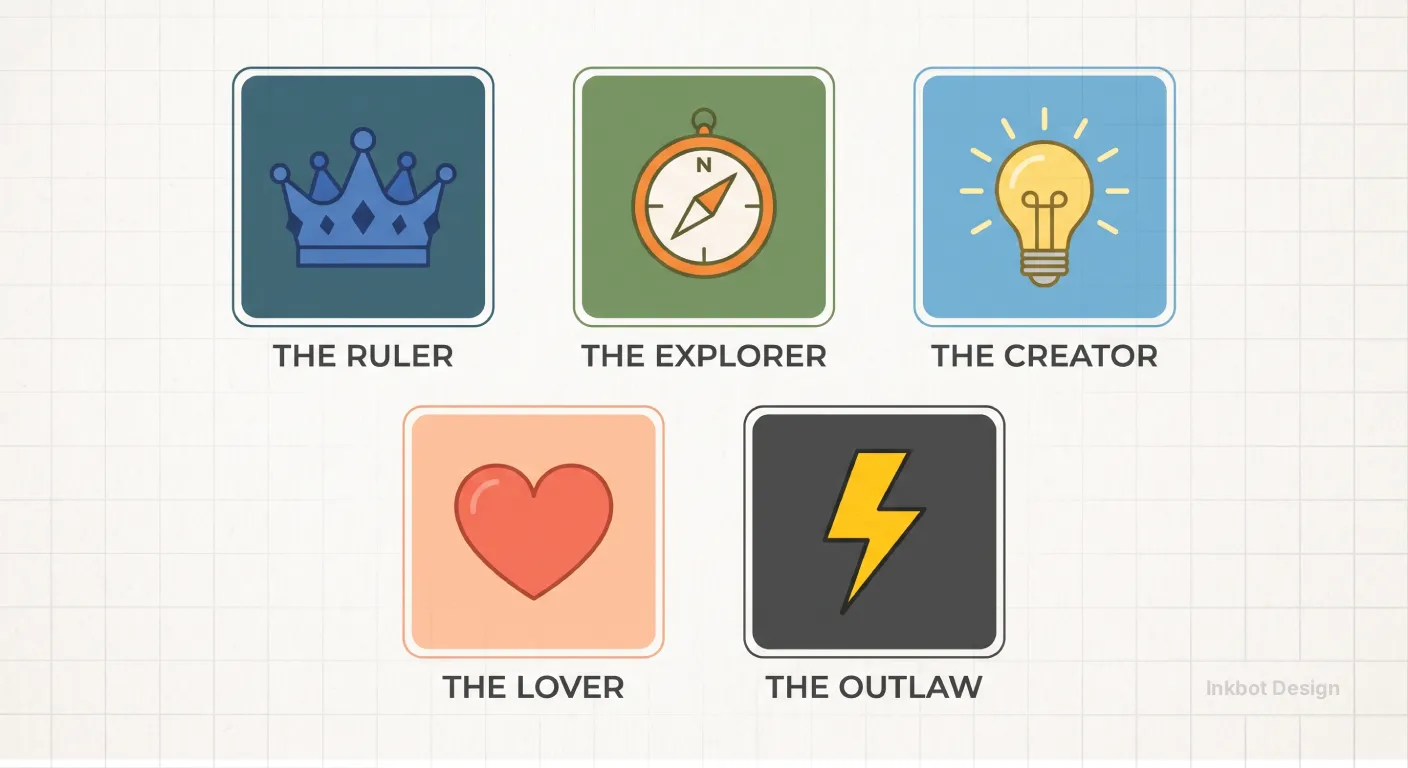
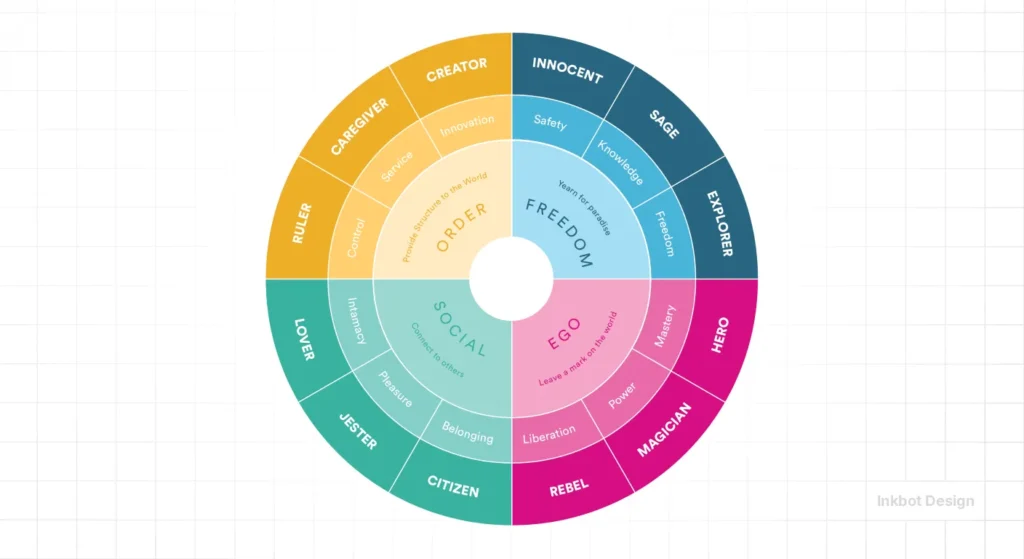
Margaret Mark and Carol S. Pearson developed the twelve-part brand framework in The Hero and the Outlaw (2001), drawing on Carl Jung.
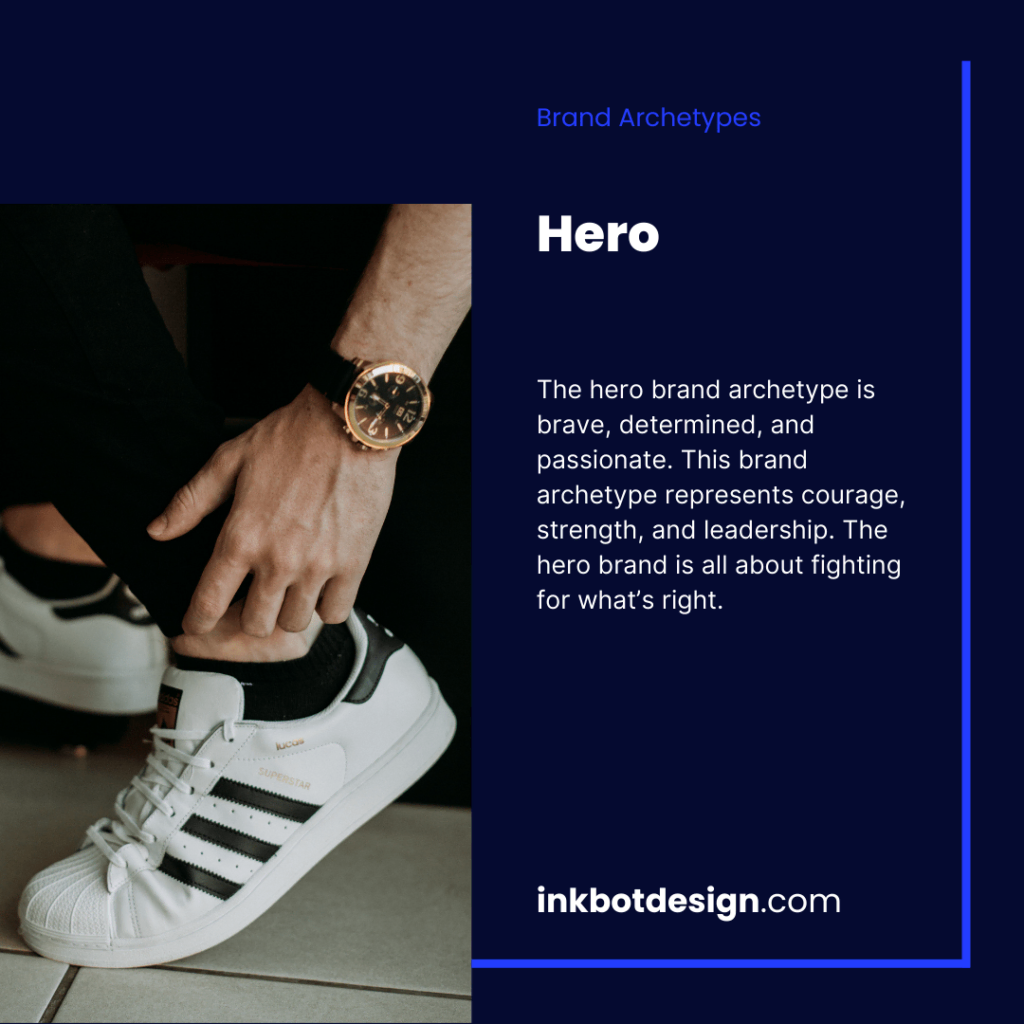
You’ve seen the wheel. It’s the one with Nike on it, and that’s the tell: the framework was built for people buying things for themselves.
Intelligent people continue to use the framework because it solves a real problem. A rebrand involves hundreds of small decisions made by different people over months.
An archetype gives a partner group one shared word for “what we’re like”, which stops the copywriter, the designer and the business development director pulling in three directions. That value holds for a 90-person accountancy practice as much as for a trainer brand.
The problem is the input. A consumer buys a pair of Nikes for themselves, so the archetype only has to match who they want to be.
Your client’s COO buys on behalf of other people, with their money, in front of their board. Apply the consumer method (pick the personality, then express it) to that buyer, and you answer a question nobody on the committee asked.
“People Buy on Emotion, Though. Surely a CFO Does Too?”
Yes. Just not the emotion the archetype guides describe.
The emotion behind a senior B2B purchase is mostly anticipatory: the fear of being visibly wrong. The old line “nobody ever got fired for buying IBM” (widely quoted, origin disputed) has outlived the mainframe because it describes the mechanism precisely.
The buyer isn’t purchasing the best option. The buyer is purchasing the option that will still look reasonable if things go badly.

Follow the chain. A senior buyer commits organisational money. The outcome gets attributed to them personally. So they favour options that are easy to justify, and that justification has to withstand scrutiny from colleagues with different priorities.
Consider an employment law firm pitching to a national retailer (an illustrative scenario, not a documented case).
The HR director wants empathy for line managers, the finance director wants fee certainty, and the general counsel wants no surprises at tribunal. That is three people with three fears, and they must reach one decision.
This is where most archetype work breaks. Gartner’s 2025 buyer research found that content relevant to the whole buying group improved consensus by 20%, while content tailored to individual stakeholders had a 59% negative effect on it.
Gartner’s explanation is confirmation bias. Each person hears the message that flatters their own view, and the group drifts further apart.
An archetype chosen to excite one persona behaves the same way. The Hero might thrill an ambitious CEO and quietly alarm the finance director, who reads “bold” as “expensive and unpredictable”. Nobody says so in the pitch. The firm just doesn’t get the call back.
Hidden buyers make it worse. Research from Edelman and LinkedIn in 2025 describes influencers who never download a guide, attend a meeting or appear in CRM attribution. Those people still decide whether a purchase looks safe, commercially sound or compliant.
Your archetype reaches them second-hand, through whatever the champion forwards, so it has to make sense out of context.
“A brand archetype in professional services is a promise about how the decision will look afterwards. The Sage says the choice was well-informed. The Ruler says it was controlled. The Caregiver says nobody was exposed. If the archetype cannot be restated as a sentence, the buyer would say to their board, it is decoration.”
“Fine. So Which Archetype Should We Be?”
Your client interviews will tell you which fear dominates. Don’t assume it from your sector. A tax practice serving founders may find the dominant fear is being out-thought. The same practice serving a family office may find it is being indiscreet.
| Archetype | The decision signal it carries | Committee member it reassures | How it fails in professional services |
| Sage | Expertise, evidence of thinking | CEO, technical specialists | Turns into lecturing: thought leadership nobody asked for |
| Ruler | Control, governance, stability | Finance director, board, risk committee | Reads as arrogant, or too expensive for mid-market clients |
| Caregiver | Duty of care, reduced exposure | General counsel, HR, compliance | Reads as soft, implying slowness under pressure |
| Hero | Performance when stakes are high | CEO in a crisis, litigation or turnaround work | Overpromises; one lost matter undermines the whole story |
| Magician | Transformation | Board seeking change | Unverifiable; triggers “sounds like consultants” |
| Everyman | Plain dealing, fair fees | Owner-managers, cost-focused finance teams | Invites commodity comparison and fee pressure |
| Outlaw | Challenge to the incumbent | Rarely anyone on a committee | Signals unpredictability to the people who vote no |
Two things matter after that, and founders usually get both wrong.
First, the primary archetype answers the committee’s biggest fear, and the champion’s ambition goes into the secondary archetype.
The popular 70/30 split (a core archetype plus an “influencer”) is a sensible ratio. The error is filling the 70 with whatever the founders find exciting.
Second, expression comes last. Colour and typography should carry the chosen signal. The piece on colour psychology explains why “trustworthy blue” proves nothing on its own, and the piece on design psychology covers how buyers judge credibility before they read a word.
A Sage expressed through navy and a serif typeface, looks like every other firm on the shortlist. A Sage expressed through published, specific, checkable thinking looks like the safe choice.
“Who Decides? Our Partners Have Strong Opinions.”
Your recent buyers decide. The partners approve.
In practice, that takes four moves:
- Interview five to eight recent clients, including at least two pitches you lost, and ask one question: “What felt risky about choosing us?”
- List every role that sat on those committees, including people who never met you.
- Name each role’s dominant fear in plain language.
- Choose the archetype whose signal answers the most fears at once.
Then test the choice. Could each role repeat your firm’s story in one sentence without contradicting the others?
The partner workshop is where most archetype decisions go wrong because everyone in that room is a seller, and nobody is the buyer.
“We Ran an Archetype Workshop Last Year. Was It Wasted?”
Probably not. It may just need to be reread from the other side of the table.
Three shifts make that urgent.
The website now does the early selling.
Gartner has reported that 61% of B2B buyers prefer a rep-free buying experience. Your partners still matter, but your own pages now carry the first round of explanation and trust-building, before anyone books a call. An archetype that only comes alive in a partner’s pitch is invisible at the stage when the shortlist is formed.
The shortlist gets built without you.
By the time a partner is invited to pitch, someone has already compared your site to two competitors’. If your archetype isn’t legible there, you’re competing on fees.
Consistency has become an operational question.
Most archetype guides treat consistency as visual sameness.
Gartner’s buying-group findings point to something more useful: every member of the committee should take away the same meaning, whether they read the website, the proposal, or a forwarded LinkedIn post.
Kapferer’s Brand Identity Prism is a practical way to audit that, facet by facet.
Take last year’s workshop output and run one test. For each archetype trait you chose, write down which buyer fear it answers. A trait that answers no fear is founder preference. Keep it in the culture and take it off the website.
Choose the Archetype Your Client Can Defend in the Boardroom
Branding archetypes still earn their place in a professional services rebrand. They give partners a shared language and stop their identities from drifting. What they can’t do is choose themselves from the inside.
C-suite buyers are accountable, rarely alone, and mostly afraid of a visible mistake. Gartner’s evidence shows that messages built for the group hold committees together, while messages built for individuals pull them apart.
The archetype that wins carries a signal (expertise, control, duty of care) that every person on the committee can repeat and defend.
So before the next rebrand workshop, interview the buyers.
If you want an outside view of where your current brand sends the wrong signal, request a free Brand Equity Audit™. It’s a structured diagnostic that shows where the brand is losing commercial ground and what to fix first.
FAQs
What are branding archetypes?
Branding archetypes are recurring character patterns, adapted from Carl Jung’s work, that brands use to express a consistent identity. Margaret Mark and Carol S. Pearson popularised a 12-archetype brand framework in 2001. In B2B professional services, an archetype works best as a decision signal, such as expertise or control, rather than as a personality.
How many brand archetypes are there?
The standard framework uses 12 archetypes: Sage, Ruler, Caregiver, Hero, Magician, Creator, Explorer, Outlaw, Lover, Jester, Everyman and Innocent. Mark and Pearson’s The Hero and the Outlaw (2001) set this structure. Professional services firms typically draw their primary archetype from the Sage, Ruler, or Caregiver because these three carry the strongest risk-reduction signals.
Which brand archetype suits a law firm or accountancy practice?
The buying committee’s dominant fear sets the right archetype for a law firm or accountancy practice. Where clients fear exposure, the Caregiver or Ruler fits. Where they fear poor advice, the Sage fits. The champion’s ambition, such as growth or transformation, belongs in the secondary archetype.
Is it true that 95% of purchasing decisions are subconscious?
No. The 95% figure is not a measured statistic. It is usually traced to the work of Harvard Business School professor Gerald Zaltman on consumer thinking. Senior B2B decisions are also heavily shaped by explicit justification to colleagues, which is why defensibility matters more than subconscious appeal.
Can a firm change its brand archetype during a rebrand?
Yes. A rebrand is the natural moment to change archetype, especially ahead of an acquisition or repositioning, when the buying committee itself may change. The new archetype should be tested against interviews with recent and lost clients, not only chosen in a partner workshop.
What’s the difference between a brand archetype and brand personality?
A brand archetype is the underlying character pattern a brand borrows, such as the Sage or the Ruler. Brand personality is how that pattern surfaces in tone, vocabulary and visual identity. In professional services, the archetype should be chosen for the decision signal it sends, and the personality should then express it consistently.
Should B2B brands tailor archetype messaging to each stakeholder?
No. Gartner’s 2025 survey of 632 B2B buyers found that individually tailored content had a 59% negative impact on buying-group consensus, while content relevant to the whole group improved consensus by 20%. One archetype, expressed as one shared story, serves the committee better than persona-by-persona variations.
