Tone of Voice Guidelines Your Team Can Actually Use
Tone-of-voice guidelines should help colleagues decide what to write when situations become difficult. This guide turns brand traits into writing rules, with a reusable template, examples from professional services, and a practical review method. Use it to test whether your guidance works without the founder having to rewrite every sentence.
 By Stuart Crawford
 Reviewed by Tabitha Ayers
10 min read

On this page10 min left
- What should tone of voice guidelines help people do?
- Why do we need this when we already have brand guidelines?
- A tone of voice guidelines template your team can use
- Tone of voice examples for professional services
- Will this make every writer sound the same?
- Can we just give the guidelines to AI?
- Who owns the guidelines, and how do we measure their usefulness?
- Test whether colleagues can apply the rules independently
- Measure the work, not the attractiveness of the PDF
- Test the guidance before commissioning a bigger document
- Questions people ask
Tone of voice guidelines should tell your colleagues what to write when a client challenges a fee, a deadline slips, or a partner edits the website. A list of personality traits cannot settle those decisions on its own.
Useful guidance combines a stable brand voice with writing rules, contextual examples and an owner who can resolve exceptions.
The words also need to match the business. Gartner, the research and advisory company, reported that 80% of 303 US consumers surveyed in October 2024 agreed that brands with consistent pricing are more trustworthy.
That finding concerns consumer pricing, not UK professional-services copy.
The relevant caution is narrower: reassuring language cannot make inconsistent commercial behaviour disappear.
What should tone of voice guidelines help people do?
Tone of voice guidelines translate a brand’s intended personality into writing decisions: how to explain a recommendation, acknowledge uncertainty, respond to dissatisfaction and ask for action. A usable document includes rules, boundaries and examples, then shows what changes when the reader’s situation changes.
- Voice defines the qualities the writing should retain.
- Tone adapts the expression to the reader’s needs and circumstances.
- Examples show how to apply the rules without copying every sentence.
Tone of voice guidelines define writing rules and contextual examples that help different people communicate with a consistent brand voice.
Why do we need this when we already have brand guidelines?
You may already have what you need. Check the contents before commissioning another document.
For this purpose, distinguish four jobs:
Brand resource | Question answered |
|---|---|
Positioning | Why should a particular buyer choose the business? |
Messaging | What should the business communicate about its value? |
Voice and tone | How should that message sound in this situation? |
Editorial style | Which spelling, punctuation and terminology conventions apply? |
A visual identity manual can specify a logo’s clear space, but it won't help a relationship manager explain a price increase. An editorial style guide can settle capitalisation without deciding whether an apology sounds evasive.
Tone guidance belongs within your wider verbal identity. The document may sit inside existing brand guidelines; a separate PDF is optional.
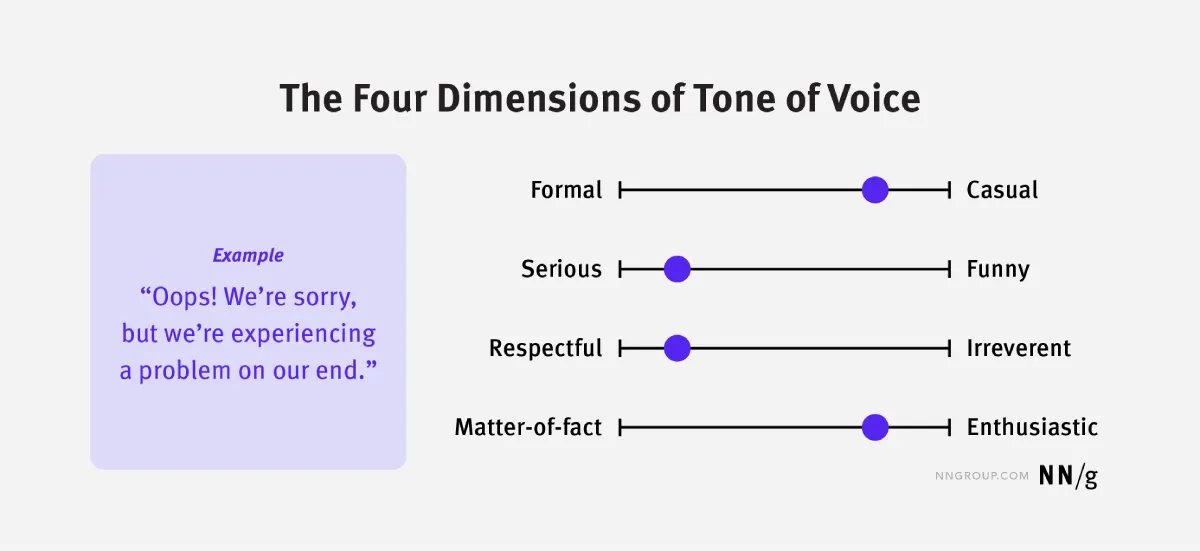
Nielsen Norman Group, the user-experience research consultancy, recommends keeping brand personality consistent while varying tone for the user’s emotional state and the topic. A financial report and a graduate careers page need different treatment.
If the problem is wider than writing consistency, brand voice and copywriting services may help connect the underlying positioning to the language.
If colleagues simply cannot find the approved terminology, start by addressing access issues. Another strategy workshop would be an expensive answer to a missing link.
A tone of voice guidelines template your team can use
Build the document around decisions colleagues repeatedly face. The following six-part template is a proposed working format, not a research-validated standard.
Before drafting, collect representative material: a proposal, a service page, a client email and a complaint response. Include examples people disagree about. Those disagreements reveal where the writing rules need to be adjusted.
If partners disagree about who the business serves or what the business promises, settle that first. A writing guide cannot resolve an unresolved commercial position.
1. Purpose, audience and writing task
Start with a short instruction:
This guide helps [roles] write [materials] for [audiences], so readers can [decision or action].
For a hypothetical accounting practice:
This guide helps advisers and marketing colleagues explain recommendations to owner-managed businesses, so clients can decide what to do next and recognise any applicable conditions.
Then distinguish audience knowledge. A finance director may recognise a technical term that a first-time business owner needs explained.
Avoid banning specialist language automatically. Keep the term when precision requires the term; add an explanation when the reader needs one.
2. Voice principles translated into rules
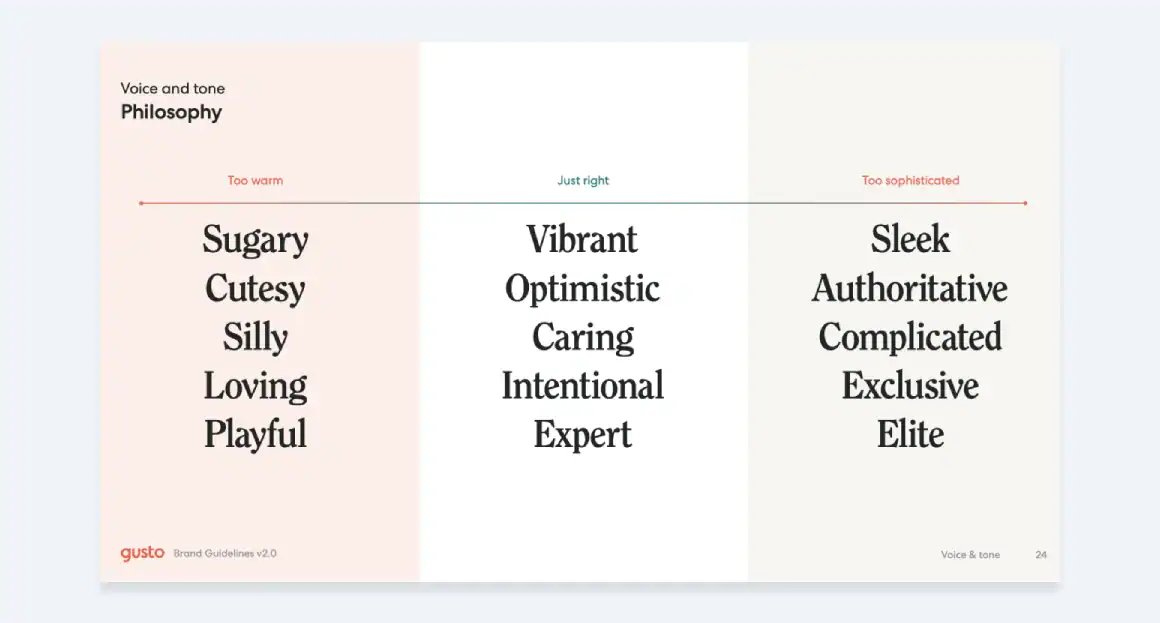
Use a principle, an observable behaviour and a boundary.
Principle | Writing rule | Boundary |
|---|---|---|
Confident | State the recommendation before the supporting explanation. | Do not hide uncertainty or imply a guaranteed result. |
Approachable | Explain unfamiliar language at the point of use. | Do not assume the reader lacks professional knowledge. |
Candid | Name the issue and its consequence directly. | Do not blame the reader or speculate about responsibility. |
Considered | Explain the trade-off behind the recommendation. | Do not bury the answer beneath every possible qualification. |
These are illustrative choices. Your business may need different principles.
Nielsen Norman Group’s tone framework distinguishes formality, humour, respectfulness and enthusiasm. The dimensions help describe differences more precisely than an isolated instruction to “be professional”
Use brand voice archetypes as a discussion aid if useful. Translate any chosen archetype into writing behaviour before asking colleagues to apply the label.
3. Fixed rules and flexible tone
Specify what must remain consistent:
- Approved service names.
- Standards for supporting claims.
- Treatment of uncertainty.
- Respect for the reader.
- Responsibility for promises and commitments.
Then identify what can change: technical detail, formality, pace and the amount of enthusiasm.
A recruitment announcement can express enthusiasm. A missed-deadline email should focus on the consequences and next steps.
Nielsen Norman Group advises against humour in routine error messages because repeated jokes can irritate users. That guidance supports a practical exception: a playful brand does not need a playful response to every problem.
4. Language, claims and terminology
Record approved terminology alongside the reason for each restriction.
“Never use jargon” is too vague. “Explain the abbreviation on first use when writing to non-specialist clients” gives the writer a decision.
For claims, specify:
- Which evidence supports a performance statement.
- Who can approve a client result.
- Where qualifications must remain.
- What to do when supporting evidence is missing.
If a sentence says the service “will reduce costs”, the reviewer needs more than a tone preference. The reviewer needs to know whether the business can support that promise.
For acquisitions, add a naming decision: when should writers use the legacy practice name, the new brand or both? Give colleagues approved wording rather than leaving every office to improvise.
5. Examples with reasons
Include a before-and-after pair for each important rule.
Annotate the change. “Better” is not an explanation.
A useful note might read:
The revision names the recommendation first, explains the condition and removes a claim the supplied evidence does not support.
Keep examples close to the tasks colleagues perform. A memorable advertising line teaches little about how to write a scope-change email.
For a wider range of applications, use B2B brand voice examples as adjacent reading rather than filling this document with unrelated consumer slogans.
6. Ownership and exception rules
End with practical instructions:
- Where the current version lives.
- Who owns changes.
- Who reviews technical claims.
- Which situations require additional approval.
- How colleagues submit a disputed example.
Add a precedence rule:
Preserve factual accuracy and necessary qualifications. Explain the reader’s next step. Apply the preferred tone within those boundaries.
Nielsen Norman Group’s analysis of navigation labels recommends descriptive wording over conversational phrasing when friendly language makes the destination harder to understand. Personality has a boundary: the reader must still complete the task.
Tone of voice examples for professional services
The following examples concern a hypothetical 100-person consultancy. The assumptions are that the consultancy values direct advice, explains its reasoning and avoids unsupported promises.
These examples illustrate decisions. No client outcome or measured improvement is claimed.

Explaining a fee increase
Before:
We are delighted to announce an adjustment to our pricing structure as we continue our commitment to exceptional service.
After:
Your monthly fee will increase from £2,000 to £2,200 from 01/01/2027. The revised fee includes the additional reporting agreed at our review. If the revised scope no longer suits your requirements, please contact your relationship manager before renewal.
The opening supplies the information the client needs: the current fee, revised fee and effective date. The explanation ties the change to a stated assumption about scope.
“Delighted” describes the sender’s feelings. The client has a different concern.
Use this structure only when the explanation is accurate. If the increase reflects higher delivery costs rather than additional work, say so. Do not invent a service improvement to make the message sound warmer.
Gartner’s consumer pricing research is a reminder to examine the underlying practice, not evidence that this wording will increase trust or retention.
Apologising for a missed deadline
Before:
We apologise for any inconvenience caused by unforeseen circumstances affecting delivery.
After:
We missed the delivery date agreed for your report. We are sorry. Your project lead will confirm the revised schedule by 12 noon tomorrow and explain which decisions the delay affects.
The revision identifies the failure, accepts responsibility and commits to a specific update.
Only promise the update if the project lead can provide the update. A precise sentence containing an unreliable promise creates another problem.
Nielsen Norman Group recommends that error messages explain the issue in familiar language and offer constructive advice. Applied here as an editorial analogy, the client email should explain the problem and what happens next. The research concerns interfaces, not consultancy delivery.
Challenging a client’s assumption
Before:
We believe there are alternative considerations worth exploring.
After:
The proposed timetable leaves no time for checking the source data. We recommend moving the presentation or reducing the scope. Keeping the current scope and date increases the risk of presenting figures that have not been checked.
The writer challenges the plan without questioning the client’s competence.
The voice remains direct. The tone is measured because the message concerns a disagreement rather than a celebration.
If the evidence is incomplete, state the condition: “Based on the timetable supplied…” is useful when the timetable may have changed. Removing that qualification would make the sentence shorter and less accurate.
Will this make every writer sound the same?
No. Shared rules can leave room for different sentence structures and individual expression.
One adviser may write, “We recommend delaying the launch.” Another may write, “Our recommendation is to delay the launch until the checks are complete.” Both can meet the same standards if the recommendation, reasoning and conditions are clear.
Use a tone matrix to distinguish situations:
Situation | Tone adjustment | Keep consistent |
|---|---|---|
Proposal | Confident, with evidence beside claims | Scope and qualification |
Technical briefing | Precise; explain unfamiliar terms | Accuracy |
Complaint | Calm; acknowledge the specific issue | Responsibility and next action |
Recruitment | More enthusiastic and conversational | Truthful description of the role |
Client warning | Direct; front-load the consequence | Respect and uncertainty |
Service announcement | Match enthusiasm to the reader’s likely reaction | Useful information first |
Nielsen Norman Group’s tone research found differences in how participants perceived paired website samples when tone changed. Those findings support testing the impression your wording creates; they do not identify a universally correct voice.
Can we just give the guidelines to AI?
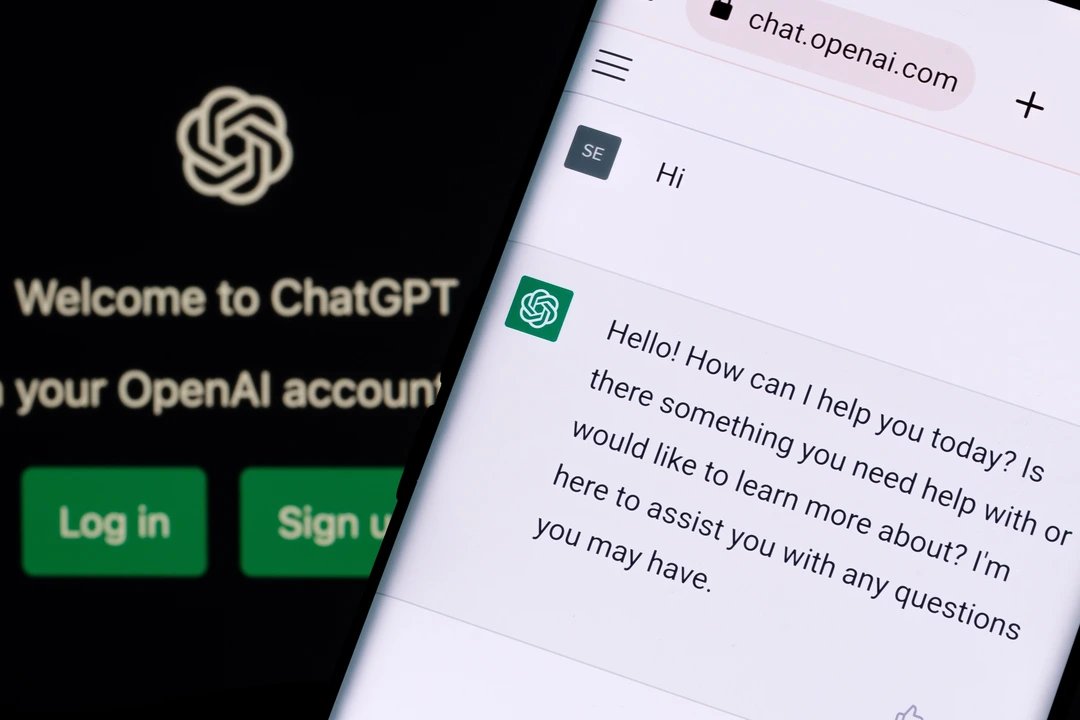
Yes, as drafting instructions. Do not treat the document as permission to publish unchecked output.
A voice prompt must constrain both the facts and the phrasing. For the hypothetical consultancy, an AI brief could read:
Task: draft a client email explaining a delayed report.
Reader: the client’s finance director, who needs the report for a board meeting.
Approved facts: the report will miss the agreed delivery date; the project lead will provide a revised schedule tomorrow.
Voice: direct, considerate and specific.
Rules: acknowledge the missed commitment; do not invent a reason; do not promise a completion date; do not claim the delay has no financial effect.
Output: a draft for human review. Flag missing information.
The instruction “sound confident” is insufficient. Confidence must not become a reason to remove a material qualification.
Add an approved example and explain why the example works. Then require a reviewer to compare the draft with the supplied facts, not merely decide whether the draft sounds polished.
For a broader production workflow, AI brand voice strategy is the adjacent task. Keep the basic writing guide useful to people who never open an AI tool.
The same distinction matters in automated forms and portals. Nielsen Norman Group recommends specific, human-readable error messages that help users recover. An on-brand apology without an actionable next step still leaves the user stuck.
Do not put confidential client information into a tool unless the business has approved that use and the applicable handling arrangements. Where the tool is not approved, use an anonymised or synthetic brief instead.
Who owns the guidelines, and how do we measure their usefulness?
Name one editorial owner who can settle wording questions. Assign technical reviewers where a message requires subject expertise.
The owner could be a marketing director, head of communications or another colleague with authority to maintain the document. The job matters more than the title.
Partners should review technical accuracy where required. Not all partners need a vote on every contract.
Test whether colleagues can apply the rules independently
Run a small internal trial before polishing the document.
Give several colleagues the same writing task, along with approved facts and a draft guide. Ask each colleague to produce a response without coaching.
Review:
- Did each draft preserve the required facts?
- Did each draft identify the reader’s next step?
- Which rules produced different interpretations?
- Which questions required the guide’s author to intervene?
- Did reviewers object to a rule breach or simply prefer different wording?
Use the disagreements to improve the guidance.
This is a proposed operational test. Nielsen Norman Group separately recommends testing tone with users, including asking users to identify the impression a passage creates. Internal consistency testing and reader-perception testing answer different questions.
Measure the work, not the attractiveness of the PDF
Record drafting time, approval rounds and reasons for substantial rewrites. Compare similar tasks before and after adoption.
Separate factual corrections, missing brief information and tone changes. Otherwise, a difficult proposal can make the writing guide look unsuccessful simply because the underlying assignment was harder.
Also review approved examples periodically. If colleagues repeatedly ask the same question, the answer belongs in the document.
Do not attribute revenue changes to the guide without a defensible method. Sales performance can change alongside pricing, demand, staffing and positioning.
Test the guidance before commissioning a bigger document
A short guide that helps a colleague explain a fee change is a useful starting point. Expand the document when a recurring decision needs an answer, rather than adding pages to make the deliverable look substantial.
If your positioning is settled and the writing problems are narrow, the template above may be enough to begin internally.
If conflicting messages point to a wider problem with the brand’s position or promise, request Inkbot Design’s free Brand Equity Audit™ to identify where the brand may be losing commercial ground and prioritise what to examine next.
Today, choose one difficult client message. Give a colleague the approved facts and your current guidance, then ask for a draft without explaining the rules aloud.
Record where the colleague has to guess. Fix that part first.
Questions people ask
How long should tone of voice guidelines be?
A tone of voice document should be long enough to resolve the decisions its users repeatedly face. Start with the principles, writing rules and examples required for current work. Add detail when a recurring question warrants it. No fixed page count establishes whether the document is usable.
When should we update the writing guide?
Update the writing guide when a change affects how colleagues should communicate: a new service, an acquisition, a different audience or a repeatedly disputed rule. Routine reviews can identify outdated examples. Keep a named owner and a change record so colleagues can distinguish current guidance from superseded instructions.
Should different services have separate voice guides?
Separate service guides are justified when audiences, terminology or communication risks require materially different instructions. Otherwise, keep shared principles and add service-specific examples. Creating separate documents for each department can introduce unnecessary contradictions. Review actual writing tasks before deciding that an organisational boundary needs a different voice.
Do we need an agency to create the guidelines?
No. A business with agreed positioning, an accountable owner and access to representative writing can develop an initial guide internally. External help may be useful when partners cannot agree on the underlying voice, an acquisition creates conflicting identities, or nobody has the time to translate principles into usable examples.