How To Rank Higher On Google – The Ultimate Guide
Let’s face it: if you’re not found on Google’s first page, you’re as good as invisible online. That is because about 92% of all traffic goes to websites appearing in the first SERP. So, if you are not there, nobody is seeing your site.
Now, think about yourself briefly; how often do you click to see other pages on search results? Someone can only do this when researching or trying to cover every possible angle. But for the most part, no one has that kind of attention span.
So what should be done? The bottom line is this: You need top rankings on page one — ideally within three positions from the very top — otherwise, you won’t receive meaningful amounts of organic traffic from Google. That’s it. The difference between numbers one and five in CTR percentages will shock you.
Therefore, it’s safe to say that ranking high in Google search results should be among your top priorities when running an online business. Just so we’re clear, this isn’t something nice to have but rather a need-to-have. Get ready to take lots of notes and step up your SEO game!
- Prioritise high-quality, unique content that provides clear information gain and original data so AI and Google will cite your pages.
- Build topical authority using a Hub and Spoke model: pillar pages linked to focused sub-topic pages.
- Optimise user experience for 2026 metrics: improve INP, LCP under 2.5s, and prevent CLS to reduce bounce rates.
- Earn authoritative backlinks and local citations to boost site credibility and improve rankings in both organic and local search.
- Structure content for AI and search intent: use short summaries, lists, schema, video, and localised pages to capture rich results.
Navigating the Era of AI Overviews
The landscape of digital discovery has shifted. In 2026, a significant portion of search journeys begins—and often ends—with an AI Overview. To remain visible, your content must not only be high-quality but also structured in a way that AI models can easily parse, cite, and summarise.
Winning in this environment requires a shift from “keyword matching” to Information Gain. If your page simply repeats what everyone else is saying, an AI model has no reason to cite you. You must provide unique data, a contrarian perspective, or a more simplified explanation than currently exists.
How to Optimise for AI-Generated Summaries:
- Direct Answer Boxes: Within the first two paragraphs of your H2 sections, provide a 40-50-word “summary” of the answer. Use clear, declarative language.
- Structured Lists: AI models prefer to pull from bulleted or numbered lists for “how-to” queries.
- Entity Relationships: Clearly define how your topic relates to other major brands or concepts. For example, if you are discussing Project Management, explicitly mention how it integrates with tools such as Asana or Trello and frameworks such as Agile or Scrum.
Scenario: The “Zero-Click” Opportunity. Imagine a user asks, “How much does it cost to paint a house in London?” Instead of just listing prices, provide a Comparison Table that shows variables such as house size, paint quality (e.g., Farrow & Ball vs. Dulux), and seasonality. Because you provided the most structured data, the AI is more likely to feature your table as the definitive answer, driving high-intent traffic to your site.
Understand Google’s Perspective
You must understand how Google sees the world to beat your competition. Consider yourself in their shoes (or algorithms) for a moment.
Google’s top priority is showing the best possible results for any search query. They want to connect people with the most relevant and highest-quality content or services. This is how they remain the number one search engine that everybody uses.
We would all go somewhere else if Google’s results sucked. Therefore, they’re obsessed with relevance, quality and user experience. Their sophisticated algorithms evaluate hundreds of factors to decide which pages should rank higher than others.
Some key points include:
- Quality of content and relevance of keywords used
- Website authority and reputation
- User experiences such as loading speed or mobile-friendliness, etc.
- Natural link profile
In essence, Google wants your page to be among the best resources for that particular keyword phrase. They need authoritative, trustworthy, high-quality pages deserving more comprehensive attention.
Google Cares About User Signals
However, it’s not just about what is inputted onto a website, but also accurate user data and signals like:
- Bounce rate (do people quickly leave your page?)
- Time spent on the page
- Number of pages visited during the session, session duration, etc.
- Repeat visits/traffic over a time frame, e.g. monthly, quarter, annually ;
If every time someone lands on one of your pages from a search result, they immediately click back to Google, that tells them a lot about whether or not this was helpful information or if there might be something wrong with either our algorithmic approach towards ranking such material highly within SERPs alongside other similar type pieces, where appropriate – Onsite elements matter too!
Building Topical Authority through Hubs and Spokes
The days of ranking a single page for a competitive term are largely over. Modern search systems look for a comprehensive “knowledge map” on your site. This is achieved through a Hub and Spoke model, where one central “Pillar Page” (the Hub) links to several highly specific “Sub-topic Pages” (the Spokes).
The Semantic Strategy: Instead of focusing on a single keyword like “Home Renovation,” you should build a cluster that covers the entire journey:
- The Hub: “The Complete Guide to Home Renovation 2026”
- The Spokes:
- “How to Budget for a Kitchen Remodel”
- “Sustainable Building Materials for Modern Homes”
- “Finding Reliable Contractors: A Checklist”
- “Legal Requirements and Planning Permission in the UK”
By interlinking these pages, you signal to the algorithm that your website is an exhaustive resource. This creates a “moat” around your rankings that competitors with only single pages cannot easily cross.
When should you create a new spoke? A new page is required whenever a sub-query has a distinct Search Intent. If a user searching for “renovation costs” needs a different experience (e.g., a calculator) than someone searching for “renovation inspiration” (e.g., a gallery), they deserve separate, dedicated pages.
Image Optimisation
Optimising images is another quick win:
Utilise H2 and H3 Subheadings
Breaking up your content into sections with properly optimised H2 and H3 subheadings makes it much easier for Google to understand your page structure and the relative importance of critical topics.
Here is an example outline:
- H2: Our Seattle House Painting Services
- H3: Interior House Painting
- H3: Exterior House Painting
- H3: Cabinet Refinishing
- H2: About ABC Painters
- H3: Our Mission
- H3: Meet The Team
- H2: Service Areas…
And so on. Structure your content logically and use your target keyword in a few headers.
Craft Unique, Value-Driven Content
And now, for the most crucial part – the actual quality and uniqueness of your page content. You can’t just slap together some generic descriptions and expect to rank.
Google wants long-form, unique content that provides real value to readers. That could mean in-depth tutorials, guides, comparisons – whatever format you choose – as long as it’s high-quality and not just fluff or rehashed from other sites.
For our house painting example, you would want content covering things like:
- Interior and exterior painting process and best practices
- How to choose colours and paint types
- Examples of your best work with images
- Unique services or specialities you offer
- Customer testimonials and why clients love you
- Answers to frequently asked questions
The more comprehensive you can be on your topic while adding a unique perspective or angle, the better. Thin, generic pages just won’t cut it for competitive keywords.
Optimise For User Experience

Even though good content is essential, you should also ensure that your website’s user experience is excellent and meets Google’s requirements. Here are some areas to concentrate on:
Beyond Load Times: Mastering Interaction to Next Paint (INP)
While “how fast your page loads” remains a factor, the focus has shifted to “how fast your page responds.” In 2026, Interaction to Next Paint (INP) is the primary metric for measuring responsiveness. It tracks the delay between a user’s action (like clicking a button or opening a menu) and the visual feedback they receive.
A site that loads in one second but “freezes” when a user tries to click a mobile menu will be penalised in the rankings.
Performance Checklist for 2026:
- Optimise INP: Minimise long-running JavaScript tasks. Use Web Workers to move complex processing off the main thread.
- Largest Contentful Paint (LCP): Ensure your hero image or main headline appears within 2.5 seconds. Use Next-gen formats like AVIF for maximum compression without quality loss.
- Cumulative Layout Shift (CLS): Prevent “jumping” content. Always define width and height attributes for images and video containers.
- Server Timing: Use a high-performance CDN like Cloudflare or Akamai to reduce the distance between your data and the user.
Example: A local bakery website might load quickly, but if the “Order Now” button takes 500ms to respond to a thumb tap, the user’s signals will reflect frustration, eventually dragging down the site’s visibility.
Mobile-Friendly Design
Since over half of all web traffic comes from mobile devices, Google wants sites to be built with mobile optimisation and responsiveness in mind. Run a Mobile-Friendly Test and make necessary design changes.
Fix Broken Links & Other Issues
A messy experience irritates Google. Use a crawler like Screaming Frog to find broken links, missing images, redirect problems and any other user experience issues – then fix them.
Secure Your Site With HTTPS
SSL certificates don’t only apply to e-commerce websites. All things being equal, Google will favour secure sites over non-secure ones when ranking them. Install an SSL certificate so that users see the green lock in their browsers.
Enable AMP For a Better Mobile Experience
Depending on your content type (e.g., blog posts or news articles), Accelerated Mobile Pages (AMP) might improve its performance on mobile devices. With AMP, pages load almost instantly.
While none of these UX factors alone will get you to #1 ranking status, they help enhance Google’s overall quality assessment of a user-friendly website for better SEO results. Don’t underestimate the power of tiny changes!
Boost Your Website Authority
Here’s another huge Google ranking factor: authority. Generally speaking, websites and pages that are highly authoritative get prioritised over less established or trusted sources.
Accumulate More High-Quality Backlinks
One of the most significant signals of authority is your overall link profile, meaning the quantity and quality of websites linking to yours.
Sites that attract many editorial links from other respected, relevant websites get a significant authority boost in Google’s algorithm. These links are considered genuine endorsements of your content.
Some ways to earn more high-quality backlinks:
- Guest posting on other industry sites
- Creating exceptional content that others want to link to
- Reaching out for mentions from relevant bloggers
- Listing your business on authoritative local citations
- Building relationships with influencers in your niche
As you accumulate more links from authoritative sources over time, you’ll find it easier to outrank lower-authority competitors.
Optimise Your On-Page Authority
There are also on-page authority signals you can leverage, like:
- Having a robust, multi-level navigation structure
- Publishing a detailed “About” page
- Having an active company blog with lots of content
- Displaying author bios with credibility indicators
The more authoritative and trustworthy your website appears, the greater your chance of ranking well. This strategy will send a positive signal to Google and position your website as an authority, helping you eventually outrank your direct competitors.
Leverage Local Signals For Local SEO

You must optimise your website for local search results if you’re a business with physical locations or service areas. Almost half (46%) of all Google searches seek local information.
Claim & Verify Your Google Business Profile
Your Google Business Profile is among the most significant factors for ranking in Local Pack results (Google Maps). To optimise your listing:
- Add your business name, address, and phone number
- Select relevant categories
- Upload high-quality images and a virtual tour if applicable
- Pin the accurate location on the map
- Get lots of positive reviews from customers
Build Local Citations
Create and update listings on sites like Yelp, Facebook, YellowPages, etc., as well as niche directories related to your industry. This signals to Google that your online information is consistent and up to date.
Localise Your Content Strategy
Use this guide to create city-specific pages on your site if you serve multiple locations/regions. For each location:
- Write about area-specific topics: “Top 10 House Paint Colours in Seattle for 2024”
- Use localised keywords naturally throughout your copy — include the name of the city where appropriate (“plumber in Boise”)
- Feature neighbourhood/suburb names when applicable (use Google’s autocomplete dropdowns or keyword research tools like Moz Keyword Explorer)
- Include maps, landmark photos, and other relevant multimedia
Focus On Hyper-Local Link Building
Instead of general SEO tips for link building, I’m going to show you five specific link strategies that work best for local search:
- Sponsor a local sports team or charity event and earn a backlink from their website (if they don’t already link out to businesses that sponsor them)
- Host a community event or class that naturally attracts links from attendees’ blogs/social media profiles/etc.
- Contribute guest posts to neighbourhood/city blogs — offer topic ideas like “Things out-of-town guests should do in [your city].”
- Partner with other local businesses and ask if you can contribute a guest post to their blog or vice versa
- Contact local news/journalism organisations and offer expert tips/interviews on your industry’s latest news — they’re always looking for local experts to feature!
Develop A Keyword Content Strategy
Another key tactic is developing a comprehensive keyword content strategy. This involves:
- Thorough keyword research to identify valuable targets
- Mapping out an organised content plan and priorities
- Creating detailed briefs and guidelines per page
- Producing the specified content assets
- Promoting each new page for initial traction
Consistency is vital – you’ll want to publish fresh, SEO-optimised content on an ongoing basis. This could include:
- Service or product pages
- Blog posts
- Guides and e-books
- Videos and multimedia
- Guest posts and more
A robust library of topically organised, highly relevant content helps cast a wider SEO net. It allows you to rank for many valuable keywords, driving sustainable organic traffic over time.
Capturing Visibility through Short-Form and Visual Search
In 2026, search results are no longer just text. They are a rich tapestry of YouTube Shorts, TikTok embeds, and Google Lens results. If your strategy does not include a video component, you are ignoring over 40% of the available “real estate” on the first page.
The Multi-Platform Approach:
- YouTube Integration: Create 60-second “Explainer” videos for every major blog post. Embed these at the top of your pages to increase Dwell Time (a critical signal of quality).
- Video Schema: Use JSON-LD VideoObject markup to tell search engines exactly what happens at specific timestamps. This allows your video to appear for “Key Moments” in the search results.
- Visual Discovery: Optimise your product images for Google Lens. Use high-contrast, clear photography so users can find your shop simply by taking a photo of an item in the real world.
Case Study: The “How-To” Win A DIY brand created a 3,000-word guide on “Fixing a Leaky Tap.” By adding a 90-second video showing the process, they didn’t just rank for the text; they captured the Video Snippet and saw a 300% increase in mobile traffic from users looking for a quick visual fix.
Utilise On-Page Optimisation Best Practices
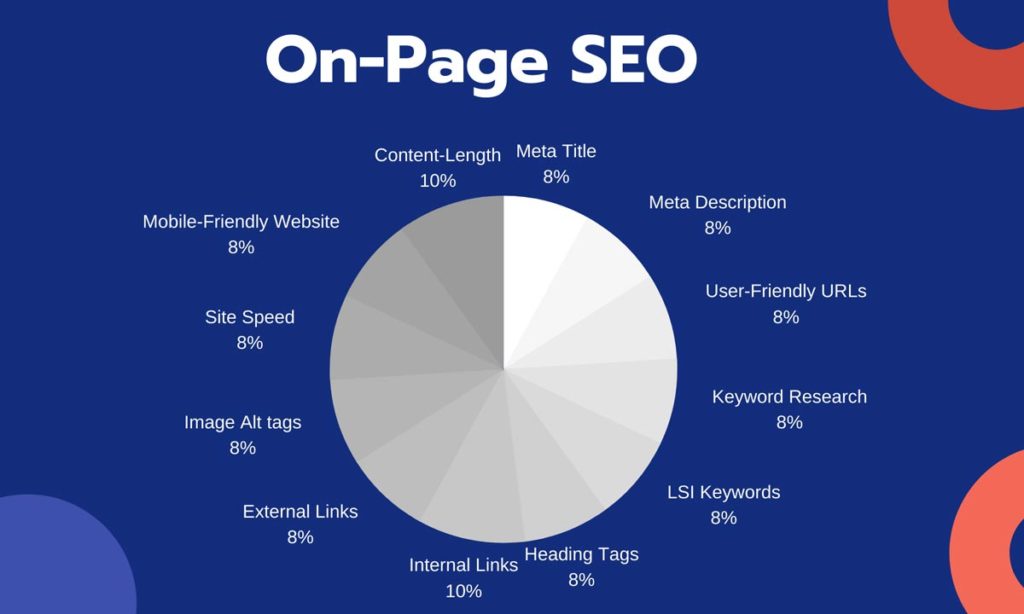
Beyond targeting specific keywords on each page, there are some broader on-page optimisation best practices to follow:
Internal Linking Structure
Linking relevant, keyword-rich anchor text between your pages helps Google better understand your content hierarchy and relationships.
An organised internal linking structure is a built-in roadmap for Google’s crawlers.
Image Optimisation
As mentioned, optimise all images with your target keyword in the file name, alt text and surrounding context.
You can also use descriptive captions and consider uploading an XML image sitemap to help Google discover all your images.
Schema Markup
Applying schema-structured data markup to your HTML can help you achieve rich snippet listings and enhanced visibility.
All content has schema types, including recipes, events, product data, reviews, and more.
Optimise For Search Intent
It’s not just about keywords; you must map your content to the user intent behind searches.
For example, searches with words like:
- “How” = Informational/Educational intent
- “Best” = Commercial investigation/Comparison intent
- “Where to buy” = Transactional intent
Customise your content and calls to action based on the primary search intent you’re targeting.
Monitor & Improve With Analytics
Optimising for higher rankings is an ongoing process, not a one-time thing. You’ll need to consistently:
- Monitor your positions in the Google Search Console
- Analyse engagement metrics in Google Analytics
- Identify areas for improvement based on user signals
Maybe your pages have a high bounce rate or low average time on the page. Or specific keywords aren’t getting any impressions or clicks at all.
Use this data to spot potential issues, test new optimisations, and iterate over time. The sites that put in continual work and evolve with searcher behaviour are the ones that maintain their rankings long-term.
Consider Paid Search Support.
While SEO should be the primary focus, remember to complement your organic efforts with paid search campaigns. PPC ads instantly put you at the top of results, driving an influx of targeted traffic.
For highly competitive terms where it’s difficult to rank organically right away, running paid search ads creates visibility and leads while your SEO ramps up.
Mobile-First Indexing & Page Experience

Google has moved to “mobile-first indexing” as mobile usage continues to grow. In this case, they crawl and index the mobile version of your site first.
Core Web Vitals
The new Page Experience algorithm update that Google released focuses on Core Web Vitals during the mobile-first transition, and these include:
- Loading performance (Largest Contentful Paint)
- Interactivity (First Input Delay)
- Visual stability (Cumulative Layout Shift)
Pages with low mobile usability deliver a poor user experience because they are slow and clunky to navigate.
However, optimising these page experience metrics goes beyond just being mobile-friendly.
Mobile Usability Guidelines
Here are some other guidelines for ensuring good mobile usability:
- Have enough space between tap targets so users don’t accidentally tap the wrong one.
- Use responsive design; avoid using pinch-zoom
- Optimise font sizes for legibility on mobile screens
- Avoid intrusive interstitials/popups, which can cover the main content or be hard to dismiss on smaller devices
More searches are happening on smartphones and tablets now than on desktop computers, so if you want your website ranked higher in Google search results, ensure it offers a seamless browsing experience across all platforms.
Answering the Modern Searcher: Advanced FAQ Strategy
The “People Also Ask” (PAA) section is a goldmine for capturing traffic from users who are still in the “exploration” phase. By mirroring the conversational language used in these accordions, you can appear multiple times on a single search page.
2026 Comparison Table: Choosing Your Visibility Path
| Feature | Organic Growth | Paid Search (PPC) | AI Overview Citation |
| Speed of Results | Slow (3-9 months) | Instant | Variable |
| Long-term Cost | Low (Compounding) | High (Pay-per-click) | Medium (Maintenance) |
| Trust Factor | Very High | Medium | High (Authoritative) |
| Best For | Brand Authority | Product Launches | Informational Queries |
Conclusion
As you can see, many interconnected tactics are involved in ranking higher on Google’s search results pages. It requires a multi-pronged, holistic approach with no natural shortcuts.
From building high-quality content optimised for target keywords to accumulating authority through high-quality backlinks to prioritising a flawless user experience – the top-ranking sites earn it.
Consistent effort over time is the key. It would help if you remembered your SEO. Top-ranking sites consistently publish fresh content, iterate on performance optimisations, and amplify their authority signals.
If you put in the hard work, over-deliver on quality and relevance at every opportunity, and diligently track and improve based on data, higher rankings and increased organic traffic will follow.
Stay committed to the process and keep searchers your #1 priority. Google will recognise and reward your efforts.
How to Rank Higher on Google (FAQs)
How do I know if my site is ready for AI-driven search?
Use the Google Search Console to check if your pages are being crawled effectively and ensure you have implemented Schema.org markup. The true test is whether your content provides a direct, cited answer to a complex conversational query.
Is “Interaction to Next Paint” (INP) more important than load speed?
In 2026, yes. While load speed (LCP) gets the user to the page, INP determines if they stay. High interaction delays are the leading cause of “bounce backs,” which signal to search engines that your page is not user-friendly.
Can I rank higher by using AI to write my content?
You can use tools like ChatGPT or Claude to assist, but “pure” AI content often lacks Information Gain. To rank, you must add human expertise, original data, or unique case studies that a machine cannot replicate.
How do I appear in the “Local Map Pack” for multiple cities?
You must have a physical presence or verified service area for each. Beyond your Google Business Profile, create localised “City Hubs” on your site that mention specific landmarks, local partners, and neighbourhood-specific news.
Does social media activity affect my search rankings?
Not directly as a “ranking factor,” but high social engagement drives brand searches and traffic. When more people search for your brand name on Google or YouTube, it signals massive authority, which indirectly boosts all your rankings.
Why did my rankings drop after a site update?
This is often due to “Crawl Errors” or broken internal links. Use Screaming Frog to audit your site for 404 errors and ensure your 301 redirects map old URLs to new, relevant ones.

