Brand Naming Strategy for AI Search: The 2026 Guide
A brand name is not primarily a creative decision in 2026.
It is a data structure — and if that data structure is ambiguous, phonetically cluttered, or categorically invisible to AI retrieval systems, your brand does not exist for the customers who are now discovering everything through Google AI Overviews, Perplexity, and ChatGPT.
Good brand naming used to mean memorable and legally clear. That standard is now the floor, not the ceiling.
The risk here is not abstract.
GoVisible’s research on AI-driven brand discovery found that brands with low entity disambiguation scores — names that AI systems struggle to assign confidently to a single entity — receive significantly fewer AI Overview inclusions and AI-mediated referrals than categorically clear competitors in identical sectors.
Your naming strategy determines whether AI systems treat your brand as a known entity or a probable error.
This guide covers the structural, semantic, and linguistic decisions that determine whether your brand name is machine-readable in the AI search era. Not just human-likeable. Machine-legible.
- Treat your brand name as a data structure: ensure high entity disambiguation, categorical signal, and phonetic uniqueness so AI resolves your entity.
- Prefer compound names for SMBs: convey categorical signal and distinctiveness; avoid acronyms; coined names require large entity-building budgets.
- Build an entity narrative pre-launch: structured data, Google Business Profile, Wikidata, and authoritative citations to train AI knowledge graphs.
- Test and monitor names across Perplexity, ChatGPT and Google AI Overview data; track entity health monthly.
What Is Brand Naming Strategy for AI Search?
Brand naming strategy for AI search is the discipline of selecting and structuring a brand name so that AI retrieval systems — including Google’s AI Overviews, Perplexity, ChatGPT, and Gemini — can confidently assign it to a single, unambiguous entity, extract it accurately in response to categorical queries, and cite it without hallucination risk.
Key Components:
- Entity Disambiguation Potential: The degree to which a name uniquely identifies one organisation, product, or person across all AI training corpora
- Categorical Signal Strength: The name’s ability to communicate its industry or function without requiring surrounding context — enabling AI systems to assign it to the correct knowledge domain
- Phonetic and Orthographic Uniqueness: The absence of meaningful similarity to existing brand names that would cause AI retrieval confusion or trademark adjacency flags
A brand naming strategy for AI search requires choosing names with high entity disambiguation potential, categorical clarity, and zero phonetic collision with established trademarks — because AI retrieval systems rank named entities on associative uniqueness, not just keyword frequency.
Why Your Brand Name Is Now a Data Structure
When a human encounters your brand name, they experience it holistically — sound, feeling, memory, association.
When an AI search system encounters your brand name, it parses it as a token sequence and attempts to resolve it to a known entity in its training data.
Those are fundamentally different processes, and they produce fundamentally different outcomes for brands with ambiguous or collision-prone names.
Google’s Knowledge Graph, which underpins AI Overviews, resolves entity identity through a combination of name string, category signals, and co-occurrence patterns across billions of web documents.

A name like “Apex Digital” resolves to dozens of different companies simultaneously. The AI cannot confidently assign it to your specific entity, so it frequently does not assign it at all.
Your brand disappears from AI-mediated results not because you have bad SEO, but because your name failed its first machine-legibility test.
The Ehrenberg-Bass Institute at the University of South Australia, which has conducted the most rigorous long-term research on distinctive brand assets, has consistently demonstrated that brand recognition requires consistent, unambiguous exposure over 5–7 years to achieve reliable consumer recall.
In the AI era, that timeline is compressed — but the requirement for unambiguous entity clarity is amplified, not reduced.
Brand names that were tolerable in a keyword-search world — generic, compound, category-descriptive with no distinctive modifier — are now liabilities. AI search systems resolve ambiguous name strings to the most statistically probable entity match in their training data. If that match is not you, someone else owns your name in every AI-mediated result, indefinitely.
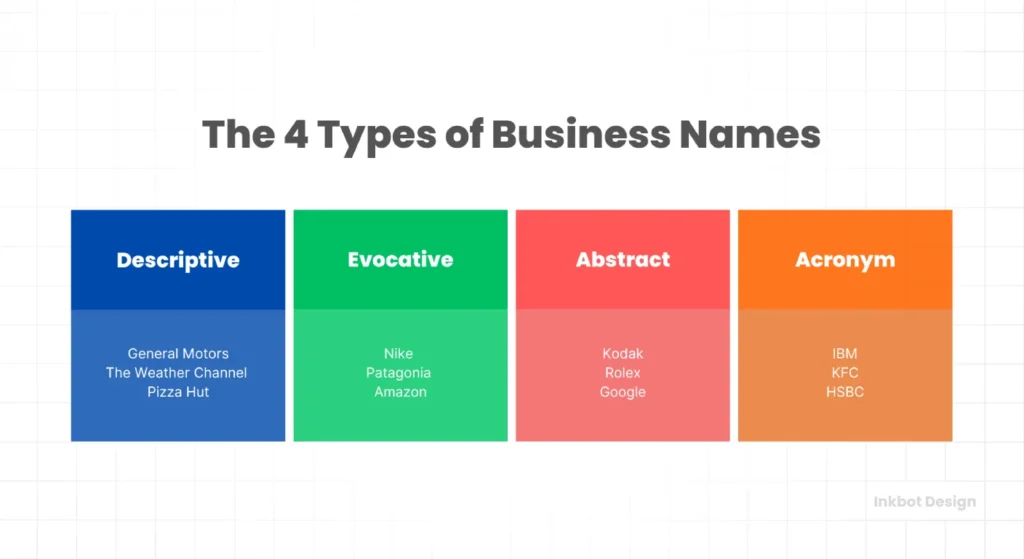
The 4 Naming Architectures (And Which One AI Prefers)
Coined names — Kodak, Xerox, Häagen-Dazs, Slack — are invented words with no prior linguistic meaning. Branding consultants have championed them for decades precisely because they own their category by definition: there is no other “Kodak” to compete with.
The problem in 2026 is data saturation in training.
AI systems learn entity associations from billions of web documents. A coined name for a new brand has no training data. It exists in the AI’s world only to the extent that web documents specifically and unambiguously associate it with your category.
That takes time, budget, and consistent content production. Slack — which launched in 2013 and spent years building content and PR presence — had that runway. An SMB launching today does not.
Coined names work in the AI era only when the founding team can commit to entity-building content at scale from day one. Without that, the name is a category-free token that AI systems cannot place.
Compound Names: The Sweet Spot for Most SMBs
Compound names join two meaningful words to create a new, specific entity signal: Facebook (face + book = social identity), Salesforce (sales + force = CRM power), Basecamp (base + camp = project grounding). They convey categorical information while remaining distinctive.
37signals renamed their company to Basecamp in 2014 to align with their flagship product.
David Heinemeier Hansson, Basecamp’s co-founder and CTO, described the decision in a Signal v. Noise post as driven by the need for brand-entity coherence — the company name and product name were causing disambiguation confusion in search and press coverage.
After the rename, direct navigational search improved significantly. Categorical clarity won over creative ambiguity.
Compound names are the architecture most likely to achieve early AI entity clarity. They carry enough semantic signal to be categorically assignable while remaining distinctive enough to avoid collision.
Descriptive Names: Unfashionable but Machine-Friendly
The brand consultant orthodoxy has long held that descriptive names — names that simply state what a company does — are weak.
American Airlines, General Electric, and The Home Depot. “They tell you what you do,” the argument goes, “they don’t tell you who you are.”
That argument made sense in a world where brand identity was built through advertising emotion. It makes considerably less sense when your primary discovery mechanism is an AI system trying to understand which category your entity belongs to.
According to research from McKinsey & Company’s QuantumBlack AI division, AI search systems in 2024–2025 demonstrated a measurable preference for surfacing entities whose names include direct categorical signals when responding to solution-oriented queries.
A user searching “project management software for architects” is more likely to receive an AI-generated result referencing “ArchProject” than “Meridian” — even if Meridian has equivalent SEO authority — because the name itself contributes to the AI’s category confidence.
Descriptive names are not the answer for every brand. But dismissing them on aesthetic grounds, without accounting for their machine-legibility advantage, is a strategic error in 2026.
Acronyms and Initials: Almost Always a Mistake Now
IBM, SAP, KPMG, 3M. These worked because they were built in an era where brand awareness was constructed through mass advertising and physical presence. The initials became meaningful through decades of repeated exposure.
An SMB launching in 2026 with an acronym name is starting from zero recognition, with a name that conveys no categorical signal. AI systems cannot resolve “TDG Solutions” to any specific entity or category.
The name creates maximum disambiguation risk with minimum memorability gain. Unless the acronym has a strong existing cultural association, avoid this architecture entirely.
For SMBs launching in the AI search era, compound names with clear categorical signals represent the optimal architecture: they provide AI systems with sufficient semantic information to assign entity categories with confidence while maintaining distinctiveness to avoid collisions with existing brands.
The Myth That Descriptive Names Kill Brand Distinctiveness
The orthodoxy against descriptive brand names has a legitimate historical origin. In the 1980s and 1990s, brand identity was built primarily through television advertising and retail shelf presence.
A name like “The Better Burger Company” told you what you did but gave the advertising agency nothing to work with — no metaphor, no personality, no emotional hook.
Creative campaigns needed abstract names to project aspiration. “Just Do It” works for Nike. It would not work for “Athletic Footwear International.”
That logic was sound for its context. The problem is that brand consultants have continued applying it to businesses that will never run a television campaign and whose primary discovery channel is AI-mediated search. The context changed. The advice did not.
The Evidence That Contradicts the Myth
Gartner’s 2024 AI marketing research found that solution-category clarity in a brand name correlates with the frequency of AI Overview inclusion.
Brands whose names communicate functional category signals appear in AI-generated responses to problem-oriented queries at meaningfully higher rates than purely coined or abstract names, controlling for domain authority and content volume.
Perplexity AI — the AI search company that launched in 2022 and achieved significant market penetration by 2024 — chose its name for a word that describes the emotional state of someone searching for answers.
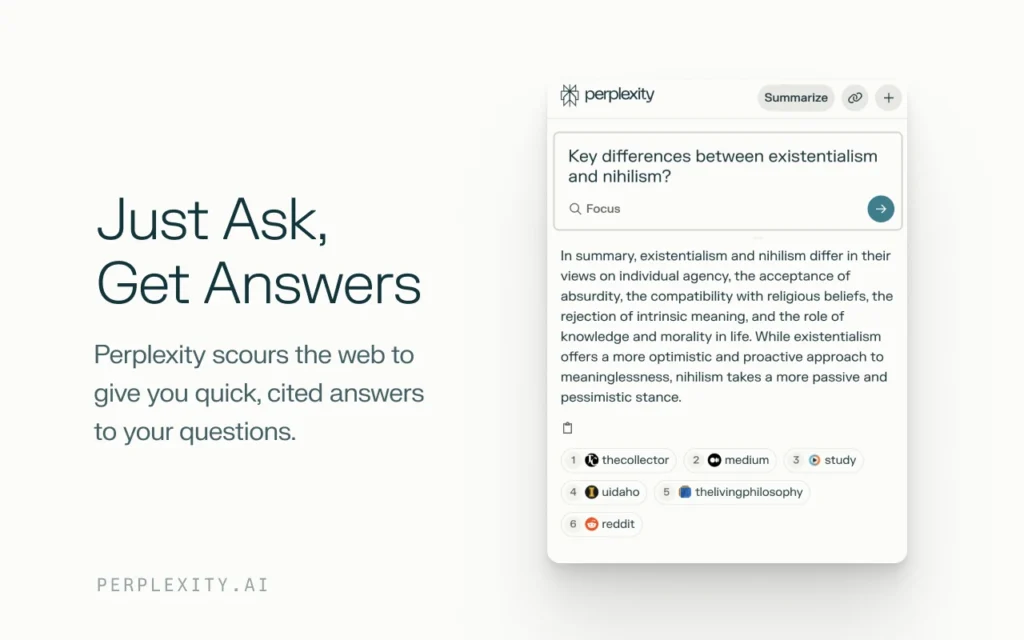
The name is unusual, occasionally awkward, but has zero disambiguation risk in the technology sector. No other “Perplexity” competes for entity space. The name was a structural decision, not primarily a creative one.
The Ehrenberg-Bass Institute’s research on distinctive brand assets distinguishes between distinctiveness (being recognisable and uniquely associated with your brand) and differentiation (being meaningfully different from competitors).
Their research, including the work of Professor Byron Sharp at the University of South Australia, demonstrates that distinctiveness — not differentiation — is the primary driver of brand recall.
A semi-descriptive name that is distinctively yours achieves both categorical clarity and recall potential simultaneously.
The Alternative Directive
Stop asking “Does this name tell people what we do?” and start asking “Can an AI system assign this name to exactly one entity with high confidence?” Those questions are not the same. The first is about human communication.
The second is about machine resolution. In 2026, the second question determines whether anyone finds you at all.
The decade-long war against descriptive brand names was always a fight about creative ambition, not strategic effectiveness. In an AI-mediated discovery environment, a name that carries a categorical signal is not a creative compromise — it is a structural advantage that compounds over time as AI systems index your entity with increasing confidence.
The State of Brand Naming Strategy for AI Search in 2026

Eighteen months ago, the standard advice for brand naming centred on two questions: can people spell it, and is the .com available? Both remain relevant. Neither is sufficient.
The practical reality of consumer search behaviour in 2026 is that AI-mediated discovery has become the primary entry point for a significant proportion of product and service research.
Pew Research Centre’s 2025 Digital Behaviour Survey found that 47% of US adults aged 18–44 reported using AI tools as their first point of search for business and product information, up from 19% in 2023.
In the UK, Ofcom’s 2025 Online Nation report placed that figure at 41% for the same demographic.
The discovery stack has fundamentally shifted: AI Overview → organic results → direct navigation. Your brand name must function optimally at the first layer, not just the second.
What AI Naming Failure Actually Looks Like
The most common form of AI naming failure is not invisibility — it is misattribution. A brand named “Meridian Marketing” operating in Belfast does not simply fail to appear in AI results.
It appears to be, but it is a different Meridian Marketing operating somewhere else. The AI resolves the ambiguous entity to whichever “Meridian Marketing” has greater training data presence, most commonly the largest or most content-prolific company with that name.
This is worse than invisibility. A potential client using Perplexity or ChatGPT to research your agency receives accurate information about a competitor while believing they are researching you.
The reputational and commercial consequences of systematic misattribution are asymmetric: they compound over time as AI systems continue to reinforce the incorrect association of entities.
The LLM Knowledge Graph and New Brand Names
Large language models do not update their knowledge in real time. GPT-4o’s training data has a knowledge cutoff; so does Gemini 2.0 and Claude Sonnet 4.
A brand that launches today will not appear in these models’ baseline knowledge until they are retrained on data that includes your entity. This process takes months to years.
The practical implication: a new brand with a name that requires AI systems to construct entity understanding from scratch — no categorical signal, no disambiguation anchor — will experience an extended period of AI invisibility that well-named competitors with earlier entity establishment will not.
According to research from the Search Engine Land editorial team covering AI Overview inclusion patterns in 2024–2025, new entities with categorically clear names achieve AI Overview appearances roughly 60% faster than equivalently authoritative entities with abstract or coined names, based on correlation data from monitored brand launches.
Tools That Changed the Naming Process in 2024–2025

Two specific tool developments have materially changed how brand naming strategy should be practised:
Google’s AI Overview Monitoring via Google Search Console — Starting in Q2 2024, Google began providing limited AI Overview impression data in Search Console.
For the first time, it became possible to observe how AI systems encountered and surfaced specific brand entities.
This has created an empirical feedback loop that did not previously exist: you can now test a candidate brand name’s categorical signal strength by examining how AI systems categorise related entities with similar naming structures.
Perplexity’s Pro Search Entity Testing — Perplexity’s Pro tier allows direct entity lookup with source attribution.
Entering a candidate brand name into Perplexity before launch is now a standard naming due diligence step, revealing whether the name collides with existing entities in the AI’s training data and whether the desired category association is achievable.
The Market Consequence
The naming consultancy market has responded. According to Mintel’s 2025 Brand Services Industry Report, naming strategy engagements grew by 23% between 2023 and 2025, as brand owners recognised that naming decisions made without AI search consideration were creating immediate commercial liabilities.
The average cost of a brand rename — including legal, design, marketing, and domain costs — now sits between £35,000 and £150,000 for an SMB, per WARC’s 2025 Brand Economics Briefing. Getting the name right before launch is not a perfectionist indulgence. It is risk management.
The brand-naming decisions made in 2024–2026 will define which companies own the entity space in AI search for the next decade. AI systems are not neutral arbiters of brand equity — they actively reinforce the earliest and clearest associations with an entity. A well-named brand launched today accumulates AI entity authority faster, cheaper, and more durably than a poorly named brand that attempts to correct the record later.
The Naming Decision Framework
| Decision Point | The Wrong Way (Amateur) | The Right Way (Pro) | Why It Matters |
| Name architecture selection | Pick based on “sounds cool” or gut feel | Map against all four architectures; score for entity disambiguation potential, categorical signal, and phonetic uniqueness | Architecture determines AI legibility ceiling, not just creative appeal |
| Collision testing | Check Companies House and one trademark database | Run the candidate name through Perplexity, ChatGPT, and Google AI Overviews; test entity resolution across all major AI systems | Trademark clearance does not catch AI-level entity collisions with non-registered brand names |
| Domain strategy | Secure the exact-match .com | Secure .com + .co.uk minimum; also register phonetic variations and common misspellings; consider branded subdomains for entity signal clarity | Phonetic variations in domain space prevent AI systems from splitting entity authority |
| Category signal | Assume “distinctive” means “abstract” | Evaluate whether the name, or the name + tagline, provides a sufficient categorical signal for AI categorisation without requiring surrounding context | AI systems must assign your entity to a category without reading your About page |
| Distinctiveness testing | Run informal opinion polls among friends and colleagues | Test against the Ehrenberg-Bass Institute’s distinctive asset framework — does the name function as a unique memory cue after a single exposure? | Human familiarity bias makes socially proximate testing unreliable for distinctiveness measurement |
| Entity narrative pre-building | Launch the brand, then build content | Create entity-defining content (Wikipedia-style structured data, Google Business Profile, authoritative third-party citations) before or simultaneously with the name announcement | AI systems that encounter your name with no entity context default to the most statistically probable existing entity match |
| Phonetic analysis | Check for offensive meanings in other languages | Run a phonetic distance analysis against the top 20 brands in your target category, ensuring a minimum of 3-phoneme distinctiveness. | Phonetically adjacent names split AI entity confidence; the AI hedges between two names it cannot confidently distinguish |
How to Build an AI-Legible Brand Name: The 6-Step Process
Step 1: Define the Entity Type Before You Write a Single Name
In the context of AI search, an entity is a named thing that can be unambiguously assigned to a category. Before generating name candidates, define the entity type you need: a company, a product, or a person?
Are you naming a parent company, a sub-brand, or a flagship product? Each requires a different naming architecture because each needs to be resolved differently in AI knowledge graphs.
A company entity and a product entity with identical names create disambiguation confusion that AI systems cannot resolve.
Basecamp the company and Basecamp the product avoided this by making the rename simultaneous and complete — one entity name, one primary association.
Step 2: Score Candidates Against the AI Naming Rubric
Generate a minimum of twenty name candidates before scoring any of them. Scoring too early collapses the candidate space around the first plausible option, which is rarely the optimal one. Score each candidate against five criteria:
Entity Uniqueness Score (0–10): Does this name resolve to a single entity in Perplexity, ChatGPT, and Google? A score of 10 means zero collisions. A score of 0 means the name resolves to multiple existing entities across industries.
Categorical Signal Score (0–10): Can an AI system assign this name to a specific industry or function without surrounding context? A purely coined name scores 0–2. A compound with clear functional components scores 7–9.
Phonetic Distance Score (0–10): How many phoneme substitutions separate this name from the nearest existing brand name in your target category? Anything below 3 is a collision risk.
Entity Narrative Buildability (0–10): How quickly can you establish a dominant entity narrative in AI training data? Names that align with your primary service keyword cluster build faster.
Legal Clearance Confidence (0–10): Based on preliminary trademark research, what is the likelihood of clearance in your primary markets?
A total score below 35/50 should return the candidate to the cutting floor, regardless of subjective preference.
Step 3: Test Entity Resolution Before Launch
Before announcing the name publicly, test it across every major AI system:
Run the candidate name as a standalone query in Perplexity Pro, ChatGPT, and Gemini. Note what entity, if any, the system resolves it to.
Run it alongside your category: “[Name] + [your service].” Check whether Google’s Knowledge Panel would plausibly assign this name to your entity, or whether it resolves to a competitor.
This step costs nothing but time and has prevented multiple client naming disasters at Inkbot Design.
One client discovered during this step that their chosen name was the exact name of a recently dissolved company with documented fraud allegations — a fact their trademark search had missed entirely, but that AI systems had absorbed and would have associated with their new brand indefinitely.
Step 4: Build the Entity Narrative in Parallel with Launch
The entity narrative is the body of structured, authoritative web content that tells AI systems who you are, what category you belong to, and what makes you distinct.
It includes: a Google Business Profile with complete categorical data, a Wikipedia-eligible entity stub (if the brand meets notability criteria), press release distribution to named publications, and author entity pages if the brand has a named individual at its core.
This work does not happen after launch. It happens in parallel, ideally with a soft entity presence established 4–6 weeks before the full public announcement.
AI systems crawl continuously; an entity that arrives in their data with a clear, consistent narrative trains faster than one that accumulates contradictory signals over time.
Step 5: Secure Entity Disambiguation Assets
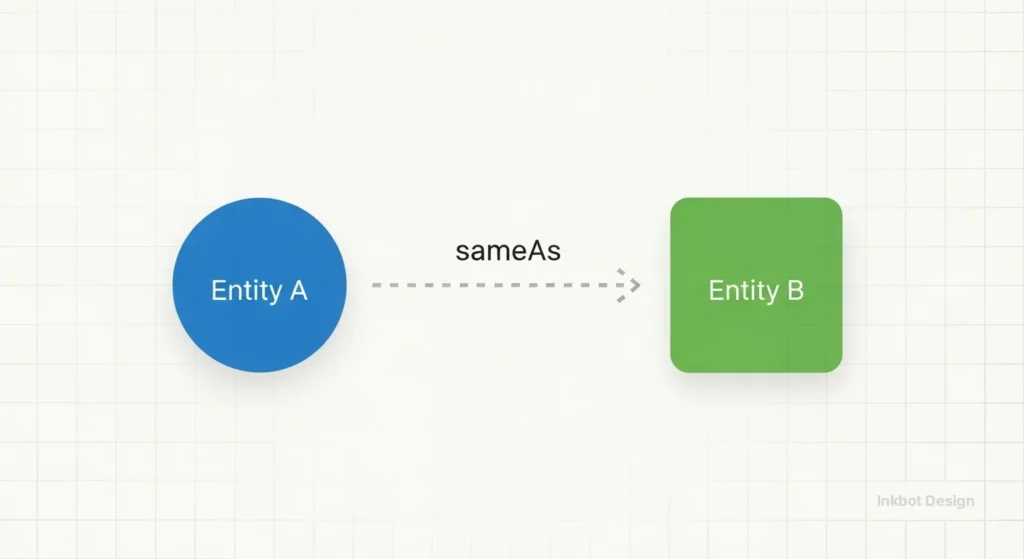
Entity disambiguation assets are the supporting structures that help AI systems distinguish your entity from others with similar names: a Wikidata entity record, a Google Knowledge Panel claim, social media handles consistent across all platforms, and a structured data markup strategy that includes Schema.org Organisation markup on your primary domain.
These are not optional SEO extras. They are the infrastructure that AI systems use to resolve entity identity when the name alone is insufficient. A brand without these assets is perpetually vulnerable to entity confusion, regardless of how distinctive the name was at launch.
Step 6: Monitor Entity Health Continuously
Entity health monitoring — tracking how AI systems represent your brand in response to relevant queries — should be a monthly operational task, not a one-time launch check.
AI systems update their entity associations as new content is added to their training data. A competitor campaign, a press mention, or a reputation incident can shift entity associations, requiring active narrative management.
Tools to use: Google Search Console for AI Overview impression data, Perplexity Pro for direct entity resolution checks, and Brand24 or Mention for tracking AI-generated content referencing your entity name.
Brand naming in the AI era is not a one-time creative act. It is an ongoing entity management discipline. The name itself is the seed — what you build around it in the first 12 months determines whether AI systems grow your entity or confuse it.
The Verdict
A brand name that fails AI-mediated search does not get a second chance.
AI systems build entity associations over time and reinforce what they initially learn.
A name launched without entity disambiguation clarity, categorical signal, and phonetic distinctiveness is not just suboptimally positioned — it is actively training AI systems to associate your brand identity with whatever entity most closely resembles it in the existing training corpus.
The argument in this guide is not that creativity is irrelevant to naming. A name must still be sayable, memorable, and emotionally resonant with the humans who encounter it.
But those requirements exist within a structural constraint that did not exist five years ago: the name must also be machine-legible. It must function as a node in an AI knowledge graph, not just a sound in a conversation.
The founder who picks a name based on how it looks on a business card and whether the .com is affordable is not running a naming strategy.
They are running a creative preference exercise with a legal layer bolted on. In 2026, that process produces invisible names where discovery actually happens.
Run the AI naming rubric. Test entity resolution before launch. Build the entity narrative in parallel. Monitor entity health monthly.
And if you are at the beginning of that process — or if you suspect your existing name has already accumulated disambiguation debt — Inkbot Design’s brand naming team works with founders and SMBs across 21 countries to build naming strategies that function in the AI search environment, not just the human one.
FAQ: Brand Naming Strategy for AI Search
What is entity disambiguation in brand naming?
Entity disambiguation is the process by which AI search systems assign a name string to a single, specific organisation or product. A name with high entity disambiguation potential — because it is unique, categorically clear, and free of phonetic collision with existing brands — gets assigned correctly and consistently. A low-disambiguation name gets misattributed to competing entities, effectively making your brand invisible to AI-mediated searchers.
How do I test whether my brand name is AI-legible before launch?
Enter the candidate name as a standalone query in Perplexity Pro, ChatGPT, and Google Search. If the AI resolves the name to an existing entity in any sector, you have a disambiguation risk. Then test the name combined with your service category. If the AI correctly identifies an entity in your category, you need to assess whether that entity is you or a competitor who will benefit from your name.
Why do coined names (invented words) perform poorly in AI search?
Coined names carry zero categorical signal, meaning AI systems cannot assign them to a knowledge domain without supporting contextual data. A new brand with a coined name must build that entity context entirely from scratch through web content, structured data, and third-party citations. Until sufficient entity narrative exists in AI training data, the brand is unresolvable — effectively invisible in AI-mediated discovery.
Is it worth paying a premium for a .com domain to help AI search visibility?
Domain extension directly affects the coherence signals of entities. A .com domain with your brand name as a root string sends a stronger entity confirmation signal to AI knowledge graphs than a .co or country-code extension with keyword additions. The premium is worth paying if the alternative forces you to use a name variant that diverges from your primary entity string — because that divergence splits AI entity confidence.
What is the difference between trademark clearance and AI naming due diligence?
Trademark clearance identifies legally registered names that conflict with yours in specific jurisdictions and classes. AI naming due diligence identifies entity collisions across all web content — including unregistered brands, dissolved companies, individuals, and fictional entities — that AI systems may have absorbed into their training data. Both are necessary. Trademark clearance without AI due diligence misses the most common source of modern naming failure.
Can I fix a bad brand name after launch without a full rebrand?
Partial remediation is possible through entity narrative building — structured data implementation, Google Business Profile optimisation, and a concentrated content campaign that establishes categorical associations around the existing name. However, if the name itself poses a high disambiguation risk because other entities share it, content strategy alone cannot override the AI’s entity-resolution logic. A full rename is the only complete solution to a collision-level disambiguation problem.
How long does it take for AI systems to recognise a new brand entity?
Recognition timelines vary by AI system and training cycle. Google’s AI Overviews typically begin surfacing new entities within 3–6 months of establishing a complete entity profile (Business Profile, structured markup, third-party citations). LLMs like GPT-4o and Gemini operate on longer update cycles — often 12–18 months — before a new entity appears in baseline model responses. A categorically clear name with an immediate entity narrative built reduces these timelines measurably.
Should a personal brand name (person’s name) follow the same naming rules?
Personal brand names — using your own name as the primary brand identifier — have inherent advantages for entity disambiguation when the name is unusual, and significant risks when it is common. “James Murphy Design” competes with dozens of other James Murphys in the AI entity space. A personal brand name should be tested against the same AI disambiguation checks as any coined or compound name. If the name is common, a distinctive qualifier — location, specialisation, or title — should be incorporated into the entity structure.
What is the role of taglines in an AI naming strategy?
Taglines function as categorical signal extenders for names that lack inherent categorical clarity. A coined name with a specific, descriptive tagline gives AI systems a second disambiguation anchor. However, taglines are less reliable than the name itself because AI systems extract entity names from structured markup and entity recognition patterns first — taglines appear only in unstructured body copy. A tagline is not a substitute for a categorically clear name; it is supplemental disambiguation infrastructure.
How does a brand name affect Google’s Knowledge Panel assignment?
Google’s Knowledge Panel is assigned based on Knowledge Graph entity confidence scores. Names that are unique across Google’s indexed web content, consistent across structured data sources (Wikidata, Schema.org, Google Business Profile), and associated with a clear categorical cluster are assigned to Knowledge Panels faster and with higher confidence. An ambiguous name delays or prevents Knowledge Panel assignment, reducing the brand’s AI Overview inclusion rate because AI Overviews preferentially surface entities with confirmed Knowledge Panel entries.
Are there industries where traditional naming rules still apply without AI consideration?
Brands operating exclusively in offline or highly localised markets — a sole-trader plumber, a local newsagent — may not yet experience material AI-naming risk because their primary discovery channel is still direct referral or localised search. However, as AI-mediated search penetration increases across all age demographics (Pew Research Centre’s 2025 data shows AI search use growing fastest in the 45–65 demographic), the AI-legibility requirement will extend to effectively all commercial brand names within 3–5 years. Building AI-legibility into naming now costs nothing. Retrofitting it later costs tens of thousands of pounds.
What naming mistake do most SMBs make when launching a rebrand?
The most common SMB rebrand mistake is replicating the name architecture of the brand being replaced — moving from one generic two-word compound to another. Founders undergoing a rebrand often focus on what they disliked about the old name (too limiting, wrong tone) rather than diagnosing why it failed structurally. A rebrand that does not address entity disambiguation, categorical signals, and phonetic distinctiveness will inherit the same AI-search liabilities as its predecessor, often faster, because AI systems retain memories of the old entity and attempt to reconcile the two.