Brand Messaging Hierarchy: What Every Division Can Change
A messaging hierarchy gives a complex B2B company rules for what stays consistent, what teams can adapt and which claims need evidence. Build the shared position first, translate the position for different buying roles, then assign ownership. The result is a usable decision system rather than another approved copy document.



On this page7 min left
- What does a brand messaging hierarchy govern?
- Foundation, implementation and supporting messages need different rules
- What must stay consistent across every practice?
- How should audience messages differ?
- Where do mission and expression belong?
- Build the message-control table before rewriting the website
- A worked example: two practices, one buying case
- Test a message across channels before extending the system
- Give partners room to adapt, with clear approval triggers
- Start with the contradiction buyers can already see
- Questions people ask
Your transaction advisory team and your outsourced finance team do not need the same pitch.
They do need agreement about what the business can promise.
A brand messaging hierarchy sets that boundary: shared positioning, audience-specific messages and supporting material, with rules for adaptation and evidence.
Gartner reported in 2025 that 69% of B2B buyers encountered inconsistencies between supplier websites and seller information.
That establishes a problem worth checking.
The finding does not establish that a messaging hierarchy improves conversion.
Within a broader verbal identity framework, the hierarchy governs the relationships among messages.
Brand voice and copywriting then turn those decisions into language people can use.
What does a brand messaging hierarchy govern?
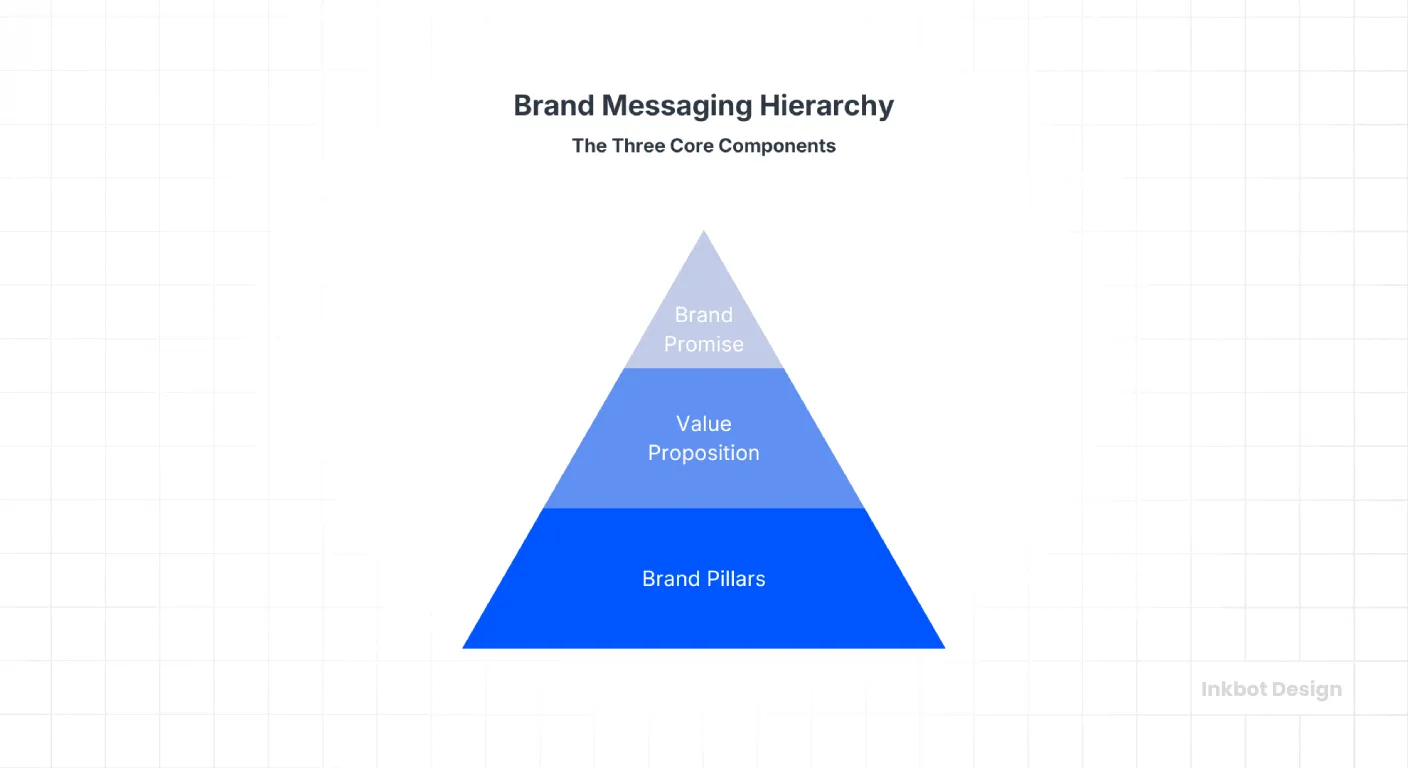
A brand messaging hierarchy defines which ideas apply across a business, how those ideas translate for different audiences and which supporting claims require evidence. For a multi-practice professional services business, the useful output is a message architecture with decision rules, rather than a list of approved sentences.
- Foundation messages establish positioning and value.
- Implementation messages adapt the emphasis for an audience or situation.
- Supporting material explains purpose, expression and relevant detail.
A brand messaging hierarchy organises shared positioning, audience-specific messages and supporting material, with clear rules for adaptation, evidence and approval across teams.
Foundation, implementation and supporting messages need different rules
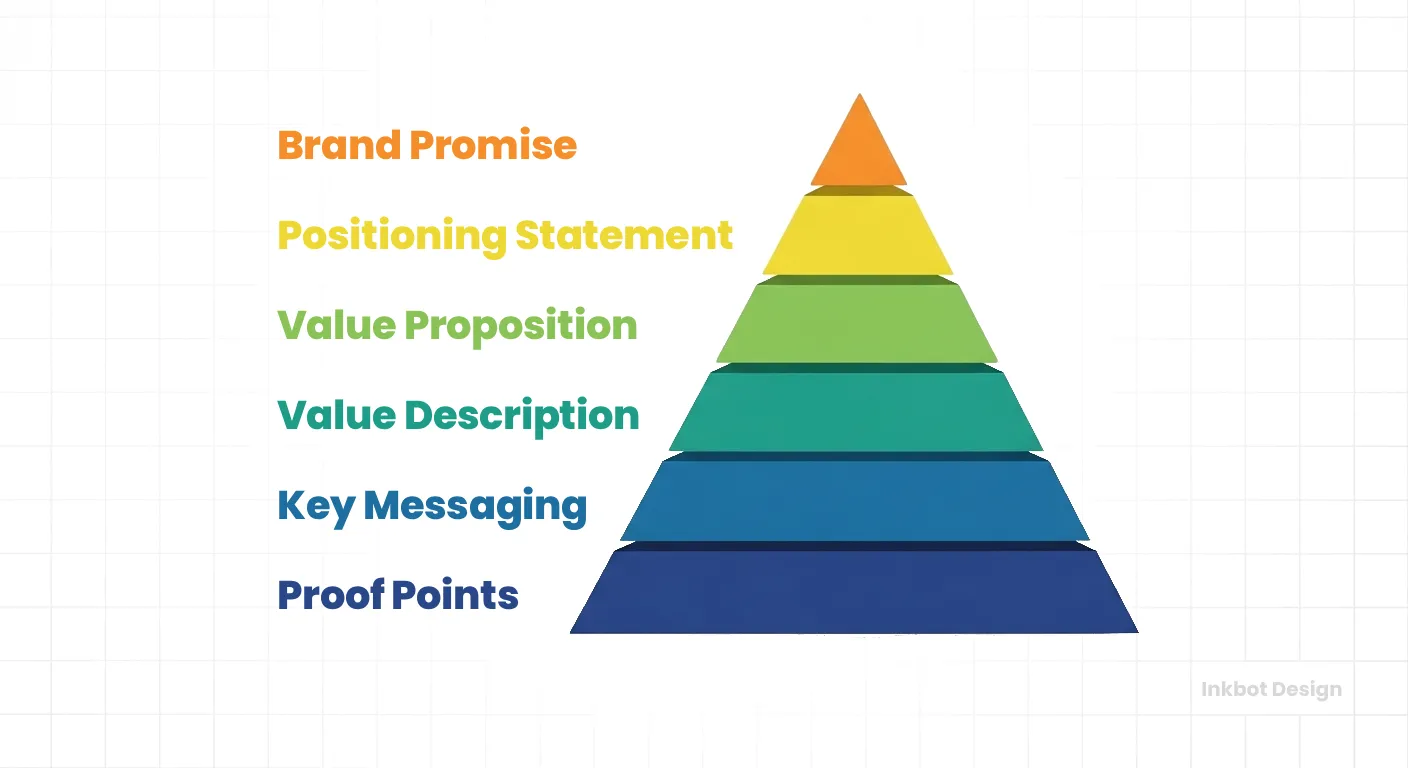
A pyramid is a useful way to show priority. A managing partner can see the central proposition above service details.
Keep that visual if it helps. Add the missing decisions beside it: who can change each message, what must remain true and what evidence limits the claim.
McKinsey & Company reports in its 2026 B2B research that buyers use an average of 10 channels across the purchasing journey, with inconsistent information among them being a leading driver of supplier switching.
That makes the relationship between claims a practical concern, beyond the order of copy on a single page.
What must stay consistent across every practice?
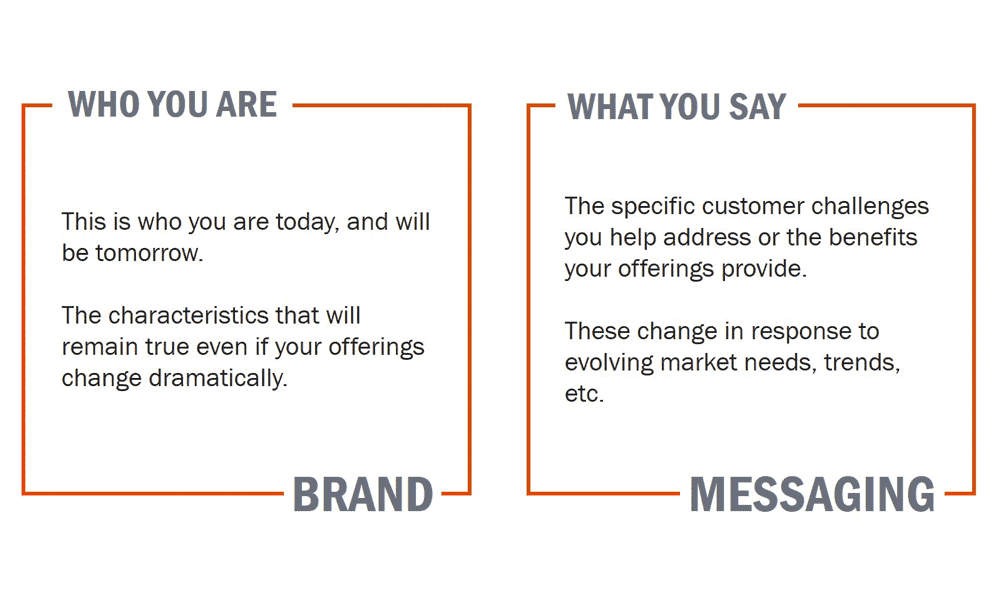
The foundation should record the business’s positioning and value proposition: the clients the business prioritises, the problem the business addresses and the reason a buyer should consider the business.
For a hypothetical transaction-focused accountancy practice, that might be:
“We help owner-managed businesses prepare for a sale by connecting financial preparation with transaction advice.”
That sentence makes choices. The audience is owner-managed businesses. The situation is preparation for a sale. The proposed value comes from connecting work that might otherwise be commissioned separately.
A tax partner can explain the tax implications. A corporate finance partner can discuss buyer scrutiny. Neither partner should quietly expand the proposition into a claim that the practice guarantees a successful exit.
The foundation fixes meaning. Exact wording can vary.
If leadership cannot agree on the target client or the work the business intends to win, pause the copywriting. A messaging document can record a positioning decision; a messaging document cannot decide on leadership’s behalf.
How should audience messages differ?
Implementation messages translate the shared proposition into an elevator pitch, a practice-area introduction, or an audience-specific explanation.
Give the finance director and founder different starting points into the same buying case. Do not promise “minimum disruption” to one and an unrestricted transformation programme to the other without explaining the trade-off.
Gartner’s 2025 survey found unhealthy conflict in 74% of B2B buying teams. Gartner also cautioned that individual-level relevance can create conflict within a buying group. Audience tailoring, therefore, requires a shared decision underlying the different messages.
For the hypothetical practice:
- Founder message: prepare the business for buyer scrutiny before entering a sale process.
- Finance director message: identify reporting gaps and agree who will address them before due diligence.
- Shared buying case: establish what preparation is needed, who owns the work, and what remains outside scope.
Personas belong here as working descriptions of decision roles and concerns. A fictional name and photograph add little if the document never explains what the finance director needs to approve.

Where do mission and expression belong?
Supporting material includes the mission statement, brand story and instructions for expression.
A mission can explain why the business exists. A brand tone of voice defines how the language changes between a board paper and a first conversation.
Neither substitutes for evidence.
If a service page promises a named partner throughout an engagement, the delivery model must support that promise. A paragraph about personal service cannot settle whether “throughout” includes every meeting, every deliverable or only escalation.
Keep proof beside the claim being supported. Evidence is a condition across the hierarchy, rather than the final decorative layer underneath it.
Build the message-control table before rewriting the website
Start with the material buyers already encounter: the homepage, principal service pages, recent proposals, pitch decks and standard capability statements.
For each recurring claim, record the wording and the implied promise. “Partner-led” and “partner-delivered” may look similar in a document. Ask the delivery team whether the two phrases describe the same service.
Gartner’s inconsistency finding provides a reason to compare channels; the table below is a proposed way to do so, not a research-validated intervention.
Use six fields.
Field | What to record | Example |
|---|---|---|
Shared meaning | The proposition the message must preserve | Prepare owner-managed businesses for a sale |
Audience application | The concern the message addresses | Reporting readiness for a finance director |
Permitted variation | What the writer may adapt | Opening example, terminology and emphasis |
Evidence and limits | Source, scope, permission and review date | Approved case covering financial preparation only |
Accountable owner | Who confirms the promise remains true | Head of transaction advisory |
Approval trigger | What requires a fresh decision | New service, outcome claim or delivery commitment |
Write a usable record, not “adapt as appropriate”. That phrase sends the decision straight back to the next writer.
A worked example: two practices, one buying case
Take a hypothetical 90-person accountancy business with transaction advisory and outsourced finance teams. Assume both teams contribute to sale-preparation engagements, but neither team can guarantee transaction timing or price.
The homepage says:
“Financial preparation and transaction advice for owner-managed businesses planning a sale.”
The outsourced finance page may emphasise reporting readiness. The transaction advisory proposal may explain preparation for buyer questions. Both messages preserve the same scope.
Now consider this proposed pitch line:
“We increase your sale value and complete the transaction faster.”
Reject that wording unless the business has evidence capable of supporting both claims, including the relevant conditions and limitations. Completing financial preparation does not, by itself, establish control over buyer behaviour or market timing.
A narrower line might be:
“We identify gaps in financial information before buyer due diligence begins.”
Approve that line only if the engagement actually includes that work. Specific wording still needs checking.
The distinction matters when a practice uses a case study from one successful engagement. Permission to describe that case does not automatically justify a general promise about every future client.
Test a message across channels before extending the system
Choose one proposition and trace the proposition through a homepage paragraph, a service page, a partner’s pitch and a proposal.
Ask whether a buyer would infer the same service, responsibility and limitation from each version. Different words are acceptable. Different promises require a decision.
Gartner’s March 2026 report found that 45% of surveyed B2B buyers used AI in a recent purchase. The survey covered 646 buyers and was conducted in August–September 2025.
The finding supports preparing explanations that remain understandable outside a direct sales conversation; the finding does not establish how any particular AI system will describe your business.
Give an unfamiliar colleague the four extracts without additional explanation. Ask the colleague to describe the service and its limits. Treat the answers as a diagnostic exercise, not a statistically representative test.
If the explanations conflict, identify the claim responsible before commissioning more copy.
Give partners room to adapt, with clear approval triggers
“Won’t this turn every partner into a corporate spokesperson?”
Only if the rules control every sentence, keep the restrictions on promises, evidence and scope. Let partners choose relevant examples and explain technical work in their own language.
Gartner’s buying-group findings support caution about independently tailored messages, rather than a requirement for identical scripts.
A shared decision can accommodate different concerns without giving each stakeholder a different account of the service.
“We haven’t got time for another approval process.”
Then avoid sending every wording change for approval.
Changing “business owners” to “founders” may be an editorial decision. Adding “guaranteed completion” changes the promise. Route the second change to whoever owns delivery and evidence.
Assign a central messaging owner to maintain the current document. Assign practice leaders responsibility for service accuracy. Give both roles a clear route for resolving disagreement.
Record where a withdrawn claim appeared. Updating the master document is insufficient if an old proposal template still contains the promise.
For an acquired practice, check whether the parent business genuinely shares the acquired team’s capabilities before adopting the acquired team’s claims across the group.
Where capabilities remain separate, make the distinction explicit.
Use brand language guardrails for recurring wording restrictions. Keep commercial approval decisions in the message record, where the reason for the restriction remains visible.
Start with the contradiction buyers can already see
The first deliverable should be a decision on one live contradiction.
Choose a service that appears on the website and in a recent proposal.
Place both descriptions next to the delivery team’s account of what clients receive. Decide which meaning the business can support, then update the relevant source material.
A marketing lead and practice head may be able to complete that work internally. External help becomes more useful when the disagreement concerns positioning, a merger or which clients the business intends to pursue.
If the gaps extend beyond wording, request Inkbot Design’s free Brand Equity Audit™, a written diagnostic covering positioning, messaging, visual presentation and digital visibility.
Start today by finding one claim the website and proposal describe differently.
Questions people ask
Do we need a full rebrand to fix our messaging?
No — a messaging hierarchy can be revised without changing the visual identity. Begin with the disputed claims and positioning decisions. Consider a wider rebrand when the intended audience, business structure or market position has changed enough that the existing identity no longer represents the business.
What is the difference between brand architecture and message architecture?
Brand architecture defines how corporate, service and subsidiary brands relate. Message architecture defines how propositions and claims relate. An acquired consultancy may retain a separate brand while sharing part of the parent’s corporate narrative. Settle that relationship before assuming one hierarchy should govern every message.
How often should we review the hierarchy?
Review the hierarchy when a service, delivery commitment, target audience or supporting evidence changes. Set an agreed review date for time-sensitive claims. A business launching new services frequently needs closer maintenance than a practice whose scope and evidence remain stable; a calendar review should not delay a necessary correction.
Can AI draft copy from the hierarchy?
Yes — AI can draft from approved messages, but the resulting copy still needs review. Supply the shared proposition, permitted variations, claim limits and evidence. Check for added guarantees, expanded capabilities or case-study results rewritten as general promises. Approval of the source document does not approve every generated sentence.