The 10 Best 1980s Logos and the Stories Behind Them
Forget the nostalgia. The standard view of the 1980s—all big hair, shoulder pads, and screeching synth-pop—misses the point.
Beneath the neon veneer, the 80s were a bare-knuckle battleground for brands. It was the decade where the modern corporation found its voice, and the logo became its primary weapon. This was the era of the challenger, the innovator, and the global behemoth.
We’re not here to admire old designs like museum pieces. We’re here to dissect them as the powerful business assets they were. Each of these logos solved a problem, told a story, or signalled a seismic shift in strategy.
This isn’t a history lesson for an entrepreneur or business owner today. It’s a masterclass in what works. These brutal, practical truths hidden in the logos defined a decade.
- 1980s logos were strategic tools solving business problems, not mere nostalgic style.
- Apple’s rainbow bite sold creativity and humanised technology, not just colour displays.
- MTV’s flexible logo became a living canvas, keeping the brand constantly fresh and relevant.
- Nike’s Jumpman embodied aspiration, turning a sub‑brand into a powerful cultural totem.
- Great logos answer a clear job: signal intent, be legible, authentic, and strategically focused.
1. Apple: The Rainbow Bite of Genius
The Context: Selling Colour in a Monochrome World
In the late 70s and early 80s, computers were beige, boring boxes for hobbyists and accountants. The Apple II was different. Its killer feature, revolutionary for a personal computer, was colour graphics. The company needed a mark that screamed this difference from a hundred paces.
The Design Breakdown: A Simple Shape with Complex Meaning
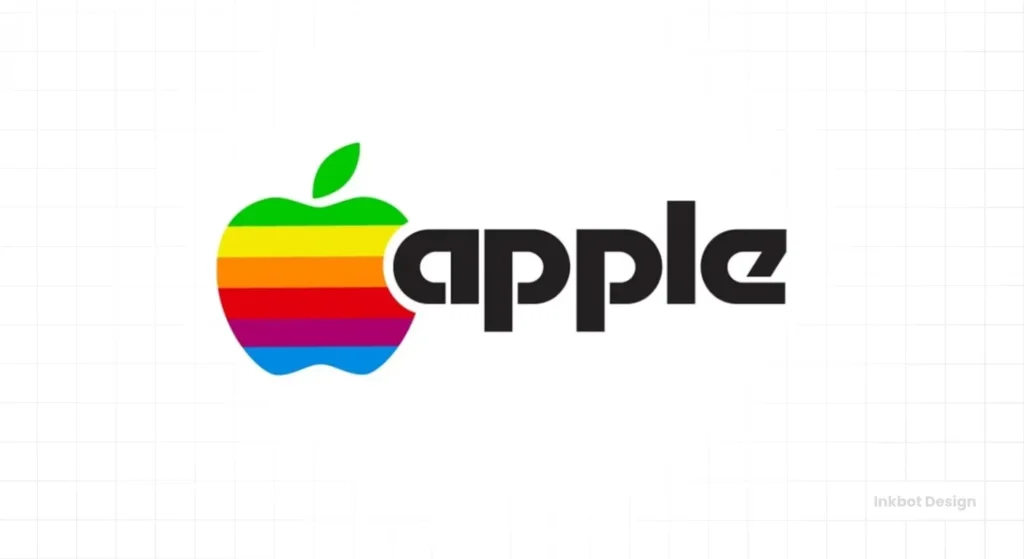
The logo, designed by Rob Janoff, was a simple apple silhouette with a bite taken out of it—rumoured to prevent confusion with a cherry tomato and to play on the “byte” pun. The masterstroke was the horizontal rainbow stripes, which directly represented the Apple II’s colour capabilities. Even then, the stripes were deliberately out of order, a subtle nod to Apple’s “Think Different” mantra.
The Genius: It Humanised Technology
The rainbow logo did a remarkable job of making a cold piece of technology feel warm, accessible, creative, and even a bit rebellious. It wasn’t for the corporate drones in their grey suits but for the artists, kids, and revolutionaries. It created a tribe.
The Brutal Takeaway
Your logo should sell the benefit, not the feature. Apple wasn’t selling a 6-colour display; it was selling creativity, individuality, and a new way of seeing the world. Ask yourself what feeling your service or product unlocks, and design for that.
2. MTV: The Logo That Couldn’t Sit Still
The Context: Inventing the Music Video
In 1981 a radical idea was born: a 24/7 television channel that played music videos. It was chaotic, irreverent, and aimed squarely at a youth culture that felt ignored by traditional media. The branding couldn’t be static; it had to feel as rebellious as the artists it featured.
The Design Breakdown: A Chunky’ M’ and a Spray-Painted’ TV’
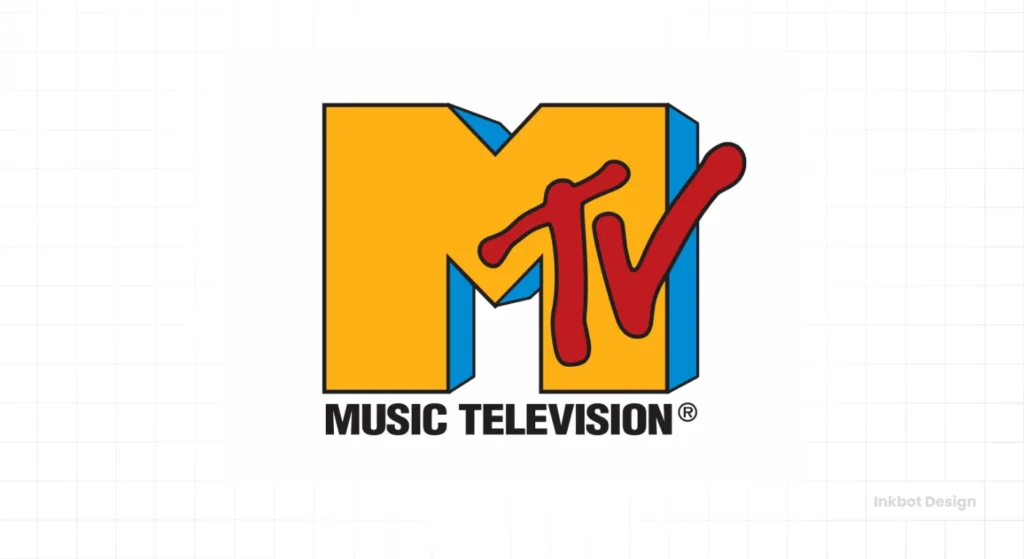
Designed by Manhattan Design, the core logo was a bold, blocky “M” with a graffiti-scrawled “TV” slapped onto it. It was simple, raw, and had an anti-corporate feel baked in.
The Genius: An Identity as a Stage, Not a Stamp
The true genius was the decision to make the logo a shapeshifter. The “M” could be made of brick, filled with static, or launched into space as a cow jumped over it. It was constantly changing, animated by countless artists and studios. The logo became the main attraction, a canvas for endless creativity.
The Brutal Takeaway
A rigid brand isn’t always a strong brand. Building flexibility into your identity allows it to stay relevant, surprising, and engaging. It signals a confidence that your brand is more than just a static mark; it’s a living idea. This level of strategic thinking is something we explore in every logo design project.
3. Nike Air Jordan “Jumpman”: The Man Becomes the Mark
The Context: A Rookie, a Risk, and a Revolution
In 1984, Nike took a massive gamble on a promising but unproven rookie basketball player named Michael Jordan. The “Air Jordan” line was born. After a few years of immense success, the brand needed a symbol as iconic as the man himself. Based on a photo of Jordan, the logo first appeared on the Air Jordan III in 1988.
The Design Breakdown: A Silhouette of Greatness
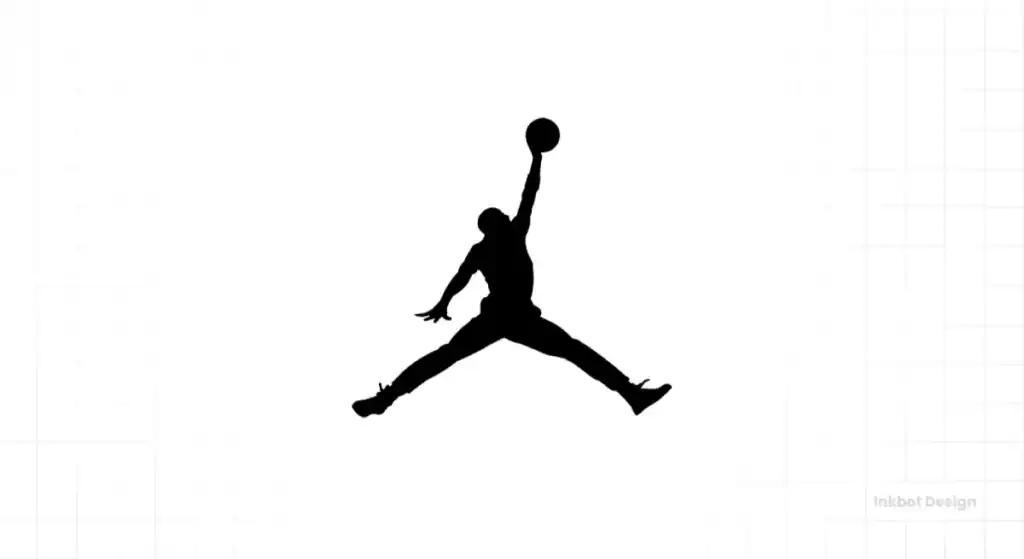
The “Jumpman” logo is a simple black silhouette of Michael Jordan leaping through the air for a dunk. There’s no face, no name, no uniform number. It’s pure, dynamic, athletic poetry captured in a single shape.
The Genius: It Captured an Aspiration, Not Just a Person
The logo doesn’t just represent Michael Jordan; it represents the idea of greatness. It’s the human desire to fly, achieve the impossible, and perform under pressure gracefully. People weren’t just buying shoes but a piece of that feeling.
The Brutal Takeaway
You can build an entire empire from a sub-brand if it’s anchored to a powerful enough story and hero. The Jumpman logo proves that the most resonant symbols tap into universal human aspirations. They transform a product into a totem.
4. Pepsi: The Choice of a New (and Louder) Generation
The Context: The Never-Ending Cola Wars
The 1980s were the peak of the Cola Wars. Coca-Cola was the established, classic incumbent. To compete, Pepsi had to be everything Coke wasn’t: young, exciting, modern, and loud. They were the brand of pop music (singing Michael Jackson, Madonna), and their logo had to reflect this.
The Design Breakdown: The Globe, Modernised
Throughout the 80s, Pepsi refined its globe logo. The design, often attributed to the in-house team, became sharper, cleaner, and was paired with a bold, proprietary typeface. The red and blue were vibrant, creating a high-energy mark that felt perfectly at home in a music video.
The Genius: It Positioned Pepsi as the Future
While Coke represented tradition and nostalgia, the Pepsi brand screamed “now.” The logo was a crisp, optimistic, and energetic badge for a generation defining itself against the past. It felt less like a 100-year-old corporation and more like a pop culture phenomenon.
The Brutal Takeaway
You can’t afford to be quiet or polite if you’re the challenger brand. Your identity must be a clear and aggressive statement of differentiation. Know who you are not, and build your visual language to attract the audience that the market leader is ignoring.
5. CNN: The Unblinking Eye of the News
The Context: The Audacious Idea of 24/7 News
Before 1980, news came in predictable doses: the morning paper and the evening broadcast. Ted Turner’s Cable News Network was a wild gamble on the idea that people wanted news, live, all the time. From day one, the brand needed to look credible, instant, and utterly reliable.
The Design Breakdown: A Continuous Red Line
The original monochrome logo is deceptively simple, quickly updated to its iconic red. The letters C-N-N are connected by a line running through their centre, suggesting a cable. It’s a monogram and visual metaphor for the business itself.
The Genius: It Visually Represents “Always On”
The connecting line is the key. It communicates connection, flow, and a constant, uninterrupted stream of information. It’s a direct promise of the service: we are your link to the world, and that link is never broken. For a new, unproven concept, this visual reassurance was critical.
The Brutal Takeaway
A great logo often explains the business model at a glance. It should answer “What do you do?” with an immediate, intuitive visual cue. The CNN logo isn’t just a name; it’s a promise of constant connection, a principle we champion at Inkbot Design.
6. NBC: Taming the Peacock
The Context: A Network Needing a Modern Edge
By the mid-80s, NBC’s branding was a mess. They had a stylised “N” that led to a lawsuit and an old, fussy 11-feathered peacock used to signify “in colour.” They needed a single, strong, modern mark to unify the brand and project leadership.
The Design Breakdown: 11 Feathers to 6, Perfectly Executed
The legendary firm Chermayeff & Geismar took on the challenge. Their 1986 solution was radical in its simplicity. They reduced the peacock to its absolute essence: a body created from negative space and six simple, teardrop feathers in the colours of the rainbow. Each feather represented one of the network’s six divisions.
The Genius: Subtraction as an Act of Strength
The new peacock was elegant, clever, and incredibly modern. They made the concept stronger by removing unnecessary details—the spindly legs, the detailed body, and the extra feathers. It was a confident move that showed the network was looking forward, not back.
The Brutal Takeaway
Rebranding successfully means having the courage to remove what’s unnecessary to reveal the powerful core idea. It’s not about adding more flair; it’s about disciplined subtraction. Most businesses are afraid to be this simple. Don’t be.
7. Miami Vice: Selling an Atmosphere
The Context: Redefining the Look of Television
Miami Vice wasn’t just another cop show but a cultural event. Premiering in 1984, it threw out the gritty, brown-and-grey rulebook of television. It replaced it with a world of pastels, Ferraris, and high fashion. The show’s “logo” had to capture this entire vibe.
The Design Breakdown: Neon, Pastels, and Art Deco Fonts
The title card, designed by C&C Graphics, used a distinctive Broadway-style Art Deco font for “Miami” and a script font for “Vice.” This was all drenched in the now-iconic pastel pinks and turquoise blues, often glowing with a neon effect. It didn’t look like a TV show title; it looked like the sign for the most fabulous nightclub in the world.
The Genius: The Logo Was the Product’s Vibe
This is a prime example of a brand identity that is the product’s core appeal. The show was selling a fantasy of 80s cool, and the logo was the front door to that fantasy. It was pure atmosphere, a perfect distillation of the show’s groundbreaking aesthetic.
The Brutal Takeaway
Sometimes your brand is the aesthetic. For lifestyle, entertainment, or fashion brands, the logo’s job is not to be a neutral container for the name but a concentrated dose of the feeling you’re selling.
8. AT&T: Saul Bass and the “Death Star”
The Context: The Breakup of a Behemoth
In 1984, the US government forced the breakup of AT&T’s telecommunications monopoly. The company, once known simply as “Ma Bell,” had to reinvent itself completely. It was no longer just the national phone company; it had to become a global player in a newly competitive world. They hired the master, Saul Bass, to signal this change.
The Design Breakdown: A Sphere Wrapped in Lines
Bass’s solution was a sphere, representing the globe. It was striated with lines of varying thickness, suggesting electronic communication wrapping the planet. It was simple, futuristic, and powerful. Its imposing, monolithic nature quickly earned it the nickname the “Death Star.”
The Genius: Signalling a Global Future, Not a National Past
The old bell logo was nostalgic and distinctly American. The new globe was forward-looking and international. Straightforwardly, AT&T communicated its new mission: to be a leader in the global information age. It was a visual declaration of intent.
The Brutal Takeaway
When your business undergoes a fundamental change, your logo must be the most precise and immediate signal of that new reality. It’s a tool to manage perception and announce to the world that the old rules no longer apply. If you’re facing a similar pivot, it might be time to request a quote and discuss how a new identity can define your future.
9. IKEA: A Flat-Packable Identity
The Context: Taking Swedish Simplicity Global
IKEA had been expanding for decades, but the 1980s saw it become a global phenomenon. It needed to codify its identity by opening stores across Europe and the US. The brand was built on Swedish values—simplicity, efficiency, and cheerful frugality—the logo needed to embody this.
The Design Breakdown: Bold, Simple, and Unmistakably Swedish
The blue and yellow logo, standardised in 1983, is as straightforward as it gets. It uses a bold, heavy slab-serif font inside a simple oval. The colours are taken directly from the Swedish flag. There is zero ambiguity.
The Genius: It Works as Well on a Billboard as on a Cardboard Box
The IKEA logo is a masterclass in pragmatism. It’s incredibly legible at any size. Printing in two colours on billions of cardboard boxes is easy and cheap. Its bold letterforms are unmistakable from a distance on a giant warehouse store. It is a flat-packable logo.
The Brutal Takeaway
Your logo has a practical job to do. Before you worry about whether it’s clever or artistic, ask if it’s legible, scalable, and versatile. Great design is often just the ruthless application of common sense. IKEA’s identity is a testament to pragmatic, hard-working design.
10. Swatch: The Mark of Playful Rebellion
The Context: Saving Swiss Watches with Fun and Plastic
In the early 80s, the traditional Swiss watch industry was on the verge of collapse, decimated by cheap quartz watches from Asia. Swatch was the radical counter-attack: an affordable, plastic, fashion-forward Swiss-made watch. The branding had to be as fresh and modern as the product.
The Design Breakdown: A Clean, Confident Wordmark
The Swatch logo, unchanged since 1983, is a simple, sans-serif wordmark. It’s clean, geometric, and balanced. The cross in the “S” is a subtle nod to the Swiss flag, grounding the playful brand in the credibility of Swiss manufacturing.
The Genius: It Feels as Modern and Accessible as the Watch
The logo has the same personality as the product. Unlike other Swiss watch brands, it’s not ornate, pretentious, or traditional. It’s simple, fun, and democratic. It feels like a piece of pop art, not luxury jewellery.
The Brutal Takeaway
Your brand’s personality must be perfectly aligned across every touchpoint, from the product to the packaging to the logo. This consistency is how you build an iconic brand. Swatch never wavered, and its simple wordmark symbolised an accessible style.
What These 80s Relics Mean for Your Business Today
Looking back at these logos reveals four timeless truths that are more relevant than ever.
- Strategy Over Style: None of these iconic marks started with “let’s make something that looks cool and 80s.” They each started with a business problem: How do we sell colour? How do we look at the global? How do we challenge the leader? Your logo must be a strategic tool first and a piece of art second.
- Your Logo Must Have a Job: The CNN logo’s job is to communicate “always on.” The job of the IKEA logo is to be legible on a box. The Jumpman’s job is to sell aspiration. Give your logo a specific, measurable job beyond identifying your company name.
- Authenticity Wins: The Apple logo felt creative and rebellious because the company was. The MTV logo felt chaotic because the channel was. Your brand identity is most powerful when it’s an honest reflection of your company’s culture and reason for being.
- Signal Your Intentions: When AT&T broke up, its logo told the world it was going global. When NBC cleaned up its act, the peacock signalled a new era of modern broadcasting. Use your visual identity as a clear flag to the market, telling them where you’re going next.
FAQs about 1980s Logos
What were the main design trends for 1980s logos?
The 80s saw a split between bold, geometric corporate modernism (like AT&T and NBC) and more expressive, colourful, and often chaotic aesthetics driven by pop culture (like MTV and Miami Vice). Neon colours, chrome effects, and strong, simple shapes were standard.
Who were the most famous logo designers of the 1980s?
Two towering figures from a slightly earlier era, Paul Rand (IBM, ABC) and Saul Bass (AT&T, United Airlines), were still hugely influential. Firms like Chermayeff & Geismar (NBC) and agency work from places like Manhattan Design (MTV) also defined the decade.
Why is the Apple rainbow logo so famous?
It perfectly captured the brand’s spirit of creativity and human-centric technology, differentiating it from its competitors’ cold, corporate feel. It also directly highlighted the Apple II’s key feature: colour display.
What’s the story behind the Nike “Jumpman” logo?
It’s a silhouette of Michael Jordan from a 1984 photoshoot for LIFE magazine. It was first used on the Air Jordan III sneaker in 1988. It became the official logo for the entire Jordan Brand, a subsidiary of Nike.
Why did AT&T change its logo in the 80s?
A 1984 court ruling forced the breakup of AT&T’s monopoly on the US telephone system. The company needed a new identity to signal its transformation from a national utility (“Ma Bell”) into a competitive, global technology company. The Saul Bass-designed globe did precisely that.
How did the MTV logo change so many times?
The logo was designed to be a “living” identity. The core shape of the “M” and “TV” remained, but different artists constantly changed the fill, pattern, and animation. This reflected the channel’s dynamic and creative spirit.
What is the design style of the Miami Vice logo called?
It’s a combination of influences, primarily Art Deco revival typography (seen in the “Miami” font) mixed with a neon-pastel colour palette that came to define the 1980s “Florida” aesthetic.
Is the current Pepsi logo the same as the 80s version?
No. While it still uses the red, white, and blue globe, the Pepsi logo has been redesigned multiple times since the 1980s. The current version is a minimalist take on the classic globe, often featuring a subtle “smile.”
What do the colours in the IKEA logo mean?
The blue and yellow colours are taken directly from the national flag of Sweden, the company’s country of origin. This roots the brand identity in its Swedish heritage and design ethos.
Did Swatch ever change its logo?
No. The simple, clean wordmark created in 1983 has remained the company’s logo ever since, a testament to its timeless, modern design.
Is Your Logo Doing Its Job?
The logos of the 80s were more than just decoration; they were hard-working assets that built empires and defined industries. They solved problems, communicated vision, and made powerful emotional connections.
If you look at your logo and it isn’t working that hard for you, it might be time for a change. A logo shouldn’t just be a placeholder. It should be your most diligent employee.
Explore our logo design services to see how strategic thinking can transform your brand’s most important symbol.