Professional Services Brand Strategy: The 10 Steps That Make a Premium Fee Defensible
A litigation practice can have a sharp new logo, a rewritten website and a positioning statement three partners signed off on — and still lose the instruction to a firm the client’s board had simply heard of more often.
The identity was not the problem. The brand never did the one job that matters in professional services: it never made choosing the firm feel like a safe decision the buyer could defend to the people they answer to.
That is the gap most brand strategy work leaves open. The differentiation is real, and it changes nothing about the outcome, because in high-value professional services, the purchase is rarely made by one person acting alone.
Gartner’s B2B research finds that more than 40% of deals stall through buying-group misalignment — the committee cannot agree, so it defaults to the safer-looking option. Distinctiveness does not resolve that. Defensibility does.
A serious brand strategy for a professional firm is built to reduce the perceived risk of choosing you, then to give the person championing you the evidence to win the internal argument.
- Brand's job is risk-reduction: make choosing your firm feel safe and give the internal champion evidence to defend it.
- Sequence matters: fix the commercial strategy first; identity must follow claim, proof and pricing logic.
- Define a narrow specialist claim, build verifiable proof, then codify partner behaviour and rehearse consistency.
- Design the buyer-facing experience and measure commercial KPIs: target enquiries, premium win rates, and fee realisation.
How Professional Services Brand Strategy Actually Works
Professional services brand strategy is the discipline of aligning a firm’s commercial strategy, specialist claim, proof, partner behaviour, buyer experience and identity so that choosing the firm feels lower-risk than the alternatives.
It is achieved in ten steps, but the steps are not the point — the point is that each one removes a specific reason a client or the client’s colleagues might hesitate.
- Buyers judge a professional firm on risk before they judge it on craft — they are spending someone else’s money on a result they can’t inspect up front.
- The decision usually falls to a committee, so the brand’s job is to arm the person on the inside who wants to hire you, not to charm a single reader.
- And sequence is everything: build the identity before the commercial claim, and you have decoration, not strategy.
Professional services brand strategy is the discipline of making a firm’s specialist claim, proof and buyer experience reduce the perceived risk of choosing it.
Why Professional Services Firms Fail Despite Following the Checklist
They fail because they run the checklist as a distinctiveness exercise when the buyer is running a risk-reduction exercise.
Intelligent people hold the distinctiveness view for good reason — in consumer categories, mental availability and standout genuinely drive growth, and the Ehrenberg-Bass Institute has spent decades demonstrating it.
Professional services buying works differently. The purchase is high-stakes, infrequent, hard to reverse, and made by people whose own credibility is on the line if it goes wrong.
The numbers describe the real decision. Edelman-Trust-style B2B research consistently finds that around 86% of buyers cite expertise as a top trust driver, yet only 45% find the sellers in front of them trustworthy — a credibility gap that no logo closes.
Meanwhile, 55% of the hidden buyers in a committee — the people the pitching firm never meets — use thought leadership to evaluate vendors before a shortlist even forms.
A rebrand that produces a confident visual system and a clever line, but no legible proof and no material the champion can circulate internally, leaves that gap exactly where it was.
“Professional services firms do not win premium work by looking more distinctive. They win when the person inside the client’s organisation who wants to hire them can defend that choice in a room the firm will never enter.”
This is why cosmetic rebrands underperform their invoices.
The firm changes what the buyer sees and leaves untouched what the buyer’s committee needs: a specific claim, verifiable proof, and a reason the premium is the safe option rather than the expensive one.
In 17 years of brand work, the pattern I see most often is a firm that has invested heavily in how it looks and barely at all in how it is chosen.
The replacement directive is simple to state and hard to do: build the brand as a system that makes a specific high-stakes decision safer, and judge every step by whether it removes a reason to hesitate.
The Ten Steps, in the Order That Actually Matters
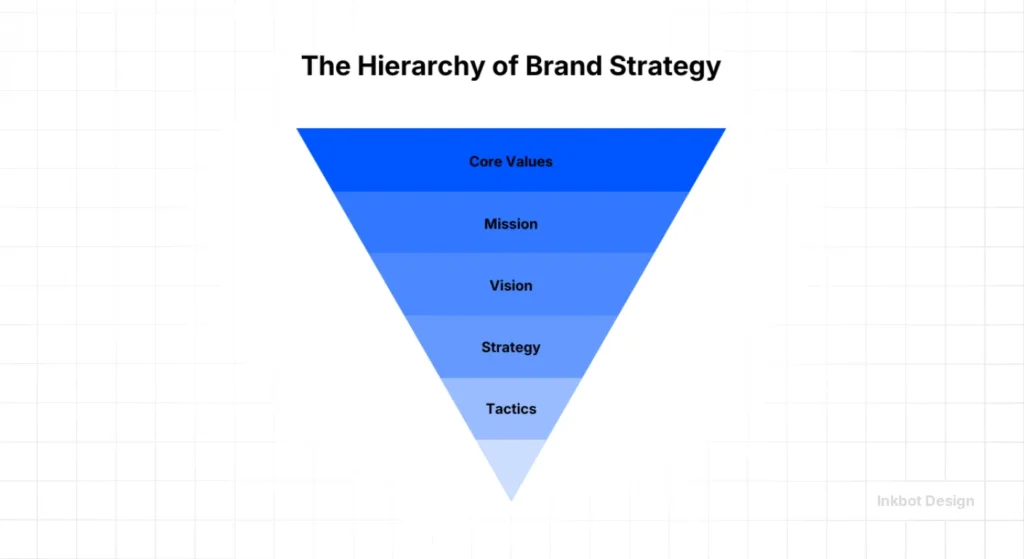
The order is the strategy. Most guides list ten steps as though they were independent tasks; they are not.
Each step earns the right to the next, and doing identity before the commercial claim — the most common sequencing error — is what produces a good-looking firm that still can’t explain why it costs more.
1. Fix the commercial strategy first.
Be specific about what that means, because “start with strategy” is the advice everyone gives and no one operationalises. It means answering three questions on paper before design begins: what work you will turn away, what you will charge a premium for, and what a client gets from you that they cannot get from the firm down the road.
A brand cannot make a muddled commercial model legible. It can only make a clear one visible.
2. Choose a client you can credibly own.
Narrow deliberately. A 12-partner tax practice that claims “SMEs across all sectors” competes with everyone; the same firm claiming “owner-managed manufacturing businesses facing succession” competes with almost no one and gets recommended by name.
3. Research how that client actually decides.
Map the full buying committee, including the hidden buyers who never take the meeting. Since more than 40% of deals stall on committee misalignment, this is where you learn which objections you must pre-empt.
4. Define the specialist claim.
State the one thing the firm is demonstrably better at, in language the client uses, not the firm’s internal jargon. This is the sentence the champion will repeat internally.
5. Build the proof, not the promise.
A claim without evidence is marketing; a claim with named outcomes is a credential. This step directly attacks the 86%/45% credibility gap.
6. Set the pricing logic that the brand must justify.
With average US law-firm worked rates rising 7.3% in 2025, according to the 2026 State of the US Legal Market, a premium now needs an articulated reason before procurement reduces the decision to an hourly comparison.
7. Codify partner behaviour.
Codify partner behaviour, because in professional services, the partner in the room is the brand at the moment of decision. The mechanism is simple and brutal: a buyer weighs the polished proposal against the partner who contradicts it live in the pitch, and believes the partner every time.
If three partners describe the firm three different ways in the same meeting — which happens more than firms admit — the prospect notices the incoherence before the firm does. Write down how partners describe the claim, the proof, and the price. Then rehearse it.
8. Design the buyer-facing experience.
The pitch, the proposal, the website — every asset the champion uses to sell you internally. Thomson Reuters research shows 88% of buyers value seller input most at the comparison and pricing stages, so that is where the experience must be strongest.
9. Build the identity — now, not first.
With the claim, proof and pricing logic settled, the visual and verbal system finally has something true to express. Identity built here reinforces a strategy; identity built first invents one.
10. Implement, then track what actually moves.
Measure enquiries from the target client, win rates against premium competitors, and fee realisation — not brand-awareness vanity metrics that never reach a P&L.
Where the Process Needs Judgement, Not a Template
The steps are learnable. The calls between them are where firms actually win or lose, and the hardest is how narrow to cut the specialist claim.
Too broad, and a 50–200-person firm is a generalist competing on price.
Too narrow, and you have built an elegant brand for a market too small to pay for it.
No formula returns the right answer — it comes from reading one firm’s client book, its live pipeline, and how much premium work the partners genuinely want versus the volume work that keeps the lights on.
This is exactly where AI-generated brand guidance collapses, because the answer is not a general rule; it is one firm’s particular arithmetic.
How AI Is Changing What Your Brand Must Claim

The value your brand claims is shifting under you.
Thomson Reuters found that 80% of surveyed law-firm respondents expect AI to fundamentally change how they price, staff and deliver work over the next five years, with an estimated 190 working hours saved per lawyer annually.
A brand strategy built around effort — years of experience, hours of diligence, the size of the team — becomes harder to defend as that effort itself is compressed.
The correction is to claim judgement, not time. Thomson Reuters reports that UK legal buyers increasingly favour firms pairing technical expertise with commercial judgement and practical guidance, and expect their advisers to use AI to improve efficiency and quality.
“We use AI” is not a position.
“We combine specialist judgement with a faster, more transparent delivery model” is one.
The same pressure is reshaping category norms elsewhere: KPMG reported private-equity firms invested more than $50 billion in CPA firms over six years, and by Q3 2025, 11 of the 30 largest US accounting firms had taken PE investment — a shift toward larger multi-service platforms that an NBER working paper on more than 3,600 transactions from 1999–2024 also documents.
In a consolidating category, a legible specialist claim is what stops a firm from being absorbed into a platform’s undifferentiated middle.
A sceptical reader will push back here on two points.
First: isn’t “risk-reduction” just positioning by another name?
No — positioning states what you are; a risk-reduction system also builds the proof and the buyer-facing material that lets someone else act on it.
Second: We already have referrals, why change?
Because 52% of corporate legal respondents expect more work to move in-house, and referral flow built on relationships thins exactly when specialisation and legible value would keep it.
The Verdict
The firms that win premium professional services work are not the most distinctive.
They are the ones whose brand makes a nervous buyer’s decision feel safe and gives that buyer something to defend it with internally.
Every step in this guide serves that single job — which is why the sequence matters more than the checklist, and why identity belongs near the end.
Design cannot invent a reason to choose you — it can only express one that already exists and is already true.
Build the visual system before the claim and the proof, and you are asking a logo to carry an argument the firm has not yet made. Build it after, and every design decision has something real to reinforce.
Start today with step one: write down, in one sentence, the specific reason a client can confidently choose and justify choosing your firm. If you cannot, that is the gap costing you premium work — and the place to begin.
If you want an outside read on exactly where your brand is losing commercial ground, request a free Brand Equity Audit™ — a structured, written diagnostic, delivered in 48 hours, that identifies where the risk-reduction system is broken and what to fix first.
FAQs
What is a professional services brand strategy?
Professional services brand strategy aligns a firm’s commercial model, specialist claim, proof and buyer experience so that choosing the firm feels lower-risk. It differs from consumer branding because the purchase is high-stakes, infrequent and usually made by a committee that must justify the decision internally.
Why do professional services rebrands often fail to win more work?
They fail because they treat branding as a distinctiveness exercise when buyers are running a risk-reduction exercise. A new identity without legible proof or material can circulate internally, leaving the credibility gap — 86% of buyers value expertise, but only 45% trust the sellers in front of them — untouched.
What is the right order for a professional services brand strategy?
Commercial strategy first, identity last. Fix what the firm sells and why it earns a premium, define the specialist claim and its proof, then build the visual system to express it. Identity built before the claim invents a strategy rather than reinforcing one.
How is AI changing the positioning of professional services?
AI compresses routine work, so brands built on effort weaken. Thomson Reuters found 80% of law-firm respondents expect AI to change how they price, staff and deliver within five years. Firms must claim judgement, specialist knowledge and outcomes — not time spent.
When should a firm rebrand?
A firm should rebrand when its commercial strategy has changed — ahead of a growth phase, acquisition, or repositioning — not merely when the identity looks dated. Rebranding without a shift in what the firm sells or to whom produces cosmetic change that does not move win rates or fees.
