Corporate Finance Branding: Why Advisers Lose Mandates Before the First Call
A £40m management buy-out is being shortlisted right now. Three advisory firms make the intermediary’s longlist. Two get a call.
The third — competent, experienced, arguably the best technical fit — never hears why it was dropped.
It was dropped because, in the 90 seconds a corporate development director spent on each firm’s site, the third firm read as “another corporate finance boutique,” while the two that progressed made their specific relevance to this deal legible on the first scroll.
That is the commercial reality corporate finance branding exists to change, and most advisory firms get it exactly backwards.
Corporate finance branding is not a credibility exercise. It is a deal-friction reduction system.
In a market where nearly every firm claims trusted advice, deep expertise and transaction experience, design earns its keep by making relevance, specialist fit, and proof of execution obvious before anyone picks up the phone.
This sits within the broader discipline of financial advisory brand positioning, and it is the part most firms underinvest in precisely because it feels like decoration rather than deal flow.
The stakes are not abstract. According to Edelman-style B2B research cited across the sector, 73% of decision-makers trust thought leadership more than conventional marketing material when assessing capability — yet only 15% rate the thought leadership they encounter as very good or excellent.
That gap is the whole opportunity: the firm that articulates its expertise clearly is competing against a field that mostly doesn’t.
- Resolve situational positioning first: state the three transaction situations you're the lowest-risk choice for.
- Build a proof architecture organising deals by situation, sector, size and outcome so relevance surfaces within ten seconds.
- Make the firm legible to referrers and substantiate claims, notably AI, so intermediaries can describe you accurately.
How Corporate Finance Branding Wins Mandates

Corporate finance branding wins mandates by reducing uncertainty at four decision points: shortlisting, referral, diligence, and internal defence. It is achieved in five stages — situational positioning, proof architecture, intermediary-facing legibility, capability substantiation, and referral-ready assets — each closing a specific gap where a buyer or referrer currently has to guess.
- Shortlisting: the buyer decides within seconds whether a firm is a plausible fit for a specific type of transaction.
- Referral: an intermediary or lawyer needs to describe the firm accurately to a third party without the firm present.
- Internal defence: a champion inside the buyer’s organisation must justify the choice to a committee.
Corporate finance branding is a deal-friction reduction system that makes an advisory firm’s specialist fit and proof of execution legible before the first conversation.
What You Need in Place Before You Touch Design
Before any visual work begins, three things must be in place, and most firms skip all three.
- First, a defensible answer to “which transactions are we the lowest-risk choice for” — not a sector list, a situation list.
- Second, documented proof of execution that can be shown, not merely asserted: completed deals with structure, sector, and outcome.
- Third, internal agreement among partners on the firm’s actual position, because a brand cannot make legible what the partnership itself disputes.
The failure mode here is starting with a logo brief.
We audited a mid-market advisory practice where three partners each described the firm’s core strength differently in the same capabilities deck — origination, execution rigour, and sector depth — and none had noticed the contradiction.
A prospect reading that deck cannot form a clear judgement, so they default to the safer-looking competitor. Design applied over an unresolved position photographs the confusion in higher resolution.
Stage One: Position Around Situations, Not Sectors
The most valuable differentiation is situational, not stylistic.
Corporate finance firms compete on transaction situations — carve-outs, succession exits, management buy-outs, distressed sales, founder-led exits, buy-and-build programmes — far more than on generic sector labels.
A firm that owns “complex carve-outs in industrials” is legible in a way that “trusted M&A advisers to the mid-market” never will be.
The current market makes this concrete. KPMG surveyed 700 senior M&A decision-makers across 20 countries and found that 50% expect a moderate or significant increase in carve-out activity over the next 12–24 months, while 71% of private-equity dealmakers said they are open to or actively pursuing portfolio separations.
KPMG also found that 95% of private-equity respondents and 83% of corporate respondents expected their next transaction to fall below $1 billion, with $250 million to under $500 million the single most common expected range.
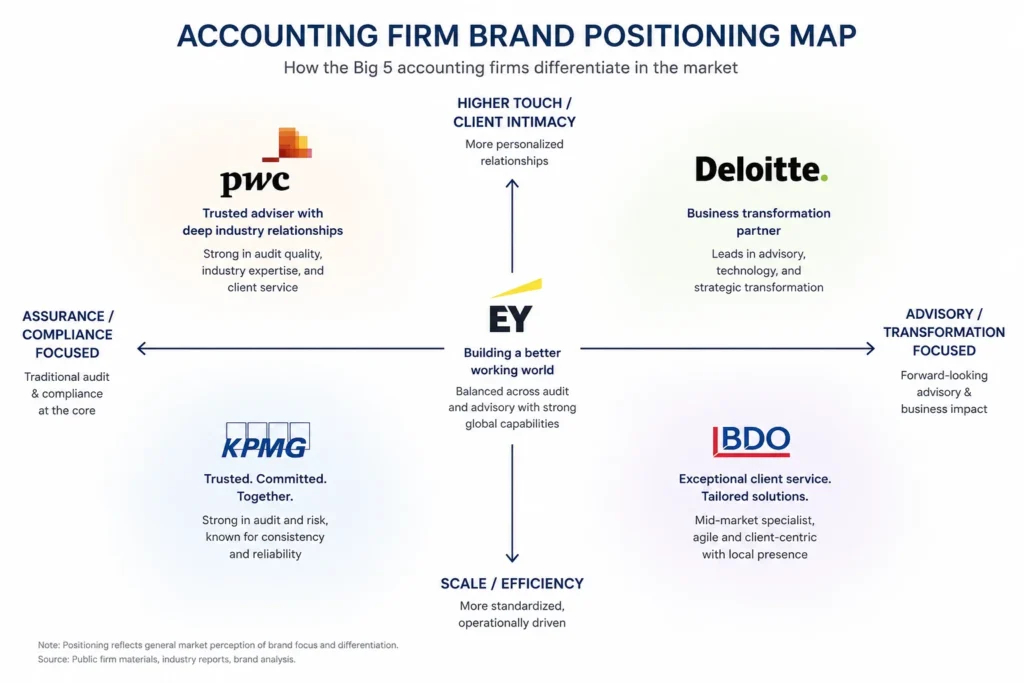
The commercial opportunity is not a blockbuster M&A. It is owning a specific situation that the mid-market keeps needing.
You know this stage is done right when a stranger can read your positioning statement and name three transaction types you should be called for. You know it has failed when the statement would fit any firm on the longlist.
The failure mode is hedging — trying to appear universally capable, which in a selective market reads as unspecialised.
“Private equity experience is not a position. A firm has to show whether it is most valuable at origination, quality of earnings, add-on acquisition, integration or exit preparation. The adviser who names the situation they solve best is the adviser a referrer can actually recommend.”
Stage Two: Build a Proof Architecture, Not a Portfolio
Proof of execution has to be structured so a buyer can extract relevance in seconds, not buried in a chronological deal list.
A proof architecture organises completed transactions by situation, sector, deal size and outcome, so a corporate development director assessing fit for a £60m carve-out finds the matching evidence without reading forty tombstones.
This is institutional trust made operational — trust as a retrievable structure rather than a claimed attribute.
The mechanism matters. A buyer shortlisting advisers is managing personal risk: choosing wrong is visible and costly to them internally.
Structured proof lowers that perceived risk by letting the buyer verify fit themselves, quickly, without a meeting. An undifferentiated tombstone wall does the opposite — it forces the buyer to do the sorting, and most won’t.
You know this stage is done right when your three most relevant credentials for any given enquiry type surface within 10 seconds.
The failure mode is volume as a substitute for relevance: 200 deals listed by date, none findable by situation.
Stage Three: Make the Firm Legible to Intermediaries
Intermediaries refer to what they can describe accurately without you in the room.
A corporate lawyer who ran a client’s disposal will only float your name if she can say, in one line to that client, what you’re specifically good at — “they’ve done three carve-outs in your sector this year” carries; “they’re a good corporate finance firm” doesn’t, because it distinguishes nothing.
The brand’s job is to load that one describable line into the referrer’s memory and make it stick.
This is where identity does functional work: it fixes the describable line in place.
A corporate finance rebranding that leaves referrers unable to repeat your position has failed its primary commercial job, however polished the result.
The working test is simple — can a referrer who saw your firm once describe it correctly a month later? If not, the identity is decorating a position that was never transmitted.
Stage Four: Substantiate Capability Claims, Especially AI

Capability claims now require visible substantiation, because the market has learned to discount unsupported ones — AI most of all.
KPMG found that 56% of surveyed dealmakers now use AI in due diligence and valuation, and 53% in deal sourcing and strategy, with 59% reporting more than a 10% efficiency improvement in competitive intelligence and market analysis.
AI is dealmaking infrastructure, not an innovation-page slogan.
The branding consequence is direct. A firm claiming AI-enabled diligence or data-led decision-making has to make that capability intelligible through its evidence structure and thought leadership, or the claim reads as the generic AI-flavoured language buyers now skim past.
Traditional signals of seriousness — dark blue, skyline photography, opaque “insight” — do not substantiate a capability claim.
Demonstrated method does.
This is the substance behind a credible fintech corporate identity: it has to carry proof, not just tone.
“AI is no longer an innovation-page claim. More than half of surveyed global dealmakers now use it in due diligence and valuation, which means an advisory brand’s entire job is to distinguish real operational capability from generic AI-flavoured language. The firms that show the method win the benefit of the doubt.”
Where the Market Stands Now
The deal market in 2026 is bifurcated, and it changes what branding must do.
According to PwC, US M&A value reached $1.2 trillion in the first five months of 2026, nearly double the $603 billion recorded in the equivalent period in 2025 — yet deal volume slipped 4%, from 4,851 to 4,653 transactions.
The gap was driven by 39 transactions above $5 billion, more than 50% above the prior-year period, with a combined value nearly tripling to $957 billion.
PwC describes a market where high-quality transactions progress while others stall on valuation gaps, financing and tariff exposure.
The recovery in deal value should not be mistaken for a return to easy deal flow. EY-Parthenon expects US M&A volume for transactions above $100 million to grow 8% in 2026, with 11% projected growth in corporate M&A but flat baseline private-equity volume.
Deloitte’s January 2026 survey of 1,500 US corporate and PE leaders found that 90% of PE and 80% of corporate respondents expected to complete more deals in 2026 — optimism that EY tempers with a projection of flat baseline PE volume as firms prioritise selectivity.
Regulation now shapes positioning too.
Allen Overy Shearman reported global M&A value of $2.8 trillion in the year to June 2026, while deal volume ran 14% lower than in the second half of 2025, identifying antitrust, foreign-subsidy rules, foreign-direct-investment screening and tax reform as factors affecting timing and execution.
Clifford Chance similarly expects regulatory risk allocation and cross-border capital flows to remain key determinants of activity.
A selective, regulation-heavy market rewards advisers who make their relevance to a specific mandate immediately clear. Generalist positioning is least defensible exactly when it matters most.

What the Stages Can’t Tell You
The stages give you the sequence; judgement decides the emphasis, and this is where experience separates a working brand from a cosmetic one. Two firms with identical credentials can require opposite positioning.
A boutique built on two rainmakers whose names open doors should foreground those people; a firm whose edge is a repeatable diligence methodology should foreground the method and deliberately de-emphasise individuals, because “it depends on the partner you get” is exactly the risk its buyers fear.
Same sector, same deal sizes, opposite brand architecture. Read the flattering choice instead of the risk-reducing one, and the identity works against the pipeline.
The pattern I see most often is firms defaulting to the positioning that flatters the partnership rather than the one that reduces buyer risk. It is deciding which true thing about the firm most reduces the specific uncertainty its buyers carry.
The Step Everyone Runs in the Wrong Order

Here is the sequence correction the whole article has been building toward: firms design the identity first and derive the position afterwards, when the order must reverse.
Most advisory rebrands begin with visual identity — logo, palette, website — and treat positioning as copy to be fitted in later.
That is why so many polished corporate finance brands still lose mandates. The design is resolving a question the firm never actually answered.
The prevailing view is defensible on its face.
Partners see competitors with dated identities and reasonably conclude the visible problem is visual, so they commission the visible fix. The identity looks better.
Nothing in the pipeline changes, because the friction was never visual — it was the buyer’s inability to determine specialist fit, and a new logo does not answer “why this team for this deal.”
Reverse the order. Resolve the situational position, build the proof architecture, confirm referrers can describe you — then design an identity that carries all three.
The market data support the sequence: a bifurcated, selective market rewards specific, legible relevance, and visual polish does not substitute for it.
Design comes last because only then does it have a settled position to express. This is the discipline separating effective financial services branding from expensive decoration.
Two Objections Worth Answering
“Our mandates come from relationships, not our website — so branding is secondary.”
Partly true, and it’s the strongest objection.
But relationships generate referrals; the referrer still has to describe you accurately, and the buyer still conducts due diligence before committing.
Branding is what makes the relationship transmissible and the diligence reassuring. It doesn’t replace the relationship. It stops the relationship from leaking value at the handoff.
“Situational positioning narrows us — we’ll miss mandates outside the niche.”
The selective market data argues the opposite. When 95% of surveyed PE respondents expect sub-$1bn deals and half anticipate more carve-outs, the firms that own a situation get called for it specifically. At the same time, generalists compete on price for whatever’s left.
Narrow positioning does not require fewer mandates. It is the better-qualified ones who won earlier.
The Verdict
Corporate finance branding does its real work before a single conversation happens — at the shortlist, in the referral, during the quiet internal defence of a choice already half-made.
Treat it as a credibility veneer, and you will produce a firm that looks more premium and wins no more mandates, because the friction was never that you looked insufficiently serious.
The friction was that buyers, intermediaries and referral sources could not quickly determine why your team was the lowest-risk choice for their specific transaction.
The market has made this sharper, not softer. A bifurcated 2026 — high value, lower volume, more carve-outs, heavier regulation, real AI adoption in diligence — rewards advisers whose relevance is legible and punishes those hiding behind generalist “trusted adviser” language.
Situational positioning, structured proof, referral-ready legibility and substantiated capability are not brand decoration. They are commercial infrastructure that reduces uncertainty at the exact moment a mandate is decided.
The single action worth taking today: write down the three transaction situations your firm is the lowest-risk choice for, then check whether a stranger could find that answer on your website in ten seconds. If they can’t, that is where you are losing mandates — and it is fixable.
To find out exactly where your brand is losing commercial ground, request a free Brand Equity Audit™ — a structured diagnostic that identifies the friction points costing you mandates and what to do about each one.
Frequently Asked Questions
What is corporate finance branding?
Corporate finance branding is the system of positioning, proof and identity that makes an advisory firm’s specialist fit and execution record legible to buyers, intermediaries and referrers. It functions to reduce decision-making friction at shortlisting, referral and diligence stages, rather than simply signalling premium credibility through visual polish.
Why do corporate finance firms lose mandates they’re qualified for?
Firms lose qualified mandates when buyers cannot quickly determine why that specific team is the lowest-risk choice for a specific transaction. The loss usually happens at the shortlist or referral stage, before any conversation, when generalist positioning fails to communicate specialist fit fast enough to survive comparison.
How is corporate finance branding different from a logo or visual identity?
A logo is one output; corporate finance branding is the underlying system that decides what the identity should express. Visual identity applied over an unresolved position amplifies confusion. The position, proof architecture and referral legibility must be settled before design can do commercial work rather than decorative work.
Does branding actually affect deal advisory mandates?
Yes — branding affects mandates because most shortlisting and referral decisions occur before direct contact, based on how clearly a firm communicates its relevance. When buyers assess fit from a website or a referrer’s description, the clarity of positioning and proof directly shapes whether a firm progresses to conversation.
What is situational positioning in corporate finance?
Situational positioning defines a firm by the transaction situations it solves best — carve-outs, management buy-outs, succession exits, distressed sales — rather than by broad sector labels. It works because referrers and buyers can match a specific situation to a specific firm, which generic “trusted adviser” positioning makes impossible.
How should an advisory firm present its deal track record?
Present the track record as proof, architecture organised by situation, sector, deal size and outcome so that a buyer can extract relevant credentials in seconds. A chronological tombstone list forces buyers to sort the evidence themselves; a structured architecture lets them quickly verify fit and reduces their perceived risk.
Is it true that narrow positioning loses you mandates?
No — narrow positioning wins better-qualified mandates in a selective market. When most surveyed dealmakers expect sub-$1bn deals and rising carve-out activity, firms that own a situation get called for it directly, while generalists compete on price for undifferentiated work. Focus concentrates enquiries rather than reducing them.
When should a corporate finance firm invest in rebranding?
A firm should rebrand when its positioning no longer matches the transactions it wins, when partners describe the firm inconsistently, or when referrers cannot describe it accurately. Rebranding to fix a dated visual identity without resolving the underlying position produces a better-looking firm that wins no additional mandates.
How do you make AI capability credible in financial branding?
Substantiate AI claims through visible methods and evidence rather than innovation-page language. With over half of surveyed dealmakers now using AI in diligence and valuation, buyers discount generic AI claims. A credible brand shows how the capability is applied to specific deal tasks, distinguishing real operational use from marketing vocabulary.
Why does thought leadership matter for corporate finance firms?
Thought leadership matters because decision-makers trust it more than conventional marketing when assessing capability, yet rate most of it poorly. That gap is an opportunity: a firm articulating genuine sector-specific insight clearly stands out against a field of generic content, substantiating expertise that would otherwise be an unsupported claim.
What is the most common mistake in corporate finance branding?
The most common mistake is designing the visual identity before resolving the firm’s position. Rebrands typically start with the logo and website and treat positioning as later copy. This produces polished brands that still lose mandates because the friction was never visible — it was an undetermined specialist fit.
How quickly can better branding affect a firm’s pipeline?
Improved positioning affects qualification and referral behaviour first, often within a quarter, as intermediaries begin to describe the firm more accurately and enquiries arrive better matched. Mandate wins follow the sales cycle length, so pipeline quality shifts before win counts, making early progress visible in enquiry relevance rather than closed deals.
