
How to Build Topical Authority Through Content Architecture
A 40-partner accountancy firm can publish 200 articles across tax, audit, corporate finance, R&D relief, VAT, and every webinar topic an agency ever pitched them — and still not be the name a private-equity buyer thinks of for transaction-side diligence.
Coverage is not authority.
The firm that owns “transaction diligence for lower-mid-market deals” with a handful of tight, connected, deeply-sourced pages will out-refer the firm that scattered itself across every adjacent subject.
Topical authority is a positioning decision that is executed in content. Most firms execute the content and skip the decision.
This guide is the method for doing it in the right order — and the discipline most guides never mention: deciding where to stop.
If you are already rethinking how the firm presents itself, it belongs alongside the rest of your digital marketing services planning, not in a silo owned by whoever runs the blog.
The stakes are not abstract. In CMI and MarketingProfs’ 2025 B2B research, 58% of respondents rated their content strategy only “moderately effective” — a majority sitting on a strategy that exists on paper and underperforms in practice. Having the diagram is not the same as owning the topic.
- Draw the exclusion boundary before building clusters; refusing adjacent topics preserves topical authority and prevents dilution.
- Design deliberate content architecture: assign each page a distinct role so pages do not compete and clusters answer buyer decisions.
- Measure the portfolio not single pages; track cluster traffic and generative visibility in Google Search Console to govern authority.
How Topical Authority Is Actually Built
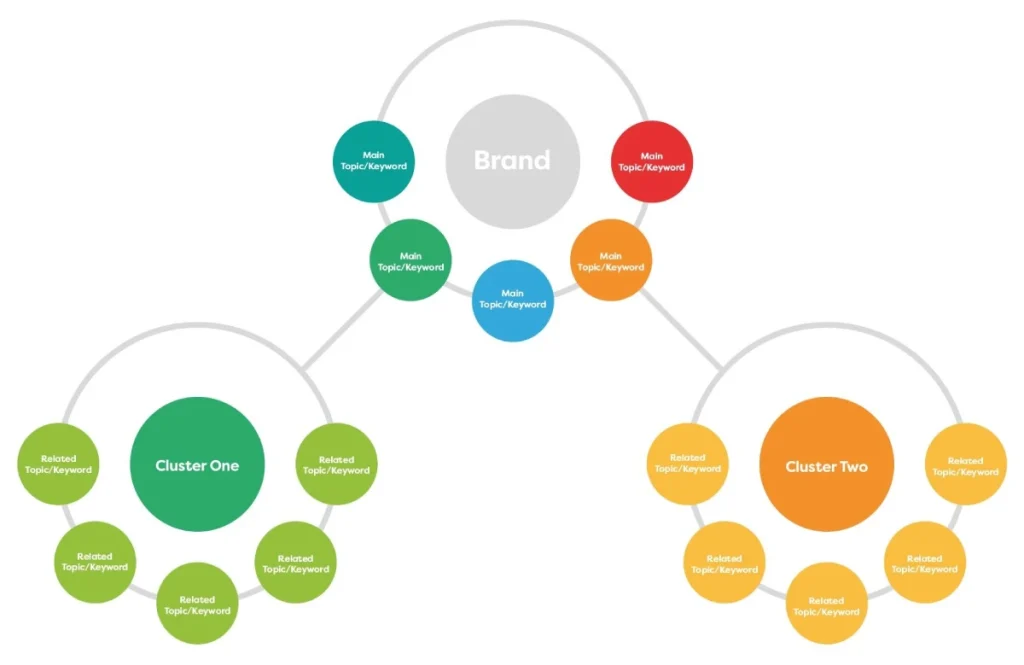
Topical authority is a search engine’s assessment that a site is a genuine expert across a whole subject, not just a match for one keyword. It is built by designing content architecture — a deliberate structure in which each page holds a distinct, defensible role — rather than by publishing a high volume of overlapping pages around a keyword cluster.
- It is earned per topic, not site-wide: a firm can hold deep authority on one subject and none on an adjacent one.
- It is diluted by breadth: publishing off-topic content measurably widens what Ahrefs calls a site’s “radius” and weakens its focus.
- It is a maintenance discipline, not a launch event: authority decays when the library is not governed.
Topical authority is a website’s demonstrated depth of expertise across a subject, built through content architecture that assigns each page a distinct role rather than through publishing volume.
What You Need in Place Before You Publish Anything
Most guides start with keyword research. That is the third step, not the first.
The honest entry conditions are commercial and editorial, and skipping them is why the CMI research found that 42% of underperforming B2B marketers blamed a lack of clear goals.
You need three things settled before a single brief is written.
- First, a defined subject the firm has the credibility to own — not a service line, a problem the firm solves better than generalists.
- Second, a named audience and their decision stages, because 39% of that same underperforming group said their content was not tied to the customer journey.
- Third, an owner: a single person accountable for the architecture, not a rotating cast of freelancers. Only 26% of B2B marketers told CMI their organisation had the right technology to manage content across the business — the governance gap is where most libraries quietly rot.
If you cannot name the problem you want to own in one sentence, you are not ready to build clusters. You are ready to have a positioning conversation first.
Stage One: Define the Subject You Have the Right to Own
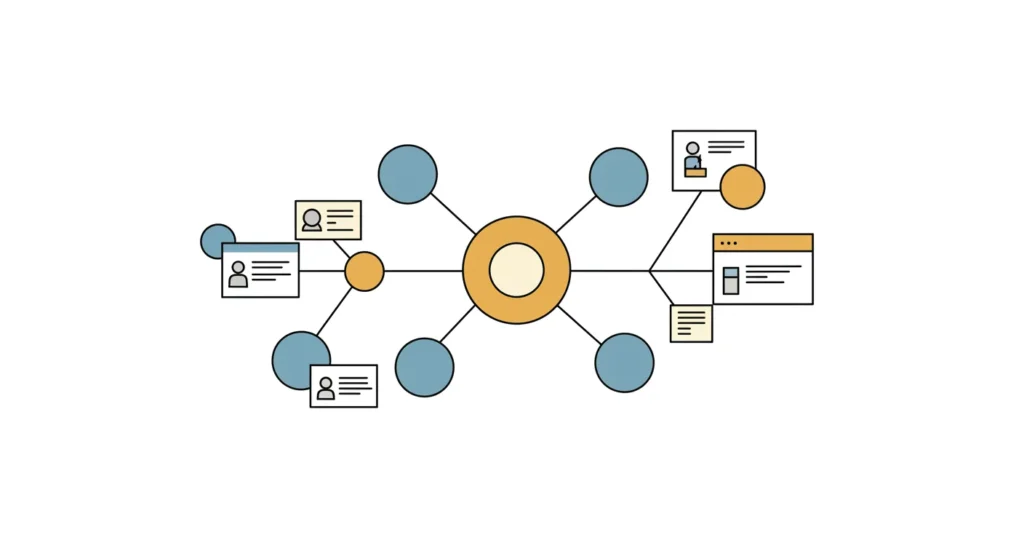
The first stage is choosing the subject — and choosing it narrowly enough that the firm can genuinely out-expert a generalist.
A 12-partner employment-law practice does not build authority on “HR law.” It builds authority on “tribunal defence for regulated employers,” where its casework is deep, and its point of view is earned.
You know this stage is done when the subject passes a single test: could a competitor with a bigger content budget still not credibly claim it?
If the answer is no, the subject is too broad.
The failure mode here is choosing a category (“marketing,” “corporate finance”) instead of a problem, which sets the firm up to compete on volume against everyone — the one game a specialist always loses.
Stage Two: Draw the Boundary Before You Draw the Clusters
The second stage is the one nearly every guide omits: deciding what the firm will not cover. Authority is as much about disciplined exclusion as it is about coverage.
A specialist agency does not become authoritative by publishing a generic explainer on every adjacent subject; it becomes authoritative by owning a coherent, connected set of problems and refusing the rest.
This matters mechanically, not just editorially. Ahrefs’ analysis of how search engines assess authority points to a “site focus score” — how concentrated a site’s content is around a core topic — and a corresponding penalty when content strays.
Publishing the adjacent explainer does not add authority; it spends it. You know this stage is done when you have a written exclusion list — the topics the firm could write about but deliberately will not, because they belong to someone else’s territory.
The failure mode is treating every keyword with search volume as an obligation.
“Coverage is a cost, not a virtue. Every page a firm publishes on an adjacent subject loses the topical focus it was trying to build. The most authoritative libraries are not the largest — they are the ones that said no most consistently, to the most tempting adjacent topics, for the longest time.”
Stage Three: Assign Each Page a Distinct Role
The third stage is clustering — but role-first, not keyword-first. A pillar page defines the subject and the firm’s position on it.
Cluster pages each answer one distinct decision or question a buyer has as they move toward instructing the firm.
The test is that no two pages compete for the same intent. If two briefs answer the same buyer question, you have one page and a redundancy, not two assets.
This is where “cover every related question” goes wrong. It produces overlapping pages that cannibalise one another and a library that nobody can confidently maintain.
Among CMI’s underperformers, one in five said their strategy emphasised quantity over quality. The failure mode at this stage is a spreadsheet of 60 keywords converted directly into 60 briefs without asking what role each page plays.
Stage Four: Write to Earned Experience, Not to the Brief

The fourth stage is production, and the bar has moved.
Ahrefs analysed 900,000 English-language pages newly published in April 2025 and found 74.2% contained some AI-generated content, with only 25.8% classified as purely human-written.
When a competent first draft is nearly free, publishing volume stops being a proxy for authority. What a generic model cannot produce is your firm’s actual casework, your named results, your point of view.
The failure mode here is a technically complete page that any competitor could have published — a page with no fingerprint.
Stage Five: Measure the Portfolio, Not the Page
The fifth stage is measurement, and as of 2026, it is a portfolio question rather than a page-by-page guess.
In June 2026, Google launched dedicated generative AI performance reports in Search Console, giving sites visibility into impressions and pages that appear in AI Overviews and AI Mode.
A firm can now audit which areas of its expertise surface in generative answers and which are invisible — and manage the library accordingly.
Measure clusters, not pages. Track whether non-branded organic traffic to the subject hub grows, whether the firm’s rankings broaden across long-tail variations it never explicitly targeted, and whether its strongest expert pages appear in generative results.
The failure mode is judging a single page’s traffic in month one and abandoning the architecture before the cluster has connected.
Authority in an Answer-Led Search Market

The ground under this has shifted, and it strengthens the architecture-first case rather than weakening it.
Google announced in May 2025 that AI Overviews had reached more than 1.5 billion users across 200 countries, and AI Mode expanded into the UK in July 2025.
As search shifts from ten blue links towards AI-generated answers, a strategy built on isolated keyword pages becomes less resilient — an answer engine rewards a connected body of evidence, not a scattered one.
The click data sharpens the point. Pew Research Centre analysed March 2025 browsing data from 900 US adults and found that traditional results were clicked in 8% of Google visits that featured an AI summary, compared with 15% of visits without one.
This is a defined US panel, not a universal forecast — but the direction is clear: generic “what is” content that a summary can fully answer has less strategic value.
The role of content architecture is to identify where a firm adds experience, evidence, and decision support that a summary cannot substitute for.
The risk is not AI-assisted content itself.
Google’s current spam policy defines scaled content abuse as producing many pages primarily to manipulate rankings. It states plainly that the policy is production-method-neutral — human-produced content also breaches it if the purpose and output are low-value.
The danger is treating a content architecture as a production line for pages whose only distinct purpose is to capture a query.
The Step Everyone Does in the Wrong Order

Here is the correction the ranking articles miss. The prevailing advice — build pillar and cluster pages, cover every related question, interlink them — is not wrong.
Intelligent practitioners hold it because it genuinely works for a site starting from zero structure; giving scattered content a hub-and-spoke shape clarifies a site for search crawlers.
The advice is not wrong. It is incomplete, and incomplete in a specific, damaging way.
It puts coverage before the boundary. Firms decide what to add before they decide what they should be known for and what they will refuse.
So the clusters bloat, the pages overlap, and the library becomes something nobody can confidently maintain.
The CMI data identifies the endpoint: 45% of B2B marketers said they lacked a scalable model for content creation, compared with just 35% who had one. That is not a linking problem. It is a sequencing problem.
Content architecture is an editorial operating system, not an SEO diagram.
Its job is to decide what the firm should be known for, which questions it has the credibility to answer, how each page contributes a distinct role, and — the part that separates authority from noise — where content should stop.
The replacement directive is simple to state and hard to hold: draw the exclusion boundary in Stage Two, before you build a single cluster in Stage Three. Decide what you refuse before you decide what you cover.
Two Objections a Managing Partner Will Raise
“Fewer pages means less traffic — surely more coverage wins more search terms.”
More pages win more impressions on terms the firm has no authority to hold, which convert poorly and dilute focus. The 22% of CMI respondents who called their content extremely or very successful cited understanding the audience (82%) and industry expertise (70%) as their top success factors, not volume. Narrow-and-deep out-earns broad-and-shallow at the enquiry stage, which is the stage that pays.
“We don’t have the casework to fill deep pages on a narrow subject.”
Then the subject is correctly sized, and the firm has a credibility problem, not a content problem — one no amount of publishing solves. A narrow subject the firm genuinely owns beats a broad one it can only describe.
The Verdict
Topical authority is not a volume achievement. It is a structural one — earned when a firm’s content architecture makes its expertise obvious to readers, to search engines, and to the firm itself.
The whole method turns on a single reordering: decide what you will refuse before you decide what you will cover. Every stage in this guide serves that sequence.
Define the problem you can own. Draw the boundary. Assign each page a distinct role. Write about real experiences that a model cannot fake. Measure the portfolio, not the page.
The evidence points one way. When 74.2% of new pages already carry AI-generated content, volume is worthless as a signal, and Google’s own spam policy punishes scaled production without value regardless of who typed it.
The firms that will hold authority through an answer-led search market are the ones that own a coherent, connected set of problems better than any generalist — and had the discipline to leave the rest alone.
Do one thing today: write your exclusion list before your content calendar. Name the ten adjacent topics the firm could credibly cover and will deliberately refuse.
Everything downstream — clusters, briefs, links, measurement — is decided by that list, which is why the architecture and the calendar are only its output.
If you want an outside read on where your brand is currently losing commercial ground — including whether your content is building authority or spending it — request a free Brand Equity Audit™.
It is a structured diagnostic that identifies exactly where the brand is under-earning and what to do about it.
FAQs
What is topical authority?
Topical authority is a search engine’s assessment that a website is a genuine expert across an entire subject rather than a match for one keyword. It is built through content architecture that gives each page a distinct role, and it is evaluated per topic — a site can hold deep authority on one subject and none on an adjacent one.
How is topical authority different from domain authority?
Domain authority estimates a site’s overall trust and link strength across everything it publishes. Topical authority measures depth and credibility within one specific subject. A firm can have modest domain authority yet dominate a narrow subject through concentrated, well-structured, genuinely expert content on that single topic.
Does publishing more content build topical authority?
No — volume alone does not build authority and can actively dilute it. Ahrefs’ analysis indicates that a site’s focus score weakens when content strays off-topic. Authority comes from concentrated depth on a defined subject, not from covering every adjacent question a keyword tool surfaces.
How do I choose which topic to own?
Choose a problem, not a category. “Tribunal defence for regulated employers” is a problem a specialist firm can own; “employment law” is a category it will compete on volume to lose. The right subject passes one test: a competitor with a bigger budget still could not credibly claim it.
Why does exclusion matter for topical authority?
Publishing off-topic content diverts focus rather than adding to it. Every page on an adjacent subject widens a site’s topical radius and weakens the signal that it is an expert on its core subject. The most authoritative libraries are the ones that consistently refused tempting adjacent topics.
When should I draw the exclusion boundary?
If you cannot name the problem you want to own in one sentence, you are not ready to build clusters. Settle the positioning first — the subject, the audience’s decision stages, and the single person who owns the architecture — then brief a word of content.
How many pages does a topic cluster need?
As few as give each buyer decision its own distinct page, and no more. If two briefs answer the same buyer question, that is one page and a redundancy. Among CMI’s underperforming B2B marketers, one in five said their strategy over-emphasised quantity — the count is not the goal.
Is AI-generated content bad for topical authority?
No — Google’s spam policy is production-method neutral and targets low-value scaled content regardless of author. The risk is using AI to mass-produce pages with no distinct purpose. AI-assisted pages that carry genuine expertise, casework, and a point of view are not penalised for being AI-assisted.
How do I measure topical authority?
Measure the cluster, not the page. Track non-branded organic traffic to the subject hub, broadening rankings across long-tail variations, and — since June 2026 — appearances in Google Search Console’s generative-AI performance reports, which show which expertise areas surface in AI Overviews and AI Mode.
How long does topical authority take to build?
Longer than a single page in the first month, which is where most firms abandon it. Authority accrues as a cluster connects and the site’s focus concentrates. Judging one page’s traffic in isolation early, then dismantling the architecture, is the most common self-inflicted failure.
Does topical authority still matter with AI Overviews and AI Mode?
Yes — arguably more. As search shifts towards AI-generated answers reaching over 1.5 billion users, answer engines reward a connected body of expertise over isolated keyword pages. A firm with structural authority on a defined subject is more citable in generative answers than one with scattered coverage.
Who should own content architecture in a firm?
One accountable person, not a rotating cast of freelancers. Only 26% of B2B marketers told CMI their organisation had the right technology to manage content across the business — the governance gap is where libraries decay. Architecture needs a single owner responsible for the boundary and the maintenance.
