M&A Brand Transition Timeline: The 4-Clock Method
An M&A brand transition timeline is not one schedule but four overlapping clocks: legal entity change, financial reporting cutover, IT and domain migration, and public brand reveal. Treating them as a single launch date is why transitions fail. This guide shows which milestone gates each workstream, and when to move.
 By Stuart Crawford
 Reviewed by Tabitha Ayers
Updated 11 min read

On this page11 min left
- What Is an M&A Brand Transition Timeline?
- Why This Matters for Professional Services Firms Preparing to Rebrand
- The Anatomy: Four Clocks and How They Run
- Where People Get It Wrong: The Rename Is Not the Reveal
- A Worked Example: A 90-Partner Firm Sequences Its Transition
- The Distinct Angle: Plan the Dependency Map, Not the Launch
- Where This Stands Now
- The Verdict
- Frequently asked questions
Three months after a Midlands accountancy firm completed its acquisition, its new name went live on the website, the letterhead, and LinkedIn on the same morning – while its old email domain silently bounced two weeks of client correspondence, including three engagement letters.
The rebrand was on time. The transition failed.
It failed because the firm planned a single launch date while it was actually running four different clocks, and nobody had asked which one gated the others.
That question – not “when do we go public?” – is the whole discipline.
Getting the M&A brand architecture strategy right upstream only pays off if the transition sequence downstream respects its dependencies.
What Is an M&A Brand Transition Timeline?
An M&A brand transition timeline is the sequenced plan governing when a merged or acquired firm changes its legal identity, financial reporting, technical infrastructure, and public-facing brand – coordinated so each change happens in the right order relative to the others, not on one shared launch date.
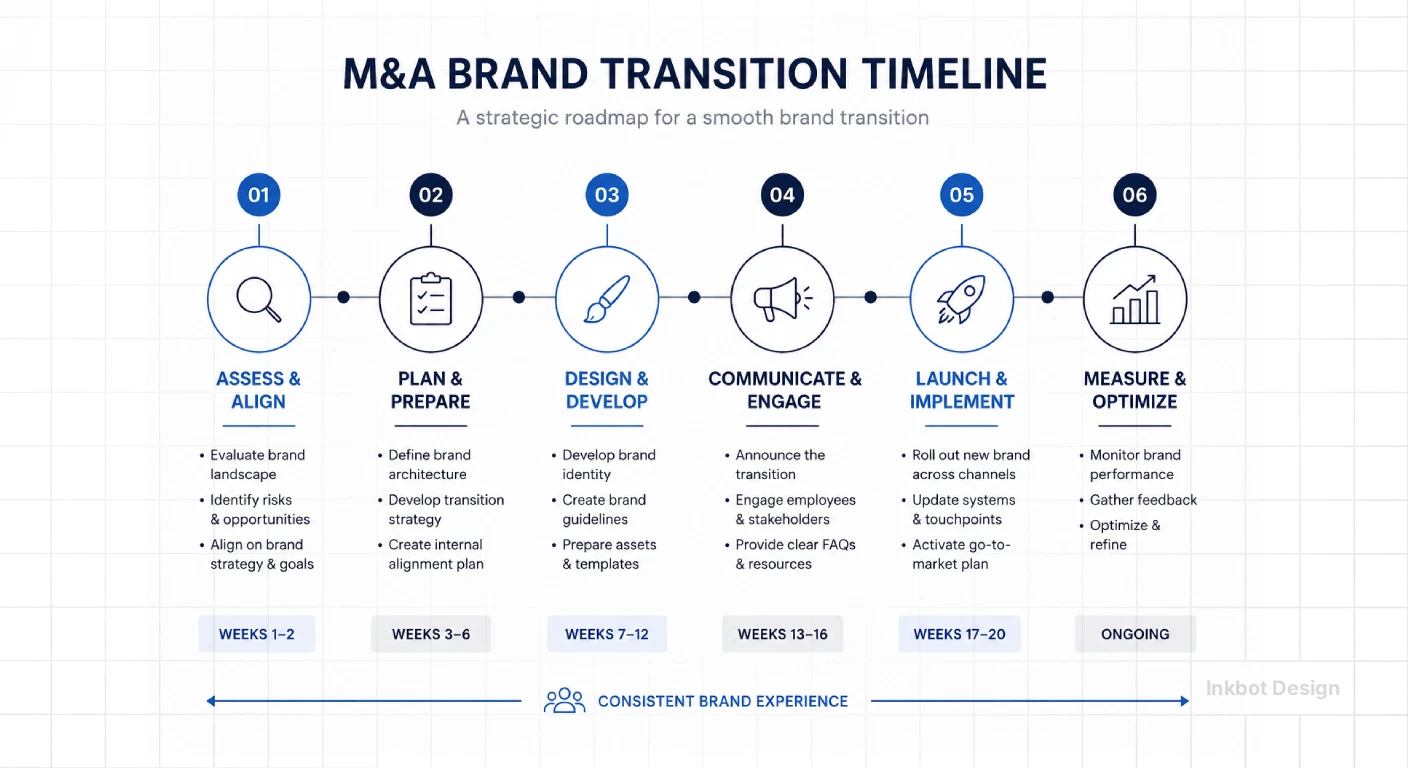
- It comprises four distinct workstreams: legal entity change, financial reporting cutover, IT/domain/email migration, and public brand reveal.
- Each workstream moves on its own clock, with its own hard deadlines and external dependencies.
- The planning task is identifying which milestone gates each of the others – the dependency map, not the calendar date.
An M&A brand transition timeline runs on four separate but overlapping clocks: legal entity change, financial reporting cutover, IT and domain migration, and public brand reveal.
Why This Matters for Professional Services Firms Preparing to Rebrand
For a 50–200-person professional services firm, a mistimed transition does not just look untidy – it interrupts revenue and regulatory standing.
A law or accountancy firm's client relationships, engagement letters, and regulated correspondence all pass through the exact systems a transition touches: the trading name on the retainer, the domain the client emails from, and the entity that holds the professional indemnity cover.
When the public reveals that the IT migration has overrun, clients email an address that no longer receives emails.
When the legal rename outruns the finance cutover, invoices go out under a name the client's accounts payable system does not recognise, and they sit unpaid.
The scale of the exposure is not marginal.
Brand assets can represent a substantial share of a firm's enterprise value. The Landor M&A brand study, reported by Business Insider, found 74% of S&P Global 100 companies rebrand after an acquisition – meaning most acquirers walk directly into this sequencing problem rather than around it.
The firms that suffer are the ones treating it as a marketing launch.
A brand transition does not fail on the logo. It fails on the calendar – when the reveal outruns the plumbing, and clients discover the new name by watching their own emails bounce.
The Anatomy: Four Clocks and How They Run

The Legal Clock: Entity Change and Companies House
The legal clock governs when the trading entity's name formally changes, and it is the least flexible of the four.
A UK firm changing its registered name files with Companies House and receives a certificate of incorporation on change of name; the new name has legal effect from the date on that certificate, not the date marketing chooses.
Regulated professional services firms carry an additional dependency: the SRA, ICAEW, or equivalent regulator must reflect the change, and professional indemnity cover must name the correct entity.
The legal clock frequently gates the finance clock, because you cannot invoice under a name that does not yet legally exist.
The Financial Clock: Reporting Cutover
The financial clock governs when reporting, invoicing, and consolidated accounts switch to the new entity – and it answers to dates the brand team does not control.
Financial reporting cutovers align to accounting period ends, VAT quarters, and audit timetables, not to a convenient launch morning.
iDeals reports that 2024 data showed average deal close times decreasing for the first time in four years, thereby compressing the runway between signing and the first reporting period under the new structure.
The financial clock's cutover date is usually fixed early and immovably; the other three clocks should be planned around it, not the reverse.
The IT Clock: Domain, Email, and Systems
The IT clock governs domain, email, and system migration, and it is the one most often underestimated and most capable of causing visible client damage.
Email domain changes, DNS propagation, mailbox migration, and practice-management system updates have lead times measured in weeks, and they must be completed before the public reveals the new brand.
This is the clock that led to the Midlands firm's failure.
The IT clock does not gate revenue the way legal and finance do. Still, it gates client experience – and in professional services, client experience is the product.
The Brand Reveal Clock: The Public Moment
The brand reveal clock governs the public-facing switch – website, signage, social, announcements – and it is the only one of the four with genuine discretion over its date.
Because it is flexible, teams mistakenly treat it as the timeline and pull the other three toward it.
The reveal should be the last domino, timed to fall only after legal existence, financial readiness, and IT migration are confirmed complete.
A reveal is cheap to delay by a fortnight and expensive to un-launch.
Deciding between a branded house and a house of brands shapes what the reveal says, but never license it to outrun the plumbing.
Where People Get It Wrong: The Rename Is Not the Reveal
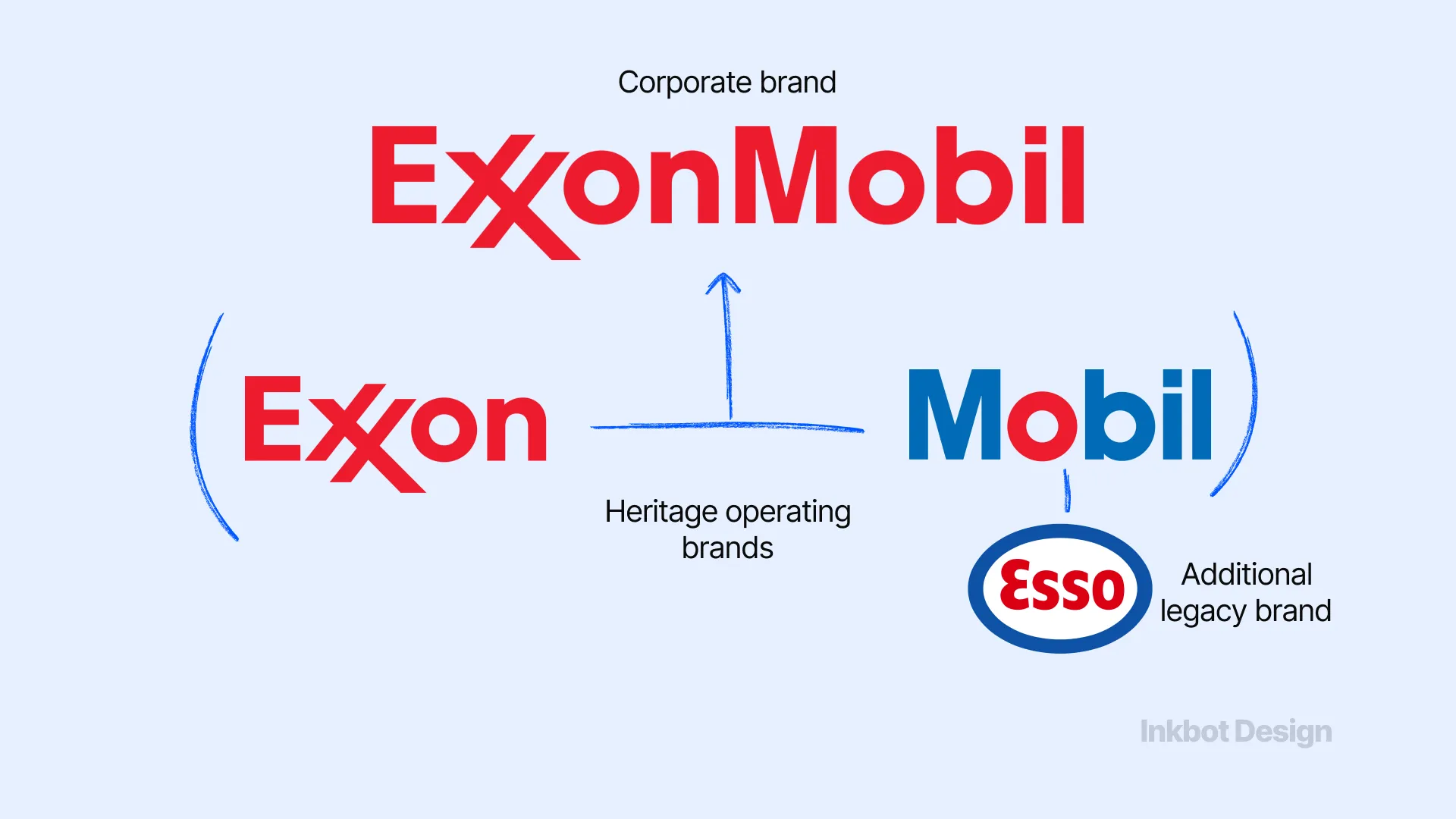
The most common error is assuming the legal name change and the public brand reveal are the same event, scheduled together.
They are not, and forcing them together creates the failure.
The legal rename is a filing with a certificate date; the reveal is a communications decision.
They can – and usually should – be weeks apart, with the legal entity changed quietly first so that invoices, contracts, and regulatory records are correct before a single client is told to expect a new name.
Firms that fuse these two into one date discover that the milestone with the least flexibility (legal) ends up dictated by the milestone with the most (reveal).
That is the dependency map inverted.
A Worked Example: A 90-Partner Firm Sequences Its Transition
Take a 90-person consultancy acquired by a larger group, rebranding to the parent's name.
Sequenced by dependency rather than by launch date, the plan runs:
- fix the financial cutover to the next accounting period end (the immovable anchor);
- file the Companies House name change to take effect two weeks before that cutover, so invoicing under the new entity is legal from day one of the new period;
- complete domain, email, and practice-management migration in the fortnight between certificate and cutover, running old and new email in parallel;
- Then, and only then, schedule the public reveal for the week after cutover, when every underlying system already answers to the new name.
DealFlow OS notes that the first 90 days after close are critical, with client retention and continuity as immediate priorities – this sequence protects exactly those. The reveal is last because it is the only clock that can safely wait.
The Distinct Angle: Plan the Dependency Map, Not the Launch
Intelligent teams plan brand transitions as launches for a defensible reason: the reveal is the visible, emotionally significant moment, the thing the market reacts to, so it feels like the event to organise everything around.
That instinct is not stupid – it is just aimed at the wrong milestone.
The reveal is the output of the transition, not its governing constraint.
The sharper model treats the timeline as a dependency map with four clocks, then asks one question per workstream: what must be true before this can happen? Legal existence must precede legal invoicing.
IT migration must precede public reveal. Financial cutover anchors to external accounting dates that nobody can move.
Once those dependencies are drawn, the sequence stops being a matter of preference and becomes almost deterministic – you are no longer choosing a launch date, you are reading off the order the dependencies dictate.
Brand transition is not a launch you schedule. It is a dependency chain you read. The firms that treat it as a project-management problem keep their clients; the ones that treat it as a marketing moment explain the bounced emails afterwards.
This is where migrating brand equity and integration planning meet the operational reality – the strategy is only as good as the sequence that delivers it.
Where This Stands Now

Deal conditions in 2026 are compressing transition planning rather than easing it.
PwC's 2026 mid-year outlook puts global M&A value on track toward roughly $4tn, up 13% on 2025, following what Bain reports was a strong 2025 rebound and the second-highest deal-value year on record. Volume, though, is concentrated.
PwC describes an increasingly “K-shaped” market in which value pools into large, well-capitalised deals. At the same time, overall volume stays muted, and notes that deals over $5bn account for nearly half of global deal value in 2026, which is precisely why transition planning gets compressed in the biggest transactions, where the pressure to reveal quickly is highest.
The appetite is not slowing. PwC's 2026 outlook reports that 41% of CEOs globally plan a major acquisition within three years, and that around a third of the 100 largest 2025 deals cited AI as a strategic driver, with the first half of 2026 active across technology, media, and financial services.
For a professional services firm, the takeaway is narrow and practical: more of your peers will face this sequencing problem, and shorter close times leave less runway to get the four clocks in order.
The firms that pre-draw the dependency map before signing will absorb the compression. The ones improvising it after close will not.
Two objections a sceptical Managing Partner will raise are worth answering directly. First: “Our transition is simple; we don't need four workstreams.”
Even a single-office rename touches all four clocks – the entity still files, finance still cuts over, email still migrates, the public still finds out; simplicity reduces scale, not clock count.
Second: “Surely legal and marketing already coordinate.”
They coordinate on what changes; the failure is almost always in sequence, and sequence is nobody's default job unless someone explicitly owns the dependency map.
The Verdict
A brand transition timeline is not one schedule with a launch date at the end. It is four clocks – legal, financial, IT, and brand reveal – each with its own deadlines and its own dependencies, and the entire discipline is working out which milestone gates which workstream.
The firms that lose clients during transition are rarely the ones with the wrong logo.
They are the ones who planned a launch when they should have drawn a dependency map, and let the most flexible clock – the reveal – dictate the least flexible ones.
The correction is structural, not cosmetic.
Fix the financial cutover to its external anchor first.
Establish legal existence before you need to invoice under it. Complete IT migration before you point anyone at the new brand.
Reveal last, into systems that already answer to the new name.
Do that, and the transition becomes almost boring – which, for a firm whose product is client trust, is exactly what you want it to be.
If you are heading into an acquisition or rebrand and cannot yet name which clock gates the others, that is the gap to close before anything goes public.
Request a free Brand Equity Audit™ – a structured, written diagnostic that identifies exactly where your brand is losing commercial ground and what to do about it, with no sales call.
Frequently asked questions
What is an M&A brand transition timeline?
It is the sequenced plan governing when a merged firm changes its legal identity, financial reporting, IT infrastructure, and public brand. Rather than a single launch date, it coordinates four workstreams so that each change occurs in the correct order relative to the others.
When should a firm rebrand after an acquisition?
The public reveal should come last – after legal name change, financial cutover, and IT migration are complete. Revealing first, before systems answer to the new name, is the most common cause of client-facing disruption during transition.
Does the legal name change have to match the public rebrand date?
No – they should usually be separate. The legal rename is a Companies House filing with a certificate date; the reveal is a communications decision. Changing the entity quietly first ensures invoices, contracts, and regulatory records are correct before clients are told.
How long does email and domain migration take in a merger?
Domain changes, DNS propagation, and mailbox migration typically take several weeks to complete. They must be finished before the public reveal. Running old and new email in parallel during migration prevents bounced correspondence that damages client relationships.
What's the difference between the legal clock and the financial clock?
The legal clock governs when the entity's name formally changes at Companies House; the financial clock governs when reporting and invoicing switch to the new entity. The legal clock often gates the financial one, since you cannot invoice under a name that does not yet legally exist.
Why do brand transitions fail even when the rebrand is on time?
Because “on time” usually means the reveal hit its date while the underlying clocks were unfinished. A transition fails when the public reveals outrun IT migration or legal existence. Clients encounter the new brand before the systems behind it are ready.
Is it true that most acquirers rebrand?
Yes – the Landor M&A brand study, reported by Business Insider, found 74% of S&P Global 100 companies rebrand after an acquisition. Most acquirers therefore face the transition sequencing problem directly rather than avoiding it.
How should a professional services firm sequence its transition?
Anchor to the fixed financial cutover date first, establish legal existence before invoicing, complete IT migration before the reveal, then reveal last. This order follows the dependencies rather than the calendar, protecting client continuity throughout.
What is the gating dependency in a brand transition?
The gating dependency is the milestone that must be completed before another workstream can proceed. Legal existence gates legal invoicing; IT migration gates the public reveal; external accounting dates gate the financial cutover. Identifying these is the core planning task.
Why is the financial clock the least flexible?
Financial cutovers align with accounting period ends, VAT quarters, and externally set audit timetables. These dates cannot move to suit a launch, so the other three clocks should be planned around the financial cutover rather than the reverse.
When is it safe to schedule the public reveal?
Only after legal existence, financial readiness, and IT migration are confirmed complete. The reveal is the sole clock with genuine discretion over its date, making it cheap to delay a fortnight and expensive to launch prematurely.
How do shorter deal close-times affect transition planning?
iDeals reports that 2024 close times decreased for the first time in four years, compressing the runway between signing and the first reporting period. Firms that pre-draw the dependency map before signing absorb this compression; those improvising after close struggle with it.