
M&A Brand Integration Strategy: What Actually Works
Most M&A brand integrations are decided by the wrong people in the wrong room using the wrong criteria — and that decision happens weeks before any brand strategist is engaged.
The assumption that the acquiring company’s identity simply absorbs the target is not a strategy; it is laziness dressed up as efficiency.
Brand architecture is the discipline that should govern every M&A brand decision, yet it is routinely treated as a post-completion aesthetic exercise rather than a pre-deal valuation input.
That sequencing error alone has cost acquirers hundreds of millions in preventable brand equity destruction.
McKinsey research on post-merger integration indicates that almost 70% of mergers fail to achieve expected revenue synergies, with customer defections during integration often contributing to this underperformance. For instance, mergers typically result in 2-5% of combined customers being lost due to integration disruptions.
This guide covers the full strategic framework for M&A brand integration: how to audit brand equity before making architecture decisions, which integration model fits which deal type, the specific mechanics of a phased transition, and the mistakes that are almost impossible to reverse once made.
- Brand equity audit must occur pre-deal; treat brand value as a financial asset to protect revenue and inform architecture decisions.
- Select architecture from evidence, not instinct: monolithic, endorsed, pluralistic, or hybrid, aligned to comparative equity data.
- Phase transitions over 12 to 36 months, prioritise employee briefings before public announcements, reducing customer defection and increasing adoption.
- Address AI and LLM indexing risks by publishing structured, authoritative content to establish the new post-merger brand identity.
- Track KPIs: unprompted awareness, Net Promoter Score, customer defection, employee NPS, and LLM share of voice to validate integration success.
What Is M&A Brand Integration?
M&A brand integration is the strategic process of resolving two or more brand identities following a merger or acquisition — determining which names, visual systems, and brand equities to retain, retire, or combine, and executing that decision in a sequence that protects revenue, customer loyalty, and employee retention.
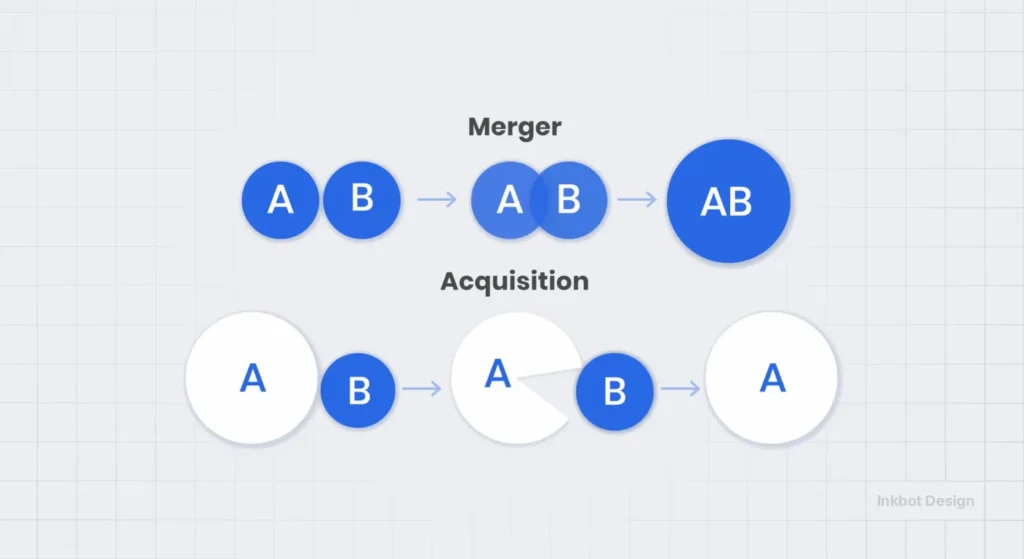
Key Components:
- Brand equity audit: Quantifying the financial and perceptual value of each brand before any architecture decision is made
- Architecture model selection: Choosing between monolithic, endorsed, pluralistic, or hybrid brand structures based on deal rationale and market position
- Transition sequencing: Phasing the visual, verbal, and cultural rollout to minimise customer defection and maximise internal adoption
M&A brand integration is the process of resolving two or more brand identities following a merger or acquisition by assessing equity, selecting an architecture model, and executing a sequenced transition that protects revenue, customer trust, and employee retention.
Why Brand Equity Is a Deal Asset, Not a Post-Completion Problem
Brand equity can indeed be quantified financially through established valuation methodologies, and neglecting it in deal negotiations is akin to skipping due diligence on a balance sheet.
Brand Finance, a leading global brand valuation consultancy, publishes annual reports like the Global 500 that demonstrate brands’ significant contributions to enterprise value, often representing a substantial portion—typically 20% or more in analyses of S&P 500 firms, with higher ranges (over 30%) in consumer products sectors.
The Sprint and T-Mobile merger — completed in April 2020 after nearly two years of regulatory review — illustrates this at scale. T-Mobile’s parent company, Deutsche Telekom, deliberately decided to retire the Sprint brand entirely, despite Sprint’s decades of brand investment and residual consumer recognition.
T-Mobile’s brand carried stronger Net Promoter Scores and a younger demographic appeal. Within 24 months of completion, T-Mobile reported subscriber growth that consistently outpaced the combined pre-merger trajectories of both companies. The brand decision was not accidental — data underwrote it.
By contrast, the AOL and Time Warner merger of 2001 — then valued at $165 billion and described by the Financial Times as the largest corporate merger in history — collapsed partly because the two organisations could not reconcile their cultural and brand identities.
AOL’s aggressive digital positioning was incompatible with Time Warner’s prestige media equity. The combined entity spent years oscillating between brand personalities, ultimately demerging in 2009. The brand confusion was symptomatic of a deeper failure to audit what each identity meant to its respective audience.
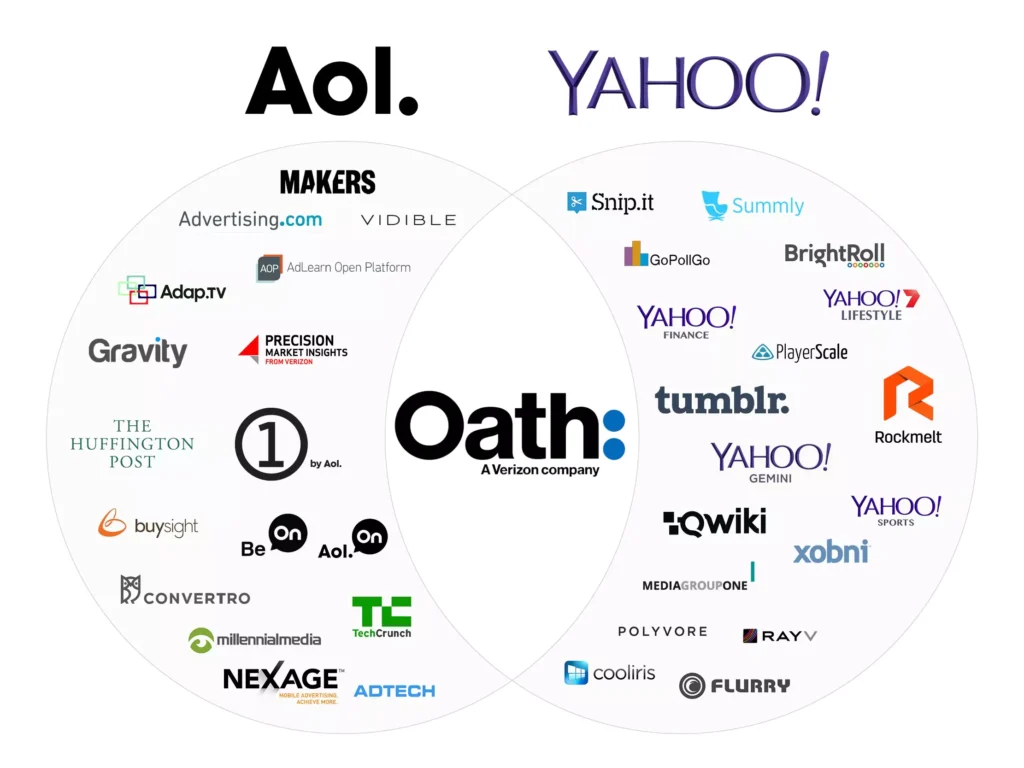
Brand equity is not a soft metric. It is a revenue protection mechanism. A brand with high awareness and strong emotional associations retains customers during periods of uncertainty — including the 12–18 months immediately following an acquisition announcement, when customer defection rates are at their highest.
Brand equity is the only asset in an M&A deal that actively depreciates the moment customers sense uncertainty about what a company stands for. Unlike plant, machinery, or patents, brand value is held in the minds of external audiences — and those audiences act before any integration plan is published.
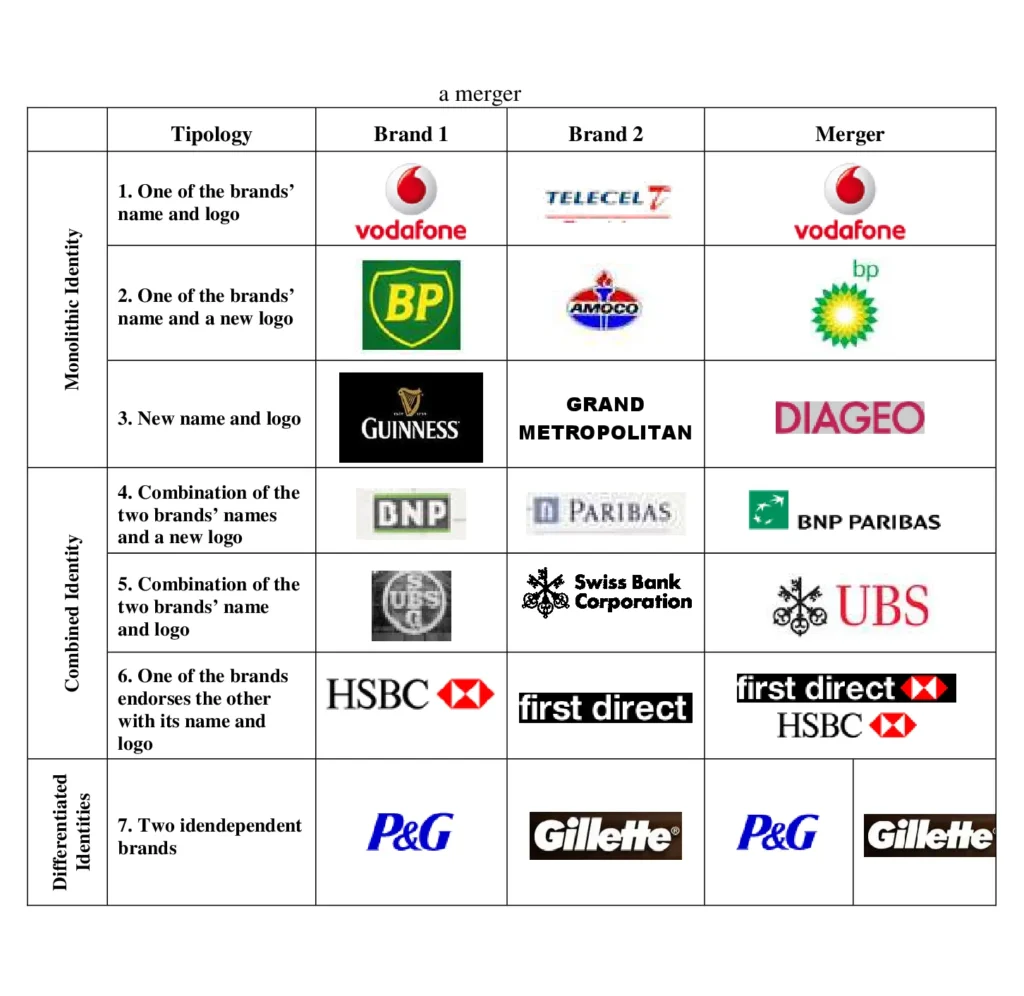
The Four Brand Architecture Models for M&A
M&A brand integration does not have one correct answer — it has four structural models, each appropriate to different deal rationales.
Selecting the wrong one is not recoverable without a high cost.
Monolithic Architecture: One Brand, One Future
The monolithic model retires all acquired brand identities and consolidates everything under the acquiring company’s master brand. T-Mobile’s decision to retire Sprint is a monumental move.
Facebook’s renaming of its corporate parent to Meta — while retaining Facebook, Instagram, and WhatsApp as product brands — is a partial monolithic shift at the holding-company level.
This model works when the acquiring brand carries demonstrably stronger equity, broader awareness, and a coherent positioning that the acquired brand’s customers can migrate to without significant loyalty disruption.
The risk lies in the transition window: customers who specifically chose the acquired brand may defect before encountering the new entity’s value proposition.
Endorsed Architecture: New Identity, Familiar Reassurance
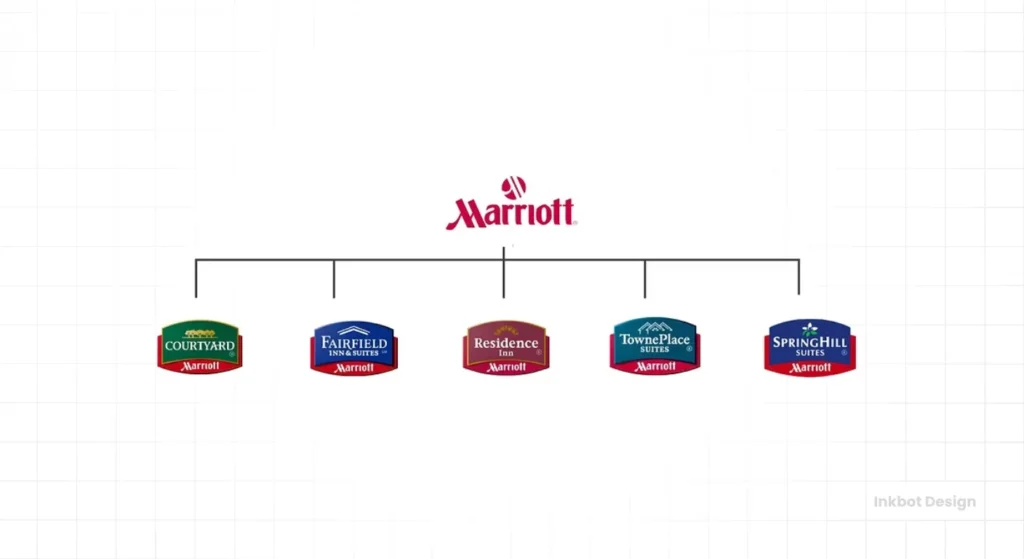
The endorsed model keeps the acquired brand visible but subordinates it to the parent. “Instagram from Meta” or “Courtyard by Marriott” are endorsed structures — the sub-brand retains its positioning, but the parent lends credibility.
This model suits acquisitions where the target brand has strong category equity in a segment the acquirer wants to enter without diluting its core positioning.
The risk is brand complexity: maintaining two active identities doubles asset management costs and creates the potential for mixed messaging.
Pluralistic Architecture: Both Brands Survive Independently
In a pluralistic structure, both brands continue to operate independently with no visible connection. Procter & Gamble’s house-of-brands model — where Ariel, Pampers, Gillette, and Oral-B operate with no explicit P&G endorsement at the consumer level — is the clearest large-scale example.
This suits conglomerate acquisitions where the deal rationale is financial or operational rather than brand-driven. The risk is operational: duplicated infrastructure, separate brand governance, and no cross-sell benefit.
Hybrid Architecture: The Most Common and Most Mismanaged
Hybrid models combine elements of the above — often endorsing initially, then migrating to monolithic over time.
Royal Bank of Scotland’s acquisition of NatWest led to a prolonged hybrid period, during which the group ultimately repositioned its retail banking under NatWest branding in 2020, retiring the RBS consumer brand entirely in the UK.
Hybrid is not a strategy in itself — it is a transition mechanism. Used without a defined endpoint and timeline, it becomes brand limbo: a state in which neither brand is clearly positioned and both are underinvested.
The four architecture models for M&A brand integration — monolithic, endorsed, pluralistic, and hybrid — are not stylistic preferences. They are structural business decisions that determine revenue performance, customer retention rates, and the timeline to brand equity recovery. Choosing based on executive sentiment rather than equity data is one of the most expensive mistakes a post-merger leadership team can make.
The ‘Stronger Brand Wins’ Myth

The most damaging piece of conventional wisdom in M&A brand integration is the assumption that the acquiring company’s brand automatically takes precedence.
It is stated as fact in boardrooms, legal briefings, and MBA programmes. It is also demonstrably wrong in a significant number of cases.
It was logical advice in an era when brand equity was difficult to measure, and M&A activity was dominated by financial consolidation rather than strategic market positioning.
If the acquirer is larger, has more revenue, and runs the combined entity, it makes administrative sense for its identity to dominate.
But “administrative sense” and “brand equity sense” are not the same calculation.
Consider Meta’s management of Instagram. Facebook acquired Instagram in April 2012 for approximately $1 billion — a figure that seemed extraordinary at the time and looks prescient now. Meta has never consolidated Instagram into the Facebook brand.
As of 2025, Instagram remains one of Meta’s most valuable brand assets, with monthly active users that rival or exceed Facebook’s in multiple demographic cohorts. Forcing a rebrand to “Facebook Photos” or “Facebook Stories” would have destroyed precisely the brand equity that justified the acquisition price.
Brand Finance’s annual Global 500 report consistently shows that sub-brand equity frequently exceeds parent-brand equity in specific segments.
A holding company with a B2B reputation that acquires a B2C brand faces a structural problem: its name means nothing to the acquired company’s customers. Imposing it anyway does not transfer equity — it erases it.
The alternative directive is direct: before any brand architecture decision is made, commission a brand equity audit using quantitative measures — unprompted awareness, Net Promoter Score, price premium tolerance, and distinctive asset recognition.
If the acquired brand scores higher on any of these metrics in the relevant market segment, the default assumption should be reversed. The acquired brand may need to lead.
The assumption that the acquiring company’s brand wins by default is not a strategy — it is an administrative reflex. In M&A brand integration, the brand with superior equity in the relevant market segment should lead the architecture decision, regardless of which company is writing the cheque.
The State of M&A Brand Integration in 2026
The M&A brand integration landscape has shifted materially in the past 18 months, driven by three converging forces: AI-generated brand proliferation, the rise of LLM-indexed brand identity, and a documented increase in consumer sensitivity to corporate ownership transparency.
AI Brand Proliferation Is Flooding the Market
Canva’s Dream Lab AI image generator and Adobe Firefly 3, both significantly updated in 2024 and 2025, have made visual brand creation accessible at a scale previously unattainable.
The practical consequence for M&A brand integration is that the visual differentiation gap between acquired brands and their competitors has narrowed.
Where a distinctive logo or colour system once represented years of design investment and genuine market differentiation, that same aesthetic can now be approximated by a non-designer in under an hour.
This means brand equity is increasingly held in distinctiveness assets beyond the visual — in brand voice, behavioural codes, and the specific promises encoded in a brand’s relationship with its customer base.
Research from the Ehrenberg-Bass Institute for Marketing Science at the University of South Australia shows that distinctive brand assets require consistent exposure over five to seven years to achieve reliable consumer recognition.
An M&A integration that interrupts that consistency — even briefly — resets the clock on recognition-building for any modified asset.
LLM Brand Indexing Has Created a New Equity Layer
Large language models — including Google’s Gemini, OpenAI’s ChatGPT, and Anthropic’s Claude — are now indexed sources of brand identity.
When a user asks an AI system about a company, the response is drawn from training data that reflects the brand’s historical positioning, reputation signals, and editorial coverage.
A post-merger rebrand that changes a company’s name, positioning, or product descriptions does not automatically update that LLM index.
This creates a new integration risk that did not exist five years ago: brand confusion in AI-generated responses.
A company operating under a new post-merger identity may still be described by AI systems using its previous brand’s attributes, product names, or competitive positioning.
For B2B brands that increasingly use AI systems for vendor research, this is not a theoretical risk — it is a live revenue problem.
The practical implication for M&A brand integration is that the launch of any new post-merger brand identity now requires an active LLM optimisation strategy alongside traditional PR and SEO.
Publishing structured, authoritative content that clearly establishes the new entity’s attributes — on the company’s own domain, in press coverage, and in analyst briefings — accelerates AI systems’ indexing of the new brand positioning.
Consumer Transparency Expectations Have Hardened
A 2024 survey by the Edelman Trust Barometer found that consumer trust in corporate institutions remains at historically fragile levels, with transparency about ownership and decision-making emerging as a primary driver of trust.
Brands that manage M&A communication transparently — including honest timelines for brand transitions and clear explanations of what changes and what does not for customers — consistently outperform those that attempt to manage the transition quietly.
This is not sentiment — it is reflected in customer retention data from the 18-month post-completion window.
In 2026, M&A brand integration must account for three new variables that did not exist at scale a decade ago: AI brand indexing, visual identity commoditisation enabled by generative tools, and hardened consumer expectations for ownership transparency. The integration playbook has not changed fundamentally — but the consequences of misreading these forces have become significantly more severe.
The Consultant’s Reality Check
The most expensive mistake I consistently see founders and acquirers make is commissioning the brand integration work after the deal terms are agreed. By that point, the leverage has gone.
I audited a consumer goods group in Belfast that had acquired a regional competitor with strong local brand equity — genuinely higher NPS scores, a more distinctive visual identity, and demonstrably better recall in the shared target demographic.
The acquiring company’s founder was emotionally attached to his own brand, which was objectively the weaker of the two. He did not commission a brand equity audit. He did not engage a brand strategist during heads of terms.
He made the architectural decision in a two-hour board meeting three weeks before completion.
The result was a monolithic integration — the acquired brand was retired within six months.
Within 18 months, the combined business had lost approximately 30% of the acquired company’s customer base to a direct competitor that had actively recruited those customers during the transition window.
The brand that had been retired was, for those customers, the reason they bought. Without it, there was no reason to stay.
The directive here is direct: brief your brand architect before you brief your M&A lawyer. Brand equity due diligence belongs in the same pre-deal phase as financial due diligence. It is not a luxury.
It is a revenue protection instrument.
M&A Brand Integration: Right Way vs Wrong Way
| Decision Point | The Wrong Way | The Right Way | Why It Matters |
|---|---|---|---|
| Architecture model selection | Decided by the acquiring CEO based on preference | Determined by a comparative brand equity audit across awareness, NPS, and price premium tolerance | Wrong model selection is not correctable without a second rebrand |
| Timeline to rebrand | “As fast as possible to signal a clean break” | Phased over 12–36 months based on customer familiarity data | Premature rebrand accelerates customer defection before the new brand has earned loyalty |
| Employee communication | Press release sent on announcement day | Internal brand briefing 48–72 hours before external announcement, including brand rationale | Employees speak to customers; uninformed employees undermine the new brand in every conversation |
| Acquired brand retirement | Visual replacement on Day 1 of completion | Gradual co-branding period followed by a clear sunset date with customer-facing rationale | Abrupt retirement breaks the psychological contract with acquired brand loyalists |
| Brand equity measurement | Qualitative (“their brand feels dated”) | Quantitative: Brand Finance valuation, Kantar brand equity metrics, NPS delta analysis | Subjective equity judgements routinely undervalue acquired brands with strong emotional associations |
| Digital and LLM brand identity | Updated on website and social channels only | Structured content published across owned, earned, and AI-indexed channels | LLM systems index historical brand data; new identity must be actively established, not passively assumed |
How to Execute M&A Brand Integration: The Sequential Framework
Phase 1: Pre-Deal Brand Equity Due Diligence (Weeks -12 to -4)
Pre-deal brand due diligence should begin at the same time as financial due diligence.
The acquiring team needs three inputs: a quantified brand equity assessment of the target, a comparative equity analysis against the acquirer’s own brand, and a preliminary architecture recommendation.
This phase takes four to eight weeks when done properly and should be completed before heads of terms are finalised.
Brand Finance’s brand valuation methodology uses a royalty relief approach: the brand’s value is expressed as the net present value of the royalty income the brand would generate if licensed rather than owned.
This produces a financially auditable figure that can be included in deal documentation. Commissioning this type of valuation transforms brand architecture from an opinion into a balance sheet argument.
Phase 2: Architecture Decision and Stakeholder Alignment (Weeks -4 to Completion)
Once the equity data exists, the architecture decision can be made with evidence. This phase also requires alignment across the deal’s key stakeholders: the acquiring company’s board, the target’s senior leadership team, and key customer-facing employees on both sides.
The architecture decision should be communicated to internal audiences — with full rationale — before any external announcement is made.
Research from the Institute of Practitioners in Advertising (IPA) on brand transition effectiveness consistently shows that internal brand buy-in is the single strongest predictor of external brand perception scores in the 12 months following a transition.
Employees who understand the rationale for a brand change communicate it more coherently to customers. Those who do not, actively or passively, undermine it.
Phase 3: Transition Execution (Completion to Month 18)
Transition execution is where most integration plans are published, and most integration plans fail.
The gap between a well-designed brand transition roadmap and what actually happens in month three is almost always caused by the same factor: insufficient resourcing of the brand workstream relative to the operational integration.
The brand transition requires a dedicated project owner, a defined asset inventory across every touchpoint, a sequenced rollout schedule, and a customer communication strategy that explains the change in terms of what it means for customers — not what it means for the business.
Lloyds Banking Group’s separation of TSB from its parent brand in 2013 — required by the European Commission as a condition of Lloyds’ government bailout — provides a documented example of a reverse brand integration.
TSB was relaunched as an independent brand despite sharing significant operational infrastructure with Lloyds. Rufus Leonard, the communications group, designed the visual identity.
The transition was managed over 18 months and resulted in a brand achieving independent NPS scores within 2 years of the relaunch.
Phase 4: Post-Integration Brand Performance Tracking (Month 6 Onwards)
Brand integration success should be measured against predefined KPIs, established before completion.
Standard metrics include: unprompted brand awareness (quarterly), NPS across acquired and acquiring customer segments (monthly for the first 12 months), customer defection rate from the acquired brand’s base (monthly), employee Net Promoter Score (bi-annual), and share of voice in LLM-generated brand responses (monthly, using structured brand query testing).
M&A brand integration is a four-phase sequential programme — equity audit, architecture decision, transition execution, and performance tracking — not a single creative brief. Each phase has dependencies on the previous one. Skipping the equity audit to accelerate the architecture decision is the most common and most costly sequencing error in post-merger brand management.
The Verdict
M&A brand integration is decided before most people think it begins. The architectural choices that determine whether a deal’s brand value compounds or collapses are made — explicitly or by default — during the negotiation phase, not the integration phase.
Treating brand architecture as a post-completion marketing project is not just a process error; it is a financially quantifiable mistake.
The argument this guide has made is specific: brand equity is a balance sheet input, not a creative preference.
The acquiring company’s brand does not automatically win — and in a material percentage of cases, it should actively lose.
The four architectural models exist because four different strategic situations yield four distinct correct answers, none of which can be determined without a quantified equity audit.
In 2026, that case has become more urgent, not less. AI-indexed brand identity, commoditised visual tools, and consumer transparency expectations have added new failure modes to an already complex process.
The integration timeline has not shortened — it has become more consequential in its early stages.
If you are approaching an acquisition or operating in its aftermath, the starting point is the same: quantify what you own, quantify what you are acquiring, and make the architecture decision with evidence, not instinct.
Inkbot Design works with acquirers and leadership teams on brand architecture strategy — from pre-deal equity assessment through to post-integration performance tracking. Explore our brand architecture services or browse related content on brand strategy and identity systems.
Frequently Asked Questions
What is M&A brand integration, and why does it matter financially?
M&A brand integration is the strategic process of resolving two brand identities after a merger or acquisition. Brand Finance research shows that brand assets represent 20–40% of enterprise value in consumer businesses, making brand architecture decisions directly relevant to deal ROI and post-completion revenue performance.
When should brand integration planning begin in the M&A process?
Brand integration planning should begin at the same time as financial due diligence—typically 8 to 12 weeks before completion. Starting after completion means the architecture decision is made without equity data, which is the primary cause of brand value destruction in post-merger transitions.
What are the four brand architecture models used in M&A?
The four models are: monolithic (one master brand replaces all others), endorsed (an acquired brand is retained with parent endorsement), pluralistic (both brands operate independently), and hybrid (a phased transition between models). Each suits different deal rationales and should be selected based on comparative brand equity data, not executive preference.
How do you measure brand equity before an M&A deal?
Brand equity can be quantified using Brand Finance’s royalty relief methodology, Kantar’s brand equity framework, Net Promoter Score analysis across both customer bases, unprompted awareness research, and price premium tolerance studies. These metrics produce financially auditable figures suitable for deal documentation.
Is it ever correct to retire the acquiring company’s brand in favour of the target’s brand?
Retiring the acquirer’s brand in favour of the acquired brand’s stronger identity is correct when equity data supports it. Meta’s retention of Instagram rather than absorbing it into the Facebook brand is the most documented example. The decision should be driven by awareness, NPS, and demographic data — not corporate hierarchy.
How long should an M&A brand transition take?
Brand transition studies suggest 12–36 months for a full transition, depending on the brand’s customer familiarity index. Brands with high unprompted awareness and strong emotional associations require longer transition windows. Transitions completed in under six months consistently show higher customer defection rates.
What is the role of employees in M&A brand integration?
IPA research on brand transition effectiveness identifies internal brand buy-in as the single strongest predictor of external brand perception scores in the 12 months following a transition. Employees should receive brand briefings 48–72 hours before external announcements and must understand the rationale behind the new visual identity, not just the new visual identity itself.
How does AI affect post-merger brand identity management in 2026?
Large language models index brand identity from historical data. A post-merger rebrand does not automatically update how AI systems describe a company. New post-merger identities require structured content programmes across owned, earned, and AI-indexed channels to establish the new entity’s attributes in LLM retrieval systems.
What is the most common and most costly error in M&A brand integration?
The most common error is making the architecture decision without a brand equity audit — relying on executive instinct or the assumed dominance of the acquiring brand. This routinely results in the retirement of a brand with stronger customer equity, triggering avoidable defection in the 12–18 months post-completion.
What happens when M&A brand integration is poorly planned?
The AOL and Time Warner merger demonstrates the consequence at scale: two incompatible brand identities, no resolved architecture, and $165 billion of deal value destroyed over eight years. At the SMB level, the consequence is typically 20–30% customer defection from the acquired brand’s base in the first 18 months.
How should a company communicate an M&A brand transition to customers?
The 2024 Edelman Trust Barometer identifies transparency in ownership as a primary driver of consumer trust. Customer communications should be direct, explain what changes and what does not, provide a clear timeline, and be delivered before customers encounter the change organically — not after.
What KPIs should be tracked to measure M&A brand integration success?
Relevant KPIs include: unprompted brand awareness (quarterly); Net Promoter Score across both customer segments (monthly for the first 12 months); customer defection rate from the acquired brand’s base (monthly); employee NPS (bi-annual); and share of voice in LLM-generated brand query responses (monthly).
