Why Your B2B Elevator Pitch Is Failing the 13-Stakeholder Buying Committee
The professional services firm that communicates in abstractions bleeds market share.
When your directors pitch a £250,000 advisory programme or a complex corporate restructuring contract, they are not speaking to a single, easily inspired decision-maker. They are addressing a fragmented, risk-averse, and highly analytical buying committee.
Most corporate elevator pitches fail because they are built like consumer advertising slogans. They lead with grand statements of intent, creative metaphors, or unquantifiable promises of growth.
To win high-ticket engagements in modern B2B markets, you must strip away the performance art. Your elevator pitch is not a creative hook designed to entertain.
It is a structured piece of decision architecture designed to make your offer legible and low-risk.
Before your sales directors can deliver a message that sticks, your entire leadership team must align on a unified brand messaging framework.
This article outlines the precise 4-stage process for building an enterprise-grade corporate elevator pitch strategy that accelerates complex sales cycles and meets modern procurement demands.
- Anchor your firm in a clear industry category within five seconds so buying committees immediately comprehend what you do.
- Describe concrete operational capabilities, not abstract outcomes, showing exactly how you solve the stated problem.
- Lead with explicit de-risking: verified proof points, compliance standards, or low-commitment trials to neutralise procurement and stakeholder fear.
- Align leadership on a single value proposition and buyer insights before drafting the pitch; inconsistent messaging loses high-ticket deals.
The Core Concept of Modern Corporate Elevator Pitch Strategy
What Is Corporate Elevator Pitch Strategy?
A corporate elevator pitch strategy is a structured framework that translates complex business capabilities into a concise, low-risk, and highly legible verbal map. It exists to help diverse buying committees quickly categorise your firm, understand your specific utility, and verify that choosing you is a safe decision.
To achieve this, the pitch must answer three critical questions in under 45 seconds:
- What specific category do you operate in, and what primary problem do you solve?
- How do your concrete capabilities deliver that solution without operational disruption?
- Why is partnering with your organisation a low-risk decision for the buying committee?
An effective corporate elevator pitch strategy prioritises category legibility over creative distinction. It establishes a clear, undeniable baseline of capability before attempting to introduce competitive differentiation.
The Pre-requisites: What Must Be in Place First
You cannot build a high-performing elevator pitch on top of a broken positioning strategy.
Before you begin drafting your corporate narrative, your professional services firm must satisfy three absolute entry conditions.
1. Unified Value Proposition
Your executive leadership team must agree on a single, clear definition of how your firm creates value.
If your litigation partners, transaction advisory team, and management consultants all define your core value differently, your elevator pitch will fragment.
You must lock down your value proposition first, ensuring that every operational department draws from the same source of strategic truth.

2. Deep Understanding of B2B Buyer Dynamics
You must map the specific pain points, objections, and buying criteria of your target audience. In high-ticket B2B transactions, you are rarely selling to the end-user alone.
Your message must be tailored to B2B buyer messaging, addressing the operational needs of operations directors, the financial criteria of CFOs, and the risk-mitigation demands of procurement departments.
3. Clear Competitor Differentiation
You must identify the exact operational parameters that set your firm apart from Tier 1 competitors. This differentiation cannot be based on platitudes like “we care more” or “we have better people.”
It must be built on concrete, verifiable operational advantages—such as proprietary software, unique delivery methodologies, or specialised sector expertise.
The 4-Stage Elevator Pitch Architecture
Designing a pitch that converts requires a systematic approach. The following sequence ensures your messaging is clear, structured, and resilient to buyer scepticism.

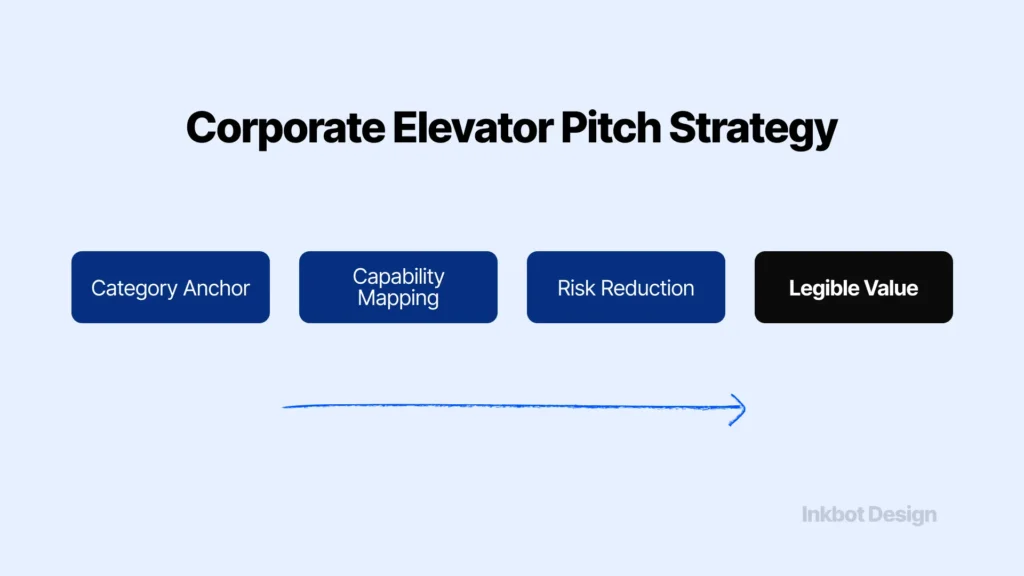
1. Establish the Category Anchor: Ensure immediate comprehension within 5 seconds.
Start by anchoring your firm in a clear, recognised industry category. Do not use creative titles or invented terminology that forces the listener to work to understand what you do. Name your category plainly (e.g., “We are a corporate restructuring advisory firm”) and pair it with the primary, systemic problem your target market faces.
2. Map Legible Capabilities to the Problem: Replace abstract outcomes with concrete operational actions.
Explain exactly how your firm solves the problem. Avoid vague outcomes like “we maximise efficiency.” Instead, list your concrete operational mechanisms (e.g., “We deploy proprietary diagnostic tools to audit supply chain vulnerabilities”). This makes your delivery mechanism tangible and believable to highly analytical buyers.
3. Introduce the De-Risking Mechanism: Neutralise the buyer’s fear of operational failure.
Enterprise buyers are highly risk-averse. Dedicate the third movement of your pitch to actively de-risking the decision to work with you. Highlight a specific proof point, compliance standard, or low-friction engagement entry point (such as an initial diagnostic audit) that lowers the stakes for the buying committee.
4. Deliver a Legible, Structured Value Metric: Define what success looks like without using hype.
Conclude the pitch by defining the outcome of your engagement using structured, professional terms. Connect this outcome directly back to the initial problem you introduced in Step 1. End with a clear invitation to take a low-commitment next step, such as a diagnostic review.
The Judgement Layer: Balancing Brevity and Legibility
This is where standard, AI-generated pitches fall apart. They assume that a pitch is a static formula that can be applied universally.
In the real world, senior leadership must exercise sharp professional judgement to adapt the pitch based on the context of the conversation and the specific makeup of the audience.
Adapt to the Buyer Persona
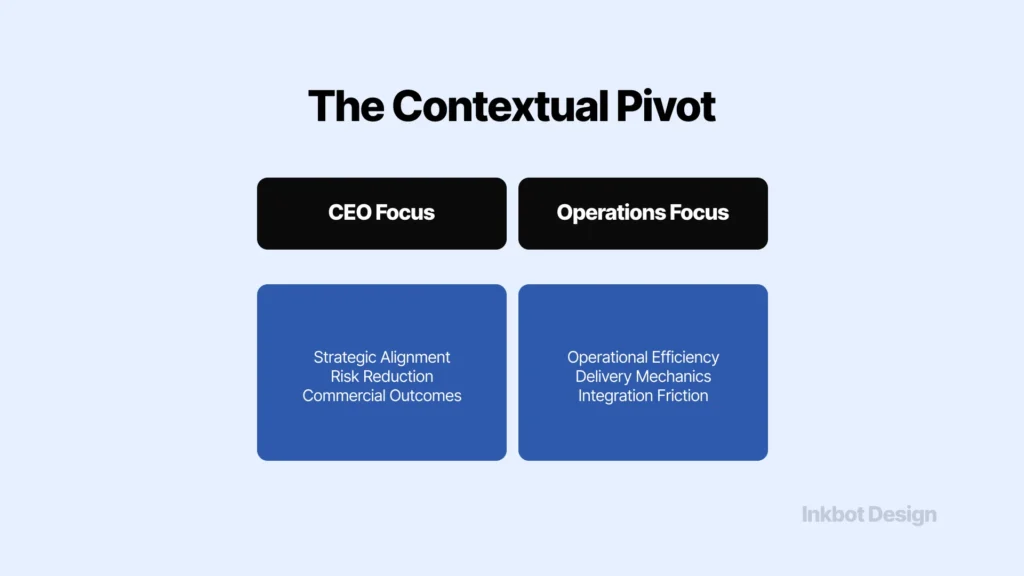
When speaking directly to a CEO, your pitch should focus on high-level strategic alignment and risk reduction.
However, if you are presenting to an Operations Director, you must instantly pivot to operational efficiency and delivery mechanics.
The core of the pitch—your brand messaging framework—remains identical, but the emphasis shifts.
Manage the Complexity of the Deal
A pitch for a £50,000 project can afford to be brief and outcome-focused.
A pitch for a £5,000,000 enterprise integration, however, must lead heavily with de-risking mechanisms, category compliance, and structural stability.
Do not try to force a complex, multi-year partnership into a superficial, 15-second sales slogan. Give the deal complexity the structural depth it deserves.
Case Evidence: Restructuring a Confusing B2B Message
At Inkbot Design, we regularly see highly successful professional services firms struggle to explain their actual value.
We recently worked with a London-based executive search firm that was pitching high-ticket talent acquisition services to FTSE 250 companies. Their original elevator pitch sounded impressive, but left prospects confused about their actual methodology:
“We are a premier human capital partner leveraging holistic synergy to transform organisational leadership and unleash executive potential across the global enterprise landscape.”
It was a parade of banned words and empty abstractions. Nobody knew what they actually did.
We worked with their leadership team to restructure their pitch around clear category anchoring, legible capabilities, and an explicit de-risking mechanism:
“We are a retained executive search firm specialising in placing CFOs into private-equity-backed mid-market companies. We utilise a proprietary 14-point psychometric assessment to verify cultural and commercial fit, reducing the risk of executive placement failure by 40% over the first 12 months.”
The results were immediate. By stripping away the corporate fluff and focusing on legible value, the firm’s directors reported clearer sales conversations, faster lead qualification, and significantly less time spent explaining basic operational details to prospective clients.
The Reality of the 2026 Buying Landscape
The corporate buyer of 2026 is highly sophisticated, deeply sceptical, and rarely acts alone.
To understand why abstract elevator pitches fail, you must look at the data driving modern enterprise purchasing decisions.
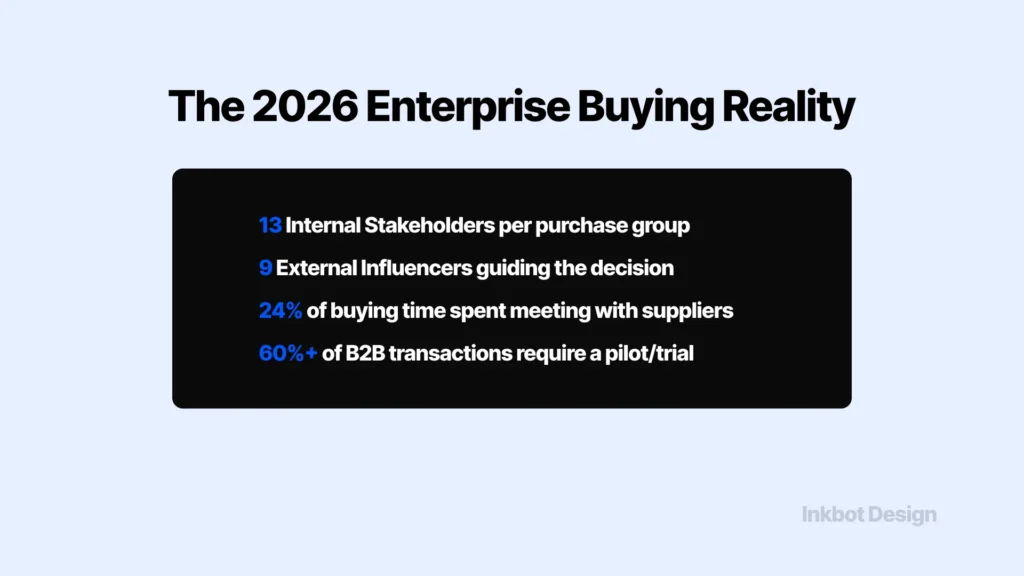
According to The State of Business Buying, 2026, a comprehensive research report published by Forrester Research, the typical B2B buying decision now includes an average of 13 internal stakeholders and 9 external influencers.
Furthermore, procurement departments are getting involved earlier in the sales cycle to enforce strict risk-mitigation protocols.
Research from Gartner reveals that internal buying teams can comprise 11 to 20 individuals, each with their own specialised operational concerns.
Gartner also reports that enterprise buyers spend only 24% of their active buying time meeting directly with potential suppliers.
The remaining 76% of their time is spent conducting independent research, evaluating competitors online, and collaborating internally.
This means your elevator pitch cannot afford to be a fragile, one-line creative slogan.
If your message is not highly legible, it will not survive the internal discussions that happen when your sales team is out of the room.
It must be structured so that a champion inside the client organisation can easily repeat it to the other 12 members of the buying committee.
The Disagreement: Why Your Pitch Must Stop Trying to Inspire

The consensus advice found across most business publications is that an elevator pitch should be “inspiring,” “creative,” and “memorable.”
Marketing gurus insist that you must make the client feel an emotional connection to your brand.
This advice is flatly wrong for high-ticket B2B professional services.
Enterprise buyers are not looking to be inspired by your pitch; they are looking to protect their organisations from making a catastrophic, career-limiting purchasing mistake.
High-ticket professional services engagements are inherently risky.
If an advisory firm botches a corporate restructuring or delivers a flawed tax optimisation strategy, the client’s business suffers, and the internal executive who hired them risks losing their job.
“In high-ticket B2B, buyers do not buy because they are excited. They buy because the fear of staying the same exceeds the perceived risk of making a change. Your pitch must lower that perceived risk.”
Instead of trying to sound inspirational, your pitch should focus entirely on lowering the buyer’s anxiety.
The table below contrasts the traditional, hype-driven approach to elevator pitches with a modern, risk-mitigated decision architecture.
Pitch Architecture Comparison
| Element | The Slogan-Based Pitch (Consensus) | The Decision Architecture Pitch (The Better Way) |
| Primary Goal | To excite, inspire, and entertain the listener | To reduce uncertainty and establish immediate category clarity |
| Core Message | Vague, abstract outcomes (“We transform business performance”) | Clear, legible capabilities (“We optimise mid-market supply chains”) |
| Tone | Enthusiastic, promotional, and marketing-heavy | Measured, analytical, objective, and authoritative |
| Risk Management | Ignored completely in favour of creative storytelling | Addressed directly via verified proof points and low-risk trials |
| Buying Committee Fit | Fails when reviewed by legal, procurement, or CFOs | Easily understood and approved by all 13 buying stakeholders |
By shifting your pitch from a creative performance to a structured de-risking framework, you align your messaging directly with the commercial realities of the modern enterprise buyer.
The Verdict: Actionable First Steps for Leadership
An outstanding corporate elevator pitch strategy is not a piece of creative writing. It is a highly disciplined operational asset that directly impacts your sales velocity and conversion rates.
If you want to transform your firm’s messaging from abstract fluff into a high-performance commercial tool, you must start with a systematic review of your current brand positioning.
Your first step today is to audit your existing leadership narrative. Gather your directors and ask them to write, in two sentences, exactly what your firm does, who it serves, and how you de-risk the engagement.
If you receive three different answers, your brand messaging is fragmented, and you are actively losing ground in high-stakes pitches.
To identify exactly where your messaging is losing commercial impact and how to fix it, request a structured diagnostic audit from our team.
We will analyse your current brand positioning, evaluate your competitive differentiation, and provide a clear, actionable roadmap to align your message with the needs of modern enterprise buying committees.
Request a Free Brand Equity Audit™ at Inkbot Design
Frequently Asked Questions
Why do most corporate elevator pitches fail in B2B sales?
Most B2B elevator pitches fail because they lead with abstract outcomes and marketing hype rather than clear category anchoring and legible capabilities. This leaves risk-averse buying committees confused about what the firm actually does and how it delivers its services.
How long should a professional services elevator pitch be?
A professional services elevator pitch should be between 30 and 45 seconds long. This is long enough to establish category anchoring, map capabilities, and introduce a de-risking mechanism, but brief enough to maintain engagement in high-pressure business environments.
What is the role of a brand messaging framework in an elevator pitch?
A brand messaging framework acts as the single source of strategic truth for an organisation’s communications. It ensures that all partners, directors, and sales teams utilise identical category anchors, capability maps, and proof points when pitching to prospects.
How do you de-risk a corporate pitch for enterprise procurement?
You can de-risk a corporate pitch by highlighting verified client proof points, industry compliance certifications, or by offering a low-commitment, structured initial engagement—such as a diagnostic audit—that allows the buyer to evaluate your capabilities with minimal financial exposure.
Should an elevator pitch focus on the features or the benefits?
An elevator pitch must balance both. While benefits establish the value of the outcome, professional services buyers require clear, legible features—your actual operational mechanisms—to verify that your firm possesses the concrete capability to deliver those benefits.
How do you handle multiple target audiences in a single pitch?
You handle multiple audiences by building a modular pitch framework. The core category anchor and de-risking mechanisms remain consistent, but the capability mapping section is pivoted to the context to address the specific pain points of the stakeholder you are addressing.
What is category anchoring in brand messaging?
Category anchoring is the practice of immediately placing your firm into a recognised, established industry category at the start of your pitch. This prevents intellectual friction and allows the buyer to understand your operational context instantly.
Why is risk reduction more important than inspiration in B2B?
Risk reduction is critical because enterprise buying decisions involve multiple stakeholders who are highly sensitive to operational disruption and financial loss. A pitch that focuses on reducing uncertainty is far more persuasive to a risk-averse committee than one that relies on creative hype.
How do we know if our firm’s elevator pitch is working?
You know your pitch is working when your sales cycle accelerates, lead qualification improves, and prospective clients immediately understand your capabilities without requiring extensive, repetitive explanations during introductory meetings.
What is the difference between a slogan and an elevator pitch?
A slogan is a brief, creative marketing phrase designed to build generic brand awareness. An elevator pitch is a structured, strategic narrative designed to communicate specific capabilities, solve targeted client problems, and de-risk complex purchasing decisions.
