Challenger Brand Strategy: How to Beat a Bigger Firm Without Outspending It
A challenger brand strategy does not win by being louder, cheaper, or more rebellious than the market leader. It wins by finding the leader’s unavoidable strength and making that strength feel like a weakness to a narrow group of buyers. Here is the mechanism, the evidence, and the moves.
 By Stuart Crawford
 Reviewed by Tabitha Ayers
10 min read
On this page10 min left
- What Challenger Brand Strategy Actually Means
- Why “Just Be Different” Is Half an Answer
- How the Leader's Greatest Strength Becomes Its Weakness
- What does this change mean for Your Firm?
- The Two Objections Worth Taking Seriously
- Where the Challenger Route Stands in 2026
- The Position You Choose Is the One the Leader Can't Take Back
- Frequently asked questions
A challenger brand strategy that copies the market leader: the same promises, the same proof points, the same reassuring corporate language, delivered on a smaller budget, is a plan to lose slowly.
The leader will always be the safer version of the thing you are both selling.
If a prospect wants that thing, they buy the leader. You become the runner-up; they mention keeping the incumbent's fee honest.
The firm that has standardised its service to scale it cannot easily offer the bespoke, partner-led engagement a founder-led client wants — and where it tries, through a boutique sub-brand, it usually starves that sub-brand of the very attention that would make it credible.
This is the ground on which the brand positioning is fought on: not whether the leader can announce its niche, but whether it can resource it without contradicting the model that made it the leader.
What Challenger Brand Strategy Actually Means
A challenger brand strategy is a deliberate positioning choice by a firm that is not the market leader to compete on a reframed basis rather than on the leader's terms. It does not require a bigger budget. It requires identifying the specific buyers the leader serves poorly, and building an offer, a message, and a proof structure aimed squarely at them.
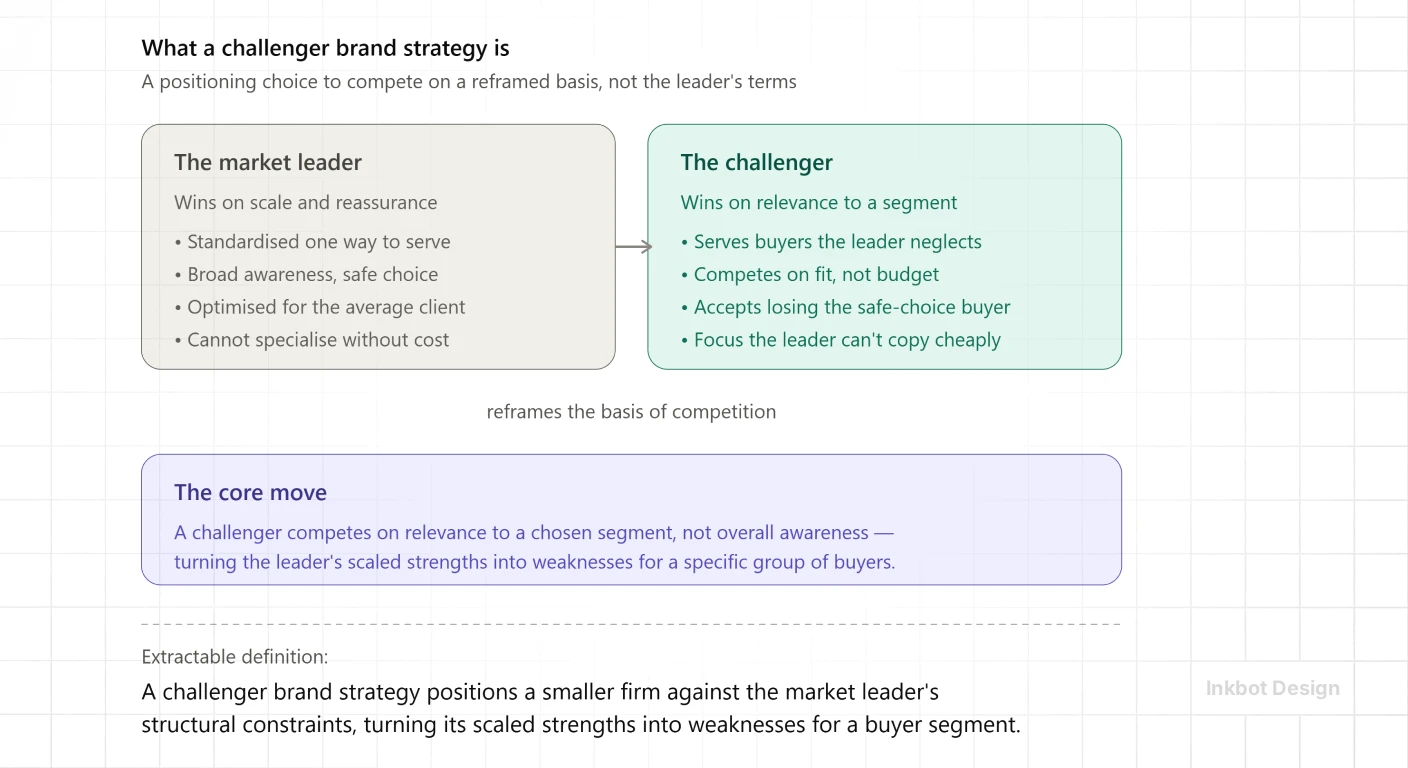
- A challenger competes on relevance to a chosen segment, not on overall awareness.
- A challenger accepts it will lose the buyers who want the safest, largest option — and stops trying to win them.
- A challenger's advantage comes from focusing on what the leader cannot copy without damaging its own scale.
Challenger brand strategy positions a smaller firm against the market leader's structural constraints, turning the leader's scaled strengths into weaknesses for a specific buyer segment.
Why “Just Be Different” Is Half an Answer

The standard advice is not wrong. It is incomplete.
Every guide on challenger brands tells you to be distinctive, pick a fight, serve an underserved niche, move faster, and commit to bold creativity.
Intelligent people repeat this because it genuinely describes what successful challengers look like from the outside.
Airbnb refused category conventions. Dollar Shave Club did use irreverent creative. The observations hold.
The problem is that they describe the symptom, not the cause. “Be different” tells you the outcome you need without telling you where the difference should come from. Difference for its own sake is just noise with a design budget.
A firm that repositions around a quirk no buyer cares about has been distinctive and irrelevant at the same time, which is the most expensive place a rebrand can land you.
The useful question is not “how do we stand out?” It is “where is the leader structurally unable to follow us?” Answer that, and distinctiveness stops being a creative brief and becomes a strategic one.
How the Leader's Greatest Strength Becomes Its Weakness
Here is the mechanism the archetype lists that you skip over.
A market leader is dominant because it has standardised one particular way of serving the market, optimised it, and scaled it.
That’s not an accident of size — it is the source of the size. The leader wins on efficiency, breadth, and the reassurance of being the obvious choice.
Every one of those strengths is a commitment. And every commitment excludes someone.
The firm that has standardised its service to scale it cannot easily offer the bespoke, partner-led engagement a founder-led client wants — doing so at scale would break the economics that made it the leader.
The firm that serves everyone competently serves no single segment brilliantly. The firm optimised for the average client is, by definition, wrong for the client at either edge of the distribution.
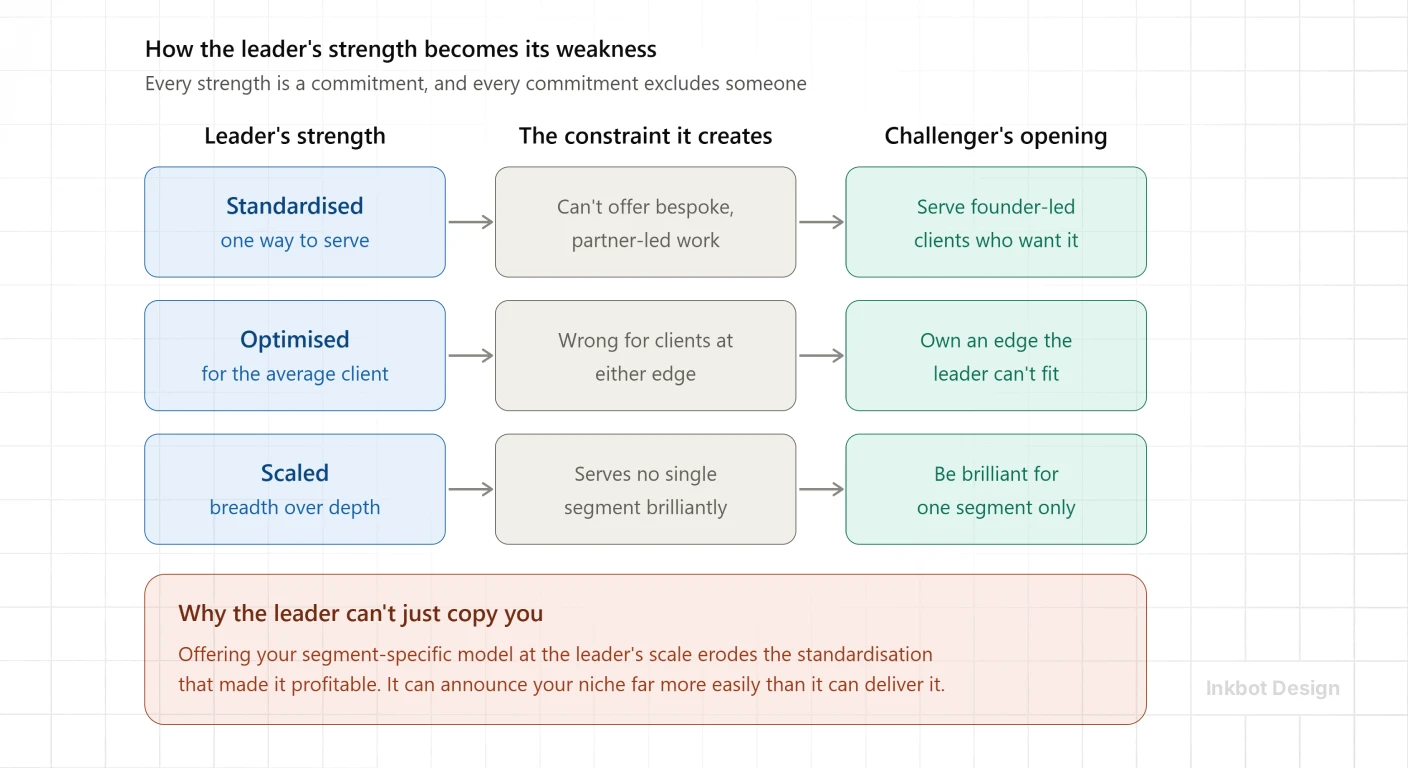
The challenger's move is not to attack the leader's weakness. It is to attack the leader's strength, reframed as a cost the right buyer is paying without realising it.
Consider what the consumer data shows about how fragile “leadership” actually is at the point of decision. NielsenIQ's 2025 study of more than 17,000 online consumers across 25 countries found that 58% say the brand or store brand is irrelevant to their choice because they buy based on necessity rather than name.
The leader's awareness advantage — the thing it spent decades and fortunes building — simply does not fire for most of a purchase.
NielsenIQ also found that 60% of consumers would buy more private-label products if a wider variety were available, which points directly at the gap: the leader's standardised range is a strength that leaves specific needs unmet.
Bain & Company's 2026 Insurgent Brands report puts a figure on what happens when challengers exploit that gap. Bain identified 113 high-growth US consumer brands that captured roughly 36% of tracked FMCG market growth in 2025, despite holding less than 2% of total market share, in a market that itself grew by under 2%.
Share of growth, not share of market, is the scoreboard that matters for a challenger — and on that scoreboard, incumbents' scale does not protect them.
“A market leader is not powerful despite its constraints. It is powerful because of them. It chose one way to serve the market, made that way brilliant, and in doing so made every other way somebody else's opportunity. The challenger's job is to be somebody else, on purpose, for a buyer who was never going to be happy with the average.”
What does this change mean for Your Firm?

If the mechanism is right, the practical implication is uncomfortable: you have to choose who you are willing to lose.
A challenger brand strategy for a professional services firm is not an exercise in adding messaging. It is a decision about which clients you will deliberately stop being suitable for, so that a narrower group finds you unmistakably suitable.
The work itself is three decisions, and none of them is cosmetic.
First, name the leader's structural commitment — how does the dominant firm in your market actually make its money, and what does that force it to standardise?
A national accountancy firm built for volume compliance cannot profitably provide a fast-growing tech founder with the advisory relationship the founder actually wants. There's your opening.
Second, define the buyer at the edge of the leader's distribution — not “SMEs”, but the specific client the leader's model serves the worst.
Third, rebuild every proof point around that buyer's specific risk, because a clearer position lowers perceived risk, and lower risk lets you charge a premium rather than a discount.
This is the same logic that underpins defensive brand strategy — you are protecting a position by making it too specific to attack cheaply.
The narrowing itself is often the hardest part, because it feels like shrinking. It is the opposite. Deciding what to stop selling is a strategic act, not an admission of weakness — the reasoning behind narrowing your service offering applies here as well.
The Default Approach | What It Costs | The Better Approach | Why It Works |
|---|---|---|---|
Match the leader's service range | You compete on price against deeper pockets | Serve the segment that the leader's scale fails | The leader can't follow without breaking its economics |
Broaden the message to reassure everyone | You become forgettable to everyone | Sharpen the message for one buyer | Specific relevance beats general awareness at decision time |
Compete on overall reputation | The leader's reputation is bigger | Compete on fit for a defined need | Fit reduces perceived risk; risk drives fee decisions |
Keep all clients to protect revenue | Positioning stays blurred | Choose who to stop being right for | Focus is the one advantage scale can't copy |
Out-produce the leader on content | You lose the volume game | Out-specify the leader for your niche | AI and buyers both reward evidenced specificity |
The Two Objections Worth Taking Seriously
The first objection is the honest one:
“Narrowing loses us revenue we currently rely on.”
It can, in the short term. The answer is not to pretend otherwise, but to sequence it — you reposition the brand and marketing around the chosen segment while continuing to serve existing clients, rather than firing them on announcement day.
The revenue you are protecting by staying broad is often the least profitable, least defensible revenue you have, and it is precisely the work a larger firm will undercut you on next year.
The second objection is sharper:
“What if the leader just copies our niche once we prove it works?”
Sometimes it will try. But the whole argument is that the leader's copy is expensive and self-damaging — offering your bespoke, segment-specific model at the leader's scale erodes the standardisation that made the leader profitable.
A genuine positioning built on the leader's structural constraint is defensible for exactly the reason it works: the leader can announce it far more easily than they can actually deliver it.
If your niche is one that the leader can copy cheaply, it was never a real challenger position — it was a feature.
Where the Challenger Route Stands in 2026
The challenger playbook has shifted, and the shift strengthens the case for professional services firms specifically.
The Seurat Group's 2026 Challenger Brand Study argues that the most effective challengers are no longer operating only at the fringes of a category — they are modernising familiar categories by improving the offer, introducing new occasions of use, and making established products relevant to audiences the incumbent stopped speaking to.
Translated into professional services: the opportunity to invent a service nobody offers is rare. It is to make an existing service dramatically more relevant to a buyer that the leader treats as an afterthought.
Two 2026 developments matter for how you execute.
Bain & Company reported that roughly a quarter of the insurgent brands it has tracked since 2017 have been acquired by major consumer-products companies, with 11 significant acquisitions in 2025 alone — a reminder that a successful challenger position becomes an asset. Still, that scale, once acquired, tends to dilute the very focus that created the value.
For an independent firm, that is a caution to protect the position rather than blur it as you grow.
The second is discovery. EY's August 2026 analysis reports that 58% of UK consumers are comfortable receiving AI-generated product suggestions, and 38% are willing to add a recommended item directly to their basket.
EY frames this as reported research rather than settled behavioural law, and its subjects are consumers, not B2B buyers, but the directional signal is relevant.
An AI recommendation engine does not default to the most famous name; it surfaces the option that best matches a stated requirement. That rewards the firm with a specific, well-evidenced, clearly structured position — and quietly erodes the unaided-awareness advantage the leader has always relied on.
Being narrowly right is becoming more valuable than being broadly known.
This is where a sharp niche marketing position stops being a brand preference and becomes a discovery advantage.
The Position You Choose Is the One the Leader Can't Take Back
A challenger brand strategy works when it stops trying to be a smaller, cheaper version of the market leader and starts being the deliberate answer to what the leader's scale forces it to neglect.
The evidence — 113 insurgent brands taking 36% of growth on 2% of share, 60% of consumers wanting variety the leader doesn't provide, AI discovery rewarding specificity over fame — all point in the same way.
Share of growth is winnable without share of budget, but only for the firm willing to choose who it is for and who it is not.
Decide on the one buyer segment the dominant firm in your market serves worst, and rebuild your entire position around being unmistakably right for them.
If you want that decision made rigorously rather than guessed, request a free Brand Equity Audit™. This structured diagnostic identifies exactly where your brand is losing commercial ground to a bigger competitor, and what to do about it.
Frequently asked questions
What is a challenger brand strategy in simple terms?
A challenger brand strategy is a way for a firm that isn't the market leader to compete by reframing the basis of competition rather than matching the leader's offer. It targets buyers the leader serves poorly and builds its position, message, and proof around them, winning on relevance rather than budget or awareness.
How can a smaller firm compete with a much bigger competitor?
By attacking the leader's structural strength, not its weakness. The leader scaled by standardising a single way of serving the market, leaving specific buyer segments underserved. A smaller firm wins by becoming unmistakably right for one of those segments — a focus the leader cannot copy without damaging its own economics.
Is being a challenger brand still effective in 2026?
Yes — arguably more so. Bain & Company found that 113 insurgent brands captured about 36% of FMCG growth in 2025, with under 2% market share. Seurat Group's 2026 study shows challengers succeeding by modernising categories, and AI-driven discovery increasingly rewards specific, well-evidenced positioning over unaided brand fame.
Why do challenger brands often lose their edge after they grow?
Because scale dilutes focus, Bain reports that roughly a quarter of the insurgent brands it has tracked since 2017 have been acquired by large companies. Acquisition brings distribution and resources, but frequently erodes the distinctive, narrowly focused position that created the brand's value in the first place.
What's the difference between being different and being a challenger?
Being different is a creative outcome; being a challenger is a strategic choice about where that difference comes from. Distinctiveness only works when it maps to something the market leader is structurally unable to offer a defined buyer group. The difference in no-buyer values is an expensive irrelevance, not a challenger position.
Does a challenger brand strategy mean lowering prices?
No — the opposite, usually. A clearer position aimed at a specific buyer reduces that buyer's perceived risk, and lower perceived risk justifies a premium rather than a discount. Competing on price puts a smaller firm on the leader's terms, where deeper pockets win. Challengers compete on fit.