Brand Impersonation Protection: Why Logos Cannot Verify Trust
Brand impersonation protection needs more than a recognisable identity. Professional services firms must give clients an independent way to verify sensitive requests, decide who responds to suspicious activity and understand what monitoring suppliers actually deliver. Build those rules into the rebrand before a copied logo becomes apparent permission to pay.



On this page8 min left
“We already have email security. Why do we need anything else?”
Because brand impersonation protection also covers requests made outside your genuine systems.
A copied website, lookalike domain or fake partner profile can appear to represent your practice without using your email infrastructure.
The US Federal Trade Commission (FTC), the consumer-protection agency, reported nearly US$1 billion in consumer losses to business impersonators in 2025.
$1B
That measures the money lost by consumers, not the costs incurred by impersonated firms, and it is not an estimate for UK professional services.
Your brand should be easy to recognise. A sensitive request should also be possible to verify. Those are different jobs.
For a firm preparing to rebrand, this belongs within brand protection before the new identity reaches clients.
A broader commercial brand audit addresses positioning and presentation; technical security and legal enforcement require their own expertise.
How Does Brand Impersonation Protection Work in Practice?
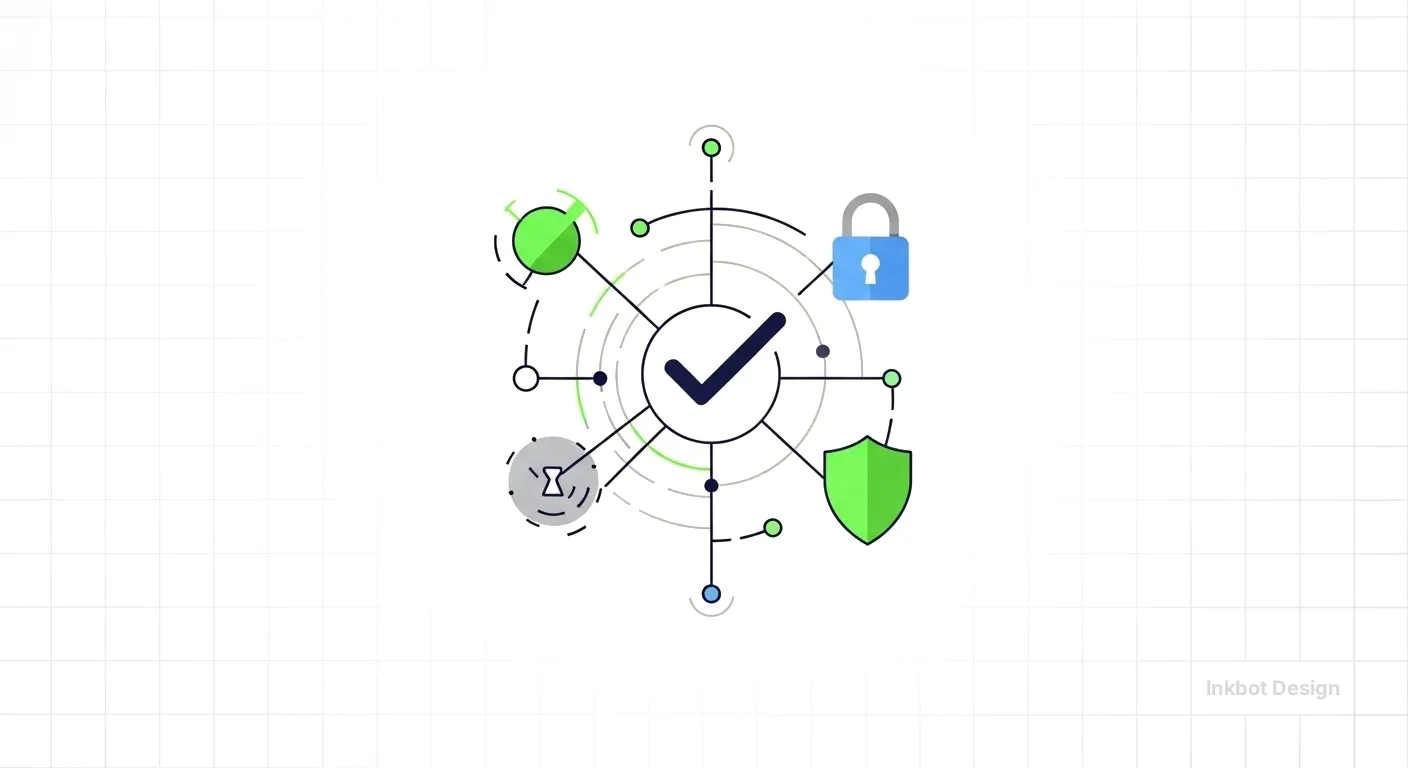
Brand impersonation protection operates across four interconnected layers to ensure a fraudulent identity cannot be weaponised against your clients:
- Technical Communication Authentication: Enforcing strict email security standards across all genuine firm domains to block direct address spoofing.
- Continuous External Perimeter Monitoring: Scanning domain registries, SSL certificate transparency logs, social media platforms, and search engine ads for deceptive lookalike registrations and brand infringements.
- Independent (Out-of-Band) Verification: Establishing non-digital or secondary operational channels that clients must use to confirm payment instructions or sensitive document requests.
- Structured Incident Response and Takedowns: Designating internal operational owners and external enforcement routes to report abuse, issue client warnings, and petition registrars for rapid asset removal.
The UK National Cyber Security Centre (NCSC), the government’s technical authority for cyber security, recommends layered defences rather than expecting people to identify every phishing attempt.
The practical aim is to prevent a familiar identity from becoming sufficient permission to pay, disclose information, or change account details.
What Does Brand Impersonation Protection Add if You Already Have DMARC?
Domain-based Message Authentication, Reporting and Conformance (DMARC) is an indispensable email authentication protocol.
Alongside Sender Policy Framework (SPF) and DomainKeys Identified Mail (DKIM), DMARC instructs receiving mail servers how to treat inbound messages claiming to come from your exact registered domain (NCSC Email Security Guidance).
When configured to strict enforcement (p=reject), it makes direct spoofing of your actual domain extraordinarily difficult.
However, technical boundaries dictate where DMARC stops:
- DMARC does not govern cousin domains (typosquatting): If your legitimate domain is companyfirm.com, your DMARC policy has zero authority over cornpanyfirm.com, company-firm.co.uk, or companyfirm-advisory.com.
- DMARC does not inspect third-party platforms: It cannot monitor a rogue WhatsApp account, a deceptive LinkedIn director profile, or a fraudulent Google ad.
- DMARC does not verify commercial authorisation: An email originating from a compromised genuine inbox will pass all SPF, DKIM, and DMARC checks, even if it carries an unauthorised bank account change request.
To evaluate your firm's exposure, leadership should ask their IT directors to answer three distinct perimeter questions:
- Direct Spoofing: Can an unauthorised external party send emails displaying our exact domain address? (Addressed by SPF, DKIM, and DMARC).
- Resemblance Attacks: Can an attacker register lookalike domains, cloned websites, or fake executive profiles that mimic our brand? (Addressed by external brand impersonation monitoring and trademark enforcement).
- Commercial Verification: If a deceptive request reaches a client or fee-earner, what operational safeguard prevents them from transferring funds or disclosing files? (Addressed by independent out-of-band verification procedures).
How Should a Professional Services Firm Approach Defensive Domain Registrations?

There is no universal formula for defensive domain portfolios.
Attempting to purchase every permutation of a trading name across hundreds of generic top-level domains (gTLDs) is commercially wasteful and administratively unmanageable.
Instead, establish a disciplined defensive registration policy covering:
- Your primary trading domain and primary national ccTLD (e.g. .com and .co.uk).
- Legacy domains retained from historical partnerships, mergers, or acquisitions.
- A tightly curated list of high-risk typographical variants (e.g. adjacent keyboard typos or common phonetic confusions).
Before purchasing any secondary domain, evaluate it against three governance criteria:
- Client Plausibility: Would a sophisticated corporate client or partner realistically confuse this URL with your legitimate correspondence address?
- Commercial Materiality: Does the address directly mirror an active service line, a legacy brand name still trusted by clients, or a primary jurisdiction you serve?
- Lifecycle Governance: Can your operations team actively maintain DNS records, SSL renewals, and auto-renewals without creating an untracked portfolio of orphan domains?
Where a domain dispute crosses borders, international trademark enforcement becomes a separate legal question. Buying another spelling is not a substitute for deciding which rights and recovery routes apply.
Who Handles Brand Impersonation Incidents, and What Evidence Is Required?
Automated threat alerts are merely notifications; they do not resolve an attack.
An effective response requires an internal incident lead designated before subscribing to external monitoring tools.
For a mid-sized partnership, the managing partner or executive director should approve the escalation protocol and ensure that deputy coverage is in place.
The NCSC specifically recommends testing incident response plans in advance to prevent confusion during an active breach (NCSC Incident Management Guidance).
The operational allocation below outlines standard duties:
Incident Stage | Proposed Owner | Completion Verification |
|---|---|---|
1. Triage & Assessment | IT or Managed Service Provider (MSP) | Threat classified, severity graded, and ticket logged. |
2. Evidence Preservation | Incident Lead with Technical Support | Raw email headers (.eml/.msg), DNS lookups, and dated screenshots secured. |
3. Brand Identity Audit | Marketing / Communications Lead | Genuine trading names, logos, partner bios, and assets confirmed. |
4. Abuse Submission | Dedicated Technical / Legal Owner | Reports filed with registrar, hosting provider, and platform abuse desks; case IDs recorded. |
5. Client Communications | Executive Leadership / General Counsel | Factual advisory issued via established, independent channels. |
6. Case Tracking & Closure | Incident Lead | Registrar responses, escalations, and post-incident reviews documented. |
When compiling evidence for a registrar takedown or social platform report, assemble a single structured dossier containing:
- The offending URL, lookalike domain, or social account handle.
- Full RFC 822 email headers preserving origin routing data (collected safely by technical staff without clicking links).
- Dated screenshots showing unauthorised use of the firm’s logo, staff likenesses, or partner signatures.
- Documentation proving your legitimate prior rights (trademark certificates or official trading registry details).
In the UK, malicious websites mimicking businesses can be reported directly to the NCSC's National Reporting Service, while suspicious emails can be forwarded to report@phishing.gov.uk.
How Can Firms Protect Clients While Malicious Assets Remain Online?
Registrar takedowns and platform removals take time—frequently spanning 24 to 72 hours, and significantly longer if the provider operates in an uncooperative jurisdiction.
Relying solely on the notice “Please remain vigilant” offloads the security burden onto the client. Instead of urging vigilance, give clients an explicit, dependable operational route to verify sensitive instructions.
The Out-of-Band Client Verification Protocol
The NCSC advises organisations to establish secondary communication methods for high-stakes transactions. For legal, accounting, and advisory firms, this means codifying four operational rules:
- Designated Authentication Channels: Explicitly state in client onboarding agreements where genuine banking and contact details reside (e.g. within an encrypted client portal or confirmed physically during onboarding).
- Dual-Authorisation Payment Rules: Establish that your practice will never amend settlement accounts or bank details via an unverified email thread. Any change request must be confirmed by telephone with a known partner using a pre-agreed number.
- Triage for Affected Clients: Specify a named emergency contact within the finance team if a client suspects they have transferred funds to an impersonated account.
- Out-of-Band Backup Channels: Maintain a tested secondary channel (e.g., SMS broadcast or portal bulletin) in case the firm’s primary mail server is disrupted.
Scenario: The Rebrand Invoice Redirection Attack
Consider a 90-person UK accountancy practice undergoing a rebrand following an acquisition.
A long-standing corporate client receives a digital invoice displaying the firm's new logo, new colour palette, genuine partner name, and an authentic-looking email signature, requesting payment to a revised bank account.
Under an unmanaged process, the visual familiarity of the branding creates a false sense of security. Under a strict verification policy, the client does not approve the transfer from appearance alone.
The client calls the finance director using the verified telephone number established during onboarding. Finance identifies the request as fraudulent, flags the lookalike domain, and prevents financial loss.
Monitoring Search Engine and Social Media Advertising
On 24 September 2026, the US FTC opened a public consultation to examine whether algorithmic advertising optimisation on major platforms facilitates business and government impersonation scams (FTC Public Notice, September 2026).
Fraudsters routinely purchase sponsored search ads targeting brand keywords, driving traffic to cloned landing pages.
When auditing brand perimeters, incident teams must monitor paid search results alongside domain registrations to ensure deceptive ads are promptly reported to ad networks.
Include paid advertising in the response scope.

On 24/09/2026, the FTC sought public comment on whether online platforms’ advertising-optimisation practices further business and government impersonation scams.
The consultation concerns the distribution of fraudulent advertisements and the underlying deception. It is not a final finding or a completed new rule.
This is one practical aspect of brand resilience: clients need a usable way to check what is happening while the incident remains unresolved.
Evaluating Brand Impersonation Protection Services: A Buyer’s Checklist
When procuring commercial brand protection services, firms frequently purchase software subscriptions that deliver endless automated alerts without human remediation.
An alert is not protection. When evaluating prospective cybersecurity and brand monitoring vendors, demand clarity on operational workflows:
Seven Due-Diligence Questions for Prospective Suppliers:
- Monitored Assets: Does the scope cover legacy-acquired domain names, partner names, social profiles, and app stores, or only exact-match domains?
- Triage Responsibility: Does the vendor manually validate and grade threat alerts, or does your internal team receive unvetted automated logs?
- Takedown Ownership: Does the vendor assemble evidence and submit abuse filings directly to registrars, or do they simply provide contact details for you to manage?
- Dispute Resolution Escalation: What process is triggered if a domain registrar or platform abuse desk ignores or rejects a takedown request?
- Contractual Volume Caps: Are there monthly thresholds on incident investigations, case submissions, or out-of-hours escalations?
- Dispute Costs: Are formal UDRP domain recovery filings, trademark notices, and legal representation included, or billed separately?
- Data Portability: Can the firm export comprehensive evidence logs, RFC headers, and historical case files upon contract termination?
Before selecting a vendor, request a live simulation: ask them to demonstrate how their service would identify, triage, and remove a fraudulent LinkedIn partner profile targeting your practice.
Testing the end-to-end operational workflow is vastly more informative than reviewing a software feature sheet.
Make Verification part of the Rebrand Sign-off.
Approve the new identity, along with the rules for checking sensitive requests.
Before launch, ask someone outside the project team to locate the genuine contact route, explain how a payment change is verified and identify who receives an impersonation report.
If the answers require the project director to explain them, revise the process.
For the commercial identity and messaging side, request Inkbot Design’s free Brand Equity Audit™ through the commercial brand audit link above.
The audit assesses positioning, visual identity, messaging and visibility; it is not a security assessment or legal clearance service.
Today, assign one owner to document and test the route a client uses to verify a sensitive request.
Questions people ask
Does a corporate rebrand require changing your domain name?
No. A strategic repositioning or visual refresh does not require migrating to a new web domain. A domain change should only occur if the firm changes its legal trading name, restructures ownership, or alters its core client portal access. If a domain migration is unavoidable, legacy domains must be permanently maintained, redirected via 301 server rules, and monitored for lookalike abuse.
Does registering a registered trademark prevent fake accounts or lookalike domains?
No. Trademark registration does not technically prevent a third party from registering a domain or setting up a social media profile. Rather, a registered trademark provides the legal standing required to pursue formal dispute proceedings (such as a WIPO UDRP case) or submit verified intellectual property infringement notices to platform abuse desks.
Should clients rely on spotting visual logo mistakes to identify phishing scams?
No. Visual inspection should never serve as the primary security control for sensitive transactions. High-resolution vector logos, partner likenesses, and typography can be scraped and cloned in minutes. The UK National Cyber Security Centre (NCSC) explicitly recommends layered authentication systems and out-of-band verification procedures rather than relying on human visual detection.
Is a brand equity audit the same as an impersonation security assessment?
No. Inkbot Design’s Brand Equity Audit™ evaluates commercial positioning, visual trust signals, messaging architecture, and AI search visibility. Technical mail server configuration (SPF/DKIM/DMARC), infrastructure penetration testing, and legal domain dispute resolution require separately scoped technical and legal engagements with qualified cybersecurity specialists.