Is AI Design Good or Bad Business? An Honest Verdict
You’re an entrepreneur, not a tech blogger. You don’t care about “generative adversarial networks.” You care about whether this “AI design” thing will save you money or cost you your business.
As a brand consultant for over 20 years, I’ve seen the trends. Flash websites. Skeuomorphism. Brutalism. And now, the AI revolution. The hype is deafening, and frankly, the advice being given to small business owners is dangerously simplistic.
The question isn’t just “Is AI design good or bad?” The real question is, “Where does it fit, and when is it a liability?”
Most businesses are using it wrong. They’re treating a calculator like it’s a financial strategist. They’re getting a “logo” in 30 seconds and wondering why it feels hollow and looks suspiciously like their competitor’s.
It’s a tool. A powerful one. But it’s also a trap. And as someone who has to clean up the strategic mess it can create, I have some strong opinions.
- “AI is creative.” No, it’s not. It’s a phenomenally complex pattern-matching engine. It remixes, it blends, it averages the entire internet. It cannot invent. It cannot have an original idea. It cannot understand your why.
- “Prompting is the new design.” This is nonsense. Knowing how to type “minimalist logo for a coffee shop, vector, flat design” is not design. Design is strategy. It’s understanding a target audience, a competitive landscape, and a unique value proposition. Prompting is just a new way to sketch.
- “I got my logo from Midjourney for £5.” And it shows. You got a generic, non-scalable, probably non-trademarkable image. You didn’t get a brand identity system. You got a JPEG.
- “AI will replace designers.” No. AI will replace lazy designers who just push pixels. It will replace designers who compete on price and speed. It will never replace a designer who thinks, strategises, and solves a unique business problem.
Now that’s off my chest, let’s look at this objectively.
- AI is a tool, not a creator — it remixes internet patterns and cannot replace human strategic insight or original ideas.
- Use AI for speed and grunt work: mood‑boarding, resizing assets, A/B variations — low‑risk, high‑volume tasks.
- Never rely on AI for core brand identity: logos and naming are high‑risk, need originality, vectors, and legal defensibility.
- AI creates "sameness" and legal ambiguity; cheap solutions defer costs as technical and brand debt, risking costly rebrands.
- Best approach is hybrid: human‑led strategy and refinement, AI as an accelerator for ideation and production.
Why Every Entrepreneur is Chasing “AI Design”
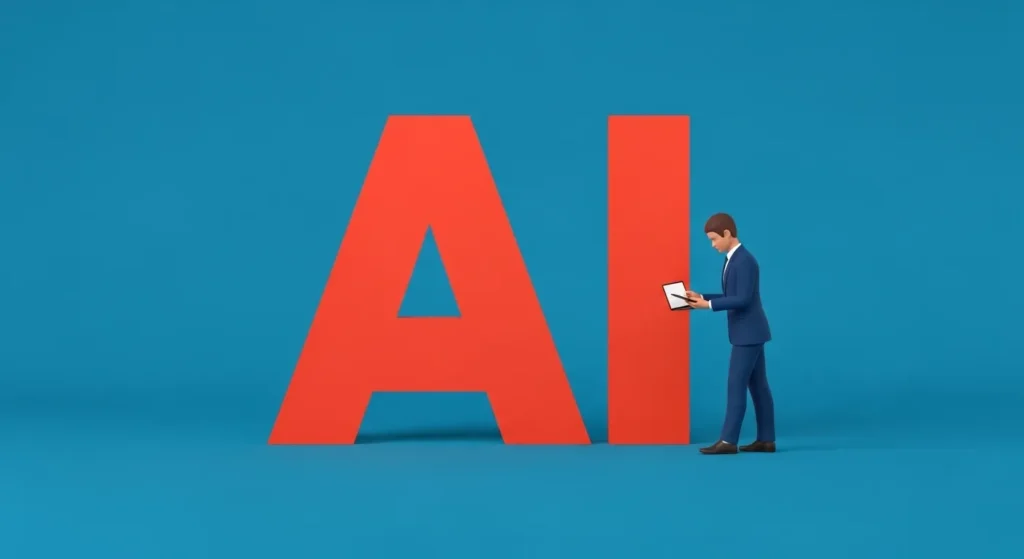
I get it. When you first start an online business, every single penny and every single minute counts. The pressure is immense.
Along comes this new technology promising to solve one of your biggest initial hurdles—your brand identity—for the price of a Netflix subscription.
1. Unbelievable Speed
You need a logo. Right now. You also need social media posts for a launch, a banner for your website, and an image for your blog post.
- The Old Way: Brief a designer, wait for concepts, review revisions, and wait for final files. This could take days or weeks.
- The AI Way: Type a prompt. Get 100 variations in 60 seconds.
For an entrepreneur juggling 50 tasks, that speed is intoxicating. It feels like a superpower.
2. The “Free” Price Tag
A professional logo design can range from a few hundred pounds to tens of thousands of pounds. Most small businesses don’t have that kind of cash to spare initially.
AI tools, by comparison, seem “free” or incredibly cheap. A £20/month subscription feels like nothing. This “democratisation” of design is the primary sales pitch. You get to look professional without the professional price tag.
Or so the story goes.
3. Infinite Iteration
Don’t like the blue? Instantly see it in 50 shades of green. Want a different layout? Click a button.
The ability to iterate without feeling like you’re “bothering” a designer or racking up billable hours is a massive psychological win. You can tweak and prod to your heart’s content until you land on something that feels “good enough.”
This combination of speed, cost, and control is why AI design is the most promising new asset for entrepreneurs. It solves immediate, painful problems.
The issue? It often creates significantly larger and more expensive problems down the line.
The “Good” – Where AI Design is Genuinely Useful (The Accelerator)
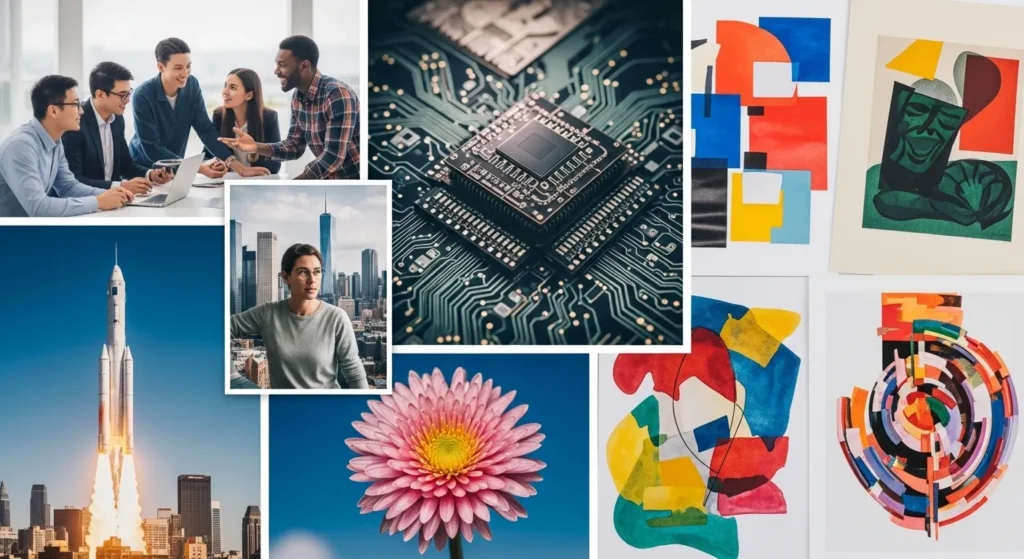
I’m not an anti-AI dinosaur. My agency uses it every single day.
When used correctly, AI is a phenomenal accelerator. It’s the best junior designer I’ve ever had. It never gets tired, it never complains, and it’s incredibly fast.
Here is where AI design is good business.
1. The Ultimate Brainstorming Partner
Stuck for an idea? A blank page is intimidating.
AI is brilliant at “what if” scenarios.
- Show me 20 mood boards for a sustainable, luxury skincare brand.
- “Generate 50 colour palette ideas based on ‘autumn in Scotland’.”
- “Give me 10 layout concepts for a webinar announcement.”
It’s a visual stimulant. 98% of what it gives you will be rubbish. However, the 2% that isn’t can spark a genuinely original idea that a human designer can then build upon. It’s a way to get unstuck, fast.
2. Crushing the “Grunt Work” of Marketing
This is AI’s single best use for small businesses.
You have your brand strategy. You have your core logo, colours, and fonts (hopefully from a human). Now you need to execute.
- Resizing Assets: “Take this main ad creative and resize it for Instagram Story, Facebook banner, and Google Display Ad.” This used to take hours. Now it takes minutes.
- Simple Social Posts: “Create a simple graphic for this customer testimonial, using my brand’s font and colours.
- Stock Imagery: “Generate a photorealistic image of a woman working at a laptop in a bright, minimalist cafe.”
This isn’t design so much as production. It’s a “doing” task, not a “thinking” task. AI is brilliant at this.
3. Data-Driven Iteration
Want to A/B test a landing page button? AI can help you generate 10 variations of “Sign Up Now” in different styles and colours almost instantly.
You can test headlines, images, and layouts at a scale that was previously impossible for a small team. This is a clear, data-driven approach to enhance your marketing.
Here’s a simple breakdown of the risk.
SME Guide to AI Design Risk: Low-Risk vs. High-Risk Tasks
| Task Type | Risk Level | Why? | Our Advice |
| Core Brand Identity (Logo, Name) | EXTREME HIGH | This is your foundation. It needs to be unique, strategic, and legally defensible. AI is generic and legally grey. | Avoid. This is an investment, not an expense. Hire a professional. |
| Website Design (Full UX/UI) | HIGH | AI can’t understand user flow, conversion goals, or your customer’s journey. It just makes “pretty” (and generic) layouts. | Use for inspiration only. The site strategy and structure must be human-led. |
| Marketing “Grunt Work” (Social Posts, Banners) | LOW | These are disposable assets. They live for 24 hours. Speed and volume are more important than deep originality. | Use AI freely. This is its sweet spot. Accelerate your production. |
| Brainstorming / Mood Boards | LOW | This is a private, internal process. The goal is to generate sparks, not final products. | Use AI freely. It’s a fantastic idea-starter. |
| Complex Illustrations / Brand Mascots | MEDIUM | You risk “sameness” and the weird “AI-hands” look. However, it can serve as a starting point for a human illustrator. | Use for concepting, then hand off to a professional illustrator for refinement. |
The “Bad” – The Hidden Traps for Small Businesses (The Impostor)
This is the part that worries me. I’ve personally “rescued” three clients in the past year who went all-in on the AI-only route.
They came to us six months in, completely frustrated. Their “brand” was a mess of inconsistent, soulless assets. They had no brand guidelines. Their logo resembled those of five other companies in their space. They couldn’t explain why they looked the way they did.
We had to start from scratch. They didn’t save money; they just wasted six months.
Here is where AI design is a bad business move.
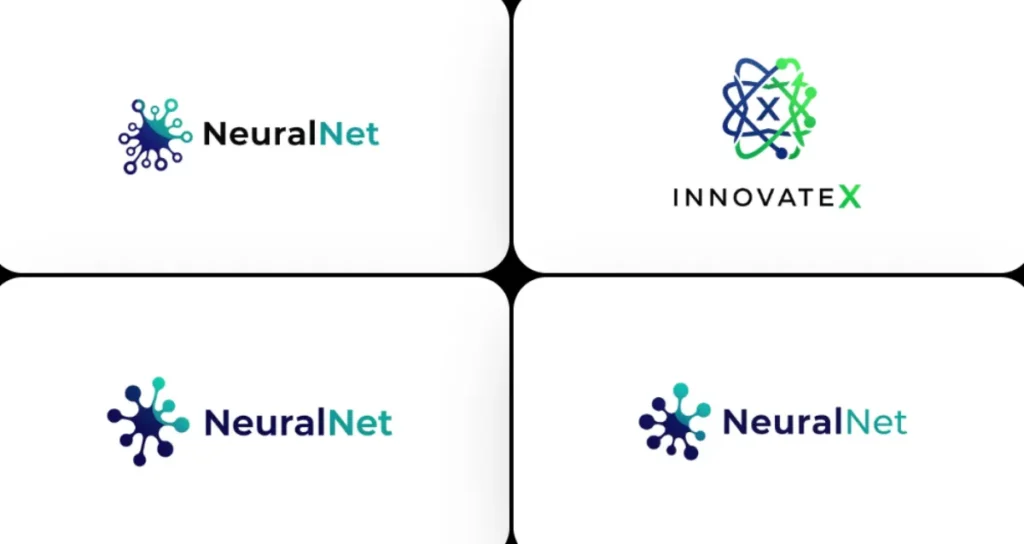
1. The “Sameness” Problem: Are You Building a Brand or a Clone?
Go to any AI image generator and type in “logo for a tech startup.”
You will get a sea of blue and purple gradients. Abstract ‘V’ or ‘G’ shapes. Clean, sans-serif fonts.
AI tools are trained on the same massive datasets. They are, by their very nature, designed to produce the most likely or average result based on a prompt. The opposite of what a brand should be.
A brand’s job is to be distinct. An AI’s job is to be generic.
If your logo looks like the average of everything else, you don’t have a brand. You have camouflage. You’re paying to look invisible.
2. The Strategy Vacuum: AI Doesn’t Know Your Customer
A professional designer’s first question is not “What colours do you like?” They are:
- “Who is your exact customer?”
- “What problem do you solve for them?”
- “Who are your top three competitors, and what do they look like?”
- “What is the one emotion you want people to feel when they see your brand?”
AI cannot ask these questions. It cannot understand nuance, psychology, or market positioning. It can only execute a visual command, completely disconnected from the business strategy.
A logo isn’t just a pretty picture. It’s the tip of the strategic iceberg. If you build on a foundation of “I just typed in what I do,” you have no foundation at all.
3. The Legal Minefield: Can You Even Own Your AI Logo?
This is the scariest part for any entrepreneur. The law is a grey, murky, and rapidly changing mess.
- Copyright: In most jurisdictions (including the US), you cannot copyright work generated purely by an AI. The US Copyright Office has repeatedly stated that human authorship is a prerequisite.
- Trademark: How can you trademark a logo if you can’t prove it’s original? What if the AI used elements from a copyrighted image in its training data? What if 1,000 other people generated a logo that looks 90% like yours?
You are building your entire business on a visual asset that you may not own and cannot defend. This is a catastrophic, company-ending risk. You’re one cease-and-desist letter away from a complete, forced rebrand.
The “Ugly” – The True Cost of “Cheap” AI Design
The biggest lie of AI design is that it’s cheap. It’s not. It just defers the cost.
You’re not paying in pounds; you’re paying in Technical Debt and Brand Debt.
1. Technical Debt: “My AI Logo is Useless”
The client rescue I mentioned? Their “logo” was a 1024×1024 pixel PNG file.
That’s it.
- They couldn’t put it on a T-shirt (it would be pixelated).
- They couldn’t send it to a sign-maker (they were laughed at).
- They couldn’t change its colour without it looking terrible.
- They couldn’t put it on a dark background because the original had a white one.
A professional designer delivers a logo system. This includes vector files (.ai, .eps, .svg) that can be scaled to the size of a billboard or a pin badge without losing quality. It includes transparent backgrounds, full-colour versions, one-colour (mono) versions, and a favicon.
The “cheap” AI logo is technically useless for 90% of real-world business applications.
2. Brand Debt: The Cost of Doing It Twice
Let’s say you use your AI logo for six months. You build some recognition. You print 5,000 business cards. You put it on your van.
Then, you get that legal letter. Or you realise you can’t scale it. Or you finally admit it just looks amateurish and is holding you back.
Now you have to rebrand. You have to pay for a professional designer anyway. And on top of that, you have to:
- Reprint all your marketing materials.
- Redo your website.
- Rewrap your van.
- Confusion to your existing customers.
- Lost momentum.
This “brand debt” is why many founders end up seeking professional graphic design services after wasting thousands of pounds and half a year on an identity that was doomed from the start.
Let’s actually quantify this.
The True Cost of “Free”: AI Subscriptions vs. Professional Design
| Cost Factor | “Cheap” AI Design (e.g., Midjourney) | Professional Design (e.g., Inkbot) |
| Upfront Cost | £20 / month | £500 – £5,000+ (one-time) |
| Files Included | 1024×1024 PNG/JPG (Raster) | Full vector files (.ai, .eps, .svg), PNG, JPG. Full-colour, mono, transparent. |
| Strategy | None. (You type a prompt). | 1-on-1 strategy calls, competitor analysis, and audience profiling. |
| Originality | Very low. Generic, based on training data. | 100% bespoke and original. |
| Legal Ownership | Legally grey. Likely un-copyrightable and hard to trademark. | Full copyright transfer. Trademark-ready. |
| Revisions | Infinite, but low-control. | Structured revision rounds with an expert. |
| Brand Guidelines | None. | Included. (How to use colours, fonts, and logo.) |
| Risk of Rebrand | High. Due to legal or technical issues. | Very Low. |
| Total 1-Year Cost | £240 + £??? in future rebranding & legal risk. | £500 – £5,000+. (Done right, once.) |
Looking at this, the “cheap” option is suddenly very, very expensive.
How You Should Use AI Design (The Hybrid Model)
So, what’s the answer? It’s not “AI-only.” And for most, it’s not “human-only.”
The smartest, most cost-effective, and highest-quality approach is the Hybrid Model. You use AI as an accelerator for a human-led strategy.
Step 1: Strategy First (100% Human)
Do not touch an AI tool. Sit down with a pen and paper (or a professional).
- Who are you?
- Who do you serve?
- Why should they care?
- What makes you different?
This is the non-negotiable foundation.
Step 2: Ideation & Exploration (AI-Assisted Human)
Now that you have a strategy, you can use AI as your brainstorming partner.
- Human: “My brand is ‘rustic, organic, and trustworthy.’ Let’s find some visual directions.”
- AI: Generates 50 mood boards based on that brief.
- Human: “Interesting. I like the earthy tones from boards 3 and 12, and the hand-drawn font style from board 7. Let’s combine those.”
Step 3: Refinement & Originality (100% Human)
This is where the professional takes over. You close the AI tools.
A human designer takes those sparks of inspiration and creates something new. They sketch, they combine, they refine. They ensure the typography is perfectly kerned. They create a custom icon.
They build an original asset that is born from a strategy, not just a prompt.
Step 4: Production & Scaling (AI-Assisted Human)
The logo system is finalised. The brand guidelines are set.
Now, you can use AI to execute that strategy.
- Human: “I need 10 social media posts for our new blog, using our brand fonts and this pull-quote.”
- AI: Generates 10 posts that are perfectly on-brand.
This is the smart way. You utilise AI for what it excels at (speed, volume) and humans for what they are essential for (strategy, originality, ownership).
This table summarises the Hybrid Model in practice.
The Hybrid Workflow: When to DIY with AI vs. Hire a Pro
| Business Need | ✅ Use AI (DIY) | ⚠️ Use AI with Caution (Hybrid) | 🛑 Hire a Professional (Human-Only) |
| Final Logo Design | X | ||
| Brand Strategy | X | ||
| Trademarkable Assets | X | ||
| Vector Files (.svg) | X | ||
| Mood Boards | X | ||
| Initial Colour Palettes | X | ||
| Social Media Posts | X | ||
| Resizing Ads | X | ||
| Blog Post Images | X | ||
| Website Layout Ideas | X | ||
| Unique Illustrations | X (Use as a base, then hire) |
Our Take: How We Actually Use AI at Inkbot Design
We practice what we preach. At Inkbot Design, we’ve integrated AI into our workflow, but not in the way you might think.
We do not use AI to generate final logos for our clients. Period. It’s unethical, it’s a legal risk, and it’s a strategic shortcut we’re not willing to take.
Here’s how we do use it:
- Client Mood Boarding: Following our strategy call, we utilise AI to generate 3-4 distinct visual worlds for the client to engage with. This helps us get on the same page visually, much faster.
- Internal Iteration: A designer will have an idea. They’ll use an AI tool to quickly mock it up in 10 different ways, checking for weaknesses before they spend hours refining it in Adobe Illustrator.
- Content & Marketing: Our marketing team uses it to help draft blog post outlines, create simple social graphics, and A/B test ad copy.
It’s an assistant. It’s a co-pilot. It’s not the one flying the plane.
The Final Verdict: Is AI Design Good or Bad Business?
Let’s circle back to the original question.
- AI Design is BAD business if you use it to replace your core brand strategy. It will ultimately cost you more. It will make you generic. And it will put you at massive legal risk.
- AI Design is GOOD business if you use it as an accelerator to execute a human-led strategy. It will save you time. It will save you money. And it will allow you (or your design partner) to focus on high-value thinking.
Don’t buy the hype that you can build a meaningful brand with a £20-per-month subscription. It’s a lie.
Build your foundation on strategy, differentiation, and human creativity. Then, by all means, use AI to build the house faster.
Your Next Steps
If you’re at the beginning of your journey, don’t build your business on a foundation of “sameness.”
If you’re one of the entrepreneurs I described—stuck with a generic, unusable AI logo and feeling frustrated—it’s not too late.
The smarter move is to invest once, do it right, and establish a professional brand identity that you own, can scale, and that actually connects with your customers.
At Inkbot, we build brands based on strategy, not prompts.
- Discover our professional graphic design services and see how we craft enduring brands.
- Read more of our insights on branding and business on our blog.
- If you’re ready to build a genuine brand, you can request a quote, and we’ll have an honest conversation about your business.
Frequently Asked Questions
Can I trademark a logo I made with AI?
It’s extremely risky and unlikely. Trademark offices require human authorship. Since AI pulls from vast datasets, your logo may not be unique enough to qualify for a trademark, and you’ll likely lose a legal challenge.
What’s the biggest mistake businesses make with AI design?
Using it for their primary logo. This is the one asset that must be 100% unique, strategic, and legally defensible. Using AI for this is a classic “penny-wise, pound-foolish” mistake.
Is AI design “real” design?
No. It is image generation. Design is a process of strategic problem-solving. AI is just one tool within that process, like a pencil or a piece of software.
Will AI replace graphic designers?
It will replace low-skill “designers” who just operate software. It will not replace strategic designers, brand consultants, and art directors who solve business problems with creativity. It will just make them more efficient.
What’s the difference between an AI logo and a professional logo?
A professional logo comes with a brand strategy, is delivered in vector files (infinitely scalable), is legally yours (copyright transfer), and is 100% unique. An AI logo is a raster image (pixelated when scaled), has a legally grey status, and is based on generic, averaged data.
Are AI design tools like Midjourney or DALL-E good for anything?
Yes, they are brilliant for brainstorming, creating mood boards, generating draft ideas, and creating disposable marketing assets (like blog images or simple social posts) very quickly.
What’s the best “hybrid model” for a startup with no money?
Pay for a single 1-hour strategy session with a brand consultant.
Use that strategy to guide AI for mood boarding.
Hire a skilled, human designer (even a freelancer) for the logo only. Get the vector files.
Utilise AI to execute your day-to-day marketing tasks based on your logo and guidelines.
Can’t I just use an AI logo and trademark it later?
You can try, but you will likely be rejected. If another business (which also uses AI) has a similar logo, or if your logo is found to be “substantially similar” to existing work, your application will fail.
Is Adobe Firefly “safer” for business use?
Adobe claims Firefly is trained on “commercially safe” data (their stock library) and even offers some IP indemnification. This makes it safer than other tools for marketing assets, but it still doesn’t solve the “strategy” or “sameness” problem for a core logo.
Is an AI-generated website a good idea?
It’s a bad idea for the same reason an AI logo is: it’s not a good fit. A website isn’t just a pretty picture; it’s a conversion machine. AI can’t understand your customer’s journey, your sales funnel, or your user experience (UX) goals. Use it for “hero image” ideas, not for the entire site build.
Why do AI-generated logos look so similar?
Because they are trained on the same data and are designed to find the “average” or “most likely” visual solution for a prompt. A “Coffee shop logo” will almost always feature a coffee bean or a cup.
What is “brand debt”?
It’s the future cost you will have to pay for making a poor branding decision today. It includes the cost of rebranding, reprinting all materials, and the customer confusion caused by the change in your identity.