Accounting Advisory Services Packaging: 3-Tier Guide
Most UK accountancy firms build three-tier advisory menus around outputs—monthly reports, KPI dashboards, and quarterly meetings—then wonder why clients haggle or downgrade. Effective packaging of accounting advisory services sells three distinct levels of decision-making responsibility, backed by strict qualification rules and the discipline to refuse unbundled compliance work.
 By Stuart Crawford
 Reviewed by Tabitha Ayers
12 min read

On this page12 min left
- How Do You Package Accounting Advisory Services Effectively?
- Why Deliverable-Based Bronze, Silver, and Gold Menus Fail in Practice
- How to Structure a 3-Tier Advisory Model Around Decision Ownership
- Prerequisites and the Disqualification Rule: Knowing Which Tiers to Refuse
- Pricing Mechanics and a Worked Restructuring Example
- Stop Selling Hours Dressed Up as Packages
- Questions people ask
Packaging accounting advisory services around deliverables—monthly management packs, KPI dashboards, and quarterly board calls—trains your clients to shop by the line item and negotiate your fees down.
A three-tier advisory model works commercially only when each tier sells a distinct level of decision-making responsibility. When your partnership is willing to turn away clients who demand a tier you do not offer.
Most mid-tier UK chartered accountancy practices do not lose £50,000 advisory mandates to larger national competitors because their technical tax or corporate finance knowledge is weaker. They lose because their proposals look like a cafeteria menu of compliance tasks with a few forecasting spreadsheets bolted onto the side.
Fixing how prospects value your expertise starts with your accounting firm brand positioning, because a firm positioned as a compliance pair of hands will never convince a managing director to pay partner rates for strategic judgement.
How Do You Package Accounting Advisory Services Effectively?

Effective accounting advisory services packaging divides a firm's commercial expertise into three fixed-fee retainers defined by who owns the financial decision—moving from diagnostic risk-flagging (Tier 1) to scenario modelling (Tier 2) and board-level governance (Tier 3)—rather than counting reports, software licences, or hours.
- Tier 1 (Diagnostic Ownership): The accountancy firm guarantees clean data and flags commercial risks early, while the client's leadership team formulates the response.
- Tier 2 (Strategic Scenario Ownership): The accountancy firm models specific commercial decisions—such as capital expenditure, hiring, or pricing shifts—before the client commits capital.
- Tier 3 (Governance & Execution Ownership): The accountancy firm sits at the board table as a fractional Finance Director (FD) to co-own commercial targets, lender negotiations, and departmental accountability.
Accounting advisory services package structures non-compliance expertise into three commercial tiers defined by decision-making responsibility rather than deliverable volume or billed hours.
Why Deliverable-Based Bronze, Silver, and Gold Menus Fail in Practice
Walk into the boardroom of most 10-partner UK accountancy practices and ask to see their Client Advisory Services (CAS) proposition.
Nine times out of ten, someone slides across a PDF table titled Bronze, Silver, and Gold.
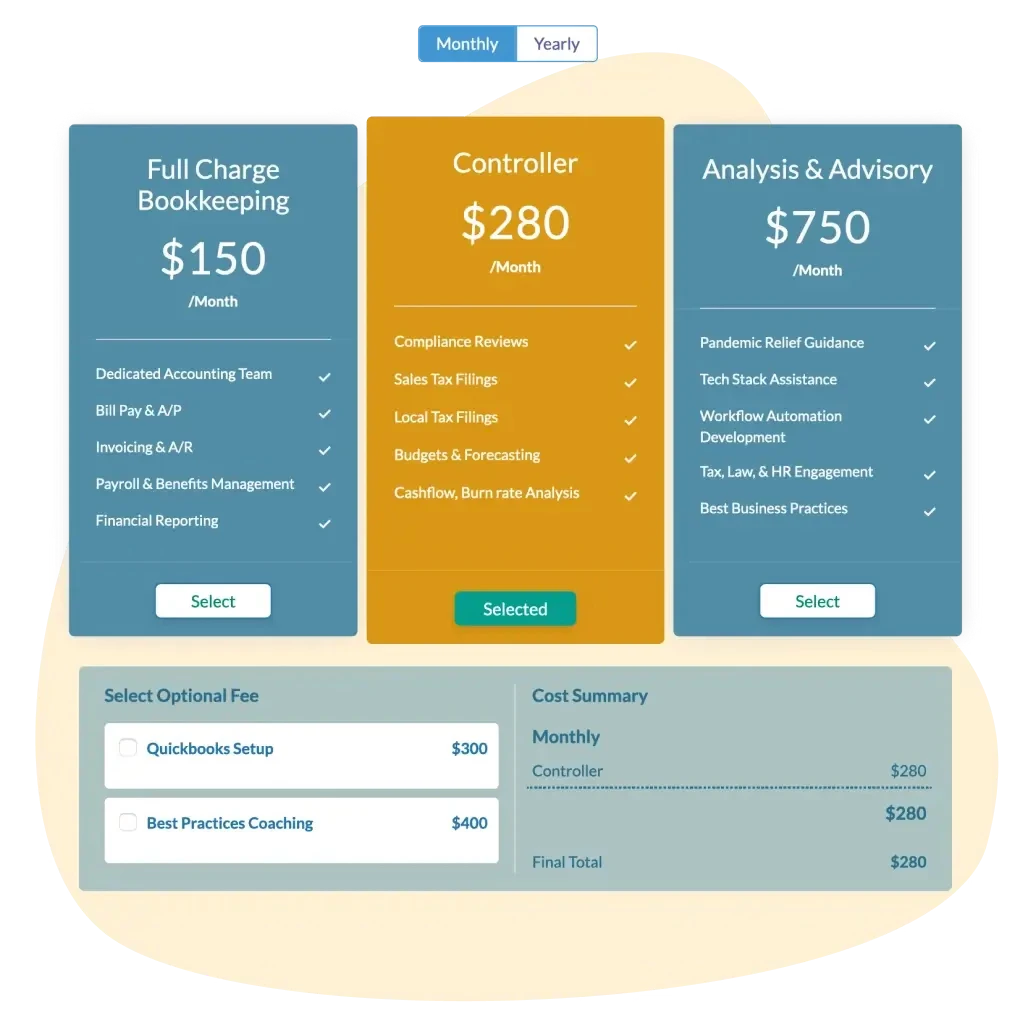
Bronze includes cloud bookkeeping reconciliations, quarterly VAT returns, and an annual pre-year-end tax call. Silver adds a monthly PDF management pack and a visual dashboard. Gold throws in a quarterly meeting and a 12-month cash flow forecast.
Looks tidy on paper. In a live competitive pitch against a top-20 national firm, that table is commercial suicide.
When you list tangible outputs on a pricing grid, you hand the buyer a red pen.
This is one commercial facet of wider accountancy firm branding: if the way you structure and name your services signals commodity labour, no visual refresh will save your recovery rates.
Why Do Clients Downgrade Deliverable-Based Advisory Packages?
Clients downgrade deliverable-based advisory packages because itemised lists of reports and meetings invite line-item price comparisons without connecting the output to a commercial risk.
When a managing director sees a £2,500 monthly fee attached to a "monthly KPI pack and quarterly review meeting," they mentally calculate the hourly cost of producing a PDF and conclude they are overpaying.
Consider how a typical £8m-turnover manufacturing client reacts to an output menu:
- They decouple the report from the outcome: The client assumes their internal bookkeeper can press export on Xero or Sage for free, because the menu sells the document rather than the partner's interpretation of creditor stretch.
- They negotiate the meeting cadence: The client asks to drop from monthly meetings to bi-monthly calls in exchange for a 30% fee reduction, turning your structured package back into disguised time-billing.
- They treat advisory as discretionary overhead: The moment input costs rise, the client cancels the "Gold dashboard" while keeping the statutory audit and tax compliance.
Every time you price an output, the client evaluates its production cost. Every time you price a decision boundary, the client evaluates the cost of getting that decision wrong.
Packaging accounting advisory services around deliverables turns your partners into high-priced administrative clerks.
When a tier menu lists management packs, dashboards, and meeting counts, rational buyers unbundle the list and haggle over the hourly cost of producing a PDF.
Stop selling the artefacts of your thinking; structure every tier around the commercial decisions your partnership helps the client make.
How to Structure a 3-Tier Advisory Model Around Decision Ownership
Building a three-tier model that prospects cannot unbundle requires replacing your list of deliverables with a Decision-Ownership Matrix.
Instead of asking "what do we send the client each month?", your partnership must define "what level of commercial risk and decision-making does the client delegate to us at each price point?"
If your firm has not yet separated its compliance identity from its strategic consulting offer, start by reviewing our guide on client advisory services branding before naming your tiers. Stop calling them Bronze, Silver, and Gold.
Nobody wants to tell their bank manager they bought the "Bronze" financial governance package. Name the tiers after the commercial mandate they fulfil.
What Are the Three Tiers of Decision-Making Responsibility?
The three tiers of decision-making responsibility divide client advisory services into Financial Visibility (spotting operational variance), Strategic Modelling (stress-testing future capital decisions), and Commercial Governance (co-owning board execution and lender relationships).
Each ascending tier absorbs a higher degree of commercial risk on behalf of the client's leadership team.
Tier & Mandate | Who It Serves | Decision Boundary (What the Firm Owns) | Partner vs Team Delivery Ratio | What Is Explicitly Excluded |
|---|---|---|---|---|
Tier 1: Financial Visibility & Risk Flagging | Owner-managed businesses (£1.5m–£4m turnover) with an internal administrator but no financial controller. | Diagnostic Ownership: Inkbot Design's model assigns the accountancy firm responsibility for data integrity and flagging margin, tax, or cash flow anomalies within 10 working days of month-end. The client owns the corrective action. | 10% Partner / 90% Client Manager & Cloud Systems | Custom acquisition modelling, pricing restructures, bank covenant negotiations, or attending operational board meetings. |
Tier 2: Strategic Forecasting & Scenario Modelling | Scaling SMEs (£4m–£12m turnover) making active hiring, capex, or geographic expansion commitments. | Scenario Ownership: The accountancy practice stress-tests specific commercial decisions before the client signs a contract—modelling cash flow troughs, debt service ratios, and margin sensitivity. | 35% Partner / 65% Senior Advisory Manager | Day-to-day staff management, leading external equity fundraising rounds, or statutory board voting rights. |
Tier 3: Board-Level Governance & Fractional FD | Mid-market enterprises (£12m–£30m turnover) preparing for exit, M&A, or complex debt refinancing without a full-time £140k CFO. | Execution & Governance Ownership: The partner sits on the board to co-own commercial KPIs, interrogate departmental heads on budget variances, and lead conversations with commercial lenders. | 60% Partner / 40% Advisory & Corporate Finance Team | Acting as a statutory de jure company director. |
Look closely at Tier 2 in that matrix.
Tier 2 shifts the burden from spotting a problem to testing the commercial fix before the client signs a contract.
When a £6m haulage client wants to acquire a competitor's fleet or open a second depot near Nuneaton, the accountancy practice does not hand over a generic spreadsheet template.
The partner models the debt-service coverage ratio under three fuel-price stress tests, calculates the exact working-capital trough in month four, and tells the managing director whether the balance sheet can survive the expansion.
How Does the 3-Tier Decision Matrix Prevent Line-Item Haggling?
The 3-tier decision matrix prevents line-item haggling by making meetings, dashboards, and reports internal byproducts of the decision mandate rather than separately priced products.
If a client in Tier 2 asks for fewer meetings to lower the fee, the partner can explain that the fee covers the firm's liability and availability to model capital decisions—not the hours spent sitting on Zoom.
When a prospect tries to pull a single feature out of Tier 2 and bolt it onto Tier 1, the structural boundary holds firm:
- The prospect's request: "Can we stay on Tier 1 for £1,250 a month, but have you review our new warehouse lease and bank facility when it comes up in Q3?"
- The deliverable-menu response (Weak): "Sure, we can quote an ad-hoc hourly rate or add a one-off forecast fee in Q3." (Result: You just trained the client never to upgrade to Tier 2, and your partner will end up absorbing half the Q3 work into unbilled Work in Progress (WIP)).
- The decision-ownership response (Strong): "Tier 1 covers backwards-looking diagnostic flagging on your historical ledger. Evaluating a warehouse lease requires maintaining a live, stress-tested three-way forecast model across the year so we can sign off on your covenant headroom. That capability only exists in Tier 2."
Prerequisites and the Disqualification Rule: Knowing Which Tiers to Refuse

Most packaging guides assume that every accountancy practice should offer a cheap entry tier, a mid-tier, and a premium tier to capture the widest possible market. That advice ruins mid-tier firms.
If you are a 12-partner practice competing against national networks for £5m–£25m corporate clients, offering a £400-a-month "Bronze Bookkeeping & Advisory Lite" tier on your website actively undermines your authority.
A commercial director looking for a strategic financial partner will not hire a firm that positions itself as a bargain-basement VAT processor.
Why Must Mid-Tier Accountancy Firms Refuse Low-End Advisory Tiers?
Mid-tier accountancy firms must refuse low-end, compliance-heavy advisory tiers because serving high-volume, low-fee accounts consumes the managerial capacity required for Tier 2 and Tier 3 turnarounds and signals a low-market brand positioning to corporate buyers.
A three-tier model only works when your lowest tier still meets your partnership's minimum commercial threshold.
You might be reading this and thinking:
"That sounds great in theory, Stuart, but I have eight account seniors on payroll who need compliance files to keep their utilisation above 80%."
Fair pushback. Dropping low-margin work overnight while carrying fixed staff overheads will wreck your cash flow.
The disqualification rule does not mean sacking forty legacy clients on Monday morning. It means separating your operational reality from your commercial positioning:
- Ring-fence legacy compliance: Keep legacy compliance-only clients in a dedicated production pod—or spin them into a separate, streamlined trading brand—so they cover senior payroll without dictating how your core partnership presents itself in new tenders.
- Set a hard entry floor for new pitches: Every new inbound enquiry above your target turnover threshold only ever sees your three decision-ownership tiers. If a prospect only wants an annual statutory accounts sign-off at the lowest possible price, refer them down-market.
- Adjust for firm scale (Decision Boundary): If you run a 3-partner regional general practice where owner-managed businesses under £1m turnover make up 70% of your local market, your Tier 1 floor may legitimately start at £600/month. If you run a 15-partner multi-office firm targeting £10m+ corporates, your Tier 1 floor should rarely sit below £2,000/month.
What Operational Prerequisites Must Clients Meet Before Entering an Advisory Tier?
Before an accountancy firm accepts a client onto any advisory retainer, the client must sign a Data Hygiene Charter guaranteeing automated bank feeds, cloud ledger standardisation, and purchase ledger cut-off by working day five of each month.
Without timely underlying bookkeeping, partner time allocated to forward-looking scenario modelling gets cannibalised by retrospective error correction.
Wait until a client breaks this rule once, and you will see why most advisory rollouts collapse internally.
If a Tier 2 client sends over a shoebox of supplier invoices on the 19th of the month, your advisory manager cannot run a working-capital sensitivity model on the 20th.
Instead, your high-cost advisory team spends twelve hours fixing the bookkeeping just to produce a baseline figure.
Make three operational prerequisites non-negotiable in the engagement letter:
- Cloud Architecture Lock: The client operates on your practice's standardised chart of accounts and approved software stack. No custom desktop spreadsheets held together by broken macros.
- The Day-5 Ledger Close: All sales invoices, purchase bills, and payroll journals for the prior month are posted by working day five. If the client misses the cut-off twice in a quarter, the firm pauses strategic modelling until the ledger is brought into compliance.
- Single Executive Sponsor: For Tiers 2 and 3, the managing director or the majority shareholder must attend the review sessions. You cannot sell decision-ownership to an office manager who lacks the authority to approve a hiring freeze or a price increase.
Pricing Mechanics and a Worked Restructuring Example

Put a single £3,500-a-month retainer on the table and a finance director has only one question: can we get another firm to do this for £2,200?
Put three distinct levels of decision responsibility on the page, and the question changes from whether to pay you to how much commercial risk the client wants to carry themselves.
If you are migrating existing long-term compliance clients onto this structure rather than pitching cold prospects, pair this pricing architecture with our step-by-step framework on communicating a fee increase without losing the client.
How Should Accountancy Firms Anchor Pricing Across Three Tiers?
Accountancy firms should anchor pricing across three tiers using an asymmetric ratio—typically 1 : 2.2 : 4.5—so the middle tier (Strategic Scenario Ownership) represents the clearest return on reduced commercial risk compared to the top-tier governance retainer.
Even spacing between tiers (such as £1,000, £2,000, and £3,000) fails to establish a strong high-end anchor and encourages prospects to default to the cheapest option.
Here is why the 1 : 2.2 : 4.5 ratio works in a boardroom proposal:
- Tier 1 (£1,500/month): Establishes the baseline cost for clean diagnostic visibility and statutory peace of mind.
- Tier 2 (£3,300 / month): For an extra £1,800 a month—less than the employer National Insurance and salary cost of a junior part-time bookkeeper—the client gains partner-led scenario modelling before every major capital commitment.
- Tier 3 (£6,750 / month): Anchors the proposal against the £120,000–£150,000 fully loaded annual cost of hiring a full-time in-house Finance Director. Against a £140,000 salary, £81,000 a year for a partner-backed governance function looks commercially rational for complex firms, while making Tier 2 look like an immediate bargain for scaling SMEs.
Worked Example: Restructuring a 9-Partner UK Practice
Take a hypothetical 9-partner UK chartered accountancy practice—let's call them Sterling & Vance LLP, turning over £4.8m in the Midlands—to see how this plays out across a pilot cohort of 22 growth-stage SME clients (£3m–£15m turnover).
The Before State (Ad-Hoc Compliance + Bolt-On Deliverable Menus):
- Client Cohort: 22 corporate clients buying annual accounts, corporation tax, and ad-hoc management packs.
- Average Annual Fee: £14,454 per client (£318,000 total annual revenue).
- The Operational Bleed: Partners were giving away "quick 30-minute calls" on acquisition targets and bank covenants for free because the Bronze/Silver/Gold menu only priced the monthly PDF packs. Unrecovered WIP across those 22 files totalled £64,000 per year.
The Restructuring Execution (90-Day Rollout):
- Audit & Segmentation: Sterling & Vance LLP audited the actual decisions those 22 clients asked about over the prior 12 months. Six clients only ever wanted clean numbers and tax certainty; eleven regularly asked: "Can we afford to hire or buy equipment?"Three needed hands-on banking and board governance; two chronically delivered late records and haggled every bill.
- Applying the Disqualification Rule: The two chronic hagglers refused the Day-5 Ledger Close prerequisite and refused Tier 1 pricing. Sterling & Vance LLP disengaged both clients from advisory services, forfeiting £19,000 in low-margin revenue and freeing up 140 manager-hours.
- Re-mapping to Decision Tiers:
- 8 clients chose Tier 1 (Financial Visibility) at £1,500/month (£18,000/year) = £144,000.
- 9 clients chose Tier 2 (Strategic Scenario Ownership) at £2,750/month (£33,000/year) = £297,000.
- 1 client chose Tier 3 (Board Governance & Fractional FD) at £4,750/month (£57,000/year) = £57,000.
- 2 clients chose to remain in a ring-fenced compliance-only pod at £9,500/year, with zero unbilled partner access, for a total of £19,000 (excluded from the advisory book).
The After State (Modelled Outcome Across the 18 Retained Advisory Clients):
- Total Advisory Retainer Revenue: £498,000 (up from £318,000 across a smaller, cleaner cohort of 18 advisory clients plus £19,000 in ring-fenced compliance).
- Partner Capacity Impact: Because Tier 1 requires only 10% partner time and strictly excludes custom scenario modelling, partners reclaimed 9 hours per month that had previously been lost to unbilled "quick questions."
Raising your advisory recovery rate does not require pitching more prospects; it requires closing the back door where partners give away Tier 2 scenario modelling inside a Tier 1 compliance fee.
When you draw a hard contractual line between reporting the past and stress-testing the future, clients stop treating partner judgement as a complimentary perk.
Stop Selling Hours Dressed Up as Packages
A three-tier advisory model fails the moment your partnership treats it as a brochure layout exercise.
Listing five tasks in Bronze, eight tasks in Silver, and twelve tasks in Gold does not transform a compliance practice into an advisory firm—it simply gives procurement-minded clients a clearer map of which line items to cross out.
When each tier sells a distinct level of decision-making responsibility, the conversation shifts from the cost of producing a report to the cost of making an unmodelled commercial mistake.
Your single action today: Pull your firm's last five advisory proposals off the server. Highlight every item that describes a deliverable (a report, a dashboard, a meeting) in yellow, and every item that describes a commercial decision you help the client own in green. If the page is entirely yellow, you can rebuild the scope boundaries internally using the Decision-Ownership Matrix above.
However, if your partners have tried introducing higher-tier retainers only to find that prospects still perceive your practice as a compliance shop compared to national mid-tier rivals, you do not just have a packaging problem—you have a brand authority gap.
Request a Free Brand Equity Audit™ from Inkbot Design — a structured commercial diagnostic for UK accountancy partnerships that identifies exactly where your visual identity, messaging, and service architecture are losing ground to larger competitors, and gives you a prioritised roadmap to fix it.
Questions people ask
Should statutory compliance be included inside a 3-tier accounting advisory package?
Yes — bundling statutory accounts and corporation tax into Tier 1, Tier 2, and Tier 3 advisory retainers prevents clients from viewing compliance and strategic advice as separate, negotiable purchases; for legacy clients who genuinely require only year-end filings, ring-fence that work inside a separate compliance pod with zero unscheduled partner access.
How many tiers should an accountancy firm present on a single proposal?
Three tiers are the optimal commercial structure for an accountancy proposal because they establish a clear baseline (Tier 1), a target-value anchor (Tier 2), and a high-level governance benchmark (Tier 3). Presenting more than three tiers increases buyer hesitation, while a single quote invites direct price-shopping against competing firms.
How do you stop Tier 1 clients from asking Tier 2 strategic questions for free?
Accountancy practices stop Tier 1 scope creep by training partners to diagnose commercial risk on the call, while deferring financial modelling to a Tier 2 upgrade. When a Tier 1 client asks whether they can afford a major acquisition, the partner outlines the variables involved and offers to move the client onto the Tier 2 retainer to run the stress tests.
Should an accountancy firm publish its 3-tier advisory prices on its website?
Publish "starting from" monthly fee thresholds for each of your three decision tiers on your website rather than fixed flat prices. Publishing minimum fee floors (for example, Tier 1 starting at £1,500 per month) disqualifies low-budget shoppers automatically while leaving room to scale the retainer for multi-entity groups or complex ledgers.
What is the difference between a visual brochure redesign and true advisory service packaging?
A visual brochure redesign changes how your existing list of deliverables looks in a PDF, whereas true advisory service packaging restructures the commercial contract, partner-to-manager delivery ratios, and decision boundaries across each tier. Designing a slick brochure around a flawed deliverable menu will not stop prospects from haggling over fees.