How to Use an Invest NI Grant to Fund Brand Development
A twelve-person consultancy in Belfast can put £8,571 of its own cash against a £28,571 brand programme and have Invest NI fund the remaining £20,000.
That arithmetic is public; it has been public for years, and almost no boutique consultancy in Northern Ireland uses it. The reason is not eligibility.
The reason is classification: partners file brand development under marketing in their own heads before they ever open the application, and marketing spend does not read as innovation to an assessor.
Brand development sits upstream of market entry, not downstream. That sequencing point is the whole of this article, and it is the same principle that governs startup branding generally: the position comes before the push.
Get it the wrong way round and you are asking Invest NI to fund a logo.
Get it the right way round, and you are asking Invest NI to fund the thing that makes the export case credible.
- Frame brand work as business innovation: sell the market-position change, not a logo; align with Innovate NI innovation definition.
- Apply for the Business Innovation Grant: 70% funding up to £20,000; ensure the 30% matched funding is ring-fenced.
- Choose the correct instrument: non-client consultancies use Business Innovation Grant, not the client-only R&D Grant.
- Set measurable commercial metrics before spending: pitch conversion, average fee, win rate; post-award evidence proves private investment leverage to Invest NI.
How an Invest NI Grant Is Secured for Brand Development
An Invest NI grant for brand development is secured in five stages: match the funding instrument to your firm’s status, frame the brand project as business innovation rather than marketing, build the matched-funding position, submit the project against Innovate NI’s innovation definition, and evidence the commercial outcome post-award.
- The Business Innovation Grant covers 70% of the eligible project cost, awarding between £5,000 and £20,000, part-funded by the UK Shared Prosperity Fund and delivered by Invest NI with Innovate NI.
- Business Innovation Grant eligibility extends to any Northern Ireland micro or small-to-medium enterprise outside primary agriculture – existing Invest NI client status is not required, unlike the R&D Grant.
- Approval turns on whether the project aligns with Innovate NI’s definition of innovation, not on how the spend is categorised in your own accounts.
An Invest NI grant can fund brand development when the project is framed as business innovation, with the Business Innovation Grant covering 70% of eligible costs between £5,000 and £20,000.
Prerequisites: What Must Be True Before You Apply
Three conditions must hold before an application is worth the hours.
You must have the 30%.
The Business Innovation Grant funds 70% of the eligible project cost. A £20,000 award – the ceiling – requires a project of £28,571 and £8,571 of your own money, available now, not contingent on a pipeline deal closing. Invest NI does not set the grant ceiling. Your matched funding sets it.
You must know which instrument applies.
The R&D Grant requires existing Invest NI client status and constitutes notified state aid; R&D grant projects cannot also be eligible for HMRC SME tax credits. The Business Innovation Grant has no client-status requirement. Most boutique consultancies applying for the first time are Business Innovation Grant applicants and do not realise there is a distinction between the two.
You must have a commercial change you can name.
Not “we want to look more professional”. A named market you are entering, a named client type you cannot currently win, or a named competitor you lose to. Assessors read hundreds of applications. The ones that fail are the ones where the outcome is an adjective.
Stage 1 – Match the Instrument to Your Firm’s Status
The Business Innovation Grant is the instrument for a non-client boutique consultancy, and confusing it with the R&D Grant results in applications being rejected before assessment begins.
Invest NI’s Business Innovation Grant is open to all Northern Ireland SMEs except primary agriculture, offers £5,000 to £20,000 at a 70% grant rate, and is part-funded by the UK Shared Prosperity Fund. The R&D Grant, by contrast, is restricted to existing Invest NI clients and is notified state aid.
How to know it is done right: you can state, in one sentence, which grant you are applying for and why your firm is eligible for that specific instrument.
Failure mode at this stage: applying for R&D funding as a non-client, or assuming client status is a prerequisite for everything and never applying at all. The second failure is more common and more expensive, because it is invisible.
Stage 2 – Frame Brand Development as Business Innovation

Innovate NI’s definition of innovation is the scoring gate, and a consultancy has no product to point to, which means the service model and market position are the innovation.
Invest NI’s Business Innovation Grant lists eligible uses, including market research, product development, market entry strategies, and trade fairs.
A boutique consultancy has no product. What it has is a proposition, and the work of defining, testing, and articulating that proposition is market research and market-entry strategy performed on an intangible.
This is where most first-time applicants lose. They write “rebrand”, and the assessor reads “new logo, existing offer”.
Write instead: repositioning the firm’s service model to enter a named market segment, with the identity and messaging system as the delivery mechanism for that repositioning. Same project. Different – and accurate – description.
“Brand development is not the decoration applied to an innovation. For a professional services firm with no physical product, the brand is the artefact through which the innovation becomes legible to a buyer, an assessor, and an investor. Fund it as infrastructure, or explain to a scoring panel why your intangible service model should be taken on faith.”
The mechanism matters here because a consultancy partner will reasonably ask why an assessor should accept this. The answer is risk.
An assessor is scoring the probability that public money produces a private return. A firm that cannot articulate what it sells to whom is a higher-risk investment than one that can, irrespective of the quality of the underlying work. Clarifying the proposition lowers assessed risk.
That is not a marketing claim. It is the same logic by which a B2B value proposition reduces perceived buyer risk and supports a fee premium.
Stage 3 – Build the Matched-Funding Position
Matched funding is a cashflow decision made before the application, not a formality settled after approval, and it sets the real ceiling on what a boutique consultancy can claim.
At the 70% rate, every £1,000 of grant requires £428 of partner cash. Firms that decide on a £20,000 ambition and then discover the £8,571 is not sitting in the account either scale the project down mid-application – which reads as indecision – or withdraw.
How to know it is done right: the 30% is ring-fenced in the business account before submission, and the partners have agreed it is spent, whether or not the grant lands.
Failure mode at this stage: treating the grant as the funding source and the 30% as the top-up. It is the reverse. The project must be one you would run at reduced scope without the grant; the grant expands the scope.
Stage 4 – Submit Against the Innovation Definition, Not the Spend Category
The application is scored against Innovate NI’s definition of innovation, so the project narrative must be built from that definition backwards. Invest NI states plainly that Business Innovation Grant projects must align with Innovate NI’s definition of innovation.
That is the criterion. Every section of the submission should be traceable to it.
Practically: lead with the commercial change, not the deliverable. The deliverable list – positioning framework, identity system, messaging architecture, sales collateral – belongs in the project plan, not the opening paragraph.
The opening paragraph is about the market you are entering and why you currently cannot enter it.
Failure mode at this stage: a deliverables-first application. It reads as a purchase order for design services, and design services are not innovative. The identical project, described change-first, reads as a market-entry strategy – which Invest NI explicitly lists as an eligible use.
Stage 5 – Evidence the Commercial Outcome
Post-award evidencing is the stage that determines whether the next application succeeds, and most first-time recipients neglect it entirely.
Set the measure before the money is spent: pitch conversion rate, average fee per engagement, enquiries from the named target segment. Whatever it is, baseline it now.
Failure mode at this stage: measuring brand outcomes with brand metrics. Awareness and recall are the wrong instruments for a twelve-partner firm. Fee level and win rate are the right ones.
The Judgement Layer: Where the Process Stops Being Steps
Two decisions in this sequence cannot be reduced to instructions, and both are where experienced judgement earns its money.
How narrow to make the market claim.
Too broad, and the innovation is invisible – “UK professional services” is not a market entry. Too narrow, and the commercial upside looks trivial against the grant.
The judgment finds the segment sufficiently specific to be a genuine entry and large enough to justify public money. There is no formula. It is read from the firm’s actual win-loss record.
When the brand work is genuinely the innovation, and when it is genuinely decoration.
Sometimes a firm wants a nicer logo. That is a legitimate thing to want and an illegitimate thing to claim public innovation funding for.
Where the Invest NI Position Stands Now
The leverage data from the most recent performance year makes the innovation-infrastructure case rather than undermining it.
In the year to March 2026, Invest NI-backed projects secured £764 million of business investment – the highest level in more than a decade (Newsletter.co.uk and Irish News coverage of Invest NI’s 2025/26 performance).
That £764m was supported by around £126 million in Invest NI grant aid across 2,221 investment projects, meaning every £1 of public support unlocked roughly £6 of private investment (Irish News and Invest NI–related press coverage).
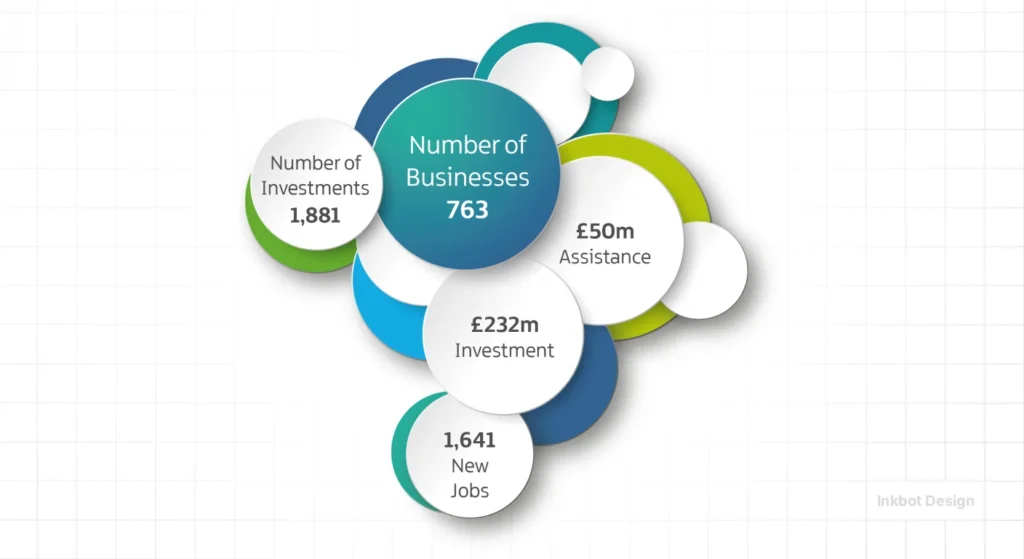
Those projects are expected to support more than 4,300 potential new jobs, the majority of which are high-skilled and above the private-sector median salary (Newsletter.co.uk and Invest NI performance reporting).
Read that ratio properly. Invest NI is not distributing money to good causes. Invest NI is buying leverage – roughly six-to-one – and every scoring decision is made by someone whose performance is measured on that multiple.
An application that increases the assessor’s confidence in the private-investment follow-through scores well. An application that reads as a cost centre does not.
For a boutique consultancy, this is the practical reframe. Your grant application is not a request. It is a proposal that your firm will convert £8,571 of partner capital and £20,000 of public money into a market position that produces fee income Invest NI can count.
The £126m across 2,221 projects works out to roughly £57,000 average grant aid per project – a £20,000 Business Innovation Grant is a small, low-risk position in that portfolio, which is precisely why it is winnable for a firm that presents a coherent case.
The Two Objections a Founding Partner Will Raise
“This is just repackaging marketing spend as innovation to game the criteria.”
No. Repackaging would mean applying the same logo refresh to the form with different wording. The distinction is whether the project actually changes what the firm sells and to whom.
If the positioning work is genuine – if the firm emerges targeting a different segment with a different proposition – the innovation is real, and the identity work is its delivery mechanism.
If nothing changes but the letterhead, the application deserves to fail, and dressing it up wastes everyone’s time, including yours.
“£20,000 doesn’t buy a serious brand programme.”
£28,571 does, and that is the actual project value once matched funding is included. For a firm under 25 people, a £28,571 positioning and identity programme is a substantial piece of work – the kind of scope that reaches brand narrative and messaging architecture, not just visual identity.
The grant does not shrink your budget. It nearly triples the cash you had allocated.
The Step Everyone Gets in the Wrong Order
Intelligent partners sequence this backwards for a defensible reason: Invest NI’s own materials list brand-adjacent spend under market entry and trade fairs.
Read literally, that places brand development after the market-entry decision – you choose the market, then you build the collateral to enter it. Invest NI publishes it that way. It is not an unreasonable reading.
It is still the wrong order, and the £6-to-£1 leverage figure is why.
A firm that decides on a market and then commissions brand work is asking a design partner to justify a decision that has already been made.
A firm that does the positioning work first frequently discovers that the market it assumed was its target is not the one where it wins. That discovery is the innovation. The collateral is what follows.
Invest NI’s own framing lists market research alongside market entry strategies as eligible uses of the Business Innovation Grant – the sequence is available in the criteria; applicants just do not use it.
“Brand development done after the market decision is decoration on a bet already placed. Brand development done before it is the diligence that de-risks the bet. Invest NI funds diligence. The Business Innovation Grant lists market research as an eligible use, and positioning work for a professional services firm is market research conducted on the firm’s own proposition.”
Apply for the positioning and market-definition work as the innovation project, with the identity system scoped as its output. Not the reverse. Broader strategic sequencing for firms at this stage is covered in Inkbot Design’s brand strategy work.
The Verdict
The classification decision is made in your head before you open the application form, and it decides the outcome.
File brand development under marketing, and you will write a deliverables-led submission that reads as a purchase order for design services – and it will score as one.
File it under innovation infrastructure, accurately, and you are describing exactly the thing Invest NI’s assessment logic is built to fund: a de-risked commercial position that converts public money into private investment at a countable multiple.
The evidence carries this. Invest NI converted roughly £126 million in grant aid into £764 million in business investment in the year to March 2026 across 2,221 projects. That is an organisation buying leverage, staffed by people scored on leverage.
A boutique consultancy that cannot articulate what it sells, to whom, and why that buyer should believe it, is a low-leverage bet – and no amount of visual identity applied afterwards changes the arithmetic. The positioning work is not the pretty part of the project. It is the part that makes the numbers plausible.
Do this today: write one sentence naming the market segment your firm cannot currently win in, and the specific reason you lose.
If that sentence is easy, you may not need the positioning work.
If it is hard – if three partners would write three different sentences – that difficulty is your innovation project, and it is fundable.
Before you commit £8,571 of partner cash to a project scope you have not tested, find out where the brand is actually costing you commercially.
Inkbot Design’s Brand Equity Audit™ is a free written diagnostic delivered within 48 hours, with no sales call, that identifies exactly where your firm is losing commercial ground and what to do about it. It also gives you the evidence base your application needs.
FAQs
Can an Invest NI grant be used for branding and design work?
Yes – where the project aligns with Innovate NI’s definition of innovation. The Business Innovation Grant lists market research and market entry strategies among eligible uses, and positioning work for a professional services firm falls within both. A logo refresh with no commercial change does not qualify.
How much is the Invest NI Business Innovation Grant worth?
The Business Innovation Grant awards between £5,000 and £20,000 at a 70% grant rate, funded by the UK Shared Prosperity Fund. A £20,000 award requires a total eligible project cost of £28,571, with the applicant funding the remaining £8,571 from its own resources.
Do I need to be an Invest NI client to apply for a grant?
No – the Business Innovation Grant is open to all Northern Ireland micro and small-to-medium enterprises outside primary agriculture, regardless of client status. The R&D Grant is different: it requires existing Invest NI client status and constitutes notified state aid.
What’s the difference between the Business Innovation Grant and the R&D Grant?
The Business Innovation Grant is open to any Northern Ireland SME outside primary agriculture and awards £5,000 to £20,000 at a 70% rate. The R&D Grant requires existing Invest NI client status, is notified state aid, and cannot be combined with HMRC SME tax credits on the same project.
Is it true that Invest NI won’t fund marketing?
The distinction is not marketing versus non-marketing. It is whether the project meets Innovate NI’s innovation definition. A repositioning project that changes what the firm sells and to whom can qualify; promotional spend applied to an unchanged proposition typically cannot.
When should a consultancy do brand work relative to applying?
Positioning and market-definition work should be the grant project itself, not preparation for it. A firm that decides its target market first and commissions identity work afterwards has already made the commercial decision the grant is meant to fund.
Why do Invest NI grant applications for brand projects get rejected?
The most common reason is a deliverables-led narrative. An application that opens with a list of design outputs reads as a purchase order for services. An application that opens with the named market being entered and the commercial change being pursued reads as an innovation project.
How much of an Invest NI grant project must the applicant fund?
Thirty per cent. The Business Innovation Grant operates at a 70% grant rate, so the applicant funds 30% of the eligible project cost from its own resources. Matched funding, not the grant ceiling, determines the maximum realistic project size.
What can a Business Innovation Grant be spent on?
Invest NI lists market research, product development, market entry strategies, and trade fairs and exhibitions as eligible uses. For a professional services firm with no physical product, market research and market entry strategy are the applicable categories.
How much business investment does Invest NI support?
In the year to March 2026, Invest NI-backed projects secured £764 million of business investment across 2,221 projects, supported by around £126 million in grant aid – roughly £6 of private investment for every £1 of public support (Newsletter. co. uk and Irish News coverage).
Is a boutique consultancy too small for Invest NI support?
No – the Business Innovation Grant is designed for micro and small-to-medium enterprises. Invest NI supported more than 10,000 client engagements between 2018/19 and 2022/23, committing over £200 million in grant aid across that period (Invest NI Performance Report 2018–19 to 2022–23).
Can Invest NI grant funding be combined with HMRC R&D tax relief?
Not on the same project as the R&D Grant. Invest NI states that R&D grant projects are ineligible for HMRC SME tax credits. HMRC R&D tax relief also requires the firm to be liable for corporation tax.
