Brand Management vs Marketing: The Guide to Value Creation
Most businesses use the terms “branding” and “marketing” interchangeably.
They throw them into a blender, hit “puree,” and wonder why their budget evaporates without moving the needle on long-term growth.
I have sat in countless offices where the “Marketing Director” is actually just a glorified ad buyer, and the “Brand Manager” is the person who shouts at people for using the wrong logo file. This confusion isn’t just a semantic annoyance; it is a financial liability.
If you treat brand management and marketing as the same discipline, you are likely sacrificing your company’s future value for a quick sale today. You are burning the furniture to heat the house.
To fix this, we need to perform a forensic separation of these two critical business functions.
- Brand management accumulates long-term value; marketing extracts short-term sales—treat them distinctly to protect future equity.
- Time horizons differ: marketing targets quarters; brand management plans for decades and preserves pricing power.
- Metrics differ: marketing uses ROAS, CTR, CPA; brand management measures sentiment, NPS, share of voice, and price elasticity.
- Governance matters: appoint a Brand Guardian, unify KPIs, and require Brand Briefs to prevent off‑brand marketing and trust erosion.
- Budgeting rule: follow Binet & Field’s ~60% brand building, 40% activation to sustain growth and avoid exhausting demand.
The Simple Answer: What is the Difference?
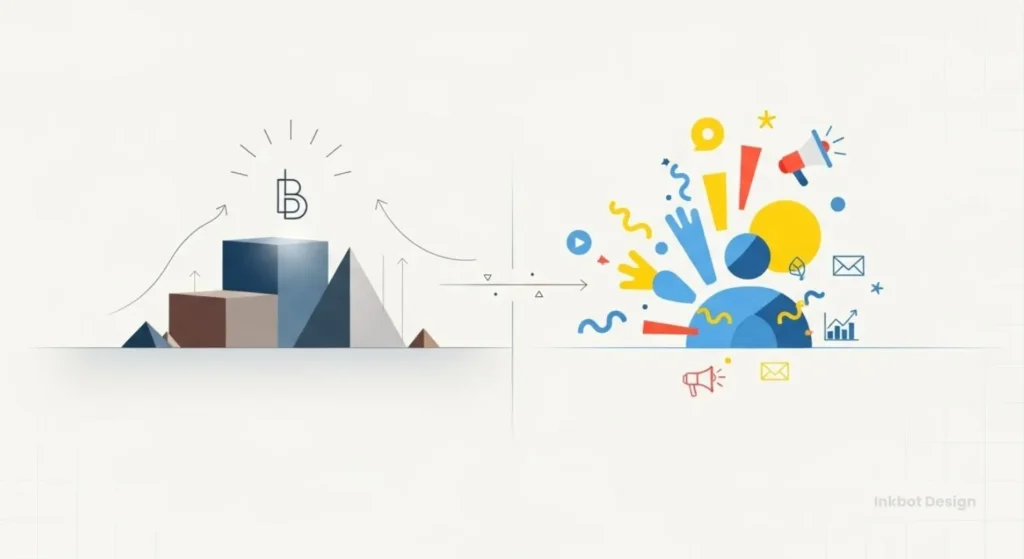
At its core, marketing is the act of extraction, while brand management is the act of accumulation.
- Marketing involves the tactics, tools, and strategies used to introduce a product or service into the market, aiming to generate immediate action (such as sales, leads, or clicks). It is active, outbound, and often short-term.
- Brand management is the strategic process of defining, maintaining, and enhancing the perceived value of the organisation over time. It is the governance of the reputation that makes marketing effective.
Think of it this way: Brand Management is the bank account; Marketing is the withdrawal. You cannot withdraw the value you haven’t deposited.
The 3 Core Distinctions
- Time Horizon: Marketing focuses on the next quarter, while Brand Management considers the next decade.
- KPIs: Marketing measures conversion rates and CPA (Cost Per Acquisition); Brand Management measures sentiment, recognition, and equity.
- Function: Marketing creates the demand; Brand Management creates the preference.
The Core Conflict: Extraction vs. Accumulation
The reason these two departments often clash is that their incentives are fundamentally opposed. This isn’t a bug; it is a feature of a healthy business ecosystem, provided you manage it correctly.
Marketing teams are under immense pressure to deliver numbers now. They live in a world of immediate gratification—Google Analytics dashboards, email open rates, and PPC reports. If a heavy discount code drives a spike in sales this week, the marketing team celebrates.
However, the Brand Manager watches that same campaign with horror. Why? Because while a 50% discount drives volume, it erodes pricing power. It teaches customers that your product isn’t worth full price. It damages the brand equity that took years to build.
The Financial Reality of Brand Equity
According to data from McKinsey & Company, strong brands outperformed the worldwide market by 73% over a 20-year period. This outperformance does not come from better ad targeting; it comes from the accumulation of trust and recognition—the domain of brand management.
When you confuse these roles, you end up with “Performance Branding,” which is often a disaster. You start optimising your logo for click-through rates (a mistake) or changing your tone of voice every week based on what’s trending on TikTok.
Real-World Example: The Gap Logo Fiasco (2010)
In 2010, Gap attempted a surprise rebrand, swapping its iconic serif typeface for a generic Helvetica box. This was a classic case of marketing-led thinking (“We need something fresh to drive holiday sales”) overriding brand management principles (“We must protect our heritage and visual assets”).
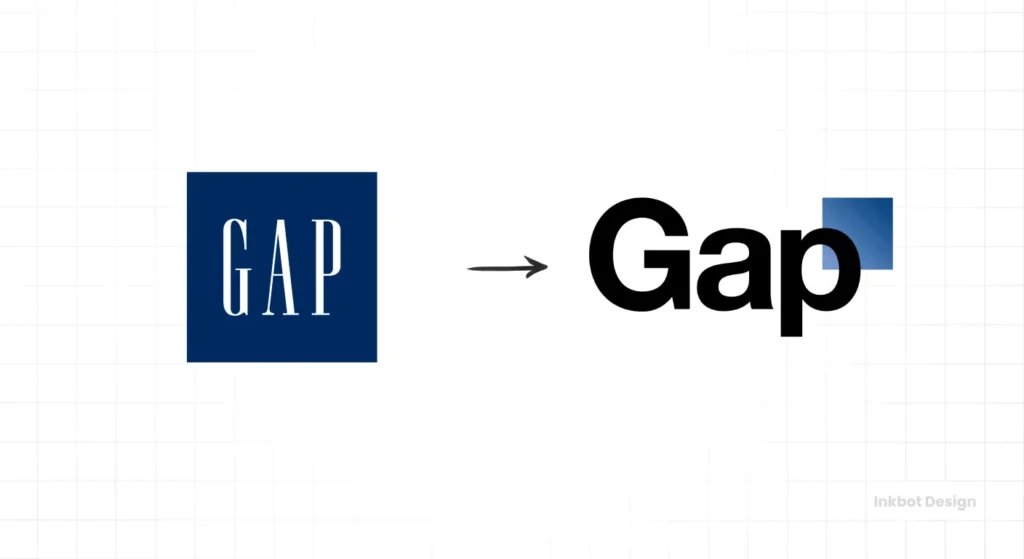
The backlash was immediate and visceral. It wasn’t just designers complaining; the general public was also involved. Gap reverted to the old logo within six days. The cost? Millions in sunk design fees and a significant hit to consumer trust. This happens when you treat a brand asset like a marketing campaign—something to be swapped out for a quick engagement boost.
Operational Differences: How They Work
To truly separate Brand management vs marketing, we must look at the daily operations. How do these roles function differently within a successful organisation?
1. The Strategy vs. The Tactic
Brand Management defines the “Who,” “Why,” and “What.” It establishes the immutable laws of the organisation.
- Who are we? (Identity)
- Why do we exist? (Purpose)
- What do we sound/look like? (Guidelines)
Marketing defines the “Where,” “When,” and “How.” It takes the assets provided by brand management and deploys them.
- Where do we find customers? (Channels)
- When do we speak to them? (Timing)
- How do we convert them? (Funnel)
If Brand Management is the architect drawing the blueprints, Marketing is the construction crew pouring the concrete. You cannot build a stable house if the architect changes the blueprints every time the construction crew finds a cheaper brick.
2. The Audience Focus
Marketing is obsessed with the Customer. Specifically, the prospective customer who is ready to make a purchase. They build personas, map journeys, and analyse churn.
Brand Management acts on a much wider stage. The audience for a brand includes:
- Employees: Internal culture is branding. If your staff hates the company, your brand is toxic.
- Investors: Brand equity drives stock price.
- Partners/Suppliers: A strong brand negotiates better terms.
- The Public: Even people who will never buy your product have an opinion on your brand (e.g., environmental impact).
Brand governance ensures that the message conveyed to investors (stability, profitability) aligns with the message conveyed to customers (innovation, value) and employees (purpose, growth). Marketing rarely has this 360-degree view.
3. The Tool Stack
You can often tell the difference by looking at the software they use.
- Marketing Stack: CRM (HubSpot, Salesforce), Analytics (GA4), Ad Platforms (Meta Ads), SEO Tools (Semrush, Ahrefs).
- Brand Management Stack: DAM (Digital Asset Management), Brand Guidelines Portals, Sentiment Analysis Tools, Employee Advocacy Platforms.
The Metrics War: Measuring Success
This is where the arguments happen. How do you measure the success of a logo? How do you calculate the ROI of a consistent colour palette?
Marketing metrics are binary and arithmetic.
- ROAS (Return on Ad Spend): I spent £1, and I made £4.
- CTR (Click-Through Rate): 2% of people clicked.
- CPA (Cost Per Acquisition): It costs £50 to get a customer.
Brand management metrics encompass both geometric and psychological aspects.
- Share of Voice (SOV): How much of the market conversation do we own?
- Net Promoter Score (NPS): Would people recommend us?
- Brand Salience: The probability that the brand comes to mind in a buying situation.
- Price Elasticity: Can We Raise Prices Without Losing Volume?
The Binet & Field Framework (The 60/40 Rule)
The most authoritative research on this topic comes from Les Binet and Peter Field, working with the IPA (Institute of Practitioners in Advertising). Their analysis of thousands of campaigns revealed a “Golden Ratio” for budget allocation.

To maximise effectiveness, Binet and Field suggest that roughly 60% of your budget should go to long-term brand building (Brand Management) and 40% to short-term sales activation (Marketing).
- Brand Building: Broad reach, emotional connection, creates future demand. Effects typically take 6 months or more to take effect, but can last for years.
- Activation: Tight targeting, rational persuasion, captures existing demand. Effects are immediate but decay instantly once the spending stops.
Most SMBs have this ratio inverted. They spend 95% on activation (PPC, Lead Gen) and 5% on branding (a logo they bought five years ago). This leads to a plateau in growth because you exhaust the pool of “ready-to-buy” customers without replenishing the top of the funnel.
The Role of Design: Wrapper vs. Product
In a marketing-led organisation, design is often treated as “decoration.” Marketers write the copy, define the offer, and then hand it to a designer with the instruction: “Make this look pretty.” This is a fundamental misunderstanding of brand identity services.
In a brand-led organisation, design embodies the strategy. The visual identity is the message.
Consider Apple. Their marketing is often incredibly simple—sometimes just a picture of the product and the name. The heavy lifting isn’t done by the “marketing tactic”; it’s done by the industrial design and the decades of brand consistency that preceded the ad.

When Brand Management leads, design systems are created to ensure consistency.
- Marketing asks: “Can we make the logo bigger and red so it pops?”
- Brand Management answers: “No. Our guidelines dictate clear space and specific colour usage to maintain premium positioning.”
This friction is necessary. Without the “Brand Police,” marketing materials degenerate into visual noise.
The Wrong Way vs. The Right Way
Here is how the distinction plays out in the real world.
| Feature | The Wrong Way (Amateur) | The Right Way (Pro) |
| Primary Goal | Sales at any cost. | Sustainable profit margins. |
| Conflict Resolution | Marketing dictates the visuals to “optimise” for clicks. | A brand sets the guardrails; marketing plays within them. |
| Budgeting | “Branding” is a line item for stationery. | Branding is 60% of the growth budget (Long-term). |
| Reaction to Trends | Jumps on every TikTok trend regardless of fit. | Evaluates trends against Brand Values before engaging. |
| Crisis Response | Deletes comments, panic-posts. | Refers to core values, responds with consistency. |
| Visual Identity | Inconsistent across channels (website vs. email). | Unbroken visual thread across every touchpoint. |
| Pricing Strategy | Discounts heavily to hit monthly targets. | Protects price integrity to maintain brand equity. |
The State of Brand Management vs Marketing in 2026
The landscape has shifted dramatically over the last 18 months, primarily due to the rapid growth of Generative AI.
The Commoditisation of Content
Marketing teams are now utilising AI to generate blog posts, social captions, and ad variations at an industrial scale. The cost of creating “average” marketing content has dropped to near zero. This creates a noisy, cluttered environment where customers are drowning in generic messaging.
This shift has made Brand Management more critical than ever. When everyone can generate “good enough” copy and images, the only differentiator left is the Brand Entity itself—the human connection, the trust, and the specific “soul” of the company.
Governance is the New SEO
In 2026, Brand Management is largely about Brand Governance. With distributed teams and AI tools creating content, the risk of “off-brand” assets flooding the market is high. Smart companies are implementing rigorous brand control systems to ensure that while AI might assist in creation, it does not dictate the voice.
The “Trust” Premium
According to the Edelman Trust Barometer, trust is now a key factor influencing purchasing decisions. Consumers are sceptical of algorithmically generated ads. They are looking for authenticity. Marketing can’t fake authenticity (though it tries). Only consistent Brand Management can build the track record of behaviour that results in trust.
The Reality Check
I once audited a mid-sized tech firm in London. They were spending £50,000 a month on Google Ads (Marketing) but hadn’t updated their website’s “About Us” page or their visual assets since 2018 (Brand Management).
Their marketing team was frustrated. “We’re driving traffic,” they said, “but nobody is converting.”
I looked at their landing pages. The messaging was aggressive, shouting “BUY NOW,” while the visual design looked like a scam site from the early 2000s. The disconnect was palpable. They were inviting people to a party (Marketing) but holding it in a derelict building (Brand).
We paused the ad spend. We reallocated that budget to a comprehensive brand refresh—fixing the messaging, the visual hierarchy, and the value proposition. When we turned the ads back on three months later, their conversion rate tripled.
The lesson? Marketing amplifies the reality of your brand. If your brand is weak, marketing just helps more people realise you are mediocre, faster.
Strategic Alignment: How to Bridge the Gap
You don’t need to fire your marketing team. You need to align them. Here is the process we use at Inkbot Design when consulting with clients.
1. Define the “Brand Guardian”
Someone must have veto power. This isn’t about stifling creativity; it’s about quality control. Whether it’s a dedicated Brand Manager or a Creative Director, one person must have the authority to say, “This campaign hits the sales target, but it violates our core values. We aren’t running it.”
2. Unified KPIs
Stop judging the brand team on sales, and stop judging the marketing team solely on clicks. Create a unified dashboard that tracks both Performance (CPA, Revenue) and Health (Search Volume for Brand Name, Direct Traffic, Social Sentiment).
3. The “Brand Brief”
Before a marketing campaign starts, it requires a Brand Brief. This document confirms:
- Does this campaign align with our purpose?
- Are we using approved visual assets?
- Does the tone of voice match our persona?
If you are struggling to define these parameters, you may need to revisit your foundation. Our Brand Strategy services are designed to codify these rules, enabling your marketing team to move quickly without compromising quality.
4. Invest in Consistency
Consistency is the most underrated driver of revenue. Brand consistency across all platforms increases revenue by up to 23% (Lucidpress). Ensure your email signature matches your LinkedIn header, which matches your packaging. It sounds trivial. It isn’t.
The Verdict
So, Brand management vs marketing: which wins?
Neither. It is a false dichotomy. You need both, but you must understand the hierarchy.
Brand Management is the General. It sets the objective, the rules of engagement, and the long-term strategy.
Marketing is the Soldier. It executes the mission, captures the ground, and secures the resources.
A General without Soldiers is a philosopher—full of great ideas with no way to execute.
A Soldier without a General is a mercenary—fighting hard but with no direction, likely to defect to the highest bidder.
If you are an entrepreneur or SMB owner, stop viewing branding as a “nice to have” cost centre. It is the vessel that holds the value of your business. Marketing is just the tap that pours it out.
If you are ready to stop churning through agencies and start building a brand that compounds in value, it’s time to get serious. Request a quote today, and let’s fix your foundation.
Frequently Asked Questions (FAQ)
Is brand management the same as marketing?
No. Marketing focuses on promoting products to drive immediate sales (extraction). Brand management focuses on building the reputation, identity, and value of the company over the long term (accumulation).
Should I invest in branding or marketing first?
Branding comes first. You must define who you are, what you stand for, and what you look like before you can effectively market yourself. Marketing a weak brand is inefficient and expensive.
What is the main goal of a Brand Manager?
The primary goal is to increase Brand Equity. This involves ensuring consistency across all touchpoints, protecting the brand’s reputation, and increasing the perceived value of the product or service in the customer’s mind.
How does brand management affect ROI?
Strong brand management lowers your Cost Per Acquisition (CPA) over time. When customers trust and recognise your brand, they are more likely to click your ads and buy your products, making your marketing spend more efficient.
Can marketing damage a brand?
Yes. Aggressive marketing tactics, such as spammy emails, misleading clickbait, or constant heavy discounting, can devalue a brand, erode trust, and undermine the equity built by brand management.
What is the 60/40 rule in branding?
Developed by Binet and Field, the 60/40 rule suggests that for maximum growth, 60% of your budget should be invested in long-term brand building, and 40% should be used for short-term sales activation.
Why is brand consistency important?
Consistency builds trust. If your logo, tone, and message vary across platforms, customers get confused. Consistent presentation has been shown to increase revenue by making the brand recognisable and reliable.
What tools do Brand Managers use?
They typically use Digital Asset Management (DAM) systems to control file usage, brand guideline portals, social listening tools to monitor sentiment, and design software.
How do I measure brand equity?
Unlike sales figures, brand equity is measured through brand awareness (search volume), brand sentiment (social listening), Net Promoter Score (NPS), and customer loyalty metrics (retention rates).
Do small businesses need brand management?
Absolutely. In fact, SMBs need it more than corporations because they lack the budget to waste on ineffective marketing. A tight, well-managed brand helps a small business punch above its weight class.