Value-Based Pricing vs Hourly Rates for Brand Agencies
There’s a conversation I have with almost every agency owner I meet. It goes something like this.
They tell me they’re working harder than ever. Clients are difficult, timelines slip, projects bleed into evenings and weekends.
Revenue is fine – not brilliant, just fine. And when I ask how they price their work, they say either an hourly rate or a project fee based on estimated hours.
That’s the problem. Right there.
I spent years pricing Inkbot Design the same way, and I’ll be honest about what it cost me – not just in money, but in the kind of work I was attracting and the clients I was building relationships with.
This article is what I’d tell my earlier self, and it’s specifically for brand agencies: the people doing identity work, rebrands, brand strategy, and visual systems.
Not SEO retainers or social media management. Brand work, where the stakes are genuinely high, and the impact is genuinely hard to see coming.
- Anchor fees to client outcomes, not hours: use Value-Based Pricing rather than Hourly billing.
- Treat Discovery as the pricing conversation: quantify the Value Gap and price around 10 to 15 per cent of projected value.
- Shift operations: sell tiered, outcome-led packages, gather case studies proving ROI, and track Profit Per Project, not billable hours.
The Lie Baked Into Hourly Billing

When you charge by the hour, you are telling a client that your value is measured in time. That your senior designer’s opinion on a logo is worth 60 minutes of thought, not a decision that will represent their business for the next decade.
That’s not just bad positioning – it’s mathematically broken for brand work specifically.
Here’s why. A brand identity for a law firm in Belfast or a financial advisory practice in London doesn’t just improve how they look. It affects every conversation their partners have with a prospect.
It affects whether a £50,000 mandate feels like a safe bet or a risky one. It affects staff confidence, recruitment, referrals, and the premium they can command on their fees.
A well-executed rebrand for a mid-sized professional services firm can reasonably be worth £500,000 to £2,000,000 in additional revenue over three years.
Not as a wild guess – as a conservative estimate based on what happens when positioning sharpens and perception shifts.
And yet, if you charge hourly, you’ll quote 80 hours at £120 and invoice £9,600.
That’s the lie. You’ve delivered something worth orders of magnitude more, and you’ve charged for the time it took to make a kettle of tea.
What Value-Based Pricing Actually Means for a Brand Agency
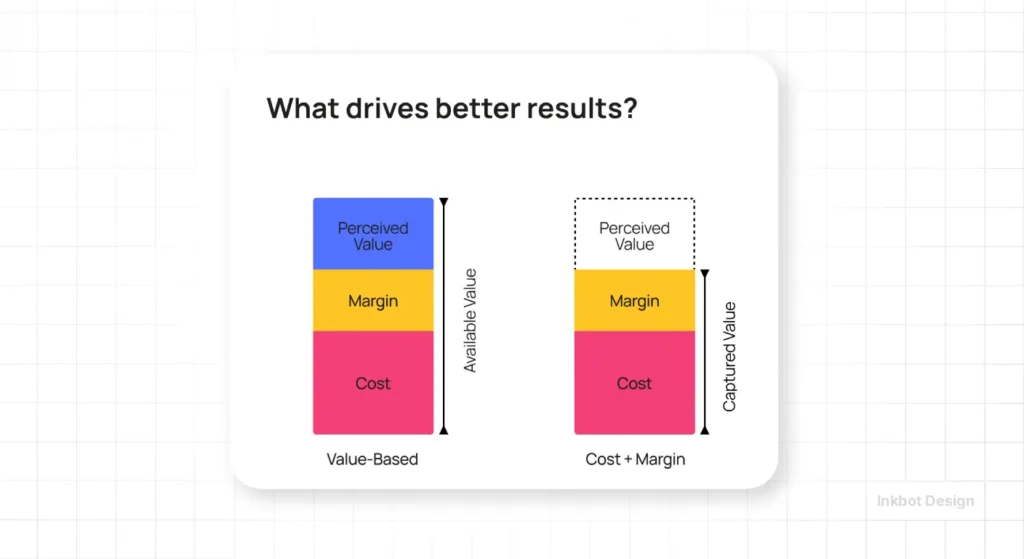
The core idea is simple: your fee should be anchored to what the outcome is worth to the client, not what it costs you to deliver it.
For a brand strategy agency, this requires a shift in how you think about what you’re selling. You’re not selling a logo, a brand guidelines document, or a discovery workshop. You’re selling the business outcome that a strong, coherent identity creates. That might be:
- A professional services firm that now competes credibly against firms three times its size
- A startup that raises its first funding round partly because investors trust what they see
- An established business that finally stops losing talent to competitors who “look like a proper company”
These are real outcomes. Real value. And when you understand that your work creates them, you stop apologising for your fees.
The principle I work from – and it took me longer than I’d like to admit to land on it – is this: price the situation, not the scope. A 12-page brand guidelines document delivered to a sole trader looking for a professional logo is worth a few thousand pounds.
The same 12 pages delivered to a 60-person accountancy practice preparing for a merger is worth dramatically more, because the stakes are dramatically higher.
Same deliverable. Completely different value. Completely different price.
The 2026 Pricing Reality: UK Market Benchmarks
Professional Services Agencies operating within the United Kingdom face a critical pivot point in 2026.
The commoditisation of basic design tasks through automated systems has driven Hourly Rates down, while the premium for Strategic Brand Identity has reached an all-time high.
To remain profitable, firms must understand where they sit within the current market landscape.
The following table outlines the current Investment Benchmarks for Brand Identity Programmes across major UK Business Hubs (London, Manchester, Belfast, Edinburgh).
UK Brand Identity Pricing Benchmarks 2026
| Agency Tier | Project Type | 2026 Average Fee (Value-Based) | Equivalent Hourly (Market Floor) | Typical Client Size |
| Boutique Studio | Visual Identity Refresh | £15,000 – £35,000 | £140/hr | £2M – £10M Revenue |
| Specialist Firm | Strategic Rebrand | £45,000 – £95,000 | £185/hr | £10M – £50M Revenue |
| Mid-Market Agency | Full Market Repositioning | £120,000 – £250,000 | £225/hr | £50M – £250M Revenue |
| Global Network | Enterprise Transformation | £500,000+ | £350+/hr | FTSE 250 / Enterprise |
Economic Shifts in Agency Revenue
Current data indicates that Agencies that utilise Value-Based Pricing report 42% higher gross margins than those that adhere to Hourly Billing. This discrepancy arises because Value-Anchored Fees account for Intellectual Property and Market Impact, whereas Time-and-Materials contracts only cover Operational Overhead.
In London and Belfast, Brand Strategy is now frequently decoupled from execution. Strategy-only Engagements now command fees ranging from £10,000 to £30,000, reflecting the high Cost of Decision-Making for Corporate Directors.
The Discovery Process Is Where the Pricing Happens
Most agencies treat discovery as something that happens before pricing. It isn’t. Discovery is the pricing conversation.
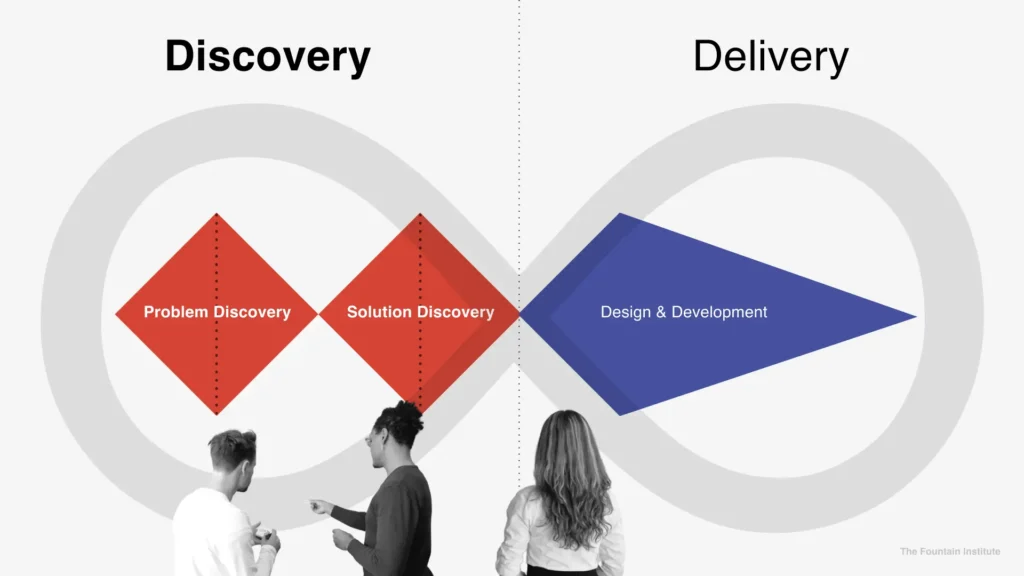
Before I give a client any sense of investment, I need to understand their business situation properly. Not just “what’s your brand problem” – that’s the surface question. The questions that matter are the ones clients don’t usually get asked:
What happens if this doesn’t change? If the brand stays as it is, what does that cost you in the next 12 months? Lost pitches, stalled recruitment, a perception gap between what you do and what you look like?
What does success look like in a year? Not vague success – specific success. Are you targeting a new market? Raising your average client fee? Moving from transactional relationships to retained advisory work?
What’s the gap between how you’re perceived and how you want to be perceived? This one matters because it frames the magnitude of the challenge – and the value of solving it.
What have you already tried? If they’ve had a rebrand before that didn’t work, understanding why tells you both about the brief and about the client’s relationship with brand investment.
When you ask these questions, two things happen. First, you understand the actual value at stake. Second – and this matters just as much – the client starts to understand it too.
By the time you present a fee, they’ve already done the mental work of connecting brand investment to business outcomes. You’re not asking them to leap. You’re presenting a number that follows naturally from the conversation you’ve already had.
The Psychology of Anchoring: Managing Senior Stakeholders
Price Anchoring is the psychological process of establishing a reference point for value before revealing a specific fee. For Brand Agencies, the Anchor should always be the Problem Cost, never the Competitor’s Price.
The Three-Step Anchoring Sequence
- The High-Stakes Anchor: During Discovery, explicitly state the cost of inaction. If a Merger fails to achieve cultural alignment due to poor Brand Messaging, the cost could run into the millions. This is your high-end anchor.
- The Comparative Anchor: Discuss the cost of other Business Investments. A Law Firm might spend £100,000 on a new office fit-out or £150,000 on a Software Implementation. Positioning Brand Strategy as a similar Capital Expenditure (CapEx) validates a higher fee.
- The Solution Anchor: Present three tiers of investment. The middle tier should be the target, while the top tier serves as a “decoy” to make the target feel like a conservative, high-ROI choice.
Managing the “Hourly” Request
When a Chief Financial Officer (CFO) asks for an Hourly Breakdown, they are attempting to reduce your Profit Margin by treating your expertise as a Commodity. The response must redirect to Risk Mitigation:
“We don’t provide hourly breakdowns because our fee is tied to the successful delivery of the [Business Outcome]. If we finish the work in 40 hours or 100 hours, your investment remains the same. This ensures our focus is on the quality of the result, not the quantity of our time.”
Calculating What to Charge: A Practical Framework for Brand Work
Brand work is harder to quantify than a lead generation campaign, where you can calculate click-through rates and conversion values. But harder doesn’t mean impossible.
Here’s the framework I use.
Step one: identify the revenue-adjacent outcome. For most of the professional services firms I work with, brand investment is tied to one or more of the following: closing higher-value clients, retaining existing clients who might otherwise drift to a competitor, entering a new market or segment, or attracting better talent. Each of these has a rough financial value.
If a mid-sized law firm closes two additional significant mandates per year because their new brand positions them credibly in a higher tier of the market – and each mandate is worth £40,000 – that’s £80,000 per year in revenue that didn’t exist before. Over three years, that’s £240,000.
Step two: price at a fraction of that value. The standard framing is 10–20% of the projected value, though in practice, it’s more nuanced than that. How proven are your results in this sector? How confident are both you and the client in the projected outcome? How much risk is the client absorbing?
For an agency with a strong track record in professional services branding and a clearly articulated methodology, pricing at 10–15% of projected value is entirely defensible. That puts a fee for the scenario above somewhere between £24,000 and £36,000, which sounds significant until you position it against a £240,000 outcome.
Step three: cross-check against your own floors. Your value-based price needs to be profitable. If the value calculation points to a fee that’s below your actual cost of delivery – because the client is small, the sector isn’t lucrative, or the scope is genuinely light – that’s useful information. It might mean adjusting scope, re-evaluating fit, or being honest that this isn’t the right project for you.
The number that emerges from this process isn’t the number you charge. It’s the range you charge within, informed by the specific situation.
Structuring Brand Pricing for Real Conversations
One thing I’ve learned over the years is that presenting a single number puts clients in a position where the only decision is yes or no. That’s a bad position for both of you.
Tiered options give clients a sense of control over their investment level while anchoring the conversation to outcomes rather than deliverables.
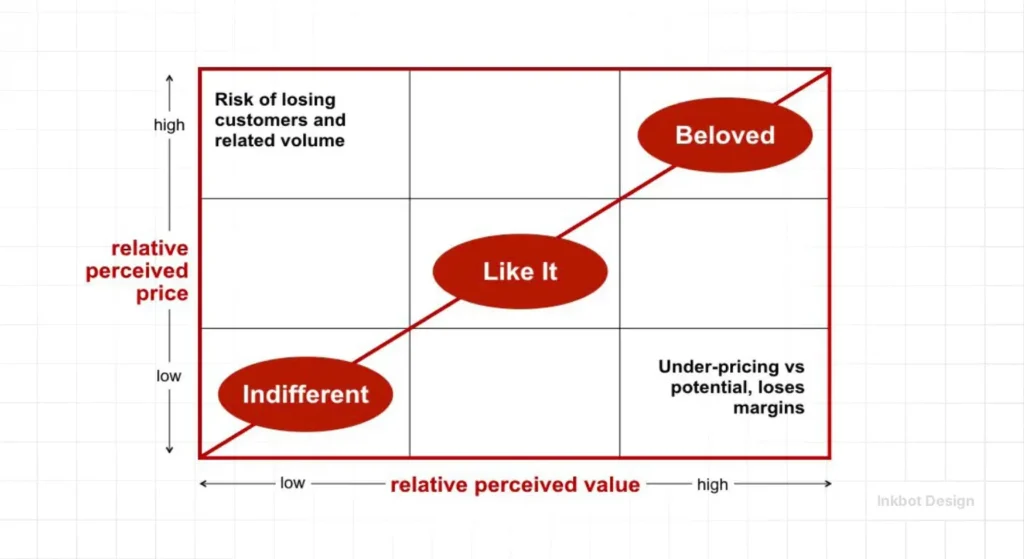
For brand identity work, I think about tiers like this:
Foundation: Core identity – the essentials that resolve the immediate problem. Logo, colour, typography, and basic application guidelines. This is for clients who need to look credible and consistent, but where the strategic stakes are relatively contained.
Growth: Full identity system plus the strategic layer. This includes brand positioning, messaging frameworks, and the application across the touchpoints that matter most to their growth – pitch decks, website direction, and key marketing materials. For clients where the brand needs to do serious commercial work, not just look good.
Transformation: The full programme. Positioning strategy, identity, system, implementation support, and an element of ongoing brand guardianship. For clients undergoing significant change – a merger, a rebrand to support market expansion, a shift in positioning after a leadership transition.
Each tier is priced based on what it’s worth to the specific client, not a rate card. And each is described first in terms of outcomes, then deliverables.
The Objections You’ll Actually Get in Brand Work
Brand clients are different from marketing clients. They tend to be more senior – founders, managing partners, chief executives – and they come with a specific set of concerns.
“We’ve had this done before, and it didn’t change anything.”
This is the most common one, and it deserves a direct response rather than a defence of brand investment in general. What I say is something like: “That’s worth understanding before we go any further. Walk me through what you expected and what actually happened.” Usually, the previous work either lacked strategic grounding – it was a visual refresh without a repositioning – or it was never properly implemented. Both are solvable problems, and identifying them early makes the case for why your approach is different.
“Can we just start with the logo and see how we get on?”
Translation: they want to manage risk by limiting the initial commitment. I don’t fight this directly. Instead, I ask what outcome they’re trying to achieve with the logo alone, and when they can’t articulate one that doesn’t depend on the rest of the brand being coherent, the answer tends to come from them, not me.
“I need to know what I’m paying for.”
This usually means they want deliverables listed. There’s nothing wrong with that – a clear scope is useful for everyone. But if I’ve led with outcomes in the pricing conversation, deliverables become supporting evidence for the investment rather than its justification. I’ll outline what’s included, but in the context of what each element enables, not as a line-item menu.
“Other agencies quoted half this.”
Same as any pricing objection: acknowledge it, don’t apologise for it, redirect to outcomes. “There’s a range of ways to approach brand work, and price usually reflects the depth of the strategic work behind it. What’s driving that price difference is worth exploring – not because their work won’t be good, but because what you’re trying to achieve sounds like it needs [specific thing]. Let me explain why.”
If they’re genuinely price-shopping and outcomes aren’t the priority, you probably can’t win that on merit anyway. Better to know early.
When Hourly Billing Still Makes Sense

I’m not arguing that hourly billing is always wrong. There are situations where it’s entirely appropriate, and pretending otherwise would be dishonest.
Ongoing brand consultancy and advisory work – where a client has a retainer and calls on you for brand guidance across multiple decisions – is difficult to productise meaningfully. A day rate or a retained advisory fee makes sense here, even if it’s not quite the same thing as pure hourly billing.
Small tactical tasks – updating an existing brand element, producing assets for an established system, reviewing a brief – don’t justify the discovery overhead that value-based pricing requires. Charge sensibly for the time involved.
Clients with unpredictable scopes – where the work genuinely can’t be estimated upfront, and the outcome is uncertain – may be better served by a time-and-materials arrangement, at least initially, until the scope is clarified.
The mistake is defaulting to hourly billing across everything because it feels safer or more familiar. It penalises you for getting faster and more experienced. Every hour you save through practice and expertise becomes revenue you never see.
Operational Excellence: Decoupling Profit from Time
Adopting Value-Based Pricing requires a fundamental shift in Agency Operations. If you are no longer selling hours, you must stop managing by hours.
Key Operational Shifts for 2026
- Result-Oriented Project Management: Shift from tracking “time spent” to “milestone completion.” Success is measured by the Velocity of moving through the Discovery, Strategy, and Creative phases.
- The Profitability Buffer: Under Hourly Billing, efficiency is a liability (you get paid less). Under Value Pricing, efficiency is your Profit Margin. Invest in AI-Assisted Workflows to handle repetitive tasks, allowing Senior Strategists to focus on the high-value Outcome-First work.
- Value-Linked Bonus Structures: Align Staff Incentives with Client Outcomes. If a project achieves its Value Key Performance Indicators (KPIs), the team shares in the success.
Internal Metric Tracking
| Traditional Metric | Value-Based Replacement | Why it Matters |
| Utilisation Rate | Profit Per Project | Encourages efficiency and high-value work. |
| Billable Hours | Revenue Per Employee | Measures the actual leverage of your team’s talent. |
| Scope Creep | Value Expansion | New requests are priced based on the additional value they create. |
Making the Transition Without Losing Your Current Clients
If you’re currently billing hourly or on a cost-plus basis, switching everything overnight isn’t realistic or wise.
What works is starting a new business. Apply value-based pricing to every new enquiry going forward. This gives you practice with the discovery conversations and the pricing presentations without putting existing client relationships at risk.
For current clients, the transition occurs naturally at renewal or during a scope change. When a retained client wants to add something new, price that addition on a value basis. When a long-standing client comes back for a refresh or an extension of the brand system, use the conversation as an opportunity to shift the framing.
Some existing clients will never shift. They’ve been on hourly billing with you for years, and that’s how they think about it. You don’t need to force the issue – just stop acquiring new clients on that model and let the portfolio rebalance over time.
The metric to watch is average project value, not the number of projects. Moving from 15 projects a year at an average of £8,000 to 8 projects at an average of £22,000 is not just better financially. It’s better for the quality of the work, the depth of the client relationships, and your own sanity.
The One Thing That Makes All of This Work
None of this holds up without proof.
Value-based pricing is a claim. When you tell a client that their investment will deliver X outcome, they need a reason to believe you. That reason is your track record – case studies that document not just what you did, but what changed for the client as a result.
Most agencies don’t have these because they don’t ask for them. They deliver the work, hand over the files, and move on to the next project. Six months later, when a prospect asks, “What have you done that’s similar to what we need?”, they can show visual work but nothing more.
Start measuring outcomes now. Ask clients six months and a year after a project what changed. What new clients have they won? Has their average deal value shifted? Are they getting better quality enquiries? Are competitors reacting to them differently? This requires a single follow-up email and builds a credible evidence base for value-based pricing over time.
The agencies that make this work aren’t necessarily better at the craft than the ones that don’t. They’re better at understanding and articulating the commercial consequences of good brand work. That’s the real skill, and it’s learnable.
The Practical Starting Point
Pick your next new enquiry. Before you scope the work or estimate hours, spend 30 minutes asking the outcome questions above. Try to understand what a successful outcome is worth to them financially, even roughly.
Then see whether the number you’d naturally land on – based on that value – is different from what you’d have charged otherwise.
It usually is. Sometimes dramatically so.
That gap is what value-based pricing closes.
FAQs
How do I price a rebrand for a pre-revenue startup?
Focus on the value of Investor Trust and Speed to Market. If the brand secures a £1M seed round, the value is the funding itself.
Should I ever offer discounts?
No. Instead, reduce the Scope of Value. If the client has a smaller budget, provide the Foundation Tier rather than discounting the Growth Tier.
What if the client’s revenue doesn’t grow?
Value-based pricing is about the Opportunity Provided, not a guaranteed commission. Ensure your contract specifies that you are providing the Asset and Strategy, not a sales guarantee.
Is Value-Based Pricing legal in the UK?
Yes, it is a standard Commercial Contract arrangement.
How do I handle “fixed-fee” competitors?
Fixed-fee is usually “Cost-Plus.” Position your Value-Based fee as an Investment with a projected ROI, making their fixed fee look like a blind expense.
Can I use this for social media management?
It is harder but possible by linking it to Customer Acquisition Cost (CAC) reduction.
Do I still need timesheets internally?
Only for Cost Analysis, never for Client Invoicing.
What is the ‘Rule of 10’ in pricing?
Aim for the fee to be 10% of the Identified Value Gap.
How do I identify the ‘Value Gap’?
Through the Discovery Process, questions are outlined in Phase 4B.
What is the best way to present the fee?
Verbally during a video call or meeting, following the Value Recap, and never in a “blind” emailed PDF.
How do I handle a request for a ‘Day Rate’?
State that you operate on a Project-Value Basis to ensure the client isn’t paying for “presence” but for “performance.”
What if the project scope is unknown?
Use a Discovery-First Engagement (paid) to define the scope before setting the Value-Based Fee for execution.
