The Rise of No-Code Software Development
No-code software development, also known as low-code or zero-code development, has recently revolutionised the way software is built.
With intuitive visual interfaces and pre-built templates, no-code platforms enable anyone to create fully functional applications quickly and affordably, regardless of technical expertise.
As no-code gains traction across industries, it can revolutionise access to software creation and unlock new levels of organisational productivity.
This guide explores the no-code phenomenon, from defining it to examining its business benefits, capabilities, and tools, to help you leverage its potential.
- No-code platforms empower users to create apps quickly without coding, democratizing software development across industries.
- They significantly reduce time-to-market and costs, enabling rapid prototyping and custom solutions aligned with business needs.
- No-code fosters innovation by allowing non-technical staff to contribute ideas and solutions, enhancing organisational agility.
- While simplifying development, careful governance is needed to mitigate risks associated with narrow feature scope and vendor dependence.
What is No-Code Software Development?
No-code development involves creating software applications using visual, drag-and-drop interfaces rather than traditional hand-coded programming.
These intuitive platforms provide pre-fabricated templates, integrations, business logic, and database building blocks, which users can piece together through a graphical user interface (GUI) to build custom programs.
Unlike coding, which requires specialised technical skills and knowledge, no-code platforms abstract away the underlying complexity, allowing anyone to “program” apps simply by configuring and connecting ready-made components.
Critical attributes of no-code development include:
- Visual, configuration-based editing interfaces
- Pre-built application templates, objects, and workflow logic
- Drag-and-drop simplicity enables app creation for non-coders
- Rapid prototyping and iteration capabilities
- Expandability through integrations and custom code
While no-code platforms can generate full-stack production apps, expert guidance is still necessary for making optimal architectural decisions and handling complex builds.
Look, it’s worth pointing out the difference between no-code and its cousin, low-code, because people get them mixed up.
Thing is, no-code is exactly what it says on the tin.
It’s for people who don’t code.
Your marketing manager, the person in accounts, whoever.
They use visual blocks, and that’s it.
Low-code, right, that’s different.
It’s for developers.
It helps them build stuff faster, but they can still jump in and write proper code for custom bits and bobs when they need to.
It gives them more power, but you’ve got to know what you’re doing.
A Brief History of No-Code
The concept of no-code development traces back to the 1980s, with the emergence of 4GL (fourth-generation programming languages) and CASE (Computer-Aided Software Engineering) tools, which aimed to boost developer productivity by providing higher-level abstractions.
Over the decades, rapid advancement in UX design and reusable component architecture set the foundation for the proliferation of no-code as it exists today:
- 1990s – Early visual rapid application development (RAD) tools emerge
- 2000s – Web-based app builders and services market gains traction
- 2010s – Mobile-first no-code platforms launch, growth explodes
- Present – Over 230 no-code solutions available across cloud marketplaces
The no-code revolution has democratised app development by removing specialised coding skills as a prerequisite. Its flexible, affordable, and easy-to-use approach unlocks innovation for tech and non-tech professionals.
The Business Case for No-Code
No-code software holds tremendous disruptive potential across sectors by accelerating delivery speed, reducing development costs, and empowering domain experts to build solutions tailored to their needs.
Speeds Time-to-Market
Where typical coded software projects run in multi-month or multi-year cycles, no-code environments facilitate rapid experimentation and iteration measured in days or weeks.
By assembling rather than manually programming apps, no-code users skip from concept to working prototype unimpeded by technical debt. Streamlined feedback loops help refine the user experience while the business logic remains flexible.
No-code platforms deliver 4x faster development cycles than traditional coding.
Shortened time-to-market accelerates value realisation while increased organisational agility and responsiveness give companies an edge over their competition, leveraging no-code solutions.
Cuts Development Costs
In addition to faster deployment, building software visually reduces costs by reducing labour intensity.
No longer beholden to expensive engineering resources, staff across the business can directly construct solutions using no-code tools. This circumvents prolonged QA testing and paves the way for rapid incremental improvements.
No-code solutions cost at least five times less overall than coded options.
For resource-constrained teams or fixed project budgets, no-code enables the creation of more features and applications at significantly lower expenditures – savings that can be reallocated to maximise other initiatives.
Aligns Solutions with Business Needs
Unlike off-the-shelf platforms or outsourced teams, no-code solutions equip internal staff to tailor systems to their current objectives.
With no technical barriers to entry, business users can translate domain expertise directly into custom apps. Workflow automation, data pipelines, customer portals, and other tools can be designed around specific organisational challenges rather than approximate fits.
By cutting the middleman and giving business leaders direct control, no-code software bridges IT delivery with line-of-business priorities. Democratised development saves money while ensuring solutions evolve alongside needs.
Facilitates Innovation Culture
Equally valuable is the cultural impact of no-codes within organisations.
Empowering staff beyond developers to ideate and experiment with their systems fosters an entrepreneurial spirit and sense of collective ownership over solutions.
With no-code democratising coding capabilities, new ideas can take shape organically from end-users rather than being constrained by the bandwidth of centralised IT teams.
Unleashing this creative potential maximises innovation, allowing companies to expand technological capabilities and gain a competitive edge. The future of no-code is bright.
Enhances IT and Developer Productivity
And don’t think for a second this is about getting rid of your IT department.
It’s about getting the rubbish off their plate.
Your tech team is probably drowning in requests for small internal tools and simple dashboards that are a pain to build but don’t require their genius-level skills.
No-code allows departments that need these things to build them themselves.
This frees up your expensive developers to focus on the big, complex, mission-specific projects that actually generate revenue.
It’s about letting everyone do what they’re best at, instead of having your top engineer build an expenses form for the fifth time.
Critical Capabilities of No-Code Platforms

Modern no-code platforms empower non-technical users with powerful app development capabilities through intuitive, click-based editors.
While coding expertise remains valuable for complex programming logic, no-code environments handle much of the heavy lifting out of the box:
- Drag-and-Drop Interface – Visually configure UIs by dragging and dropping components.
- Data Storage – Built-in databases and data modelling for persisting information
- Business Logic – Application workflow automation with simple rule-builders
- Third-party Integrations – Connectivity to external programs and data sources
- Cross-platform Deployment – Publish to web, mobile, etc., with a single click
- Security – Authentication, access controls, encryption to protect data
- Collaboration – Concurrent editing and built-in version control
- Code Extensibility – Expand functionality by writing additional code
While eliminating coding isn’t realistic for some projects, no-code platforms handle the majority of backend complexities, enabling users to focus efforts on designing seamless front-end experiences.
Paired with the right strategic vision and objectives, these robust tools provide all the power necessary to develop complete, end-to-end enterprise apps without manual coding.
Evaluating No-Code Platforms
Dozens of capable no-code solutions have emerged across cloud marketplaces to meet surging demand. Determining which platform aligns closest with your needs depends on several factors:
1. Ease of Use
As no-code targets non-developers, the interface and learning curve are crucial. Seek options with intuitive editing, detailed help guides/documentation, and visual modelling.
2. Template & Component Availability
The quality and variety of out-of-the-box building blocks dictate development speed. Prioritise options offering extensive pre-made forms, views, logic, and connections.
3. Scalability & Governance
For enterprise adoption, ensure your platform provides user access controls, data security, and scales to handle increased usage across multiple projects.
4. Deployment & DevOps
Publishing apps is table-stakes, but integrating CI/CD pipelines, configuring testing environments, and managing updates is equally vital for production-ready systems.
5. Support & Community
Despite the “no-code” name, having access to experts who can unblock progress is a lifesaver. Compare available support channels along with the vibrancy of user communities.
Today’s no-code landscape offers diverse solutions for nearly any use case imaginable. Navigating the array of options to find toolsets matching skill levels and project scopes is essential to realise full benefits.
Examples of Popular No-Code Platforms
To make this real, here are a few of the big players you’ll hear about.
They all do different jobs.
- Bubble: If you want to build a proper web application, something like Airbnb but for dog walkers, this is your tool. It handles the database, user logins, and the lot. It’s powerful stuff.
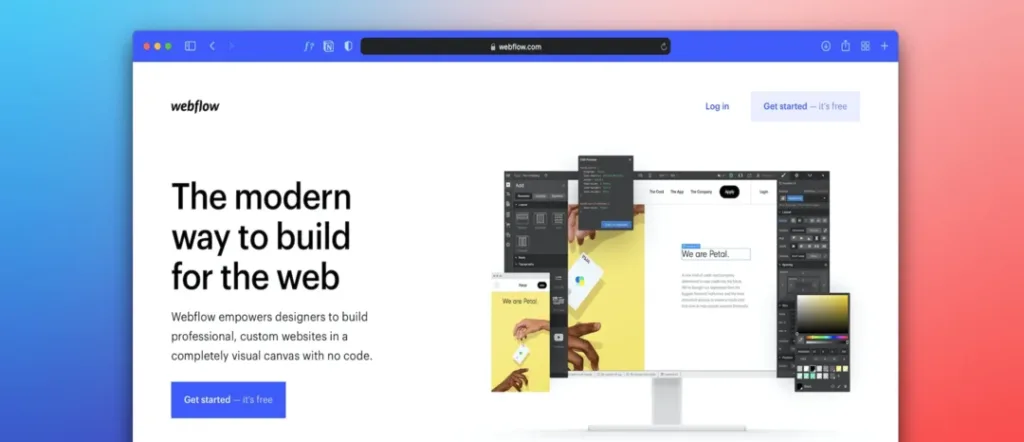
- Webflow: This is for building seriously impressive websites. It gives designers insane control over the look and feel without requiring them to write a single line of code, ensuring that things don’t look like a template.
- Zapier / Make: These aren’t for building apps, but for connecting them. Think of them as digital duct tape. You can set up your email marketing tool to communicate with your sales software automatically. It saves a ridiculous amount of time.
- Adalo: Want to build an app for someone’s phone? Adalo enables you to build and launch native apps for iOS and Android using a simple drag-and-drop interface.
Getting Started with No-Code Development
Transitioning from traditional coding to visual no-code development brings inevitable learning curves. However, core paradigms, such as breaking problems into logical components and precise specifications, carry over.
For those new to no-code, consider these tips:
- Start small – Tackle low-risk areas vs. mission-critical systems initially
- Attend training – Take advantage of available platform education resources
- Model workflows – Map steps before starting to code, including data needs
- Reuse & customise – Leverage existing templates and snippets to accelerate builds
- Collaborate – Partner with capable staff to augment capacities
- Plan for scale – Architect with enterprise-level usage, security, and longevity in mind
- Iterate ruthlessly – Take an agile approach to continually refine and improve.
No-Code Use Cases Across Industries

No-code has expanded beyond early niche applications into mainstream enterprise usage thanks to its versatility in fitting diverse scenarios.
Nearly every industry leverages no-code today in some capacity:
Business Operations
- Workflow automation
- Data collection/reporting
- Internal tool development
- Forms and questionnaire builders
- Dashboard creation
- Inventory/database management
Finance
- Custom accounting tools
- Client portals
- Automated reconciliation
- Loan origination software
- Regulatory compliance systems
- Financial modelling templates
Retail & eCommerce
- Online storefront building
- Self-service customer portals
- Order/inventory management
- Personalisation engines
- Affiliate/campaign tracking
- Reward programs
Healthcare
- Patient intake/EMR software
- Appointment scheduling
- Medical calculators and alerts
- Health analytics dashboards
- Clinical workflow automation
- Medical billing and coding
Marketing
- Landing page creators
- Email campaign builders
- Event registration and ticketing
- User research & surveys
- Social media managers
- SEO and analytics trackers
Human Resources
- Recruiting pipelines
- Applicant tracking systems
- Employee self-service portals
- Performance management
- Learning management systems
- Org charts and directory builders
Education
- Building custom student information systems
- Creating simple online course portals
- Developing dashboards to track student enrolment
- Automating student onboarding communications
- Creating interactive quizzes and learning tools
And this merely scratches the surface of no-code’s real-world applicability. The simple truth is that if a process can be defined, systematised, and improved via software, no-code solutions offer a faster and cheaper alternative to traditional coding approaches.
Risks and Limitations of No-Code
While adoption accelerates, a no-code design still carries common pitfalls without proper planning:
1. Narrow feature scope – Core complexity beyond GUI limits customizability
2. Vendor dependence – Right, this is vendor lock-in.
Once you build your entire system on one company’s platform, you’re stuck with them.
If they decide to triple their prices next year, what do you do?
If they go bust, you’re completely knackered.
Moving a complex app to another service isn’t just hard, it’s often impossible.
3. Scale constraints – A platform might work a treat for your first 100 customers, but what happens when 10,000 all try to log in at the same time?
Some of these tools have real performance limits.
They can become slow or simply collapse if subjected to too much pressure.
You must know the limits before betting the business on it.
4. Integration overhead – Connecting disparate toolsets and data
5. Security gaps – Misconfigured access, weak encryption, and auditing
6. Usage monitoring – Tracking adoption, measuring ROI accurately
7. Documentation debt – Mapping convoluted systems proving difficult
8. Skill silos – Consolidation around specific vendor tools
9. Architecture debt – Early decisions constraining future direction
10. Loose governance – Lacking controls, oversight for the enterprise
Organisations pursuing no-code development must acknowledge these hazards proactively rather than assuming magical silver-bullet properties.
Unlike traditional builds, no-code apps require long-term ownership, necessitating thoughtful design, thorough testing, effective talent strategies, and lifecycle management to manage technical debt. Shortcuts inevitably extract a toll.
The Evolution of Citizen Development

No-code platforms have cultivated an emerging discipline known as citizen development – enabling non-IT staff to build software that solves business challenges.
While empowering, simply opening the floodgates around app creation poses governance risks. Strategic alignment ensures that no-code efforts target core strategic priorities rather than pet projects.
Effective citizen development initiatives:
- Sponsor executive stakeholders
- Structure cross-functional teams
- Institute guardrails and controls
- Sandbox riskier explorations
- Enforce platforms and standards
- Provide enablement resources
- Measure ROI continuously
Well-governed programs strike a balance between democratisation and discipline, providing business units with the tools to create solutions while ensuring that IT oversees critical systems and infrastructure security.
Blending flexibility with coordination reduces shadow IT risks and helps scale no-code usage safely while capturing efficiency gains – a win/win for all.
The Future of No-Code Software
While no shortcut to coding exists, given software’s inherent intricacies, no code markedly expands who can build programs reliably.
These visual tools have graduated from basic task automation into enterprise-grade application development – a trend that shows no sign of slowing down.
Gartner predicts that by 2025, 70% of new applications that enterprises will leverage will utilise no-code or low-code technologies, up from less than 25% in 2020.
As platforms evolve to offer more intuitive abstractions, expansive component libraries, intelligent assistants, and test automation, no-code solutions will penetrate deeply across various functions. IT leaders will retain strategic oversight and handle exceptionally complex builds while business units self-serve their needs.
While coding mastery provides a formidable competitive edge, traditional frameworks seem destined to cede ground rapidly to the simplicity and versatility of no-code solutions. The implications for innovation and productivity gains are significant and cannot be overstated.
Business professionals who are merely scratching the surface of their technological potential now find doors flung wide open to transform systems and processes that precisely match their unique needs digitally.
An exciting future awaits where previously underserved domains manifest newfound tech capabilities, reimagining the art of the possible. The no-code revolution has only just begun, so buckle up!
FAQs
Can anybody create production-ready apps with no code?
No-code simplifies development immensely, but crafting robust enterprise solutions still requires some architectural expertise, even with the abundance of available templates. Citizen developers should partner strategically with IT leadership to guide mission-critical projects.
How much coding knowledge is required to use no-code platforms?
Little to no-code interfaces entirely abstract away manual coding, needing only an aptitude for logical thinking to configure application workflows visually. However, code integration may still be required for advanced customisation.
Is no code secure for sensitive data?
Leading no-code vendors incorporate enterprise-grade security controls for access, encryption, organisational policies, and compliance standards, rivalling traditional coded systems. Proper auditing and testing are still vital, however, during development cycles.
What is better for development – low-code vs no-code?
Low-code requires basic JavaScript/SQL coding skills, unlike no-code’s purely visual editing. Opting for low or no code depends on balancing customisability needs with user skill constraints. No-code speeds up prototyping, while low-code affords deeper customisation.
Can no-code completely replace hand-coding in the future?
While no code handles a sizable chunk of application logic out-of-the-box, some baseline coding will realistically persist for complex algorithms, specialised builds, legacy modernisation, and external connections. Striking the optimal hybrid approach remains critical.