Employee Advocacy: What It Is and Does It Really Work?
Employee advocacy programmes don’t build brands – they amplify what already exists.
Which means if your firm’s positioning is weak, your messaging is generic, and your partners can’t articulate why clients should choose you over the firm two floors down, rolling out a sharing programme doesn’t fix any of that. It just broadcasts the problem to a larger audience.
That is the piece most guides in this space skip entirely. They treat employee advocacy as a standalone tactic when, in practice, it is an amplification layer.
The firms that get results from it have done the harder work first: they have a coherent brand identity, clear messaging, and a strong internal branding that makes employees actually believe in what they’re being asked to share.
For UK professional services firms – law firms, accountants, consultants, financial advisers – this distinction matters more than almost anywhere else. Your people are your product. How they show up publicly is indistinguishable from your brand.
The commercial cost of ignoring this is measurable. According to Sociabble, companies with active, well-run advocacy programmes see 20% higher revenue growth and 400% higher social selling success rates compared to firms without them.
The gap between doing this well and doing it badly is not marginal.
- Employee advocacy amplifies what exists; run a structured Brand Equity Audit™ before launch to check brand readiness.
- Prioritise quality not volume: focus senior experts, use LinkedIn, and measure qualified engagement.
- Design programmes with legal input; compliance with FCA and SRA rules plus brand alignment yields measurable commercial gains per Sociabble.
What Is Employee Advocacy?
Employee advocacy is the practice of employees sharing company-related content, perspectives, or endorsements through their own personal networks and channels on behalf of their employer.

Key components:
- Employees act as voluntary brand representatives across social media, events, and professional networks
- Content is shared through personal accounts, extending reach beyond what the corporate account can achieve alone
- Advocacy can be organic (employees sharing because they genuinely want to) or programme-driven (structured with tools, guidelines, and content libraries)
Employee advocacy is the practice of employees sharing company content through personal channels, extending reach by up to 561% compared to brand-owned accounts alone.
Why Employee Advocacy Works – and When It Doesn’t
The underlying mechanism is straightforward. People trust people more than they trust corporate accounts.
A senior associate posting a considered view on a recent legal development reaches their professional network in a way the firm’s branded LinkedIn page simply cannot. The audience, perceived credibility, and algorithmic treatment are different.
The numbers support this. Content shared by employees can reach 561% further than the same content shared through brand channels, according to PostBeyond. Employees’ combined social networks are, on average, 10 times larger than their company’s follower base, per Hootsuite’s research.
A 2026 Oktopost roundup cites data showing employee-shared content is re-shared 24 times more frequently than content shared through official brand channels, with 8 times higher engagement rates.
Those figures are real. The caveat is that they assume the content being shared has value, the people sharing it have credibility in their networks, and the brand being represented has a coherent identity worth carrying. Remove any of those three conditions, and the multiplier effect works in reverse.
The Brand Coherence Prerequisite
This is the point most advocacy guides omit. Before a single employee shares a single post, there is a prior question: Is the brand worth amplifying?
For professional services firms, this is not rhetorical.
A brand is worth amplifying when it has a clear point of view that differentiates the firm from its direct competitors, messaging that speaks to the specific problems the target client actually loses sleep over, and a visual and verbal identity that is consistent enough to be recognisable.
Without those foundations, employee advocacy distributes generic content to a wider audience. The reach multiplier becomes a liability multiplier.
This is also why the correlation between strong internal culture and strong advocacy outcomes is not coincidental. Employees who understand what the firm stands for, who believe in the positioning, and who feel genuine ownership of the brand share because it reflects something they actually believe.
That authenticity is what drives the engagement numbers. Manufactured enthusiasm – templated posts, compulsory participation, “please share this” requests from marketing – produces the shares without the substance, and audiences in professional networks have developed a fairly reliable antenna for it.
The Network Quality Problem
The reach figures cited across advocacy research are aggregate statistics. They do not distinguish between a managing partner’s network of 900 senior decision-makers in financial services and a graduate’s network of 1,200 university classmates and recruiters.
For professional services firms specifically, network quality is the metric that matters. One senior partner generating genuine debate in the comments of a post about regulatory change is creating a commercial opportunity. Ten associates sharing the same infographic to mixed audiences at high volume is creating noise. Reach without relevance does not convert to revenue.
A well-designed advocacy programme in professional services, therefore, segments by seniority, client-facing exposure, and subject matter expertise – and invests most of its content effort in making the people with the highest-quality networks look genuinely expert, not just active.
The firms that run the most successful advocacy programmes in professional services are not trying to turn every employee into a content machine. They identify the individuals whose networks overlap most directly with target clients, give those people substantive things to say, and make the sharing operationally effortless. Volume is a vanity metric. Qualified reach is the asset.
What Employee Advocacy Actually Looks Like in Professional Services
The term covers more territory than most definitions acknowledge. The relevant forms for a UK professional services context are worth separating clearly.

Social Media Advocacy
This is the form most associated with the term. Employees share firm content, thought leadership, case studies, or personal professional commentary on LinkedIn, with occasional use of X (formerly Twitter) for some sectors. LinkedIn is the primary channel for B2B professional services advocacy in the UK, and its professional context means the quality bar is higher than on consumer social platforms.
LinkedIn is also where the career incentive is clearest. According to DSMN8’s 2026 benchmark report, 94% of employee advocates said posting on LinkedIn benefited their careers. That alignment between individual interest and firm interest is one of the structural advantages of advocacy in professional settings – when done correctly, both parties gain.
Event and Conference Representation
Partners and senior associates who attend industry conferences, speak at events, or host webinars are engaging in advocacy, whether or not it’s formally labelled as such.
A partner who speaks at the ICAEW’s annual conference and consistently presents views that reflect the firm’s positioning is doing more brand-building work than a year of social media posts.
The challenge is capturing the brand dividend from those appearances in a way that the wider audience can access – pre-event content, post-event write-ups, and recorded sessions all extend the initial investment.
Content Creation and Thought Leadership
The highest-value form of advocacy in professional services. Employees who write, speak, or publish under their own names, but on firm-relevant topics, generate authority that simultaneously attaches to the individual and the firm.
A tax partner who publishes a well-argued analysis of an HMRC consultation is building their own professional reputation while demonstrating the firm’s capability to every reader who follows them.
This form requires more from the firm: editorial support, clear positioning guidelines, and confidence that individual expression won’t drift away from the firm’s strategic messaging.
It also produces content with genuine search and citation value, which is increasingly relevant as AI-driven search surfaces individual expert voices as brand validators.
Internal Advocacy
Often overlooked in external-facing discussions, internal advocacy – employees who actively promote the firm’s culture and capabilities in hiring conversations, internal communications, and inter-team referrals – drives both talent attraction and cross-selling.
It is worth building into any advocacy strategy, not as an afterthought.
Employee advocacy in professional services is not a social media programme wearing a strategy hat. It is the deliberate orchestration of how individuals who carry the firm’s reputation – externally and internally – represent it across every touchpoint where professional trust is formed or lost. Social media is one channel. It is not the whole game.
The Myth: Maximum Participation Is the Measure of Success
For years, advocacy programme managers have reported participation rates as their primary success metric to leadership – and that framing made sense when the goal was proving internal buy-in and generating reach numbers to justify the budget.
The advice is outdated in 2026. LinkedIn’s feed ranking algorithm now prioritises content quality, dwell time, and genuine engagement signals over volume. Ten professionals from the same firm sharing an identical post within 24 hours of each other does not read as coordinated thought leadership to their networks.
It reads as a campaign – and in professional services, where individual credibility is the product, it undermines the very authority the programme is supposed to build.
DSMN8’s 2026 benchmark report shows 68% of advocates share three or more times per week, with 21% posting more than five times per week. Frequency at that level only adds value if the content justifies it.
For professional services firms, the realistic model is lower frequency, higher quality – one well-constructed post from a senior professional that generates 15 substantive comments in a relevant network outperforms 30 shares of the same graphic with zero discussion.
Measure qualified engagement per advocate – comments, direct messages, connection requests from target-market individuals, inbound enquiries attributable to specific posts. Track this by individual and by content type. The participation rate reveals the internal culture. The qualified engagement rate indicates the commercial impact.
Employee Advocacy in 2026: What the Data Actually Shows
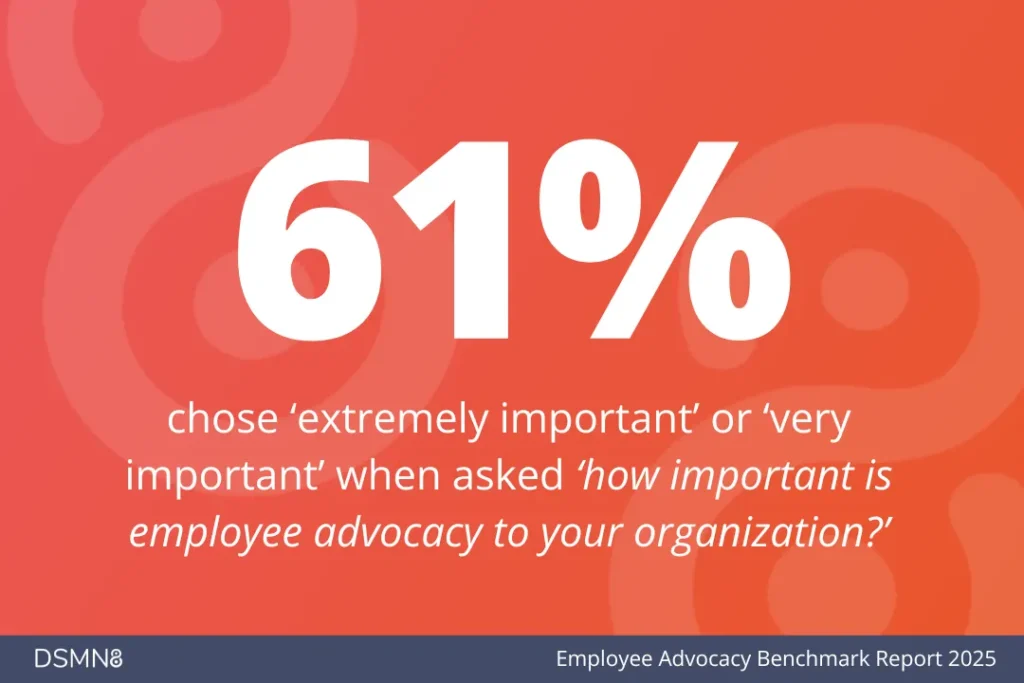
The channel has moved from experimental to mainstream. A 2025 DSMN8 benchmark report found that 61% of organisations rated employee advocacy as “extremely important” or “very important” – a signal that it has been adopted as a strategic priority rather than a marketing experiment.
In the UK specifically, adoption is ahead of the global average: Oktopost’s 2025 research showed 62% of UK respondents had active advocacy programmes, compared to 55% globally.
The distribution of benefits has also been clarified. The same 2025 DSMN8 report found that 52% of organisations cited increased brand awareness as the primary benefit of employee advocacy, placing it ahead of lead generation and talent attraction in the hierarchy of reported outcomes.
For professional services firms, brand awareness within the right professional networks is a direct precursor to new business enquiries, making this framing commercially relevant rather than just a marketing vanity metric.
Participation behaviour is changing too. According to DSMN8’s 2026 benchmark report, 68% of advocates post 3 or more times per week, with 21% posting more than 5 times per week.
That level of consistent participation suggests advocacy is becoming embedded in professional routine rather than treated as an occasional campaign activity – which is where programmes need to get to build the kind of sustained presence that shifts brand perception.
The engagement advantage of employee-shared content has also strengthened. Oktopost’s 2026 data shows employee-shared content is re-shared 24 times more frequently than content shared through official brand channels, and generates 8 times higher engagement.
The mechanism behind this is audience trust and algorithmic preference: social platforms distribute content from personal accounts to a higher proportion of followers than equivalent content from brand pages, and users engage more readily with content that appears in a professional peer context than in a branded content context.
For professional services firms, the most significant data point is the alignment of career incentives. When 94% of employee advocates report that posting on LinkedIn benefited their careers, the barriers to programme participation drop considerably.
The historical challenge with advocacy programmes was motivating employees to participate when the benefit flowed entirely to the firm. That asymmetry has largely corrected itself – particularly for senior professionals in sectors where personal visibility drives career capital as much as internal performance.
The compliance dimension has become increasingly relevant as programme scale has grown. As advocacy activity has increased in regulated sectors – financial services, law, and accountancy – the FCA’s guidance on social media financial promotions and the SRA’s conduct rules on solicitor communications have become live operational considerations.
Firms that treat advocacy programme design as purely a marketing function without legal or compliance input are carrying exposure that grows with every piece of employee-published content.
The data picture in 2026 is not “whether to run an advocacy programme” – that debate is effectively over among professional services firms above a certain size. The question is whether the brand infrastructure supporting the programme is strong enough to deliver results rather than just activity. Brand awareness numbers increase with any advocacy programme. Revenue impact is selective.
What a Failing Advocacy Programme Actually Looks Like
The failure mode is predictable and almost always traces back to the same root cause: the programme was launched before the brand was ready to be amplified.
The specific symptoms vary. Content fatigue hits within three months when the pool of shareable material runs out, and the firm starts recycling topics.
Participation drops when employees sense that the content they’re being asked to share doesn’t reflect genuine expertise – and sharing it starts to feel like it diminishes their professional standing rather than enhancing it. Leadership loses interest when the vanity metrics don’t translate into anything measurable by the time of the quarterly review.
In professional services, there is an additional failure mode unique to the sector: the reputational asymmetry between individual and firm.
A partner who posts compliantly about the firm’s services, while also posting genuinely and with authority about their specialism, creates an implicit comparison that favours the individual.
The firm’s branded content looks bland next to the partner’s expert commentary. That discrepancy is a brand positioning problem that employee advocacy didn’t create but makes visible.
The diagnostic question is direct: if you removed all the programme mechanics – the sharing prompts, the content library, the gamification – would employees still be talking about their work publicly? If the answer is no, the programme is the only thing generating activity, which means it stops the moment attention shifts elsewhere.
A better question: why aren’t they sharing already? If the answer is “they don’t have interesting things to say” or “the firm doesn’t have a view worth sharing,” that is a brand strategy problem, not an advocacy programme problem.
Where Programmes Break Before They Start

I was brought in to review a client’s content strategy – a mid-sized professional services firm with around 40 staff – where employee advocacy was already on the agenda. The partners had heard about reach multipliers and wanted to encourage employees to share content. The instinct was sound. The execution plan was not.
The mistake was a common one: the firm wanted to start with the distribution mechanism before it had anything worth distributing. The plan was to create a library of social posts, send them to staff weekly, and ask people to share. Simple enough.
The problem was that the content itself – the posts, the articles, the firm’s existing LinkedIn presence – was indistinguishable from every other mid-sized professional services firm in their sector. There was no point of view. No position on anything clients actually argued about. No voice.
We stepped back from the sharing programme and spent eight weeks on the brand first. Defined the firm’s positioning. Built a content framework around three or four genuinely contested questions in their sector where the firm had a defensible view. Created a small library of templates that gave professionals a starting structure but left room for individual voice.
When the sharing programme launched three months later, participation was lower than the partners had originally planned for – fewer people, more selective – but the quality of what was being posted was categorically different.
Within the first few months, employee shares were reaching audiences that hadn’t previously engaged with the firm at all, and the partners with the strongest LinkedIn presence started receiving direct messages from prospective clients who cited specific posts as the reason for getting in touch.
The lesson is consistent with everything I have seen since: advocacy is a distribution strategy. Distribution only creates commercial value when what is being distributed has commercial value. Start with the brand. Then scale it.
Decision Framework
| Decision Point | The Wrong Way | The Right Way | Why It Matters |
| Programme launch timing | Launch advocacy before brand positioning is defined | Establish a clear positioning and messaging framework first | Advocacy amplifies what exists; amplifying ambiguity accelerates irrelevance |
| Content creation | Provide generic, repurposable social posts for all staff | Build role-specific content with subject-matter talking points | A partner’s credibility in their network requires expert-level specificity, not marketing copy |
| Participation targets | Measure success by the percentage of employees sharing | Measure qualified engagement per advocate in target-market networks | Reach without audience relevance does not convert to a commercial opportunity |
| Content topics | Rotate through firm services and announcements | Anchor content to genuine professional opinions on contested sector questions | Promotional content is algorithmically deprioritised; opinionated expert content builds authority |
| Compliance approach | Treat employee content as informal and unregulated | Run content guidelines through legal/compliance review in regulated sectors | FCA financial promotion rules and SRA conduct requirements apply to employee posts |
| Frequency guidance | Ask all employees to share as often as possible | Set frequency by role and network quality; quality over volume | High-frequency, low-quality posting in professional networks damages individual credibility |
| Measurement cadence | Report participation rates to leadership quarterly | Track inbound enquiries, qualified connection growth, and direct attribution monthly | Participation proves activity; qualified engagement proves commercial relevance |
Frequently Asked Questions
What is employee advocacy in professional services?
Employee advocacy in professional services is the practice of partners, associates, and staff sharing the firm’s content, expertise, and perspectives through personal professional networks. Because individual credibility and firm reputation are closely linked in sectors like law and accountancy, advocacy in these settings has both commercial and reputational dimensions that consumer-facing sectors do not face.
How does employee advocacy differ from regular social media marketing?
Social media marketing operates through corporate accounts and paid distribution. Employee advocacy operates through individual professionals’ personal networks, which carry higher trust, achieve better organic reach on platforms like LinkedIn, and generate higher engagement rates. The two approaches are complementary rather than interchangeable – employee advocacy extends what corporate channels cannot reach.
Why do employee advocacy programmes fail?
Most programme failures trace back to one of three causes: the brand being advocated lacks a clear position worth amplifying; content quality is insufficient to sustain genuine professional engagement; or participation is treated as a volume target rather than a quality one. In regulated sectors, compliance design failures are also a common cause.
How much can employee advocacy extend a firm’s reach?
Content shared by employees can extend reach by 561% compared to the same content shared through official brand channels, according to PostBeyond’s research. Employees’ combined networks are, on average, ten times larger than a company’s follower base. However, these figures represent ceiling performance under favourable conditions, not a guaranteed outcome.
What content works best for professional services employee advocacy?
Original professional perspectives on contested or current sector questions consistently outperform promotional content in professional networks. A solicitor’s argued view on a legislative change, an accountant’s take on HMRC guidance, or a financial adviser’s position on a client planning question generates genuine engagement because it demonstrates expertise rather than advertising it.
How should a professional services firm measure employee advocacy success?
Beyond participation rates, effective measurement tracks qualified engagement per advocate – comments from target-market professionals, direct messages attributable to specific posts, inbound enquiries citing social media touchpoints, and connection growth within defined target sectors. Reach and impressions are useful secondary metrics. Revenue-adjacent indicators are the primary ones.
Does employee advocacy create compliance risk for regulated firms?
It can. FCA guidance on financial promotions applies to social media content published by employees of regulated firms in certain circumstances. SRA conduct rules apply to solicitors publishing content on professional matters. Any advocacy programme in financial services, legal, or related sectors should be designed with compliance and legal input, not treated as outside those frameworks.
How do you motivate employees to participate without it feeling forced?
The evidence suggests that motivation is primarily a content-quality problem rather than an incentive-design problem. When employees are given genuinely interesting things to say – positions that reflect their expertise, talking points that make them look authoritative in their networks – participation follows. According to DSMN8’s 2026 benchmark report, 94% of advocates said posting on LinkedIn benefited their careers, which suggests career self-interest is a more reliable motivator than gamification.
What is the difference between employee advocacy and employer branding?
Employer branding is the management of a firm’s reputation as a place to work, aimed primarily at talent attraction and retention. Employee advocacy is the practice of employees actively representing the firm’s commercial brand to external professional audiences. The two overlap significantly – a strong employer brand produces employees more willing to advocate publicly – but they serve different primary objectives.
When should a firm launch an employee advocacy programme?
A firm is ready for a structured advocacy programme when it has defined and documented brand positioning, a content framework that produces regular expert-level material, and clear messaging guidelines that employees can apply without needing individual approval for every post. Without those foundations, launching a sharing programme produces activity without commercial impact.
How does AI-driven search affect employee advocacy value?
AI search tools, including Perplexity, ChatGPT Search, and Google’s AI Overviews, are increasingly surfacing individual expert voices as source citations. A senior professional who has built a body of published content around their area of expertise is more likely to be cited by AI search as a credible source than a firm’s generic service pages. This creates a new dimension of advocacy value that extends beyond social media reach into search visibility and AI citation authority.
What role does internal branding play in employee advocacy success?
Internal branding is the foundation on which all external advocacy rests. Employees who genuinely understand what the firm stands for, who believe in the firm’s positioning, and who feel alignment between their personal professional identity and the firm’s brand are categorically more effective advocates than employees who are simply complying with a sharing request. Internal branding is not a nice-to-have for firms; it is a prerequisite that determines whether the external programme produces results or noise.
The Verdict
The data is settled: employee advocacy extends reach, increases engagement, and – in firms where it is run well – produces measurable commercial outcomes.
Sociabble puts the revenue growth advantage at 20% and the social selling improvement at 400%. Advocacy programmes do not produce those numbers. They are produced by brands that are worth advocating for, supported by advocacy programmes.
That distinction is the one most conversations about this topic avoid. It is easier to talk about reach multipliers and participation rates than to have the harder conversation about whether the brand being shared is actually distinctive.
For UK professional services firms, where the managing partner’s personal reputation, the firm’s visual identity, and its market positioning are all on the line every time an employee posts, the easier conversation is also the more expensive one.
The single most important step most professional services firms should take before launching or scaling an advocacy programme is a structured brand audit. Not to assess whether advocacy is a good idea – it is – but to assess whether the brand that employees would be amplifying is ready to be amplified.
If you want to know exactly where your brand stands before your team starts posting on its behalf, the Brand Equity Audit™ at Inkbot Design is a structured diagnostic that identifies where the brand is losing commercial ground and what to do about it.
It is free, specific, and the starting point that firms running successful advocacy programmes have in common.
