Brand Research Interviews: Test the Positioning Before the Rebrand
Brand research interviews should test the case for your positioning, rather than collect praise. This guide shows professional services leaders how to recruit buyers, reconstruct buying decisions, separate perceptions from capabilities, and record contradictory evidence. The result is a traceable basis for brand decisions, with the limits made explicit throughout.



On this page6 min left
Brand research interviews should test whether your proposed positioning aligns with how buyers make choices.
Before a professional services rebrand, speak to people involved in recent buying decisions, investigate what helped or hindered selection, and record what supports or contradicts the position leadership wants to claim.
A polished quotation cannot do that job alone.
Gartner reported that 69% of 632 B2B buyers surveyed in 2024 encountered inconsistencies between website information and information provided by sellers.
That finding concerns buyers’ reported experiences, not the percentage of brands with inconsistent messaging. Still, the question for your research is clear: does the promise survive the sales conversation?
Interviews contribute evidence to professional services brand strategy. The wider brand strategy process must also establish what the business can deliver.
How do brand research interviews test positioning?

Run the research by defining a positioning claim, recruiting relevant buyers, reconstructing specific buying decisions and comparing the accounts with capability evidence.
- Record supporting and contradictory accounts.
- Separate buyer perceptions from verified delivery.
- Assign an owner to each proposed decision and set evidence limits.
Brand research interviews are qualitative conversations that examine buyer perceptions, buying experiences and the evidence supporting a proposed brand position.
Write down the position leadership wants to claim before recruiting anyone. For a hypothetical tax practice, that might be: “Owner-managed businesses choose us because partner involvement reduces uncertainty during succession.”
Then record what would weaken the claim: buyers cannot recall partner involvement, did not value partner involvement, or selected the practice for another reason.
This discipline does not mean ignoring unexpected findings. Keep an open section in the guide for explanations your hypothesis misses.
Nielsen Norman Group warns that leading interview questions compromise the validity of data. A written hypothesis is therefore a research question for the team, not an answer to feed participants.
Who should you interview before a rebrand?
Recruit against the decision, rather than asking partners to nominate their favourite clients.
For a 50–200-person advisory business considering a new specialist position, a useful recruitment plan could include:
- Recent clients who selected the relevant service.
- Buyers from lost pitches or abandoned opportunities.
- Clients who left, where access is appropriate.
- Different participants in the same purchase, such as the sponsor and procurement lead.
Record why each participant qualifies. A long-standing contact who inherited the relationship may know delivery well but know little about the original selection.
“We already know our clients.”
That may be true. The research question is narrower: do you know why a particular buying group chose, rejected or misunderstood the proposition now being considered?
Keep partner interviews separate from buyer interviews. Partner accounts help establish the intended offer and operational constraints; partner accounts do not substitute for external perceptions.
There is no universal interview quota. NNg’s 2021 sample-size guidance links the required sample to research scope, population diversity and saturation: the point where further interviews no longer materially develop the themes. This is methodological guidance, not a prescribed sample for professional services branding.
Set an initial recruitment plan, analyse during fieldwork and reserve capacity for gaps. Repetition among loyal clients is not a reason to stop when lost-pitch buyers remain unheard.
What should you ask to test the positioning?
Ask buyers to reconstruct a specific selection before showing proposed messages.
This separates unaided recollection from reactions to language introduced during the interview.
Use the following as a working guide, not a script to read without listening:
- “Think about the most recent time you selected an adviser for this work. What triggered the search?”
- “Which alternatives did you consider, including doing nothing or keeping the work in-house?”
- “Before contacting anyone, what had you already decided?”
- “What made an adviser credible enough to reach the shortlist?”
- “Who else influenced the choice, and what did those people need to know?”
- “Was there anything the website led you to expect that changed during the sales conversation?”
- “What nearly stopped the appointment?”
- “What happened after the appointment that supported or challenged those expectations?”
Probe specifics. “Can you give an example?” is more useful than inviting agreement with your preferred adjective.
If a buyer says “responsive”, ask what happened. Was a deadline met? Did a partner return a call? Did the buyer receive a clear answer without having to chase?
Those accounts suggest different positioning possibilities.
Remember the limit: an interview about a buying event remains a remembered account.
NNg’s 2024 guidance explains that interview responses about past behaviour can be affected by imperfect memory and social-desirability bias. Where the distinction matters, seek corroborating material with permission: a shortlist, proposal comparison or contemporaneous email.
A document can help check the sequence. A document does not reveal every private conversation behind the decision.
Only after unaided discussion should you introduce a proposed positioning statement. Ask:
- “What does this lead you to expect?”
- “What would you need to see before believing this?”
- “Which parts fit your experience, and which do not?”
- “Who would find this irrelevant?”
Record these as prompted responses. Do not combine spontaneous buyer language and reactions to your copy as though both emerged independently.
Avoid asking whether buyers “like” the position and treating approval as validation. Someone can understand a claim, approve of the wording and still have no reason to choose the business.
How do you turn interview answers into brand decisions?

Create an evidence ledger that connects the proposed claim to source material, competing explanations and a decision. The ledger exposes the reasoning; the ledger does not validate the claim.
Start by coding the interview material. Coding means labelling relevant extracts so related observations can be examined together.
Useful starter codes might include selection trigger, shortlist reason, perceived risk, proof requested, sales contradiction and delivery experience. Add codes when the material reveals something the initial list misses.
Keep the participant’s buying role attached to each extract. A procurement lead questioning price and a finance director seeking reassurance may be describing the same appointment from different responsibilities. Do not flatten that disagreement into “buyers want value”.
Then separate the evidence:
- Perception: what the buyer believed or understood.
- Reported event: what the buyer recalls happening.
- Capability check: what records or responsible delivery leaders substantiate.
- Interpretation: what the research team thinks the evidence means.
A client saying “the partner was always available” supports that client’s perception. The statement does not establish a practice-wide availability standard.
Take a hypothetical 12-partner tax practice considering “partner-led succession advice”. The following entries are fictional and illustrate the method; no client outcomes are claimed.
Ledger field | Hypothetical entry |
|---|---|
Proposed claim | Partner involvement reduces uncertainty during succession. |
Supporting account | A recent buyer recalls a partner explaining the options before appointment. |
Contradictory account | Another buyer expected partner delivery but mainly dealt with a manager. |
Alternative explanation | The first buyer may have valued the clear explanation rather than the partner’s seniority. |
Capability check | Review engagement scope and delivery responsibilities before promising continuing access. |
Decision | Test a narrower promise about partner involvement at defined decision points; do not imply constant access. |
The contradiction changes the claim’s scope. That is a research result, even if the narrower wording feels less impressive.
“We cannot base a rebrand on a handful of conversations.”
Correct, if the proposed conclusion is a market-wide percentage or a forecast of revenue. Use interviews to investigate explanations, language and conditions. If leadership needs to know how prevalent a view is across a defined market, plan an appropriately designed quantitative study rather than converting interview counts into market shares.
Distinguish qualitative attitudinal evidence from behavioural evidence; interview accounts should not be presented as direct observation of purchasing behaviour.
For each positioning decision, record:
- What the evidence supports.
- What contradicts the interpretation.
- Which buyers or situations remain unrepresented.
- What additional finding would change the decision.
Feed those decisions into the brand strategy document.
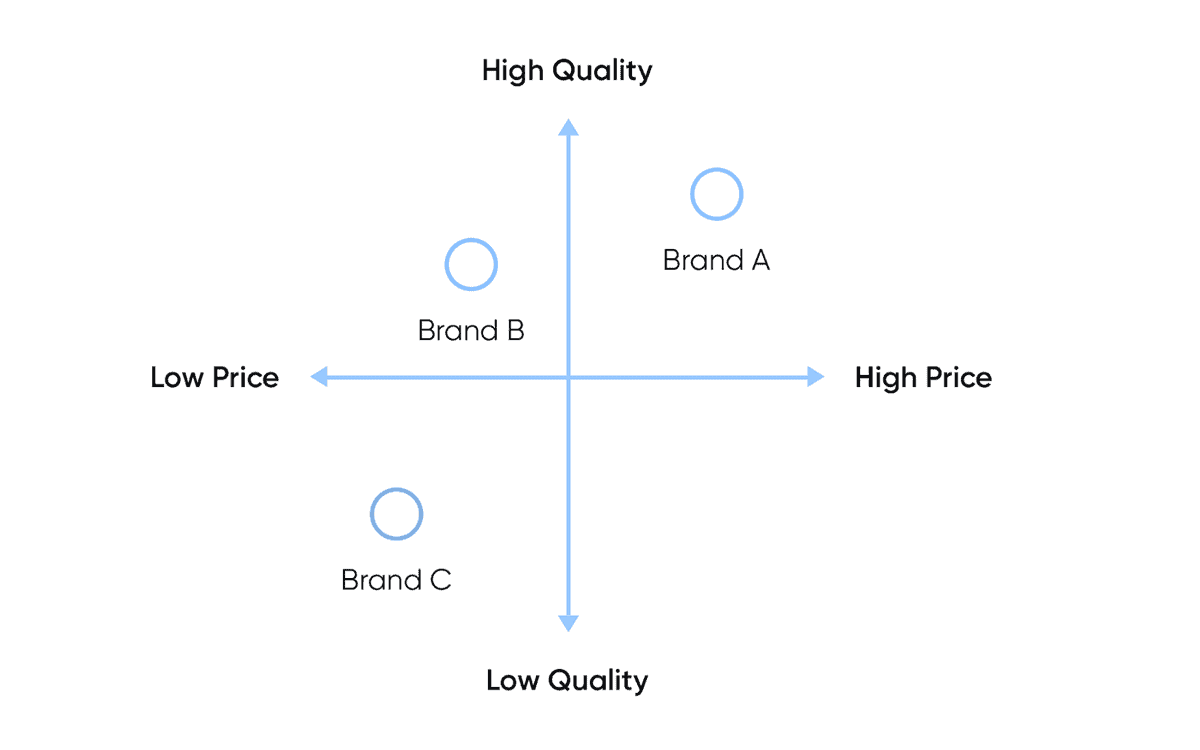
Where buyers name alternatives, use those accounts to inform competitive brand mapping.
Keep unresolved questions visible during the branding workshop; a vote in the workshop does not resolve an evidence gap.
Approve the evidence before approving the identity
A research deck can be persuasive while leaving the proposed position untested.
Before approving identity work, ask the team to show the claim, supporting accounts, strongest contradiction and capability check. If the explanation relies on a single flattering quotation, send the decision back for further investigation.
A focused internal study can be a sensible starting point when access is straightforward, and the decision is limited. Consider an independent interviewer when relationship pressure or partner disagreements make candid discussion difficult.
If the wider positioning still needs an outside assessment, request Inkbot Design’s free Brand Equity Audit™. The service provides a written diagnostic of positioning, messaging and brand presentation; the diagnostic is not a substitute for buyer interviews.
Start today by writing the position you want to claim and the finding that would make you change your mind.
Questions people ask
What is the difference between brand research interviews and a brand survey?
Brand research interviews explore accounts, meanings and explanations through follow-up questions. A survey collects responses to a more standardised set of questions. Use interviews to investigate an unfamiliar issue; use an appropriately sampled survey when the decision requires estimates of how widespread a view is. Neither method automatically validates positioning.
Should a partner interview their own clients?
Prefer someone outside the immediate account relationship when candid criticism is central to the study. Nielsen Norman Group identifies social-desirability bias as a limitation of self-reported evidence. Choosing a more independent interviewer is a practical precaution, not a guarantee of unbiased answers.
When should you show buyers a positioning statement?
Show a proposed positioning statement after asking about the buyer’s experience and unaided understanding, and introducing the claim earlier risks shaping subsequent answers. Record later reactions as prompted feedback, and test understanding, credibility and relevance separately rather than treating approval of the wording as proof.
Can AI analyse brand interview transcripts?
Yes — AI can assist with research analysis, but keep human review of the extracts that support consequential decisions. If using AI, check summaries against transcripts and preserve conflicting accounts and participant roles. Treat the output as a draft interpretation, not an independent source of evidence or a replacement for research judgement.