7 Brand Development Strategies for Scaling Brand Ops
Most founders invest heavily in identity—logo, colour palette, tone of voice—and then hand a PDF to their marketing team and call it done.
The brand deteriorates, not because the strategy was wrong, but because there was never a system built to execute it consistently at scale. That is where brand development fails, and it fails expensively.
According to AdAde’s Survey, 52% of consumers stopped buying from a brand after a single bad brand experience. Not a bad product. A bad brand experience.
The gap between a well-defined strategy and a well-run brand operation is where that revenue disappears.
For founders and marketing directors who want to understand why their brand is slipping—and what an operational fix actually looks like—the framework below is what we build at Inkbot Design. It is not inspirational. It is structural.
Effective brand governance is the infrastructure that turns brand strategy from aspiration into operational reality—and without it, every other strategy on this list eventually collapses.
- Prioritise brand operations and governance: build systems, approval workflows, and a single source of truth before scaling creative.
- Anchor on a positioning architecture, not a statement: define permitted territories, forbidden areas, audiences, and review triggers to protect mental availability.
- Audit and protect distinctive assets using Fame and Uniqueness scores; consistently deploy high-scoring assets and retire low-performing elements.
- Build an AI-visible entity surface: publish named frameworks, add JSON-LD structured data, and create citation-worthy content for AI discovery and visibility.
What Are Brand Development Strategies?
Brand development strategies are the structured frameworks founders and CMOs use to build, govern, and scale brand identity—spanning positioning, visual systems, internal governance, and market differentiation—to drive measurable commercial outcomes.
Key Components:
- Positioning architecture — The defined space your brand occupies in the market relative to competitors and in the mind of a specific buyer
- Distinctive asset management — The systematic identification, protection, and deployment of visual and verbal brand elements that trigger recognition without requiring the brand name
- Brand operations infrastructure — The governance systems, approval processes, and internal tooling that ensure the brand is expressed consistently across every touchpoint
Brand development strategies are the structured frameworks founders and CMOs use to build, govern, and scale brand identity—spanning positioning, visual systems, internal governance, and market differentiation—to drive measurable commercial outcomes.
Brand Development in 2026
Brand development has entered a period of uncomfortable honesty. For the past decade, the dominant narrative has been that authenticity is the strategy. Show your values. Be transparent. Build community.
While none of that advice is wrong, it has produced a generation of brands that feel identical: the same warm sans-serif typefaces, the same sustainability commitments, the same “we’re a people-first company” positioning.
HubSpot’s 2026 State of Marketing Report—based on responses from over 1,500 global marketers—found that 61% of marketers believe marketing is experiencing its biggest disruption in 20 years due to AI.
The specific disruption matters here: AI content generation has commoditised the surface-level signals that brands once used to appear differentiated. A tone-of-voice document is no longer a competitive advantage when a competitor can replicate its output in 30 seconds with a prompt.
What cannot be easily replicated is structural brand distinctiveness—the Fame and Uniqueness metrics used by the Ehrenberg-Bass Institute for Marketing Science at the University of South Australia to assess brand asset strength.
Research conducted by Ipsos and JKR, analysing over 5,000 brand assets and surveying 26,000 global consumers, found that 65% of brand assets fall into the “bronze” category—elements unlikely to signify the brand when used in isolation.
Only 15% of brand assets are truly distinctive: the “gold” tier, where an element immediately brings the brand to mind without the brand name present. The implication for scaling brands is significant. Most organisations are deploying brand assets that do not actually work.
Two parallel developments have sharpened this further in 2025 and early 2026.
- First, Canva’s AI-powered design tools—including Magic Design and the expanded Brand Kit functionality launched in late 2024—have made it trivially easy for non-designers to produce brand-adjacent content that looks coherent but is not actually governed. Brand managers at scaling SMBs now contend with internal teams generating on-brand-ish content that gradually dilutes the genuine, distinctive assets the brand has built.
- Second, Google’s AI Overviews and AI agents, such as Amazon’s Rufus, have introduced a new surface for brand discovery: the AI-mediated recommendation layer, where only brands with a structured, entity-rich web presence surface reliably. Brands without a clear positioning architecture are becoming invisible not just to humans but also to the algorithms serving human buyers.
The strategic implication: brand development in 2026 requires both tightening the internal system and expanding the external entity surface.
Those are different problems requiring different solutions.
Brand development in 2026 is not a creative problem. It is an operational and entity problem. Brands that win are not the most authentic—they are the most legible: to consumers, to search engines, and to AI systems that increasingly determine what buyers see first. Distinctiveness is structural, not tonal, and it has to be built deliberately before it can be defended at scale.
Strategy 1: Anchor on a Positioning Architecture, Not a Positioning Statement
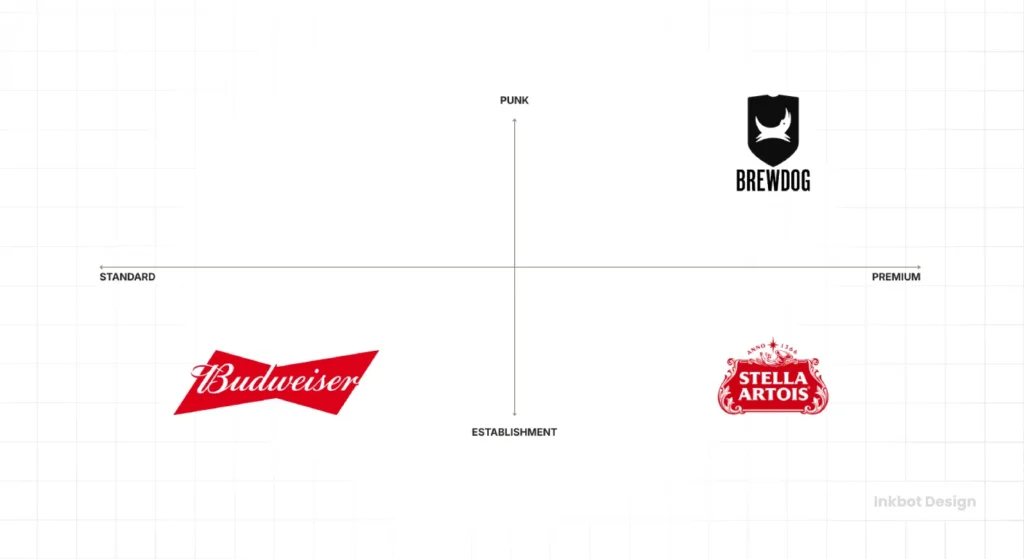
Positioning statements are not brand strategy. They are a sentence—usually a fill-in-the-blank template—that summarises who you are for, what you do, and why you are different. Every brand has one. Almost no brand has operated for more than two years without quietly shifting.
A positioning architecture is different. It defines not just the position but the rules that protect it: what the brand will and will not be associated with, which audience segments are primary versus secondary, which competitor comparisons are acceptable in sales conversations, and how the position should evolve as the company scales.
Professor Byron Sharp of the Ehrenberg-Bass Institute for Marketing Science established in How Brands Grow (Oxford University Press, 2010) that mental availability—being easily thought of in buying situations—is a primary driver of brand growth.
Positioning architecture systematically builds and protects mental availability, rather than leaving it to the creativity of whoever happens to be writing the next campaign brief.
For founders specifically, the positioning architecture failure is predictable: the brand starts with a clear, defensible niche, then scope creep pulls it into adjacent markets to chase revenue, and within 18 months, the brand stands for nothing distinctive.
B2B buyers, who, according to Deloitte’s 2025 Marketing Trends report, represent companies 3× more likely to exceed revenue goals when leading in brand-led personalisation, are particularly sensitive to positional incoherence.
They are evaluating suppliers over extended buying cycles. A brand that shifts positioning mid-cycle loses credibility faster than one that holds a narrower position consistently.
The practical output of a positioning architecture is not a single slide.
It is a governing document with four sections: the primary market position and its evidence base; the permitted adjacent territories (with conditions); the forbidden territories; and the trigger conditions under which a strategic position review is warranted.
Without the last section, founders revisit positioning every time a competitor does something new. With it, there is a structured decision framework.
Positioning architecture is not the statement you write—it is the decision framework you enforce. Without explicit rules for what the brand will refuse, the position drifts toward whatever is most convenient for the sales team this quarter. The brands with durable mental availability are not the most interesting; they are the most disciplined.
Strategy 2: Audit and Protect Your Distinctive Brand Assets

Most brands spend more time designing new assets than auditing the ones they already have. That is backwards, and the data makes it uncomfortable to defend.
The practical problem for scaling brands is compounding dilution. Each new campaign, each new product launch, each new social channel introduces new visual and verbal elements.
Without a systematic audit mapping each element against Fame and Uniqueness scores, the brand accrues creative debt: a growing library of assets that consume design resources without building the mental availability that drives recognition.
The Distinctive Asset Grid, developed by Professor Jenni Romaniuk of the Ehrenberg-Bass Institute and codified in Building Distinctive Brand Assets (Oxford University Press, 2018), plots each brand element on a two-axis matrix of Fame versus Uniqueness.
Elements in the top-right quadrant—high Fame, high Uniqueness—are the “Use or Lose” assets: they must appear consistently in every brand expression or their recognition value begins to decay. Elements in the bottom-left are candidates for retirement, not investment.
Tropicana PepsiCo’s catastrophic 2009 packaging redesign remains the most documented case of distinctive asset destruction. Tropicana invested £35 million in an advertising campaign promoting the new packaging, then watched sales drop 20%—a £30 million revenue loss—within two months of launch.
The Branding Journal’s analysis of the failure identifies the mechanism: Tropicana’s iconic orange-with-a-straw image was a high-Fame, high-Uniqueness asset. The redesign, developed by Arnell Advertising Agency, removed it in favour of a glass of orange juice.
Consumers lost the visual shortcut they had used for decades to identify the product on the shelf. The brand reverted to its original packaging within 36 days.
The brand development lesson is not “don’t change anything.” It is: audit before you redesign, and measure Fame and Uniqueness before you retire what you already have.
Distinctive brand assets are built over years and destroyed in a product launch cycle. The brands that scale without losing recognition share one operational habit: they measure asset fame and uniqueness empirically before making any changes visible to consumers. Intuition is not a measurement framework.
Strategy 3: Build Brand Governance Before You Scale, Not After

Brand governance is the infrastructure most founders build reactively—after a junior employee publishes something off-brand on LinkedIn, after a vendor produces a brochure with the wrong font, after the sales deck and the website start contradicting each other on pricing.
By that point, the brand has already been diluted. The fix is expensive and slow. The alternative is building governance into the brand architecture from the outset.
Effective brand governance is not a 60-page PDF of brand guidelines.
It is an operational system with four components: a single source of truth for all brand assets (format-agnostic, access-controlled, version-managed); an approval workflow for new brand applications; a set of exception protocols for time-sensitive situations where the full workflow cannot be followed; and a regular audit cycle to identify brand drift before it becomes brand erosion.
For SMBs scaling from 10 to 50 employees, the governance failure is almost always the same: guidelines exist, but there is no enforcement mechanism.
The PDF sits in a Notion page that three people know about. New hires produce content using whatever template they find first.
The brand drifts not through malice but through friction—it is easier to produce something passable than to navigate an unclear approval process. Good brand governance removes the friction from doing the right thing and adds friction to doing the wrong thing.
The HubSpot 2026 State of Marketing report found that 86.4% of marketing teams now use AI in at least some marketing areas.
The majority of AI-generated marketing content is produced without brand governance oversight. That number suggests scaling brands face a new version of an old problem: high-volume content production that outpaces the governance infrastructure designed to control it.
A detailed breakdown of what functional brand governance looks like at different organisation scales—from founder-led startups to mid-market teams—is outlined in our brand governance framework.
The short version: if you cannot answer “who approves this?” in under 30 seconds, you do not have a governance system. You have a document.
Brand governance is not bureaucracy. It is the operational difference between a brand that compounds over time and one that slowly becomes unrecognisable to the customers who once chose it. The governance infrastructure is boring to build and expensive to ignore.
Strategy 4: Define Category Entry Points and Own Them Deliberately
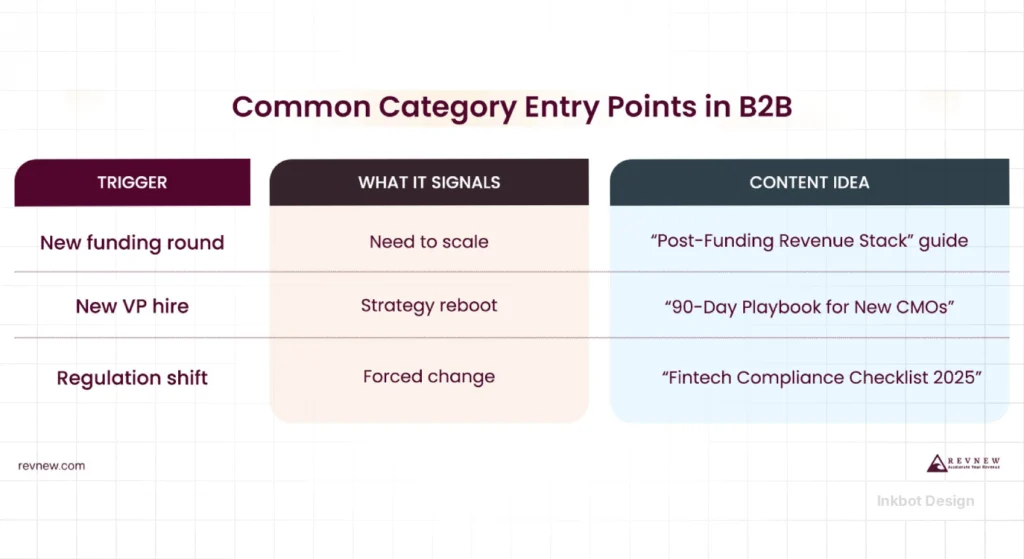
Category Entry Points (CEPs) are the buying situations, occasions, and need states in which buyers think of your category. They are not the same as your brand’s positioning. They are the mental hooks that connect a buyer’s real-world trigger to your brand’s name.
The Ehrenberg-Bass Institute identifies CEPs as a core driver of mental availability—the condition of being easily thought of when someone needs what you sell.
For B2B brands, the CEP failure is specific. Most founders build a brand around what they do, rather than around the situations in which buyers start looking. A branding agency might define its positioning as “strategic brand identity for scaling businesses.”
That is a description of the product. The CEPs—the actual moments buyers think of that category—might be: “We’re about to raise a Series A and need to look credible to investors,” or “Our sales team says our brand is costing us deals,” or “We’ve outgrown our original logo and nothing feels cohesive anymore.”
Each of these is a distinct CEP requiring distinct brand messaging.
The practical exercise is a CEP audit: list every situation in which a buyer might start looking for what you sell. Map your existing brand communications against that list. Count how many CEPs your current messaging addresses.
For most SMBs, the answer is one or two—usually the most obvious ones, often not the most commercially valuable ones.
The CEPs with the highest conversion value tend to be the ones associated with urgency or risk: the founder who has already made a costly brand mistake, the CMO whose board has questioned brand ROI, the sales director whose pipeline is stalling at the credibility check.
Once the CEP map exists, brand communications can be deliberately built around it—not as a campaign, but as a permanent layer of the brand’s market presence. Content, search visibility, social proof, and sales enablement all become CEP-specific rather than generic.
Brands are not remembered; they are retrieved. Buyers retrieve brand names when a specific situation arises that connects a need to a memory. The brands that scale fastest are the ones that have deliberately built memory structures around the most commercially valuable category entry points—not the most flattering self-descriptions.
Strategy 5: The Rebranding Myth — Why Your Brand Doesn’t Need to Change, It Needs to Be Managed
Rebranding is the most expensive misapplication in brand development. When a brand is underperforming—declining awareness, weakening conversion, sales team complaints—the instinctive response is a new identity. New logo. New colour palette. New website.
The assumption is that the brand is the problem. In the majority of cases, the brand operations are the problem. Fixing the wrong thing costs money without solving the issue.
This was the best advice available 15 years ago: when brand stagnation happened, a rebrand signalled change and created news. The rationale made sense in an era of limited content channels and slow brand communication cycles.
It no longer holds. In 2026, a rebrand generates three to six weeks of attention—and then the same operational failures that caused the brand to underperform reassert themselves under a new visual system.
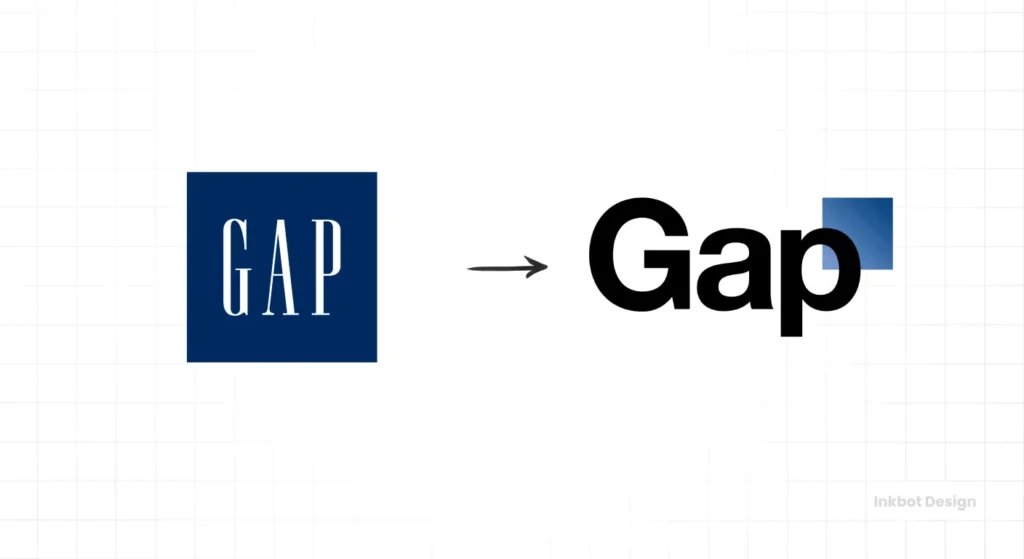
Gap’s 2010 logo redesign is the canonical cautionary tale. Faced with declining sales following the 2008 financial crisis, the company replaced its 20-year-old logo with a new design.
Consumer backlash was immediate and overwhelming: within 24 hours, one blog had generated 2,000 negative comments, and a protesting Twitter account had gathered 5,000 followers, according to The Branding Journal’s documented case study. Gap reverted to its original logo after 6 days.
The episode illustrated what brand consultant Mark Hansen, then Gap’s North America president, later acknowledged: the company had failed to engage its audience or articulate why the change was necessary. The rebrand was not the solution to Gap’s commercial problem. It was a distraction from it.
The alternative to rebranding is brand operations remediation: a structured audit of where the brand is failing across touchpoints, why it is failing, and what operational changes would fix it.
Most brand underperformance traces to four sources: inconsistent asset deployment (wrong colours, wrong typefaces, wrong tone); misaligned messaging across sales and marketing; failure to reach the right Category Entry Points in content and advertising; and weak governance allowing brand drift.
None of those requires a new logo.
Rebranding is warranted in three specific circumstances: when a brand is entering a fundamentally new market where its existing associations are a liability; when a merger or acquisition creates genuine identity confusion at the legal entity level; or when a company has survived a reputational crisis that has made the existing brand name toxic.
Outside those conditions, the brand development investment is almost always better spent on operational improvement than identity replacement.
The brands that scale without expensive identity crises share one characteristic: they fix the operational system before concluding that the brand is the problem. A new logo on a broken brand operation is decoration. The question is never ‘Is our brand right?’ It is ‘Are we executing our brand right?’
Strategy 6: Operationalise Brand Measurement Beyond Awareness

Most brand measurement frameworks stop at awareness. Did aided recall improve? Did net promoter score go up? Did branded search volume increase?
These are useful data points and nearly useless as diagnostic tools. They tell you whether brand health is moving but not why, and not which specific operational levers are driving or damaging it.
A functional brand measurement framework for scaling businesses tracks four distinct layers.
- The first is mental availability metrics: the CEP-specific recall scores described in Strategy 4, not generic aided awareness.
- The second is distinctive asset performance: tracked quarterly against Fame and Uniqueness dimensions to identify assets that are building recognition and those that are eroding it.
- The third is brand consistency scores across touchpoints: a structured audit of whether the brand is being expressed correctly in sales decks, social channels, partner materials, customer communications, and product interfaces.
- The fourth is commercial correlation: the relationship between brand metric movements and revenue outcomes, tracked over time to build the evidence base for brand investment decisions.
The fourth layer is where most SMB brands struggle. Gartner research consistently identifies attribution as the primary barrier to justifying brand investment for marketing leaders at companies with revenue under £50M.
Without commercial correlation data, brand spend is always vulnerable to the next quarterly revenue shortfall. With it, the argument for maintaining brand investment during downturns is empirically defensible.
Deloitte’s 2025 Marketing Trends report—one of the largest annual surveys of senior marketing leaders—found that companies leading in personalisation were three times more likely to exceed revenue goals compared to industry peers.
The report attributes this performance specifically to investments in data, design, and brand-led personalisation across customer touchpoints.
The measurement infrastructure to identify and sustain that kind of brand investment return does not happen accidentally. It is deliberately built and requires a framework that connects brand metrics to business outcomes rather than stopping at awareness scores.
Brand measurement that stops at awareness is like measuring a sales team’s performance by counting calls made rather than revenue closed. The metric is real, but it is not the outcome. Scaling brands need measurement frameworks that trace the line from brand expression to commercial result—and they need to build those frameworks before the board asks for justification, not after.
Strategy 7: Build Your Brand Entity Surface for AI Discovery
This is the strategy most brand consultants are not yet discussing seriously, and it is the one that will separate commercially visible brands from invisible ones within 24 months.
AI-mediated brand discovery is not a future state. According to Quad’s 2026 marketing trends research, AI-powered assistants are already functioning as gatekeepers of brand discovery and purchase decisions—particularly through Google’s AI Overviews and Amazon’s Rufus recommendation layer.
Brands that do not appear in AI-generated responses to category searches are not visible to the portion of buyers using those systems to short-list suppliers. For B2B categories, where the buying cycle is long and research-intensive, that visibility gap has direct revenue consequences.
Building an AI-visible brand entity surface requires three operational changes.
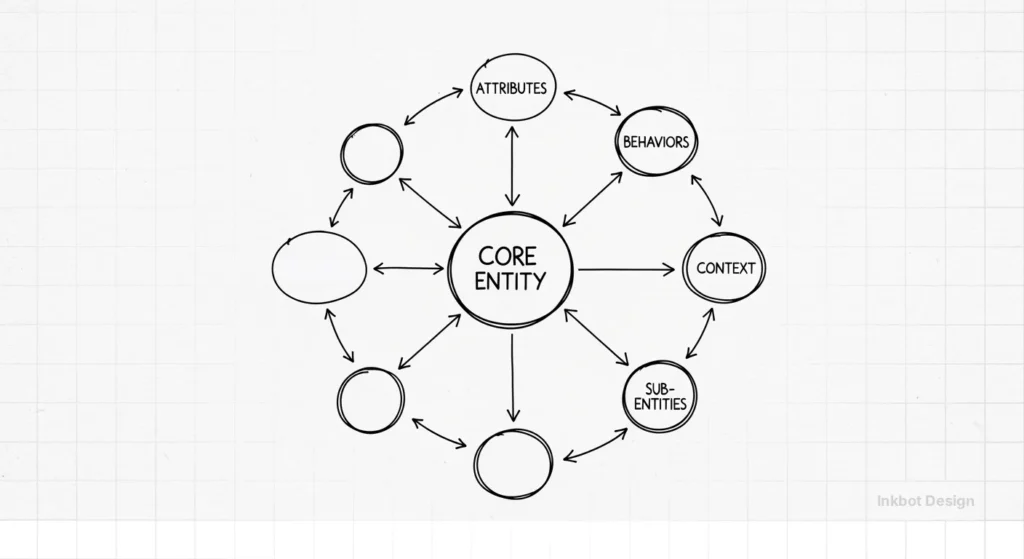
- First, the brand’s web presence must be structured around named entities—specific frameworks, methodologies, and proprietary terms that AI systems can clearly attribute to the brand. Generic content about “brand strategy best practices” does not generate attributable AI citations. Named content—”The Brand Blueprint™ methodology developed by [Agency]”—does.
- Second, the brand must generate structured data (JSON-LD schema) that correctly signals the organisation’s expertise, service areas, and geographic reach to knowledge graph systems.
- Third, the brand must build citation-worthy content: articles, research, and frameworks that are specific enough to be extracted verbatim into AI-generated summaries rather than paraphrased into oblivion.
The practical entry point for most SMBs is a brand knowledge hub: a cluster of content built around the brand’s proprietary frameworks and methodologies that differentiate it, structured to maximise both Google passage indexing and AI extraction.
This is not a blog. It is a deliberately architected content entity that gives AI systems the raw material to cite your brand accurately when a buyer asks about your category.
The next competitive advantage in brand development is not being the most creative or the most consistent—it is being the most legible to AI systems that increasingly determine what buyers see during research. Brands without a structured entity presence will not appear in AI-generated recommendations, regardless of how good their product is. Entity architecture is the new SEO, and it needs to be built into brand strategy now.
Brand Development at Scale
| Decision Point | The Wrong Way (Amateur) | The Right Way (Pro) | Why It Matters |
| Positioning | Write a positioning statement once during the brand project | Build a governing document with permitted/forbidden territory rules and trigger conditions for review | Without rules, position drifts to whatever the sales team finds convenient |
| Distinctive Asset Management | Design new visual elements for each campaign | Audit all existing assets against Fame/Uniqueness metrics before adding new ones | 65% of brand assets already fail to trigger recognition; adding more fails faster |
| Brand Governance | Store guidelines in a PDF on Notion | Build an access-controlled asset library with an approval workflow and exception protocols | Without enforcement mechanisms, guidelines are aspirational fiction |
| Category Entry Points | Write messaging around what the brand does | Map all buying situations and build CEP-specific messaging for each | Buyers retrieve brands in specific situations, not in response to generic descriptions |
| Rebranding Decision | Rebrand when growth stalls or the founder gets bored | Audit brand operations first; rebrand only when existing associations are a genuine liability | Tropicana lost £30M by removing a distinctive asset under the assumption that the brand needed a refresh |
| Brand Measurement | Track aided awareness and NPS quarterly | Track mental availability by CEP, distinctive asset Fame/Uniqueness, consistency scores, and commercial correlation | Awareness tells you the brand is known; it does not tell you whether it is driving revenue |
| AI Visibility | Publish blog content on brand topics | Build a structured entity surface with named proprietary frameworks, JSON-LD schema, and citation-worthy content. | AI systems cite specific, attributable entities—generic content disappears into the recommendation layer. |
The Verdict
Brand strategy without brand operations is not a strategy. It is a document. The seven frameworks above are not inspirational—they are structural, and the distinction matters because most brand development failures are not creative failures. They are operational ones.
The contrarian thesis this article opened with holds across every case study and every research citation above: founders do not fail at brand because they chose the wrong positioning or logo.
They fail because they treated the identity work as the deliverable and never built the system to execute it. Tropicana had a great brand. Their operation failed. Gap had a great brand. They made a panicked decision to change it without operational justification and paid the price in six days.
The single most important directive for any founder or CMO reading this: before you commission another piece of brand creative, audit your brand operations.
- Who owns brand consistency?
- What is the approval process for new brand applications?
- How are you measuring brand performance against commercial outcomes?
If you cannot answer those three questions in under five minutes, the creative work will not hold.
If you want to understand what systematic brand operations look like in practice, explore Inkbot Design’s brand strategy services and the brand governance frameworks we build for scaling businesses. The audit is where every engagement starts—and it is usually where the most expensive problems surface.
Frequently Asked Questions
What is a brand development strategy?
A brand development strategy is a structured framework that defines how a brand is positioned, expressed, governed, and measured across all market touchpoints. It covers positioning architecture, distinctive asset management, and the operational systems that ensure brand consistency scales with the business rather than fragmenting under it.
How long does brand development take?
Brand strategy development typically takes four to eight weeks for a positioning and identity project. Brand operationalisation—the governance systems, measurement frameworks, and internal adoption processes that make a strategy functional—takes three to six months to embed meaningfully at an SMB operating across multiple channels and team functions.
Why do most brand development strategies fail?
Most brand development strategies fail because the deliverable is treated as the destination rather than the starting point. A brand guidelines document is not a system. Without enforcement mechanisms, approval workflows, measurement infrastructure, and named ownership, strategy documents become historical artefacts within six to twelve months of delivery.
What is the difference between brand development and rebranding?
Brand development is the ongoing process of building, managing, and scaling brand equity. Rebranding is a specific project that replaces or significantly alters an existing brand identity. Rebranding is warranted when existing associations are a commercial liability—such as post-crisis reputation repair or merger-driven identity confusion. It is not warranted when brand operations are simply underperforming.
What are distinctive brand assets?
Distinctive brand assets are the non-brand-name elements—colours, shapes, typographic choices, sonic signatures, characters—that trigger brand recognition without the brand name being present. The Ehrenberg-Bass Institute for Marketing Science assesses distinctive assets on two dimensions: Fame (how widely recognised the asset is) and Uniqueness (how exclusively it is attributed to one brand). Only 15% of brand assets achieve true distinctiveness, according to Ipsos and JKR research across 26,000 global consumers.
How do I know if my brand needs a rebrand or an operational fix?
Audit brand touchpoints first: Are guidelines consistently followed? Is messaging aligned across sales and marketing? Are distinctive assets being deployed correctly? If the answer to those questions is no, the problem is operational. Rebrand only after confirming that existing brand associations are actively harming commercial performance in ways that governance and messaging remediation cannot fix.
What are Category Entry Points in brand strategy?
Category Entry Points are the specific buying situations, occasions, and need states in which a buyer first begins to consider a category. Developed within the Ehrenberg-Bass Institute’s mental availability framework, CEPs define the moments when a brand needs to be recalled, rather than the attributes it wants to be associated with. Building brand communications around CEPs rather than generic positioning statements improves the relevance and commercial yield of brand investment.
How should brand development strategy differ for B2B versus B2C brands?
B2B brand development must account for longer buying cycles, multi-stakeholder decision-making, and the role of brand trust in de-risking supplier selection. B2B buyers, according to research cited in Deloitte’s 2025 Marketing Trends report, are twice as likely to purchase from brands that demonstrate personal values alongside business ones. B2C brand development prioritises shelf and digital recognition speed—the seconds-long decision environment in which distinctive assets do the heaviest lifting.
What role does AI play in brand development in 2026?
AI affects brand development on two levels. Internally, AI tools accelerate content production faster than brand governance infrastructure can keep pace—creating consistency risks at scale. Externally, AI-mediated discovery systems (Google AI Overviews, Amazon Rufus) are filtering which brands surface during buyer research. Brands without structured entity presence and citation-worthy content are invisible to these systems, regardless of brand quality.
How much should a business invest in brand development?
Most companies allocate 10–20% of their marketing budgets to branding and rebranding efforts, according to research cited across multiple industry sources. For scaling SMBs, the more useful frame is proportional to the commercial risk of brand failure: if brand inconsistency is measurably costing deals (a question a brand audit will answer), the investment required to fix it is bounded by that commercial cost, not by a percentage of budget.
Is brand consistency more important than creativity in brand development?
Brand consistency is the precondition for creative effectiveness. An Ehrenberg-Bass Institute principle—supported by Professor Byron Sharp’s research on How Brands Grow—establishes that mental availability is built through consistent, repeated exposure to distinctive assets over time. Creative variation that maintains consistent brand codes builds recognition. Creative variation that abandons brand codes destroys it. Gap’s 2010 logo debacle cost the company its recognisable visual equity in six days of inconsistency.
When should a startup invest in a brand development strategy?
A brand development strategy is most valuable before a startup’s market presence is established—when there is still room to define the positioning rather than reactively deliberate. The second most valuable moment is immediately before a significant scaling phase: a fundraising round, a major market expansion, or a product launch that will expose the brand to a substantially larger audience. The most expensive time to address brand strategy is after brand drift has already fragmented the identity across channels.