B2B vs B2C Branding: The 7 Key Differences
If you believe that B2B (Business-to-Business) branding is purely logical and devoid of emotion, while B2C (Business-to-Consumer) is the only space for creativity, you are likely leaving millions on the table.
The reality is far more nuanced—and frankly, more brutal.
While the fundamentals of design—typography, colour theory, composition—remain constant, the psychological contract you sign with your audience is radically different. B2C is often a seduction; B2B is a marriage proposal involving a prenuptial agreement and a background check.
In this guide, we will strip away the fluff. We will look at the forensic differences between B2B vs B2C branding, backed by data, to ensure you stop wasting budget on tactics that do not fit your business model.
- B2B branding prioritises risk mitigation and trust; B2C prioritises desire, identity and instant gratification.
- B2B decisions involve committees (6–10 people); B2C purchases are typically made by an individual.
- B2B requires long-term, content-led nurturing and mental availability; B2C relies on short, attention-grabbing campaigns.
- B2B must balance clear, precise messaging and consistent visual identity; B2C can chase trends and emotional hype.
What is B2B vs B2C Branding?
Before we dissect the differences, we must define the entities to ensure we are speaking the same language.
B2B (Business-to-Business) Branding is the practice of creating a reputation and identity for a company that sells products or services to other businesses. The primary goal is Risk Mitigation. The buyer is purchasing on behalf of an organisation, meaning their professional reputation is at stake.
B2C (Business-to-Consumer) Branding is the practice of marketing to individual consumers for personal use. The primary goal is Identity Enforcement or Gratification. The buyer is purchasing to solve an immediate need or to signal their social status.
The Core Components
- The Stake: B2B = Career Survival. B2C = Personal Satisfaction.
- The Driver: B2B = Logic justified by emotion. B2C = Emotion justified by logic.
- The Timeline: B2B = Long-term relationship. B2C = Short-term transaction (usually).
1. The Purchasing Driver: Fear vs. Desire
The most significant divergence in B2B vs B2C branding is the psychological trigger that initiates the purchase. If you get this wrong, your copy will land flat, and your visuals will be ignored.
B2C: The Pursuit of Happiness (and Status)
In the consumer world, branding is about desire. People buy iPhones not just because the processor is fast, but because of what the Apple logo says about them. It signals creativity, status, and belonging to a specific tribe. The decision is often impulsive, driven by the need for immediate gratification or social signalling.
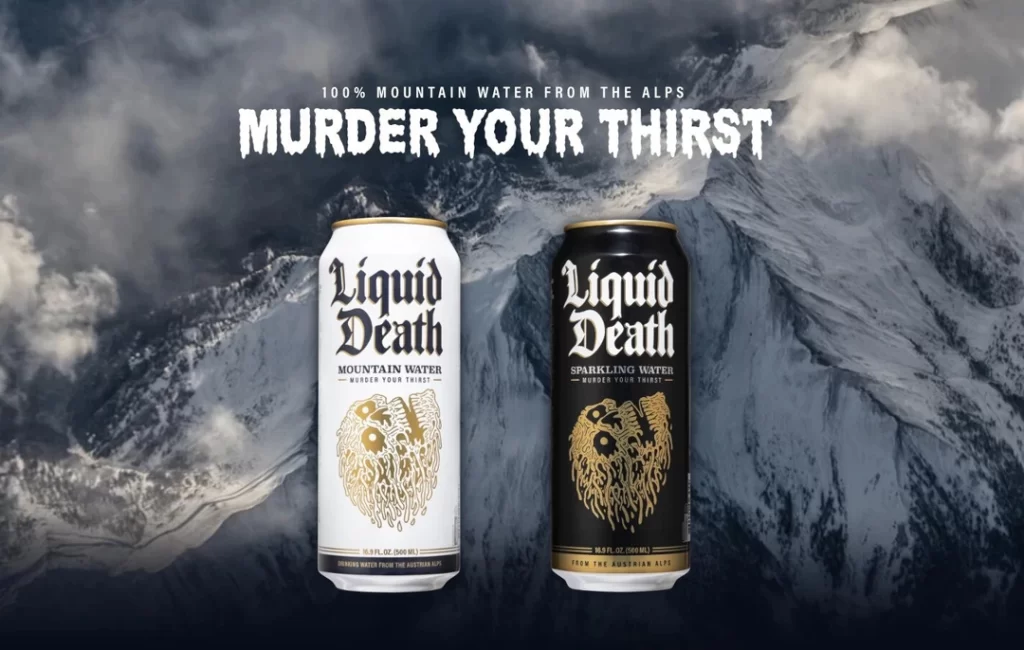
Consider Liquid Death. They sell water. Legally and physically, it is H2O in a can. However, their branding—featuring heavy metal aesthetics, melting skulls, and aggressive copy—sells a lifestyle. It creates a feeling. A consumer buys it to feel rebellious while staying hydrated. The risk is zero; if the water tastes bad, they are out £2.
B2B: The Mitigation of Risk
In B2B, nobody buys enterprise software because it makes them feel “rebellious.” They buy it because they are terrified of their current system crashing and getting fired.
The old adage, “Nobody ever got fired for buying IBM,” is the cornerstone of B2B psychology. The B2B buyer is not spending their own money; they are spending the company's money. If a consumer buys a bad pair of trainers, they return them. If a CTO buys a bad CRM system that crashes the sales team's workflow for a week, they lose their job.
Therefore, B2B branding must project stability, reliability, and competence.
Expert Note: This does not mean B2B must be boring. It means your creativity must serve the purpose of building trust, not just grabbing attention.
Real-World Example:
Look at Salesforce. Their early branding wasn't about “CRM tables.” It was the “No Software” campaign. They attacked the fear of complex, expensive, on-premise hardware installations. They positioned themselves as the safe, cloud-based liberator. They sold peace of mind.

2. The Decision-Making Unit (DMU): The Committee vs. The Individual
When we discuss brand inspiration, we often look at logos that appeal to a single person's aesthetic. In B2C, that works. In B2B, your brand has to pass a committee vote.
B2C: The Solo Dictator
In a B2C scenario, the DMU is typically one person, or possibly a couple (i.e., a partner or spouse). The distance between “I see this” and “I buy this” can be seconds. The brand only needs to resonate with that one individual's preferences.
B2B: Death by Committee
In B2B, the average purchase involves 6 to 10 decision-makers (according to Gartner). You have to brand for:
- The End User: “Is this easy to use?”
- The Manager: “Will this make my team more efficient?”
- The CFO: “What is the ROI? Is it too expensive?”
- The CTO/IT Dept: “Is this secure? Will it integrate with our legacy stack?”
- The CEO: “Does this align with our 5-year vision?”
Your branding must speak multiple languages simultaneously. Your visual identity must look modern enough for the User but established enough for the CFO. Your copy must be technical enough for the CTO but simple enough for the CEO to understand.
The “Consensus Friction”:
This is where deals die. If your brand looks too “risky” or “unconventional,” the conservative members of the DMU (usually Finance or Legal) will veto it. B2B branding is often about removing friction and providing the internal champion with the necessary assets to sell your solution to their colleagues.
3. The Sales Cycle: The Marathon vs. The Sprint
Understanding the duration of engagement is crucial for structuring your brand narrative effectively.
B2C: The Sprint
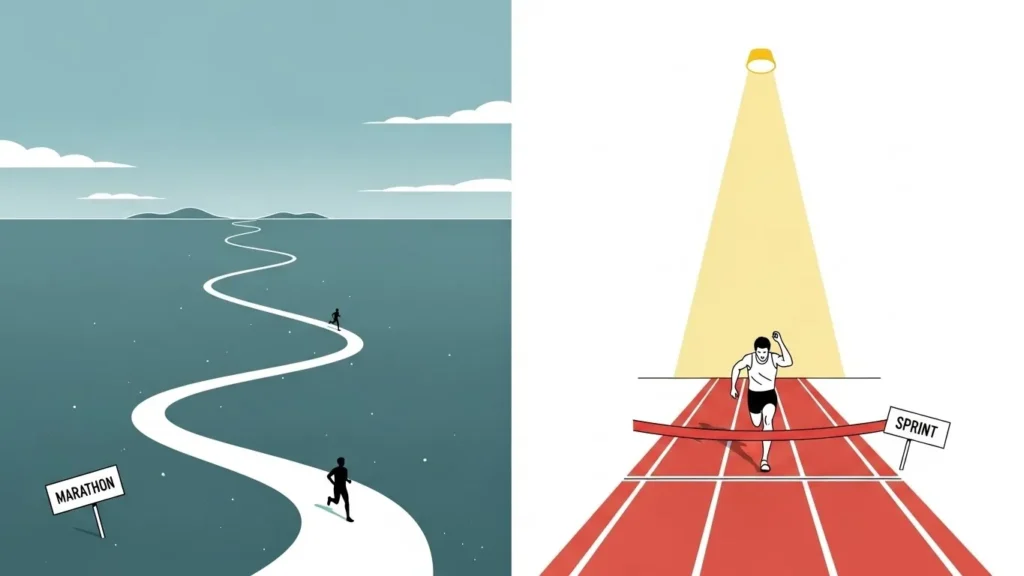
For Fast-Moving Consumer Goods (FMCG), the sales cycle is minutes. For high-ticket items (cars, luxury holidays), it might be weeks. The goal of the brand is to capture attention immediately and convert it into action. You can use urgency (“Sale ends tonight!”) and emotional spikes.
B2B: The Marathon
The B2B sales cycle can last anywhere from three months to two years. You cannot scream “Buy Now!” at a procurement officer who is in the second month of a twelve-month vetting process.
The “95-5 Rule”:
Research from the B2B Institute and the Ehrenberg-Bass Institute indicates that at any given time, only 5% of B2B buyers are “in-market” (actively ready to make a purchase). The other 95% are not.
Your branding job in B2B is Mental Availability. You must remain top-of-mind and credible for the 95% who aren't ready yet, so that when they do flip into the 5% category, you are the first name on their shortlist.
This requires a content-led brand strategy. You need white papers, webinars, case studies, and a consistent presence on LinkedIn. You aren't asking for the sale; you are proving your expertise over and over again until they are ready.
4. The Relationship: Partnership vs. Transaction
How does the customer view you after the credit card is swiped?
B2C: Transactional (Mostly)
Once I buy a can of Coke, the relationship is effectively paused until I get thirsty again. Even with subscription boxes, the relationship is usually low-touch. The brand needs to be consistent, but it doesn't need to call me every week to see how the Coke is tasting.
B2B: The Strategic Partnership
In B2B, the sale is just the starting line. High-value B2B contracts are relationships. Clients expect support, regular updates, effective account management, and strategic guidance.
Your brand voice cannot just be “salesy.” It must be “consultative.” If your brand promises innovation but fails to deliver customer support, the brand promise is broken, and churn will likely follow. In B2B, Customer Success is part of the brand.
The Consultant's Reality Check:
I once audited a SaaS company that used aggressive, “bro-marketing” tactics to acquire users. They promised the world. But their onboarding team was understaffed and slow. They had high sales, but their monthly churn rate was 15%. Their brand wasn't a partner; it was a liar. We had to completely rebrand them to focus on “Support” and “Reliability” rather than “Speed” to fix the trust gap.
5. Brand Voice and Messaging: Clarity vs. Hype
This is where I see the most failures in my inbox.
B2C: Simplicity and Hype
B2C copy can be playful, vague, and emotional. “Just Do It” tells you nothing about the shoe's arch support, but it works. B2C messaging focuses on the feeling of the result.
B2B: Clarity and Precision (The Jargon Trap)
There is a misconception that B2B requires complex language to sound “professional.” Companies fill their websites with word salad like:
“We leverage synergistic paradigms to optimise cross-functional deliverables.”
This is garbage. It means nothing.
Because B2B products are complex, your branding must be radically simple. The best B2B brands explain complex problems in clear, straightforward language. If a busy CEO cannot understand what you do in 5 seconds, they will click away.
However, you must use the correct terminology for your niche. When selling to heart surgeons, it is essential to use medical terminology correctly to convey authority. If you dumb it down too much, you appear amateurish. It is a balance between Clarity and Expertise.
The Test:
Can you explain your B2B value proposition to your grandmother? If not, rewrite it. Then, can you explain it to a PhD in your field without them laughing? If yes, you have found the sweet spot.
6. Visual Identity: Consistency vs. Trends
When you look at logo design inspiration, you will see B2C brands changing their logos every few years to stay trendy (de-branding, flat design, retro).
B2C: Chasing the Zeitgeist
B2C brands often need to reinvent themselves to stay relevant to younger demographics. Fashion, food, and tech consumers get bored easily. A visual refresh signals “New and Improved.”
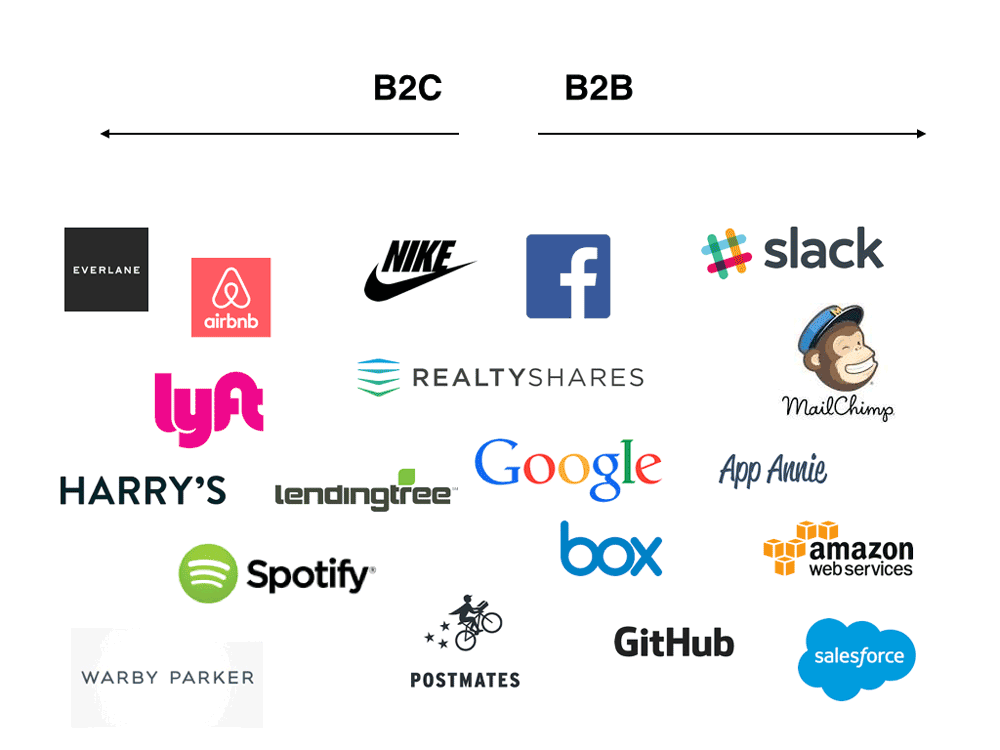
B2B: The Rock of Gibraltar
In B2B, changing your logo every two years suggests instability. Are you under new management? Did you get acquired? Are you hiding from a lawsuit?
B2B visual identity prioritises Consistency and Legibility. You want your invoices, letterheads, and business cards to match the look and feel of your website. This creates a subliminal sense of order and reliability.
However, “reliable” does not mean “ugly.” Many B2B brands are stuck in the 1990s with swooshy blue globes.
- Blue: The colour of trust (IBM, Dell, Intel, HP). It is safe, but it is crowded.
- Differentiation: Modern B2B brands are breaking the “Blue Rule.” Slack uses a multicoloured tartan. Asana uses coral and gradients.
If you want to stand out in a sea of corporate blue, do not be afraid to use colour—but keep the typography clean, strong, and Swiss.

7. The Cost of Switching: High vs. Low
B2C: Low Stakes Switching
If I switch from Colgate to Crest, the cost is zero. The risk is zero. Brand loyalty in B2C is often habitual but can be easily broken by a price promotion or a new flavour.
B2B: Vendor Lock-in
Switching B2B vendors is a nightmare. It involves data migration, retraining staff, terminating legal contracts, and downtime. The “Cost of Switching” is massive.
Branding Implication:
Your branding needs to reassure prospects that the pain of switching to you is lower than the pain of staying with their current broken solution.
Furthermore, once you have them, your brand must constantly reinforce that they made the right choice. You do this through “Thought Leadership”—consistently publishing industry insights that confirm your status as the leader. If you go silent, they start looking at competitors.
B2B vs B2C Attributes
| Attribute | B2B (Business-to-Business) | B2C (Business-to-Consumer) |
| Primary Goal | Risk Mitigation & ROI | Identity & Gratification |
| Decision Maker | Committee (DMU) of 6-10 people | Individual or Household |
| Motivation | Fear of failure, Logic, Efficiency | Desire, Status, Emotion |
| Sales Cycle | Long (Months to Years) | Short (Seconds to Weeks) |
| Messaging | Clear, Benefit-driven, Industry-specific | Emotional, Playful, Broad |
| Relationship | Long-term Partnership | Transactional / Experiential |
| Price Point | High (£10k – £10M+) | Low to Medium (£1 – £5k) |
The Great Debunk: “B2B is Not Emotional”

I promised to address the biggest myth in the industry.
There is a prevailing belief that B2B buyers are robots who input data into a spreadsheet and output a purchase order based solely on price and specs.
This is categorically false.
A study by Google, in partnership with Motista and CEB, found that 50% of B2B buyers are more likely to make a purchase if they feel an emotional connection to the brand. In fact, the study concluded that B2B customers are significantly more emotionally connected to their vendors than consumers are.
Why?
Because the stakes are higher.
If I buy the wrong toothpaste, I am annoyed.
If I authorise a £500,000 contract for software that fails, I lose my reputation. I might miss my bonus. I might get fired.
B2B buyers feel anxiety, fear, hope, and pride.
- Anxiety: “Will this work?”
- Pride: “I want to be the innovator who brought this tech into the company.”
- Trust: “I feel safe with these guys.”
The Lesson: Do not strip the humanity out of your B2B brand. You are selling to people, not buildings. Use real photography of your team. Tell stories about your founders. Show empathy for their high-pressure jobs. If you can make a B2B buyer feel safe and understood, you will consistently outperform the cheaper competitor.
The State of Branding in 2026: The Consumerisation of B2B
As we look toward 2026, the lines are blurring. We are witnessing a significant shift known as the Consumerization of B2B.
Millennials and Gen Z are now occupying decision-making roles in B2B companies. These buyers grew up with Amazon, Uber, and Netflix. They demand the same user experience (UX) from their enterprise software as they get from their dating apps.
- Seamless Digital Experience: They do not want to “Call for Pricing.” They want transparent pricing pages.
- Design Aesthetics: They will not tolerate clunky, Windows 95-looking interfaces.
- Self-Serve: According to McKinsey, over 70% of B2B decision-makers prefer remote or self-serve human interactions.
If your B2B website requires a “Demo Request” form just to see the product, you are losing 2026 buyers. Modern B2B branding must embrace B2C usability standards.
The Verdict
The distinction between B2B and B2C is not about “Boring vs Fun.” It is about “Risk vs Reward.”
If you are building a B2B brand, your job is to build a fortress of credibility that allows a committee of cautious managers to feel secure signing a check. If you are building a B2C brand, your job is to build a beacon of identity that attracts individuals looking to solve a problem or signal their status.
However, remember that in both cases, you are dealing with humans. Humans who are tired, busy, and seeking connection.
Do not treat your B2B clients like ATMs. Treat them like partners.
If you are struggling to define your position in the market or your visual identity appears outdated, it might be time for a professional audit.
Request a Quote for a comprehensive brand strategy session, or explore our Brand Identity Services to see how we have helped others achieve this.
Frequently Asked Questions (FAQ)
What is the biggest mistake in B2B branding?
The biggest mistake is assuming B2B is purely rational. Ignoring the emotional drivers—specifically the fear of professional failure—leads to dry, unpersuasive marketing. B2B buyers need to feel safe, not just see specs.
Can B2B brands be funny?
Yes, but with caution. Humour can humanise a brand (e.g., Gong or Mailchimp), but it must not undermine your authority. If you are selling cybersecurity or medical devices, prioritise competence over comedy.
How does the sales cycle affect branding?
In B2B, the sales cycle is long (months/years). Therefore, branding must focus on “Mental Availability” and nurturing trust over time through content, rather than “Buy Now” impulse tactics used in B2C.
Why is B2B design often so boring?
It is often “boring” to signal stability and avoid scaring conservative stakeholders (like CFOs). However, modern B2B brands are breaking this mould with bolder colours to stand out in a crowded digital space.
Do I need a different logo for B2B vs B2C?
Not necessarily a different logo, but the application differs. B2B identities need to scale across professional documents (white papers, contracts) and look authoritative. B2C identities prioritise shelf impact and social media trends.
What is the ‘Consumerisation of B2B'?
This refers to the trend where business buyers expect the same seamless, high-quality digital experiences (like those offered by Amazon or Apple) from their business software and vendors.
Is social media relevant for B2B?
Absolutely, but the channel mix differs. LinkedIn is the powerhouse for building B2B authority. However, Instagram and TikTok are increasingly used for “Employer Branding” to attract talent, even if they don't directly drive sales.
How do I measure ROI on B2B branding?
It is harder than B2C. You measure it through “Share of Search” (how many people search your brand name), shorter sales cycles (trust speeds up decisions), and lower price sensitivity (strong brands command premiums).
What is the ‘DMU' in marketing?
DMU stands for Decision Making Unit. In B2B, this refers to the group of people (typically the CEO, CFO, CTO, and End-User) who must agree on a purchase. Your branding must address the concerns of all these individuals.
Does colour psychology matter in B2B?
Yes. Blue is dominant because it psychologically represents trust and stability. However, using distinct colours (like purple or orange) can help a challenger brand disrupt a “sea of blue” competitors.