Competitive Brand Mapping: How to Find a Position You Can Actually Own
Put three partners from the same firm in front of the same prospect, and you’ll often hear the firm described three different ways in one meeting.
The prospect clocks it before the partners do. That gap between what a firm knows makes it different and what a buyer can actually see is where most competitive brand mapping quietly fails. Not at the chart. At the position.
Being considered early is worth more than performing well in a late comparison. Around 68% of buyers begin their process with a front-runner already in mind, and that front-runner goes on to win roughly 80% of the time.
A firm that only gets sharp on differentiation at the shortlist stage is arguing from behind. Competitive brand mapping done properly is how you earn that front-runner slot months earlier — and it starts long before anyone draws an axis.
For firms in law, accountancy or advisory, this is foundational professional services brand strategy work, not a marketing side-quest.
- Define the market as buyers do, not broad sector labels; map only the real shortlist of competitors.
- Use buyer decision criteria for axes, not attributes you already win; source axes from buyers.
- Plot positions from evidence like win/loss debriefs and RFP language, not memory or boardroom optimism.
- Treat map gaps as hypotheses: prove demand, willingness to pay, and credible delivery proof before moving into white space.
- Make your position specific and provable; publish evidence and thought leadership so buyers, referrers and AI reach the same conclusion.
What Competitive Brand Mapping Is For

Competitive brand mapping is a method for finding a credible, provable position in a category where competing firms make near-identical promises. It plots how buyers perceive rival firms against the criteria those buyers actually use — then locates a claim your firm can own and prove, not merely assert.
- It measures buyer perception, not the leadership team’s view of itself — the two are usually different, and the difference is the point.
- Its output is a defensible position, not a diagram; the chart is a by-product.
- A gap on the map is a hypothesis, not a verdict: it may signal opportunity, or no demand at all.
Competitive brand mapping is a method for finding a credible, provable market position in a category where competing firms make near-identical promises.
Why Every Firm in Your Category Sounds the Same
Firms in professional services look alike for a specific reason, and it isn’t that they are alike.
Take two 90-person accountancy firms: one wins on aggressive R&D-tax recovery and will argue with HMRC for months; the other wins on never missing a filing deadline in eleven years.
Genuinely different firms. Both describe themselves as “trusted” and “partner-led” on the homepage, because the actual difference lies in how they work, not in the words buyers use to compare them. So on a shortlist, they read as twins.
This is why a map built from the boardroom’s self-image is worse than useless. Ask a leadership team where they sit, and they’ll place themselves top-right on every axis — high quality, high service, high everything.
The map that matters is the one a sceptical buyer would draw, and it rarely flatters. Perceptual mapping exists precisely to close that gap between self-perception and how customers actually experience a brand; skip the buyer input, and you’ve mapped your own optimism.
The commercial cost is a pricing one, and it works through a mechanism.
When a buyer can’t distinguish four firms on anything but rate, rate is the only lever they can pull — so they pull it, and the firm that could have justified a premium spends the pitch defending its number instead.
Sameness doesn’t just lose you the emotional argument. It hands the buyer a reason to negotiate you down.
How to Build a Brand Map That Reflects Buyers, Not Your Boardroom
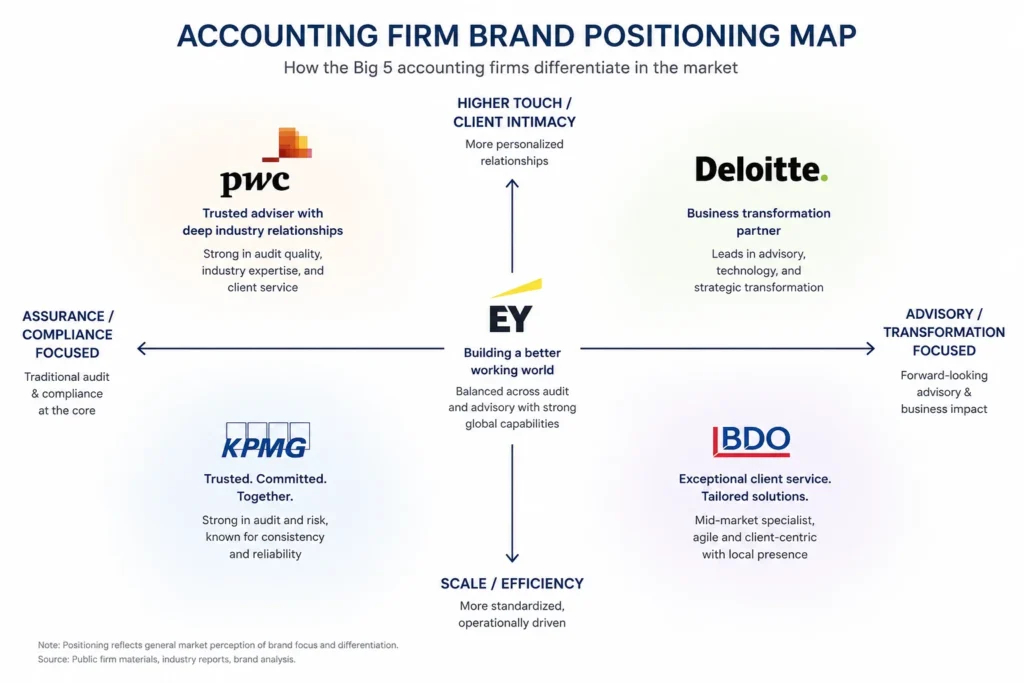
The method is four moves, in this order.
The order is the value — most firms run it backwards, starting with the chart and reverse-engineering flattering axes, which is how you get a neat graphic with no strategic consequence.
1. Define the market as the buyer defines it.
Not “UK law firms” but the specific set a buyer actually shortlists — say, the four or five firms a mid-market manufacturer would consider for a cross-border acquisition.
Get this wrong and every plot point after it is fiction.
A 14-partner tax practice that maps itself against the Big Four has found itself competing in a race it was never in.
2. Choose axes buyers use, not axes you can win.
The temptation is to pick attributes where you already lead. Resist it.
The axes must be the decision criteria that genuinely move a buyer — responsiveness, sector depth, commercial nerve, whatever it is for that market — sourced from buyers, not assumed.
Umbrex, the strategy-frameworks publisher, calls out the most common failure here directly: choosing axes customers don’t actually value, which produces a map that looks rigorous and predicts nothing.
3. Plot from evidence, not memory.
Place each rival where their buyers would place them, using win/loss debriefs, and the language buyers actually use in RFPs.
Practical test: for every plot point, name the specific input behind it. “We put Firm X low on responsiveness because two prospects last year told us Firm X took a week to reply” is a defensible placement.
“Firm X feels a bit slow” is a guess wearing a suit. If you can’t name the evidence, you can’t plot the point — leave it blank, which is itself information.
4. Read the clusters, then interrogate the space.
Where do firms bunch? Where is the map empty?
The bunching tells you the crowded claims to abandon.
The space is where the real work begins — and where most guides stop, and most firms get burned. That’s the next section.
Why Most “White Space” Is Empty for a Reason

Here is the belief worth challenging, and intelligent people hold it for good reason: find the empty quadrant, plant your flag, own the space.
It’s clean, it’s visual, and it feels like strategy. HBS Online and Umbrex both frame the gap as the prize, and for a fast-moving consumer category with real demand sitting unserved, they’re often right — White Claw finding space between beer and spirits is the textbook case.
Professional services is where that logic turns on you. A gap on the map is empty for one of three reasons, and only one of them is an opportunity.
- No demand. Nobody wants what the position offers. An accountancy firm could own “cheapest audit in the North West” — the quadrant is wide open, because clients buying audits do not shop on price alone, and the position repels the work worth having.
- No willingness to pay. Buyers might mildly prefer it, but won’t fund it. The premium you’d need to justify the repositioning isn’t there.
- You can’t credibly own it. The position is real and valuable, but your firm has no proof — no track record, no delivery model, no named clients — to make the claim stick. Claiming it just invites the market to test you and find nothing.
Deals don’t stall because a firm picked the wrong colour scheme.
More than 40% of B2B deals stall through misalignment inside the buying group, and a position the firm can’t prove makes that misalignment worse, not better — because internal champions have nothing solid to repeat on your behalf.
And there are a lot of people to convince: around 73% of purchases now involve at least three departments, with roughly 13 internal and nine external participants in the mix. A position only counts if all of them can understand and repeat it.
“A gap on a positioning map is a question, not an answer. Before you move a brand into space, you prove three things: that buyers want what sits there, that they will pay for it, and that your firm can back the claim with evidence a stranger would believe. Fail anyone, and the white space is a trap with good lighting.”
So the replacement directive is blunt. Don’t ask “where is the gap?” Ask “which position can we prove that buyers want, that nobody else here credibly owns?”
That question has a much shorter list of answers, and every one of them is defensible.
Mapping When AI Answers the Buyer Before You Do

Competitive brand mapping has become both more important and more difficult, and 2026 is why.
Buyers no longer meet a category only through Google rankings, referrals or a procurement shortlist. Forrester reports that more than nine in ten business buyers already use, or intend to use, generative AI to support purchase decisions.
Answer engines now surface and summarise suppliers before a human visits a single website — and firms leaning on interchangeable claims get grouped into one undifferentiated bucket before they’ve had a word.
This is not a case for “optimising for AI” at the expense of real positioning. It’s the opposite.
AI makes generic claims cheaper to produce at scale, which makes generic firms even easier to lump together, which raises the value of a distinction grounded in genuine expertise, delivery and evidence.
The firms that stand out are the ones whose position is specific and provable enough that a client, a sales team, a referrer and an answer engine all reach broadly the same conclusion about why they’re the better choice.
Proof is what travels. Around 79% of the hidden decision-makers in a buying group are more likely to champion a firm that consistently publishes strong thought leadership.
That’s the mechanism by which a mapped position becomes a repeated one: you give the people you’ll never meet something credible to say on your behalf. The map identifies the claim.
The evidence makes it portable. Both matter more when a machine writes the first summary of your firm.
The Verdict
The reframe that governs all of this: competitive brand mapping isn’t a hunt for space, it’s the discipline of finding a position you can prove in a category that all sounds the same. The chart is the easy part and the least important.
The value lies in defining the market as buyers define it, sourcing perception from buyers rather than your own leadership team, and refusing to move into any gap until you’ve shown it has demand, willingness to pay, and supporting evidence.
Even when a category has said the same thing for a decade, a clearer, better-proven point of view narrows the incumbent’s lead — 53% of buyers say brand recognition matters less when a supplier produces genuinely strong thought leadership.
That’s the challenger firm’s opening.
Start today with the buyer, not the chart. Before your next planning session, ask five recent buyers what actually decided their shortlist.
If you want that read done properly, request a free Brand Equity Audit™ — a structured diagnostic that shows exactly where your brand is losing commercial ground and what to do about it.
FAQs
What is the difference between a perceptual map and a competitive brand map?
A perceptual map plots how buyers perceive brands against chosen attributes. A competitive brand map is the same tool applied specifically to locate an ownable competitive position. The distinction is purpose: perception measurement versus finding a claim your firm can prove and defend commercially.
How many competitors should a competitive brand map include?
Include the specific set of real buyers that would shortlist for that decision — usually four to six firms, not every firm in the sector. Mapping against firms you never actually compete with yields misleading plot points. Define the market as the buyer defines it, then map only that set.
Is a space on a positioning map always an opportunity?
No — an empty quadrant is often empty for a reason: no demand, no willingness to pay, or no firm can credibly own it. Before repositioning into white space, confirm buyers want that position, will fund it, and that your firm has evidence to back the claim.
How often should a competitive brand map be updated?
Refresh it whenever your competitive set, buyer criteria, or your own proof changes materially — at a minimum, before any rebrand, acquisition, or new-market entry. A map is a snapshot of a moving market; a two-year-old map plots a competition that may no longer exist.
Does AI change how professional-services firms should approach brand positioning?
Yes — answer engines now summarise and group suppliers before buyers visit any website, so interchangeable claims get firms lumped together automatically. A specific, provable position expressed consistently across your evidence is what lets buyers, referrers and AI tools reach the same conclusion about why you’re the better choice.
