AI Visibility for Law Firms Isn’t a Schema Problem. It’s a Verifiability Problem
A prospective client with a £2m dispute no longer opens Google and scrolls a list of ten firms. They ask ChatGPT or Google’s AI Mode which firm to instruct — and the assistant names two or three, or names none.
If your firm isn’t one of them, you never find out. There’s no ranking to check, no lost-click line in a report. The enquiry goes elsewhere, and the partner who should have won it is left assuming the market has gone quiet.
Most firms responding to this reach for the same fix: add FAQ pages, bolt on “AI-ready” schema, publish another 2,000-word practice-area page. It rarely moves anything.
The reason is that AI visibility for law firms was never a content-formatting problem. It’s a verifiability problem — and the two require completely different work.
Google’s own guidance settled this on 15 May 2026, when it published formal advice on generative-search optimisation. The emphasis was not a new technical discipline. It was valuable, unique, non-commodity content and the continuing weight of foundational SEO.
The formatting hack that a hundred marketing blogs were selling got no endorsement at all.
That matters for a Managing Partner deciding where to spend a limited marketing budget, because it means the schema-and-FAQ route is optimising the wrong layer, and law firm website design that treats the site as a verifiable record of expertise beats one dressed up with markup the model ignores.
- Verifiability matters most: AI assistants cite firms only when independent corroboration verifies expertise, not because of website schema.
- Third-party corroboration from directories, Chambers, Legal 500 and named case records makes a firm citable to AI assistants.
- Prioritise corroboration before on-site optimisation: audit external records first, then optimise; measure impact with Google Search Console generative AI reports.
How AI Visibility for Law Firms Is Achieved
AI visibility for law firms is achieved when an AI assistant can independently corroborate a firm’s expertise sufficiently to cite it in a high-stakes legal answer without risking misrepresentation.
This happens across three stages: establish a clear, current account of the firm’s real expertise; secure independent third-party corroboration of that expertise; and remove the ambiguity that would cause a model to reject an uncertain source.
- AI assistants suppress sources they cannot verify, because naming the wrong firm in a legal answer is a liability the model is built to avoid.
- Corroboration lives mostly off the firm’s own website — in directories, recognitions and coverage the model already trusts.
- Schema helps a machine parse a page, but it never substitutes for the evidence a model needs to trust what the page claims.
AI visibility for law firms depends on independent corroboration of a firm’s expertise, not website schema, because AI assistants must verify sources before citing them in legal answers.
What You Need in Place First
Before any AI-visibility work is worth doing, a firm needs three things most guides skip: a single accurate account of what the firm actually does, consistency between that account and every external record of it, and a real point of differentiation the model can attach to the firm’s name. Skip these, and the later work compounds a weak foundation.
The honest-entry condition is that a firm can describe itself in the same way twice.
In 17 years of brand work, the pattern I see most often is a firm whose website, its Chambers entry and its partners’ LinkedIn profiles each tell a slightly different story about what the firm is best at.
It lowers confidence in all three and reaches for a firm it can describe cleanly. Consistency isn’t housekeeping here. It’s the precondition for being citable at all.
Make the Firm’s Real Expertise Legible
The first stage is stating what the firm genuinely does, specifically enough that a model can attach it to a real client question. A vague self-description is the most common failure at this stage.
“A full-service commercial firm advising clients across a range of sectors,” tells an AI assistant, nothing it can use to answer “who handles shareholder disputes for family-owned manufacturers in the North West.”
You know this stage is done right when every practice area reads as an answer to a question a client would actually ask, in the client’s own words, not the firm’s internal taxonomy.
According to the American Bar Association’s 2025 Legal Technology Survey, AI adoption among lawyers rose from 11% to 30% — the same tools clients are now using to vet firms are the ones lawyers use daily, which means the gap between how a firm describes itself and how a client searches is now measurable inside the firm’s own building.
The specific failure mode here is writing for the model instead of the client.
Keyword-stuffed, “AI-optimised” copy reads as commodity content, and Google’s 15 May 2026 guidance names non-commodity content as the actual priority. Write the true, specific thing. The model rewards it precisely because so few firms bother.
Secure Independent Corroboration
The second stage is the one that separates cited firms from invisible ones: getting the firm’s expertise corroborated by sources an AI assistant already trusts.
A firm’s own website is a claim. A Legal 500 ranking, a Chambers entry, a named case report and consistent directory data are corroboration — and corroboration is what a model weighs when deciding whether it’s safe to name you.
An AI assistant treats a law firm’s own website as an assertion and everything else as evidence. The firm that has spent a decade earning independent recognition is not just more credible to clients. It is more citable to the machine, because the machine can check it. Schema cannot manufacture what a Chambers ranking demonstrates.”
This is where the verifiability angle becomes concrete. More than half of consumers have used or would consider using AI for a legal question, and 28% of consumers who used AI were directed to contact a lawyer.
The assistant making that referral is choosing whom to name — and it chooses the firm whose expertise it can confirm across multiple independent sources, not the one with the tidiest markup.
You know this stage is working when your firm’s name appears in the same third-party contexts a knowledgeable client would trust. The failure mode is to invest entirely in on-site content while the firm’s external footprint remains thin.
You Can Finally Measure It
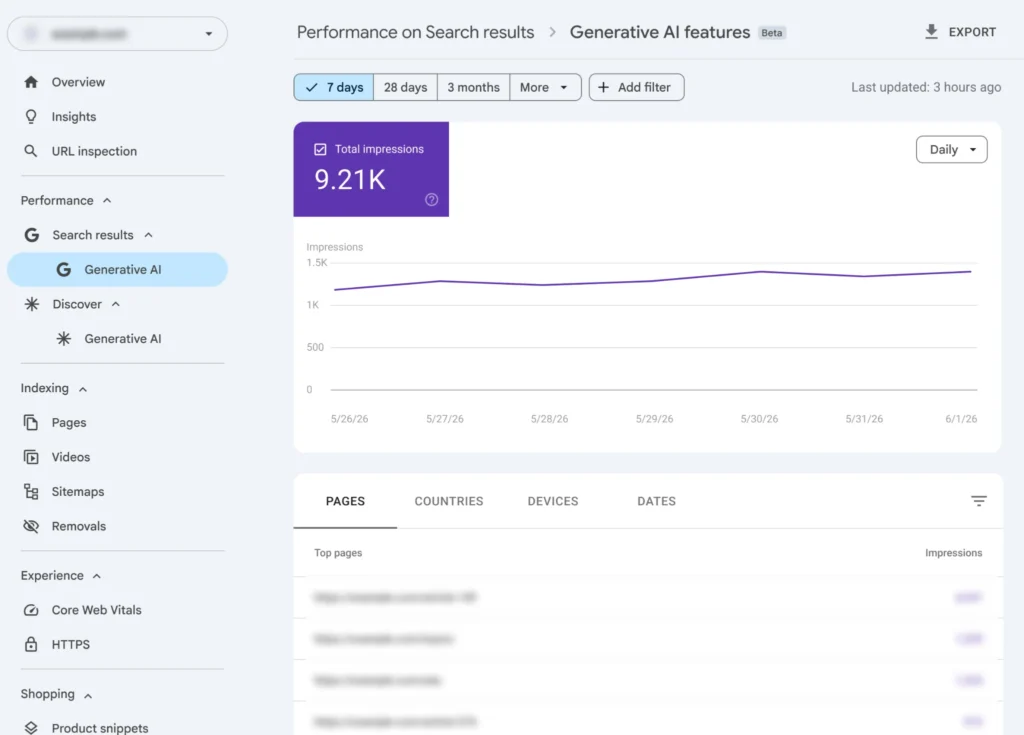
Until recently, AI visibility had no feedback loop — traffic dried up, with no diagnostic data and no equivalent of a rankings report. That changed on 3 June 2026, when Google launched dedicated generative-AI performance reports in Search Console.
The reports cover visibility across AI Overviews, AI Mode, and generative AI features in Discover, showing impressions, cited and appearing URLs, countries, devices and trends over time. Google initially rolled the feature out to a subset of sites for testing.
This matters because it moves a firm from guessing to measuring. Before June 2026, a Managing Partner could only run a few prompts through ChatGPT and hope for the best. Now, at least for Google’s AI surfaces, there is a disciplined measurement model — you can see which pages get cited and which never surface.
The scale makes it urgent rather than optional. Google said AI Mode surpassed 1 billion monthly users by May 2026, with queries more than doubling quarter over quarter since launch, and that it began merging AI Overviews and AI Mode into a single continuous AI search journey on desktop and mobile globally.
Separately, 42% of US adults now use AI chatbots to search for information. AI discovery is no longer a fringe interface sitting beside search. It is becoming the main search journey. A firm that cannot be verified is a firm quietly excluded from the channel most of its future clients will use first.
What a Model Won’t Tell You
The parts of this process that resist a checklist are where experience earns its keep.
Deciding which recognitions to pursue, how specifically to describe a practice without breaching client confidentiality, and when a firm’s differentiation is real versus wishful — none of these reduce to a rule.
A 14-partner regional firm chasing the same national directory rankings as a Magic Circle competitor is spending effort where it cannot win. The judgement call is knowing which corroboration is achievable and worth having for this firm, at this size, in this market.
The recurring judgement error is that firms treat differentiation as a copywriting exercise rather than a truth about the business.
If three partners describe the firm’s strength three different ways in the same pitch, no schema markup and no amount of AI optimisation will fix what is, underneath, an unresolved question of client trust and internal clarity.
Two Objections a Managing Partner Will Raise
“We already rank well on Google — surely that carries over?”
Partly, and that’s the trap: traditional ranking rewards keywords, backlinks and on-page optimisation. AI citation rewards verifiable consensus about your expertise across the whole web. A firm can rank page one for “commercial litigation Leeds” and still never be named by an assistant, because ranking measures the page and citation measures the entity. The overlap is real but incomplete, and the gap is exactly the work of verifiability.
“Isn’t this just SEO with a new name?”
No — it’s a change in what gets rewarded. Foundational SEO still matters; Google’s 15 May 2026 guidance makes that explicit. But the marginal work that moves AI visibility is not more content or more markup. It’s corroboration: recognition, consistency and originality that let a model trust you. Same discipline, different centre of gravity.
The Step Everyone Does in the Wrong Order
Here is the sequence correction at the heart of this. Most firms start with the website — new schema, new FAQ pages, new practice-area copy — and treat external corroboration as an afterthought, if they get to it at all. That’s backwards.
The website is the last thing an AI assistant trusts, because it’s the one source the firm controls. The corroboration a firm cannot fake — independent rankings, named case outcomes, consistent third-party records — is what the model weighs first.
Intelligent practitioners hold the website-first view for a good reason: the website is the one asset they fully control, so it is the logical place to start. Control feels like leverage.
But in a verifiability system, the sources a firm cannot directly control are precisely the ones that carry weight, because a model discounts anything self-published in a high-stakes domain.
“Optimise your website last, not first. In a verifiability system, the evidence you control counts least and the evidence you’ve earned counts most. A law firm that inverts the usual order — corroboration before cosmetics — becomes citable while its competitors are still editing their schema. That inversion is the entire advantage.”
The replacement directive is straightforward: audit your firm’s external footprint before touching a line of on-site markup. Where competing content sends you to your CMS, this sends you to your Chambers entry, your directory listings and your published case record first.
Study firms that have already earned this — the pattern is visible in detailed law firm case studies — and you’ll see the corroboration was built before the website was ever polished.
AI visibility for law firms sits within the broader discipline of commercial law firm branding, where the firm’s real reputation and its published record are made to say the same thing.
The Verdict
AI visibility for law firms was never about formatting. Every stage of this process points in the same direction: an AI assistant names the firm it can verify and rejects the one it cannot.
Schema, FAQ pages and keyword-tuned copy optimise the one layer the model trusts least — the firm’s own claims about itself.
The work that actually moves visibility is the work that makes those claims independently checkable: a clear and current account of real expertise, corroborated across the directories, recognitions and case records, a model already trusted, in the right order.
The order is the point. Corroboration before cosmetics. A firm that inverts the usual sequence — earning verifiable recognition before touching its markup — becomes citable while competitors are still editing a schema that changes nothing.
Google’s 15 May 2026 guidance, its 3 June 2026 Search Console reporting, and AI Mode passing a billion users by May 2026 all say the same thing from different angles: this channel is now central, and it rewards verifiable substance over cosmetic optimisation.
Start today by reading your firm the way an AI assistant does. Open your website, your Chambers or Legal 500 entry, and three partners’ LinkedIn profiles side by side, and ask whether they describe the same firm.
If they don’t, that inconsistency is the reason you’re not being cited — and it’s fixable.
For a structured diagnostic of exactly where your brand is losing commercial ground and what to do about it, request a free Brand Equity Audit™. It identifies the gaps between what your firm is and what the market — human and machine — can currently verify about it.
Frequently Asked Questions
What is AI visibility for law firms?
AI visibility for law firms is whether AI assistants like ChatGPT, Perplexity and Google AI Mode name and cite a firm when clients ask for legal recommendations. It depends on independent corroboration of the firm’s expertise across trusted sources, not on website formatting or schema markup alone.
Why won’t AI assistants cite my law firm even though my schema is correct?
Schema helps a machine parse your page, but it never proves the claims on it are true. AI assistants in high-stakes legal contexts suppress sources they cannot independently verify. If your expertise isn’t corroborated in directories, recognitions and case records, correct schema won’t make the firm citable.
How is AI visibility different from traditional SEO for law firms?
Traditional SEO rewards keywords, backlinks and on-page optimisation of individual pages. AI visibility rewards verifiable consensus about a firm’s expertise across the whole web. A firm can rank well on Google and still never be named by an AI assistant, because ranking measures the page, and citation measures the entity.
Does schema markup help law firms appear in AI search?
Schema helps AI systems read a page’s structure. Still, Google’s 15 May 2026 guidance emphasised unique, non-commodity content over technical formatting hacks. Schema is a minor supporting factor. The evidence that makes a firm citable lives in independent corroboration, not markup on the firm’s own site.
How do I measure my law firm’s AI visibility?
Since 3 June 2026, Google Search Console includes generative-AI performance reports covering AI Overviews, AI Mode and Discover, showing impressions, cited URLs and trends. For non-Google assistants, testing real client prompts across ChatGPT and Perplexity remains the practical approach until similar reporting becomes available.
Is it true that most clients now use AI to find lawyers?
More than half of consumers have used or would consider using AI for a legal question, and 42% of US adults use AI chatbots to search for information generally. Of consumers who used AI for legal queries, 28% were directed to contact a lawyer — so AI is now a live referral channel, not a fringe one.
When should a law firm start working on AI visibility?
Now, because AI Mode passed 1 billion monthly users by May 2026, with queries more than doubling each quarter, and Google is merging AI Overviews and AI Mode into the main search journey. A firm that isn’t verifiable today is already excluded from the channel that a growing share of clients use first.
What makes a law firm a source that AI assistants trust?
Independent corroboration. AI assistants weigh third-party recognitions such as Chambers and Legal 500 rankings, consistent directory data, named case records and coverage in trusted outlets far more heavily than a firm’s own website claims, because those sources can be verified and self-published content cannot.
Why does consistency across directories matter for AI visibility?
An AI assistant reading conflicting accounts of a firm across its website, directories and partner profiles lowers confidence in all of them and reaches for a firm it can describe cleanly. Consistent name, focus and expertise data across every external record is a precondition for being citable at all.
How long does it take to improve AI visibility for a law firm?
It depends on the firm’s existing external footprint. A firm with established directory recognitions and case records can align its account in weeks. A firm building corroboration from scratch — pursuing rankings and consistent listings — should expect several months, because a verifiable reputation cannot be manufactured quickly.
Should law firms create dedicated FAQ pages for AI visibility?
FAQ content can help if it answers real client questions in natural language. It does not help if it’s a generic, keyword-stuffed filler added purely for AI. Google’s 15 May 2026 guidance treats commodity content as a liability. An FAQ only earns its place when it says something specific and true.
Can a small law firm compete with larger firms for AI visibility?
Yes — within its real market. A regional firm won’t out-corroborate a Magic Circle competitor on national rankings. Still, it can dominate the specific practice areas and locations where it genuinely leads. Verifiable, specific expertise in a defined niche is more citable than broad, unverifiable claims of full-service breadth.
