
Reducing Corporate Jargon with Plain Language for B2B Growth
Corporate jargon is not an aesthetic flaw; it is an indicator of unquantified commercial risk.
When a UK professional services firm fills its website and proposal documents with vague corporate phrasing, enterprise buyers do not infer deep technical competence.
They infer that the firm lacks clarity about its delivery model, cannot quantify its outcomes, and poses an unmeasured operational liability.
In enterprise B2B procurement, clarity is a financial risk-reduction mechanism. Decision-makers evaluating high-value contracts do not reward verbal complexity; they filter for execution certainty.
Establishing a disciplined approach to brand voice and copywriting replaces performative industry dialect with verifiable positioning, transforming client-facing copy into an active commercial asset.
- Use plain language to reduce perceived vendor risk, maximise processing fluency and accelerate enterprise procurement decisions.
- Replace vague corporate jargon with concrete, verifiable claims, name processes, timeframes and metrics eg reduce average DSO by 11 days.
- Partners overuse jargon, signalling insecurity and obscuring capability; research by Seventh Scout links buzzword reliance to uncertain positioning.
- Unclear messaging costs mid-sized firms £325,000 annually; plain language lifts demo conversion from 44% to 73% per Aha Media Group.
What Is Corporate Jargon in B2B Copywriting?
Reducing corporate jargon in B2B copywriting means strategically eliminating vague, overused, and non-specific business language in favour of direct, verifiable prose. It prioritises precise technical terms and concrete operational outcomes over performative fluff.
- Risk Mitigation: Replaces ambiguous claims with documented capabilities that satisfy procurement requirements.
- Cognitive Speed: Reduces the mental effort buyers need to evaluate technical service offerings.
- Commercial Differentiation: Separates established practices from competitors using identical generic messaging.
Reducing corporate jargon in B2B communications increases decision-maker engagement, lowers perceived vendor risk, and accelerates complex procurement cycles.
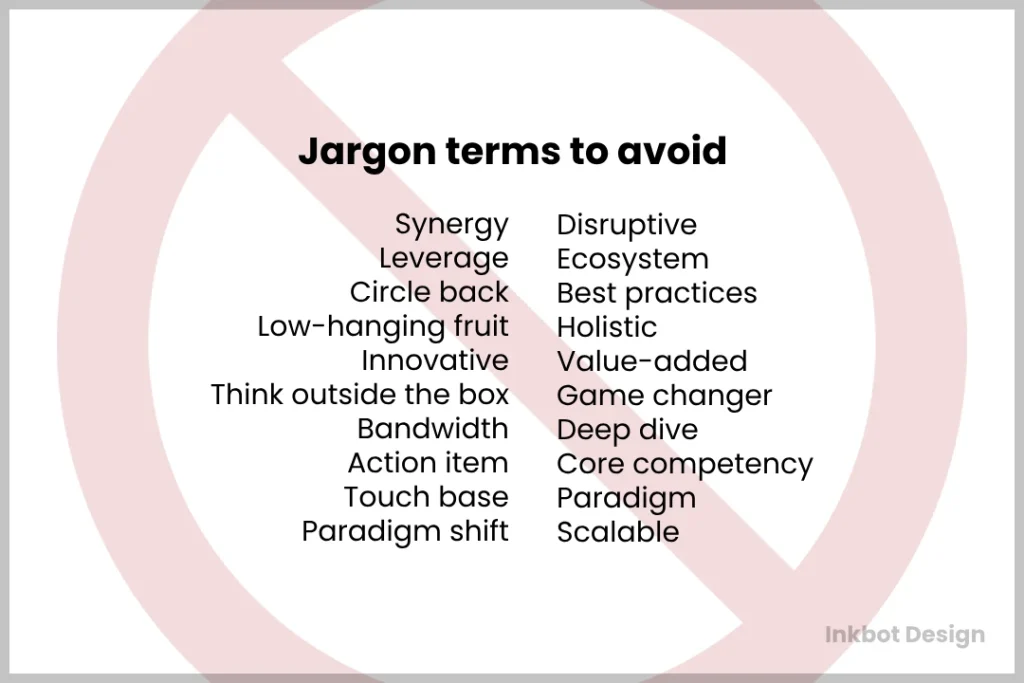
Why Professional Services Partners Default to Jargon
Senior partners in law, management consultancy, and corporate finance routinely default to complex jargon because they confuse linguistic friction with professional standing.
Decades of internal firm culture reinforce the belief that polysyllabic words and industry acronyms project authority. In reality, this reliance on abstract terminology often stems from status insecurity.
Research published by Seventh Scout highlights that professionals frequently rely on inflated buzzwords when feeling uncertain about their positioning, using flashy language as a proxy for expertise. In client-facing materials, however, this practice backfires.
Technical precision in fields like litigation or regulatory compliance is necessary and expected; generic corporate buzzwords like “synergistic alignment” or “holistic transformation” are neither precise nor technical. They are fillers that obscure actual capability.
When two competing firms pitch for a £250,000 advisory engagement, the partner who explains the precise diagnostic steps in active prose wins the contract over the partner who promises “end-to-end strategic enablement.” The former demonstrates control over the delivery process; the latter hides behind template phrases.
“Corporate jargon is the smoke screen of the unprepared. The moment a firm relies on abstract business vocabulary to describe its offering, it tells sophisticated buyers that it cannot articulate how it actually creates value.”
How Jargon Stalls Enterprise Buying
Far from proving sophistication, abstract language introduces immediate friction into enterprise procurement workflows.
B2B purchasing committees consist of multiple stakeholders—finance directors, risk leads, operational heads—who must reach consensus before releasing the budget. Jargon increases cognitive load across this committee, slowing evaluation cycles to a crawl.
A 2025 peer-reviewed study by Dr Olivia M. Bullock and Dr Termeh Bisbey, published in the International Journal of Business Communication, evaluated 1,826 participants to measure the psychological impact of workplace jargon.
The researchers proved that jargon-laden communication directly impairs processing fluency and undermines the audience’s self-efficacy. When readers struggle to process information, their confidence drops, and their willingness to share information diminishes.
In a commercial context, low processing fluency triggers risk-averse buyer behaviour. When a procurement lead reads a proposal filled with ambiguous deliverables, they cannot accurately assess operational exposure.
The default decision for an uncertain buyer is not to ask for clarification—it is to pause the purchase or select a competitor whose scope is crystal clear.
| Communication Dimension | Jargon-Heavy B2B Proposals | Plain Language B2B Copywriting | Commercial Impact |
| Buyer Processing Fluency | Low (High cognitive friction) | High (Immediate comprehension) | Plain language increases proposal review speed |
| Perceived Operational Risk | High (Vague delivery mechanics) | Low (Explicit scope and metrics) | Reduces procurement compliance delays |
| Decision-Maker Action Rate | 44% demo/pitch conversion | 73% demo/pitch conversion | Aha Media Group (2024) baseline metric |
| Trust Signal Rating | Low (Perceived performative speak) | High (Perceived transparency) | Closes the 60-point PwC executive trust gap |
| Content Engagement Rate | 22% secondary asset downloads | 68% secondary asset downloads | Drives anonymous research progression |
Data from Forrester Research’s State of Business Buying 2024 reveal that 86% of enterprise B2B purchases stall during the evaluation phase, and 81% of buyers express dissatisfaction with their chosen provider.
This rate of friction is tied directly to communication breakdowns during early-stage research. When buyers cannot extract clear answers from a firm’s digital presence, they step back.
Furthermore, McKinsey & Company’s B2B Decision-Maker Pulse Survey found that 74% of enterprise buyers expect vendors to demonstrate a clear understanding of the problem digitally before any direct sales contact occurs.
If your firm’s website relies on generic fluff, you are filtered out during the 60% of the buying journey that happens anonymously.
Quantifying the Cost of Unclear Messaging

The financial damage caused by imprecise business writing extends beyond lost pitch opportunities; it creates measurable friction across daily operations and account expansion.
According to a study by SIS International Research, companies with more than 100 employees lose an average of $420,000 (£325,000) annually due to internal and external communication barriers. This figure accounts for wasted partner hours, extended sales cycles, proposal rewrites, and lost prospective accounts.
A 2024 study by Aha Media Group evaluated the direct impact of plain language on B2B purchasing decisions. The findings were decisive: 80% of B2B decision-makers explicitly prefer plain language materials.
When presented with plain language content versus jargon-heavy alternatives, 73% of buyers indicated they would schedule a product or service demo, compared to just 44% for the jargon-laden version.
Similarly, secondary asset downloads—such as technical white papers—rose from 22% to 68% when presented with plain-language executive summaries.
Buyer Conversion Metrics: Plain Language vs Jargon
These metrics align with macro trust trends. PwC’s Trust in US Business Survey identified a 60-point trust gap between executive perception and buyer reality: 90% of business leaders believe customers trust their organisations, but only 30% of buyers agree.
Crucially, 40% of surveyed customers reported ending a commercial relationship entirely due to a breakdown in trust.
When positioning professional services firms during a rebrand, aligning brand storytelling with verifiable, plain-language statements directly addresses this trust deficit.
The Objections: Addressing the Sophistication Myth
Sceptical managing partners frequently raise two objections when advised to reduce corporate jargon during a positioning audit:
- “Our service is highly technical; plain language will make us sound unsophisticated or low-cost.”
- “Our corporate clients expect formal industry language; using simple phrasing undermines our professional standing.”
Both objections stem from confusing technical accuracy with corporate jargon.
Technical terminology—such as EBITDA adjustments, jurisdictional discovery rules, or cross-border transfer pricing—is precise, necessary, and expected by specialist buyers. It names specific legal, financial, or operational structures.
Jargon, by contrast, is the imprecise vocabulary wrapped around those concepts: delivering value-added solutions, optimising core competencies, or driving forward-thinking synergy.
Vocabulary Categorisation
Technical Terminology
- Cross-border transfer pricing
- Jurisdictional discovery rules
- EBITDA adjustments
Corporate Jargon
- Value-add solutions
- Optimising core competencies
- Strategic synergy / Forward-thinking
Eliminating jargon does not mean dumbing down technical expertise. It means stripping away empty phrases so your genuine technical capability is clear.
When designing high-converting landing page frameworks for mid-market services firms, separating precise technical vocabulary from vague corporate speak consistently yields higher engagement rates among qualified procurement leads.
The Strategic Precision Framework: Replacing Jargon with Proof
Plain language is not an exercise in vocabulary reduction; it is a discipline of replacement. Every time an abstract buzzword is removed, it must be replaced by a concrete, verifiable claim.
To execute this transition across firm-wide communications, apply three structural rules:
- Enforce the Verification Test: If a sentence cannot be proven true or false by an auditor, rewrite it. “We provide best-in-class consultancy” cannot be verified. “We have advised 42 UK legal practices through SRA compliance audits without a single penalty” can.
- Convert Passive Claims to Active Mechanics: Name the exact process, timeframes, and deliverables. Replace “optimising working capital performance” with “reducing average DSO (Days Sales Outstanding) by 11 days over a six-month engagement.”
- Prioritise Proof Over Promises: Industry trend data published in early 2026 confirms that B2B buyers now prioritise evidence over strategic ambition. The 2025 B2B Marketing Benchmark Report found that 93.7% of marketers agree that trust is the critical growth factor, with brand reputation evaluated as four times more influential than price in the final selection.
The firms that command premium retainers are never those with the most elaborate vocabulary. They are the firms that state their exact value proposition without ambiguity.
The Verdict
Corporate jargon is a commercial vulnerability that inflates buyer risk, stalls procurement reviews, and erodes trust.
Rebranding a professional services business requires stripping away performative fluff and adopting a client-facing brand voice grounded in precision, active prose, and verifiable evidence.
Plain language is not a stylistic concession for readers who cannot grasp complex ideas. It is an intentional positioning choice designed for busy enterprise buyers who refuse to waste time decoding vague promises.
If your firm is preparing for a strategic rebrand, growth phase, or market repositioning, start by auditing your current brand voice.
To identify where vague messaging and performative jargon are eroding your commercial position, request a free Brand Equity Audit™.
This structured diagnostic analysis of your positioning isolates messaging friction and outlines the precise steps required to turn your brand into a high-trust growth engine.
FAQs
Does reducing corporate jargon mean simplifying technical services?
No — reducing corporate jargon isolates generic buzzwords while preserving precise technical terminology. It removes fluff like “holistic solutions” while retaining essential industry terms like “jurisdictional discovery,” ensuring technical clarity without sacrificing professional authority.
How does plain language copy improve B2B pitch win rates?
Yes — plain language directly increases conversion rates by improving processing fluency for purchasing committees. According to Aha Media Group (2024), B2B decision-makers are 29% more likely to request a service demo when presented with plain-language materials than with jargon-heavy alternatives.
Why do senior partners frequently resist changing corporate messaging?
Yes — partners often resist messaging changes due to status insecurity and long-standing internal habits, incorrectly believing that complex phrasing demonstrates expertise. In reality, Seventh Scout research shows that overusing buzzwords signals uncertainty to prospective enterprise clients.
What is the measurable financial cost of unclear business communication?
Yes — communication barriers carry a direct financial toll. SIS International Research estimates that mid-sized businesses with over 100 employees lose an average of $420,000 (£325,000) annually due to lost deal velocity, proposal rework, and customer friction caused by unclear writing.
How does plain language impact enterprise procurement reviews?
Yes — plain language accelerates procurement reviews by removing ambiguous scope language that triggers risk warnings. Forrester Research (2024) indicates 86% of enterprise purchases stall during evaluation; explicit, jargon-free proposals reduce review friction and shorten deal cycles.
Can plain language copywriting improve website SEO performance?
Yes — plain language aligns with natural search behaviour and AI citation engines. Modern search algorithms and LLM extractors prioritise concrete claims and atomic facts over vague marketing prose, improving passage indexing and answer engine visibility.
What is the difference between technical terminology and corporate jargon?
Technical terminology defines specific, verifiable tools or legal mechanisms (e.g., “transfer pricing”). Corporate jargon consists of non-specific filler words (e.g., “seamless synergy”) that conceal delivery mechanics and fail basic audit verification tests.
How does corporate jargon affect younger decision-makers in B2B?
Yes — younger buyers reject corporate jargon. The 2023 LinkedIn & Duolingo report found that 60% of Gen Z and 65% of Millennials want workplace jargon eliminated, citing confusion, miscommunication, and mistrust when encountering opaque corporate phrasing.
When should a professional services firm audit its brand voice?
A firm should audit its brand voice prior to a strategic rebrand, market repositioning, merger, or launch into new enterprise sectors. Auditing ensures marketing assets, pitch decks, and digital touchpoints communicate clear capability before committing sales budget.
Is plain language copywriting effective for legal and financial practices?
Yes — plain language is effective in legal and financial sectors because sophisticated corporate buyers prioritise risk reduction over florid prose. Plain language allows complex deal structures or compliance frameworks to be understood without linguistic ambiguity.
