SLA Branding: Legal Design Framework for Enterprise
Treating a Service Level Agreement as a sterile legal safeguard rather than an active brand asset directly undercuts a law firm’s pricing power.
Enterprise clients do not separate legal execution from brand experience; a dense, unreadable SLA signals institutional friction and erodes premium positioning before work even begins.
When a mid-tier UK law firm presents a boilerplate, text-heavy contract, it instantly contradicts its positioning as a modern, high-value strategic partner.
Managing Partners frequently wonder why corporate clients negotiate fees aggressively during renewal cycles. The answers often lie within the operational friction built into the firm’s own legal documents.
To command premium fees in a crowded commercial marketplace, firms must align their operational delivery structures with their outward-facing brand promises.
Partnering with an expert brand strategy agency allows professional services firms to modernise these touchpoints, turning cold compliance documents into powerful instruments for client retention.
- Treat SLAs as brand assets: SLA Branding converts Service Level Agreements into scannable client-facing tools, reducing onboarding friction and defending premium fees.
- Design for rapid scanning: clear executive summaries, data tables and clean typography improve human review and automated ingestion, per NN/g findings.
- Align operations with promises: modern legal design turns contracts into retention tools, protecting margins and sustaining premium firm positioning.
What Is SLA Branding?
SLA Branding is the systematic integration of functional legal design and brand identity principles into formal service contracts to improve comprehension, reduce operational friction, and reinforce commercial trust. This practice moves beyond basic visual aesthetics to transform transactional legal documents into clear communicative assets.
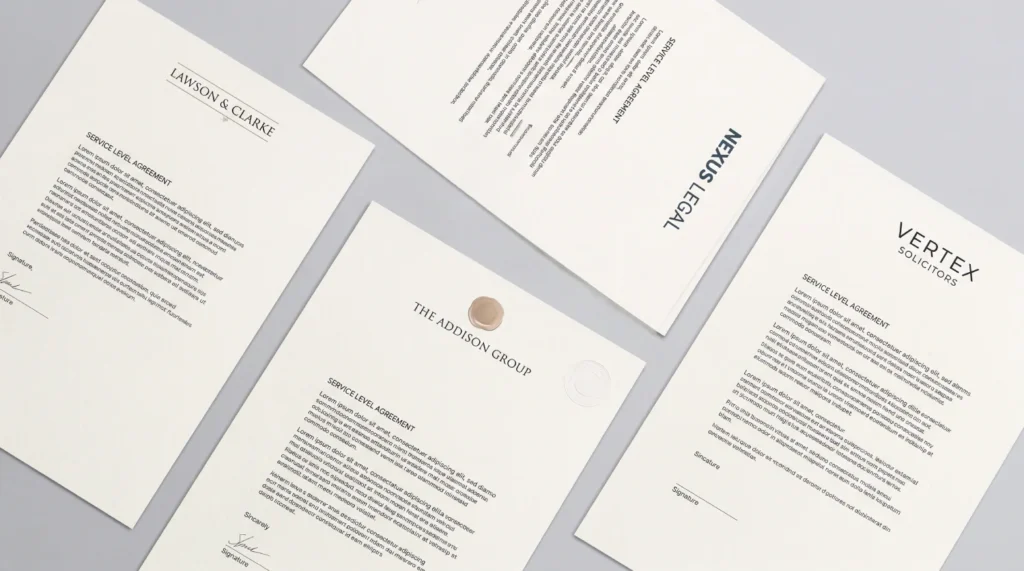
- Information Hierarchy: Organising legal obligations so that corporate executives can locate performance metrics in under thirty seconds.
- Visual Communication: Utilising clear data tables, structural timelines, and functional iconography to clarify complex liability boundaries.
- Brand Voice Integration: Replacing archaic legalese with precise, contemporary English that reflects the professional standards of the firm.
SLA Branding integrates functional legal design into service agreements to clarify enterprise compliance, reduce client friction, and reinforce corporate brand equity.
The Frictional Cost of Traditional Legal Architecture
Traditional contract structures create significant cognitive barriers that actively damage client relationships during critical onboarding phases.
When an enterprise client signs an agreement, their first operational interaction with the law firm is the review of the Service Level Agreement.
Why Complex Contracts Alienate Corporate Decision Makers
Corporate decision-makers require immediate clarity regarding operational boundaries and performance liabilities.
Research by the Nielsen Norman Group (NN/g) indicates that dense, unformatted text blocks cause user frustration and decrease overall systemic trust.
When a law firm delivers an unreadable, non-scannable document, the firm forces the client’s internal legal team to spend hours deciphering basic parameters.
This administrative drag creates an early negative impression, signalling that the firm prioritises old bureaucratic traditions over smooth commercial partnership.
The Financial Toll of Onboarding Friction
Onboarding friction caused by poor document design directly impacts client retention rates.
A global study by HubSpot found that B2B service firms lose a significant portion of long-term account value in the first 90 days due to poor communication and operational misunderstandings.
If a client misinterprets an unbranded, poorly structured SLA, misaligned expectations follow. These misunderstandings lead to fee disputes, strained communications, and an eventual refusal to buy additional services.
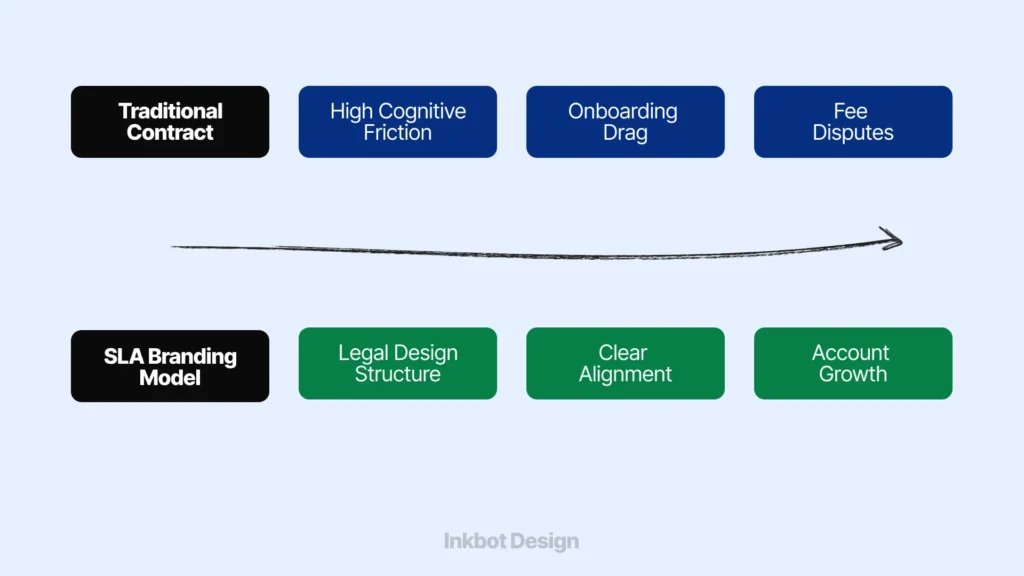
Mid-tier law firms regularly cancel out their marketing investments by issuing contracts that are unreadable and transactional, frustrating corporate buyers. True brand differentiation requires operational consistency across every single legal artefact the firm produces.
Operationalising the Legal Design Framework
Transitioning from standard legal templates to a modern legal design framework requires a systematic overhaul of document architecture.
The goal is to maintain absolute legal enforceability while maximising readability for corporate stakeholders.
Structural Scannability for Enterprise Review
Law firms must structure agreements to support rapid scanning by busy executives.
Documents should feature a clear visual summary at the start, distilling key performance indicators, response times, and primary contact structures into a single page.
Breaking dense paragraphs into modular, labelled sections ensures readers can find specific clauses instantly without having to read the entire document line by line.
| Metric | Value | Metric | Value |
|---|---|---|---|
| Response Time | 2 Hours | Resolution Target | 24 Hours |
| Escalation Path | Level 1 (Account Executive) → Level 2 (VP) |
Data Typography and Layout Standards
Document typography must be selected for maximum on-screen readability, as most enterprise clients review agreements on digital displays.
Avoid dense serif typefaces in small sizes; instead, utilise clean, professional sans-serif fonts with generous line spacing.
Table layouts must clearly separate metrics from penalties, ensuring that financial realities are fully transparent and accessible.
| Metric | Value |
|---|---|
| Availability Target | 99.9% Core Service Hours |
| Measurement Window | Monthly Calendar Cycles |
Modern legal design is not an aesthetic luxury; it is a structural necessity that protects enterprise accounts and reduces the time required to close complex corporate deals.
The Cosmetic Template Myth: Visual Alignment Equals Legal Brand Value
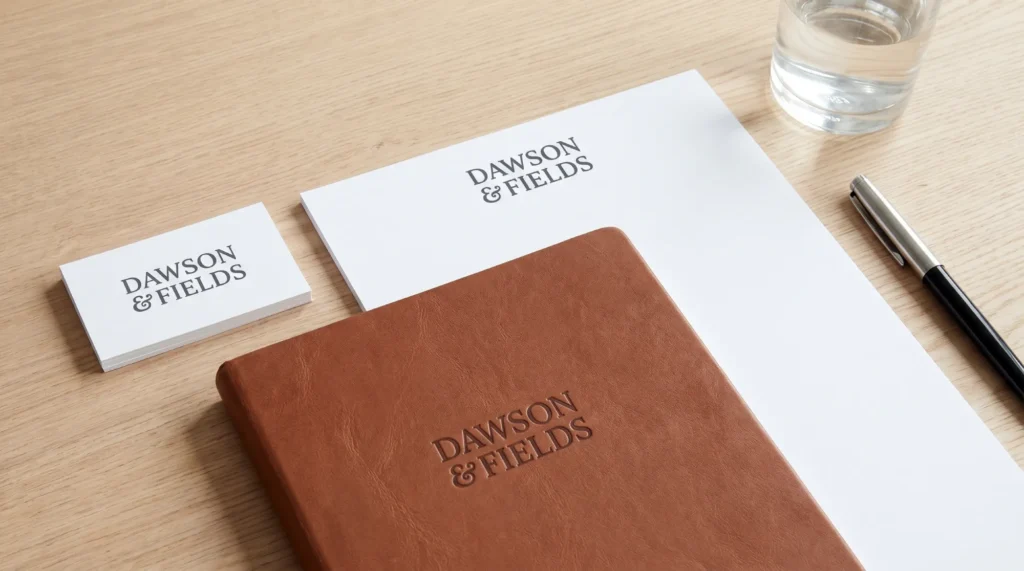
For years, professional services firms believed that applying a corporate style guide to a legal document fulfilled their brand obligations.
This advice fails in 2026 because enterprise clients evaluate legal partners on operational clarity and service transparency, not decorative PDFs.
According to research by the Nielsen Norman Group (NN/g), complex information architectures that lack functional clarity degrade user trust regardless of visual styling.
Law firms must replace superficial templating with functional legal design that makes service commitments scannable and measurable.
Law firms that merely slap a logo onto a poorly drafted MS Word template do not solve the underlying communication failure.
If a contract remains buried under outdated legalese and confusing cross-references, it will still alienate the buyer.
True SLA Branding alters the structural usability of the text, ensuring that legal mechanics actively support the broader client experience strategy.
The State of Legal Architecture in 2026
The legal sector is undergoing an unprecedented technological shift that directly alters how corporate buyers interact with legal documents.
Firms relying on old manual drafting methods find themselves eclipsed by automated systems.
Accelerated AI Integration Across Corporate Legal Teams
The speed of contract evaluation has increased due to automated legal technologies.
According to the ACC/Everlaw corporate legal AI survey, corporate legal AI adoption doubled from 23% in 2024 to 54% in 2025, with rapid adoption of automated document augmentation.
Furthermore, a 2026 Legal Tech & AI Outlook report from US Legal Support indicates that 42% of law firms are now actively using AI technologies, rising from 26% in 2024.
This trend is reinforced by the Litify 2025 report published in the Wisconsin Law Journal, which notes a 78% AI adoption rate across the broader legal industry.
Because corporate clients use machine-learning algorithms to scan inbound contracts, agreements must be structured logically for both human executives and AI processing engines.
Dense, non-standard formatting slows down automated ingestion tools, creating immediate friction during procurement.
Managing the High Failure Rate of Automation Tools
Despite rapid technology investments, corporate software deployments frequently stumble due to process complexity.
Gartner research from 2026 indicates that 50% of initial Contract Lifecycle Management (CLM) implementations still fail to meet corporate expectations.
This systemic friction occurs because firms feed poorly structured, overly complex legal documents into automated workflows.
Additionally, Gartner notes that while 33% of enterprise software will incorporate agentic AI by 2028, over 40% of agentic AI projects will be cancelled by 2027 due to rising costs and unclear value metrics.
Law firms that use clean, structured SLA Branding make it easier for enterprise clients to integrate these agreements into their digital platforms smoothly.
The Evolution of Digital Document Discovery
Document analysis remains the primary focus of legal automation, though the boundaries are expanding.
Data from a Relativity webinar confirms that document review remains the leading AI impact area at 63%. At the same time, the next frontier shifts toward early case assessment and case strategy, accounting for nearly one-third.
The scale of this shift is demonstrated by Relativity, which reported that its aiR platform has generated over 200 million document predictions across more than 250 enterprise customers.
As corporate legal departments automate bulk analysis, law firms must deliver highly structured documents that prevent processing errors and reduce AI hallucinations, which have already triggered over 120 documented court cases worldwide.
| 2026 Legal Architecture Metrics | Baseline | Current Performance | Primary Industry Source |
| Corporate Legal AI Adoption Rate | 23% (2024) | 54% (2025) | ACC/Everlaw Survey |
| Law Firm AI Technology Usage | 26% (2024) | 42% (2026) | US Legal Support Outlook |
| General Legal Industry AI Adoption | Standard | 78% (2025) | Litify / WI Law Journal |
| CLM Implementation Failure Rate | Historic | 50% (2026) | Gartner Research |
| Core AI Document Review Impact | Baseline | 63% (2026) | Relativity Analysis |
As automated legal review becomes the baseline standard for enterprise procurement, law firms must produce highly scannable, human-centred contracts to remain competitive.
Contract Strategies
| Decision Point | The Wrong Way | The Right Way | Why It Matters |
| Document Executive Summary | Omitting an overview and forcing immediate reading of deep legal clauses. | Including a single-page visual summary of all key metrics and liabilities. | Corporate buyers understand key obligations in under thirty seconds. |
| Typography Selection | Using small, dense serif fonts packed tightly into narrow columns. | Deploying clean, scalable sans-serif fonts with open line spacing. | Reduces cognitive fatigue and improves digital scannability. |
| Performance Metric Display | Hiding operational response targets within lengthy text paragraphs. | Placing response windows and targets into structured data tables. | Eliminates performance misunderstandings and prevents early fee disputes. |
| Contract Language Tone | Using archaic legalese to sound traditional and authoritative. | Writing in clear, precise corporate English focused on transparency. | Projects modern operational efficiency and speeds up procurement review. |
| Escalation Path Definition | Leaving dispute routes vague or unmapped within the contract body. | Providing a clear visual map of contact levels for issues. | Prevents relationship damage by resolving service issues fast. |
| Client Onboarding Integration | Treating contract signing as a cold administrative step. | Formatting the agreement as a welcome extension of the brand. | Validates the buyer’s investment decision and protects retention. |
Tactical Value Alignment

To escape the commodity pricing trap, law firms must connect their contractual metrics directly to the commercial outcomes their clients care about.
Moving away from standard hourly billing models allows firms to capture greater market value. When a firm structures its agreements around tangible commercial milestones, it protects its margins and transforms the contract into an active asset.
For a deep analysis of how to structure your commercial agreements around real deliverables, read our guide on outcome-based pricing.
The Verdict
SLA Branding is a critical commercial necessity for mid-tier UK law firms determined to defend premium fees and secure enterprise accounts.
Treating service contracts as sterile administrative burdens alienates corporate buyers, creates immediate onboarding friction, and directly undercuts the firm’s market value.
By applying modern legal design principles, clear data typography, and structured summaries, firms convert complicated compliance documents into powerful retention tools.
The numbers from 2026 prove that corporate legal teams are rapidly automating their contract review workflows.
Documents that fail to provide immediate human scannability and logical machine readability slow down procurement, spark avoidable fee disputes, and compromise brand equity.
True market leaders do not separate legal accuracy from client experience; they align them to build unbreakable institutional trust.
Managing Partners must honestly evaluate their current contract suites. Stop letting outdated document layouts cancel out your marketing investments and limit your firm’s revenue potential.
Request a free Brand Equity Audit™ at https://inkbotdesign.com/services/brand-audits/ to obtain a structured diagnostic that identifies exactly where your brand is losing commercial ground and learn the exact steps required to transform your legal touchpoints into high-value revenue drivers.
FAQs
What is the primary focus of SLA Branding?
SLA Branding integrates functional legal design and clear brand communication into formal service agreements. This methodology transforms traditional boilerplate contracts into highly scannable, accessible assets that reduce client friction and reinforce corporate trust.
How does poor legal design impact enterprise client retention?
Dense, unreadable contract architecture creates immediate cognitive friction during onboarding. This structural confusion leads to misaligned expectations, administrative delays, and avoidable fee disputes, ultimately driving corporate accounts to switch to clearer competitors.
Why is superficial visual templating insufficient for legal documents?
Merely adding corporate logos or brand colours to a confusing legal document fails to address the underlying communication breakdown. True SLA Branding focuses on information architecture, replacing dense legalese with scannable tables and clear corporate English.
What did the 2025 ACC/Everlaw survey reveal about legal automation?
The Association of Corporate Counsel and Everlaw survey established that corporate legal AI adoption doubled from 23% to 54% within a single year. This rapid shift means contracts must be optimised for automated ingestion by enterprise procurement teams.
How do modern legal design choices improve contract approval times?
Clean typography and clear visual summaries enable internal corporate legal teams to verify performance metrics and liability boundaries rapidly. This structural clarity eliminates text ambiguity and speeds up the entire commercial procurement cycle.
Can a structured contract help defend premium law firm fees?
A beautifully designed, highly transparent contract signals exceptional operational sophistication and modern client care. This professional presentation reinforces the firm’s high-value positioning, distinguishing it from low-cost, unbranded legal competitors.
What is the failure rate of initial CLM software implementations?
Gartner research from 2026 indicates that 50% of initial Contract Lifecycle Management implementations fail due to poor process alignment and complex document designs. Structured legal design helps mitigate these common enterprise software failures.
Why should law firms eliminate traditional legalese from agreements?
Archaic legal terminology creates unnecessary barriers to comprehension for modern corporate buyers. Replacing outdated language with precise, professional English improves clarity, reduces executive friction, and demonstrates contemporary operational efficiency.
What role do data tables play in modern legal design frameworks?
Data tables extract critical performance metrics and financial penalties from dense paragraphs and present them in clear visual grids. This presentation ensures that both parties maintain identical operational expectations from the start of the partnership.
How many legal AI cases involving hallucinations were tracked by late 2025?
Research tracking confirmed over 120 court cases worldwide involving AI hallucinations by late 2025. This risk requires law firms to deliver highly structured, unambiguous documents that prevent machine-learning evaluation systems from misinterpreting key clauses.
