Out Of Home Advertising (OOH) – All You Need To Know
Digital advertising is currently eating itself.
While CMOs obsess over ‘clicks’ that are mostly generated by bots or accidental thumb-slips, the physical world remains the only place where attention cannot be blocked, skipped, or ignored.
If you are an entrepreneur or an SMB owner, you’ve likely been told that ‘digital is everything.’ That is a lie sold to you by people who want to sell you more software.
The truth is that Out Of Home Advertising (OOH) is the last remaining bastion of ‘Public Fame.’
When you place a message on a 48-sheet billboard or a bus wrap, you’re not just reaching one person on a private screen; you are broadcasting to a community. You are signalling that your brand has the capital and the confidence to take up space in the real world.
Ignoring OOH doesn’t just limit your reach—it costs you money by forcing you to compete in the hyper-inflated, auction-based nightmare of social media feeds.
If you want to stop shouting into the void and start owning the street, you need to understand how the physical world works.
- OOH is the enduring way to capture unavoidable public attention and build brand fame beyond blocked or bot-driven digital clicks.
- Effective OOH relies on format, precise placement, and ultra-simplified creative—seven words or fewer, bold typography, strong contrast.
- DOOH and pDOOH enable contextual triggers, programmatic buying, and mobile retargeting, bridging physical exposure to measurable digital ROI.
What is Out Of Home Advertising?
Out Of Home Advertising (OOH) refers to any visual media found outside of the consumer’s home. It encompasses a massive spectrum of formats, from traditional paper billboards and bus shelters to cutting-edge digital screens in shopping centres and airport terminals. Its primary function is to build brand awareness by reaching consumers during their ‘dwell time’ or transit periods.
In many circles, people use the terms outdoor advertising and OOH interchangeably, but ‘Out Of Home’ is the broader technical umbrella. While ‘outdoor’ implies the sky is above you, OOH includes the London Underground, shopping malls, and airport lounges.

The 3 Core Elements of OOH:
- Format: The physical structure (Digital billboards, Street Furniture, Transit).
- Placement: The hyper-specific geographic location was selected for its audience demographics.
- Creative: The visual and verbal message, which must be optimised for high-speed cognition.
The Landscape of OOH: More Than Just Billboards
Most people think OOH is just a synonym for ‘billboards.’ This is a beginner’s mistake. The medium is segmented into four distinct categories, each with its own rules of engagement and technical constraints. To run successful OOH campaigns, you must understand the nuances of each.
1. Traditional Billboards (Bulletins and Posters)
These are the heavy hitters. We are talking about the massive structures overlooking motorways or the ‘posters’ seen on the sides of buildings.
In the UK, we categorise these by ‘sheets.’ A 48-sheet is the standard large format, while a 96-sheet is the double-sized behemoth that dominates the eye line.
Real-world success in this category requires an unwavering focus on advertising design. If your design is cluttered, you’ve wasted your budget.
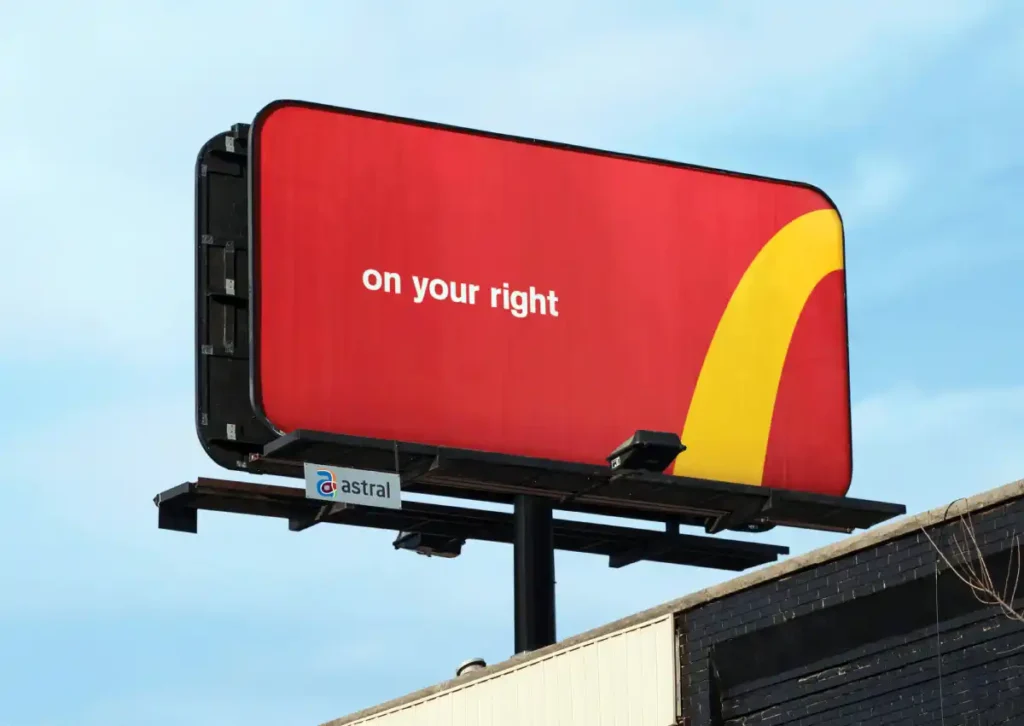
Example: In 2018, McDonald’s launched the “Follow the Arches” campaign in Canada. They deconstructed their iconic ‘Golden Arches’ logo, using only fragments of it to serve as directional signs. This worked because the brand was so established that the brain could ‘fill in the gaps.’
2. Street Furniture
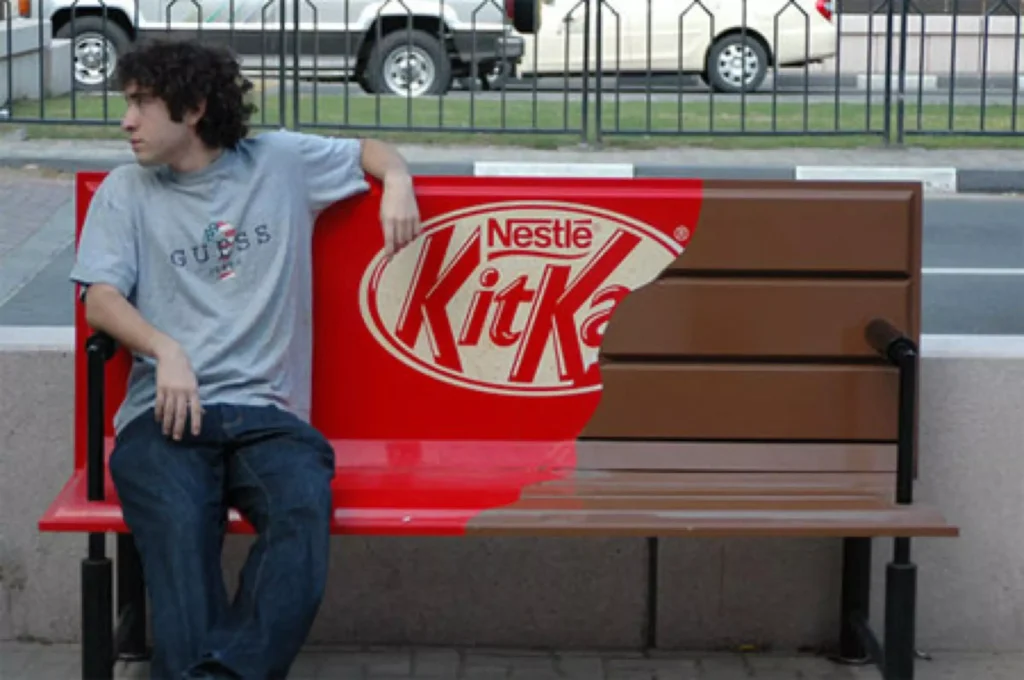
This includes bus shelters, kiosks, and telephone boxes. These are the workhorses of urban advertising. They offer ‘pedestrian-level’ engagement.
Because the viewer is often standing still (waiting for a bus), you can afford a slightly higher word count than on a motorway billboard—but don’t get greedy.
London bus shelter placements are particularly sought after because they provide high-frequency exposure to affluent commuters.
3. Transit Advertising
Buses, trains, taxis, and the London Underground. This is about movement. Transit advertising allows you to follow the customer journey.
A ‘T-Side’ on a bus provides a massive canvas that moves through high-traffic high streets, while an ‘Internal Tube Carriage’ ad offers high dwell time (often 10-20 minutes) for more complex storytelling.

4. Place-Based Media
This covers digital screens in gyms, doctors’ surgeries, shopping malls, and cinemas. These are ‘captive audience’ locations.
You aren’t just reaching people; you are reaching people in a specific mindset (e.g., ‘buying mode’ in a mall or ‘self-improvement mode’ in a gym).
The Rise of DOOH: Digital Out Of Home
Digital out-of-home (DOOH) has changed the game. We are no longer limited to static paper that takes three days to paste up.
DOOH allows for dynamic content, video, and—most importantly—programmatic DOOH (pDOOH).
Why DOOH is Winning in 2026
We are seeing a massive shift towards what I call ‘Contextual Triggering.’ Imagine a screen that only shows an ad for ‘Iced Coffee’ when the local temperature hits 22°C.
Or an ad for ‘Umbrellas’ that triggers the moment the first raindrop hits the pavement. These weather triggers turn a generic ad into a relevant solution.
According to data from WARC, DOOH now accounts for over 50% of total OOH spend in mature markets like the UK.
This isn’t just because it’s ‘flashy.’ It’s because it allows for digital marketing services to integrate with the physical world.
The Programmatic Advantage:
With pDOOH, you don’t buy a ‘board’ for two weeks. You buy ‘impressions’ via demand-side platforms (DSPs).
You can bid for screens during the morning commute and turn them off at noon. This reduces waste and makes OOH accessible for SMBs who can’t afford a £20,000 national campaign. You are now buying audience behaviour rather than just a zip code.
The Technical Reality Check: Amateur vs. Pro
If you want to appear like a global brand, you must stop designing like a local plumber. OOH is a brutal medium. There is no ‘back’ button. There is no ‘scroll.’ There is only a glance.
The OOH Design Standards
| Feature | The Amateur Way (Waste of Money) | The Pro Way (Inkbot Standard) |
| Word Count | 10+ words, including a long URL. | 7 words or fewer. Total. |
| Call to Action | “Visit our website at https://mybrand.com/promo2026” | A simple, bold Brand Name or a Search Term. |
| Typography | Thin, elegant scripts or serif fonts. | Bold, high-contrast Sans-Serif (e.g., Gotham). |
| Contrast | Pastel colours on white backgrounds. | High-saturation, high-contrast (Yellow/Black). |
| Visuals | Using 5 different stock photos. | One single, powerful focal point. |
The biggest mistake I see when auditing client campaigns is a lack of visual hierarchy. If everything is ‘loud,’ nothing is heard.
Your headline should be the first thing they see, followed by the brand name, and then the CTA. If you try to make the logo, the headline, and the photo all the same size, you end up with a visual mess that the brain automatically filters out.
Foot Traffic, Mobile Location Data, and the Bridge to Digital
The “untrackable” myth of outdoor media is dead. In 2026, we will utilise mobile location data to precisely identify who is passing by a billboard.
This isn’t science fiction; it’s standard practice.
By tracking anonymised pings from smartphones, we can measure the increase in foot traffic to a physical store after a consumer has been exposed to an OOH placement.

Mobile Retargeting: Closing the Loop
This is where OOH campaigns get truly lethal. Through mobile retargeting, we can identify the device IDs that were in the vicinity of your digital billboards.
We then serve those same users a follow-up ad on their social media feeds (e.g., Instagram, TikTok) later that evening.
This creates a “multi-touch” experience that significantly boosts brand awareness and conversion rates.
This synergy between OOH and social platforms is the secret sauce. While a digital ad might be ignored, the “physical-first” exposure helps build brand equity, making the digital ad feel like a natural reminder rather than an intrusive interruption.
The “Consultant’s Reality Check”: A Story of Failure
I once audited a regional gym chain that had spent £50,000 on a three-month billboard campaign. They were frustrated by the lack of direct ROI.
I looked at the creative. It was a photo of a woman lifting weights, accompanied by a headline that read, “New Year, New You, Join Today for Only £19.99 a Month with No Joining Fee,” a list of four locations, a phone number, and a QR code.
It was a cluttered disaster. From a moving car, it looked like a grey smudge.
We stripped it back. We used a bright, neon-green background. We used three words: “SHUT UP & TRAIN.” At the bottom, just the gym’s name.
Result? Branded searches increased by 40% in those postcodes within four weeks.
The lesson? Best print ads—and by extension, OOH ads—don’t try to close the sale. They try to open the relationship. If you try to sell on a billboard, you’ve already lost.
Creative Case Studies: Winning the Streets
To understand visual storytelling in OOH, look at the masters.
1. The “Mean Girls” Musical (London Bus Shelter Takeovers)

To promote the Mean Girls musical, the marketing team utilised London bus shelter takeovers. They didn’t just put up a poster; they transformed the entire shelter into a bright pink space.
One specific creative featured the character Regina George with a quote about “wearing pink on Wednesdays.” This used hyper-saturated bright pink lipstick tones and minimal text to dominate the urban outdoor environment.
It wasn’t an ad; it was a landmark. People took photos of it for their social media—generating millions of free impressions.
2. The “Everyday Activities” Series (Olympic Sports)
I recently saw a brilliant campaign (influenced by the style of Simon Landrein) that depicted Olympic sports through everyday activities.
One ad showed a man lifting groceries in a dynamic pose. The simplicity of the line work and the relatability of the “everyday athlete” captured the audience behaviour of a tired commuter perfectly. It used minimal OOH media space to tell a massive story.
3. Manchester Screen & Junction Dominations
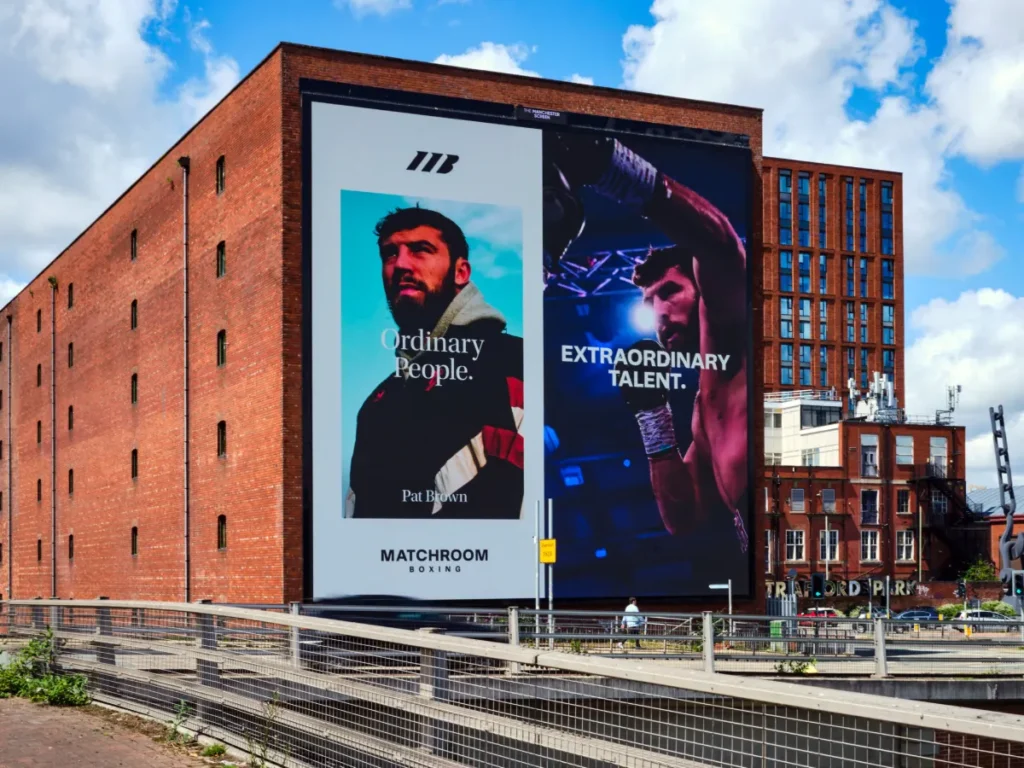
In the North of England, the Manchester Screen and various junction dominations have become the gold standard for brand safety and impact.
When Manchester City or major global brands want to signal dominance, they buy every screen at a major intersection. This “surround sound” approach ensures that no matter where a driver looks, they see the brand.
This is about communication goals—specifically, the goal of appearing “inevitable.”
Technical Specs: From Vinyl to API
For those who care about the “how,” OOH is a blend of old-school craftsmanship and new-school coding.
- Vinyl-coated fabric: Used for large-format static boards. It’s durable, weather-resistant, and provides the best colour depth for high-impact visuals.
- Scalable support: Modern OOH campaigns require assets that can scale from a 6-inch phone screen to a 96-sheet billboard without losing visual hierarchy.
- First-party customer data: Leading brands now integrate their own CRM data into their OOH buying. If they know their best customers live in certain Californian cities, they target those specific commuter corridors with pDOOH.
- Environmental initiatives: In 2026, you cannot ignore the footprint. We are seeing a rise in “smog-eating” posters and digital screens powered by 100% renewable energy. Sustainability is no longer a “nice-to-have “; it’s a requirement for brand equity.
The ROI of “Being There”
The most common pushback I get is: “But, I can’t track who saw my billboard.”
This is a fundamental misunderstanding. You are comparing OOH to a ‘Direct Response’ Facebook ad. That’s like comparing a hammer to a paintbrush.
The Truth: OOH is the most effective driver of ‘Search.’
A study by Nielsen found that OOH drives more online activity per ad dollar spent than any other offline medium. Specifically, it drives a 22% increase in search traffic. People see a board, they don’t scan a QR code (because they aren’t idiots), and then later that day, they Google the brand name.
If you want to track it, look at your UX design A/B testing data or your Google Search Console. Look for spikes in ‘Branded Search’ during the weeks your OOH campaign is live. That is your ROI.
The Verdict
Out Of Home Advertising is not a ‘legacy’ medium. It is a future-proof strategy for brands that want to escape the digital noise. But it requires discipline. It requires you to kill your darlings, shorten your headlines, and trust the power of a single, bold image.
If you treat OOH like a flyer (Brochures, pamphlets, and flyers belong in the bin, not on the street), you will fail. If you treat it like a landmark, you will win.
Are you ready to stop being invisible? At Inkbot Design, we don’t just ‘make ads.’ We build visual systems that command attention in the real world. From mastering your call-to-action design to creating a brand identity that thrives on a 96-sheet billboard, we fix the mistakes that are costing you money.
Request a Quote today, and let’s see if your brand is ready to take the lead. Or, if you’re still sceptical, read more about how out-of-home advertising is evolving in our latest case studies.
Frequently Asked Questions (FAQ)
How much does a billboard cost in the UK?
Prices vary based on location and format. A standard 48-sheet paper billboard in a regional town might cost £500 per fortnight, whereas a digital screen in Piccadilly Circus can cost tens of thousands for a single day.
What is the difference between OOH and outdoor advertising?
‘Outdoor advertising’ typically refers to media strictly outside (billboards, street signs). ‘OOH’ (Out of Home) is a broader industry term that encompasses indoor public spaces, such as airports, malls, and the London Underground.
What are weather triggers in DOOH?
These are data-driven scripts that adjust your creative based on real-time local weather conditions. For example, a beverage brand might display a “Hot Coffee” ad when the temperature is below 5°C and an “Iced Latte” ad when it’s above 20°C.
How many words should be on a billboard?
The industry standard is 7 words or fewer. The brain cannot process complex sentences at high speeds. If you need more than 7 words, your brand strategy is too complicated.
How does mobile location data help OOH?
It allows advertisers to see the density and demographics of people passing a screen. It also enables mobile retargeting, serving digital ads to people who have physically seen your billboard.
What is a ‘London bus shelter takeover’?
This is a high-impact campaign where a brand buys all the advertising space on a specific shelter, often including wraps, floor graphics, and digital screens, to create an immersive brand environment.
Can I buy OOH through a programmatic platform?
Yes. Programmatic DOOH (pDOOH) allows you to use demand-side platforms to buy screen time based on impressions and triggers rather than fixed, long-term contracts.
What is ‘Street Furniture’?
This refers to advertising on public amenities, such as bus shelters, kiosks, benches, and telephone boxes. It is ideal for reaching pedestrians with longer dwell times.
Why is OOH better for brand safety than social media?
OOH exists in a controlled, physical environment. You don’t have to worry about your ad appearing next to extremist content or fake news, which is a constant risk on social platforms.
What is ‘Visual Hierarchy’ in OOH design?
It is the arrangement of elements in a way that implies importance. In OOH, this usually means a massive headline, a secondary brand logo, and a minimal CTA.
Does OOH drive foot traffic?
Absolutely. By using mobile location data, brands can conduct “Lift Studies” that demonstrate a direct correlation between billboard exposure and in-store visits.
What is the Manchester Screen?
The Manchester Screen is one of the most iconic digital OOH sites in the North of England, located at a high-traffic junction. It is a prime example of a location used for junction dominations.