The 5-Stage Naming Methodology: From Strategy to Trademark
Most businesses treat naming like a pub quiz.
Someone shouts out ideas, the room votes, and the one that offends the fewest people gets picked.
Two years later, the founder is quietly wondering why nobody remembers their company.
I’ve worked on brand naming across professional services, tech, and financial sectors for over 17 years. What I’ve learned is that a bad name doesn’t just fail to help – it actively costs you.
It costs you in SEO, in referrals, and in pitch meetings where a prospect can’t recall your firm’s name three days later.
It costs you in the fundamental, invisible way that confused brand signals always cost: people buy what they remember, and they remember what their brain can process without effort.
The naming methodology I’m going to walk you through isn’t a creative exercise. It’s a five-stage strategic process that treats language as a business asset.
It’s what separates names that work from names that just exist.
- Start with a written Brand Strategy Brief defining positioning, audience, feeling, constraints and admired names before any name generation.
- Generate names in structured linguistic territories, descriptive, metaphorical, invented and phonetic, and score against objective criteria, not preference.
- Prioritise trademark and linguistic clearance early; only names that clear legal and cross-market linguistic checks proceed to final validation.
Why Most Naming Advice Gets It Backwards

The standard advice goes: brainstorm widely, pick something unique, check the domain, done.
That sequence is completely inverted.
You cannot generate good name candidates until you know precisely what the name needs to do strategically. You cannot evaluate names until you have criteria that go beyond personal preference.
And you cannot check a domain until you’ve cleared trademark, because if the mark is taken, the domain is irrelevant.
The other thing most guides miss: naming is a linguistic problem as much as a creative one.
Sound symbolism, syllable count, phoneme patterns – these aren’t abstract academic concerns. They directly affect whether your name sticks in people’s minds, whether it reads as premium or discount, and whether it conveys speed or stability.
BlackBerry works because the two hard [b] sounds create a tactile, physical impression – exactly right for a device you hold and press.
Dasani works because its vowel sounds are light and clean, which is exactly what bottled water needs to communicate. These aren’t accidents. They’re craft.
Here’s the methodology.
Stage 1: Brand Strategy Brief – What Does This Name Actually Need to Do?
Before a single-name candidate exists, you need a written strategic brief that answers five specific questions:
1. What is the brand’s primary positioning? Not your tagline. Not your mission statement. The single clearest sentence that defines where this brand sits relative to competitors – the territory it owns.
2. Who is the primary audience, and what do they value above everything else? For a solicitors’ firm in Belfast targeting corporate clients, this is completely different from a fintech startup targeting founder-led SMEs. The name that works for one will be wrong for the other. Corporate legal clients tend to respond to names that signal stability, authority, and longevity. Early-stage tech founders respond to names that signal agility, intelligence, and modernity.
3. What feeling should the name produce on first contact? Not what it should mean – what it should feel like. Reassuring? Formidable? Intelligent? Approachable? This is a sensory brief, not a semantic one, and most people skip it entirely.
4. What are the hard constraints? Trademark classes in which you need to operate. Geographic markets (a name that works in English may be unusable in a German-speaking market). Character limits for domain availability—category conventions you want to follow or deliberately break.
5. What are three names you admire outside your own sector, and why? This forces clients to articulate instinctive preferences they wouldn’t otherwise surface. It’s diagnostic, not prescriptive. Someone who admires Monzo, Canva, and Figma has a fundamentally different aesthetic north star than someone who admires McKinsey, Deloitte, and KPMG. Neither is wrong – but they produce completely different name directions.
Completing this brief properly takes time. It should. If you rush Stage 1, every subsequent stage is built on sand.
Stage 2: Structured Name Generation – Not Brainstorming

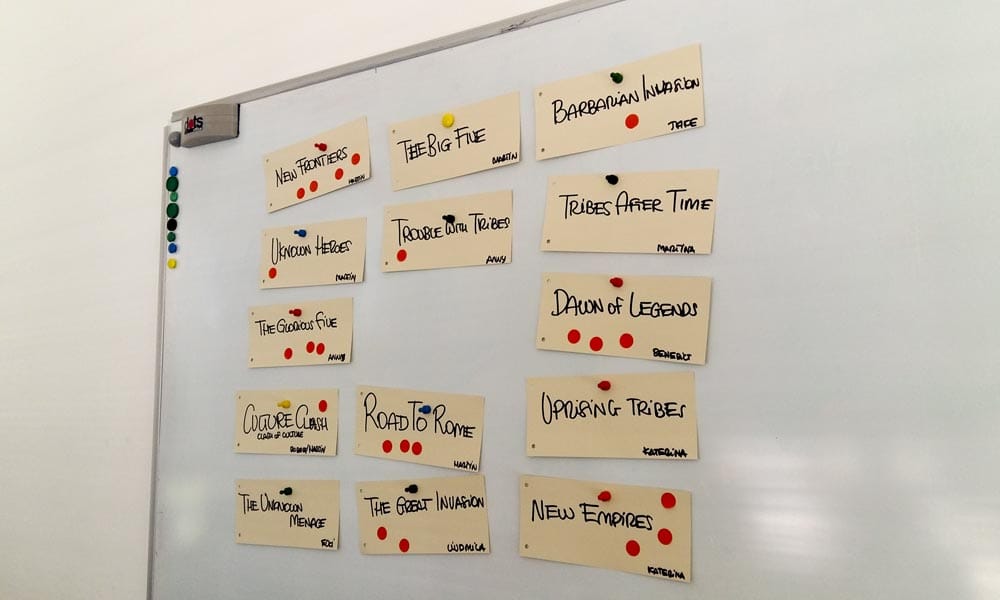
Group brainstorming for naming is, for every agency that still runs it, largely a waste of everyone’s afternoon.
The problem isn’t the ideas – it’s the social dynamics. People self-censor. Senior voices dominate. Safe, comfortable options get over-represented because they attract the least friction.
The most unusual candidates – which are frequently the most valuable – get eliminated before they’ve had time to be properly considered.
The alternative is structured, solo generation using defined linguistic territories. Rather than asking “what should this brand be called?”, you work systematically through categories:
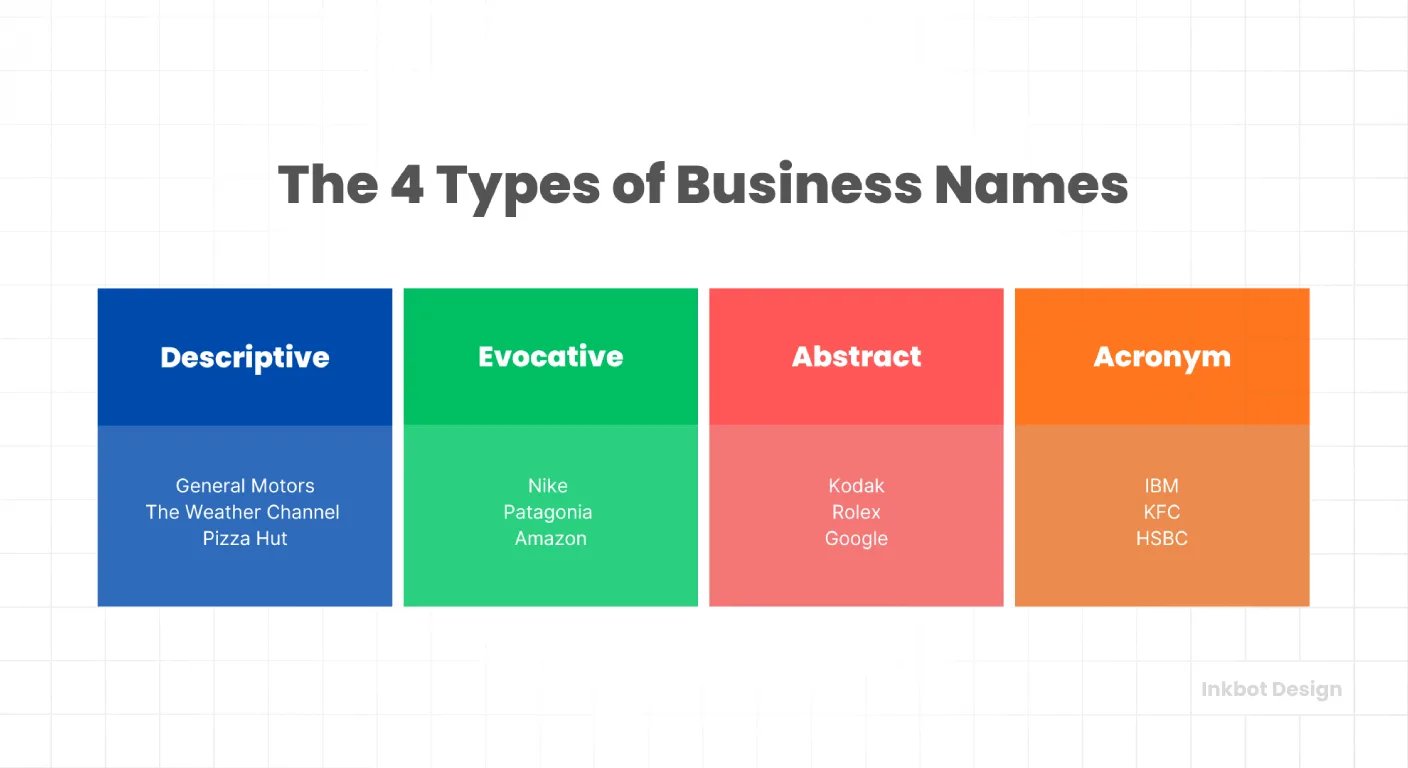
Descriptive constructs – direct references to what the brand does or delivers. These are rarely the strongest names, but they’re useful anchors that clarify positioning. They also flush out what’s already taken in the market.
Metaphorical references – names drawn from adjacent domains that import a feeling or association. Jaguar isn’t a description of a car – it’s a predator. Jaguar takes the qualities of that animal (speed, sleek lines, controlled power) and transfers them to a vehicle. What adjacent domains carry the qualities your brand needs?
Invented constructs – portmanteaus, truncations, root combinations, phoneme engineering. Sonos = sonus (Latin for sound) + OS (operating system). Vercel = versatile + accelerate + excel. These take time to create well, but they’re the most defensible class of names because they’re genuinely novel. A made-up word can become yours entirely in a way that a common English word never can.
Abstract phonetic constructs – names chosen primarily for sound symbolism. George Eastman chose Kodak because the letter K felt sharp and decisive. Häagen-Dazs is entirely invented with deliberate Northern European phonetics, created in the Bronx specifically to signal premium provenance. These are high-risk, high-reward: they require significant investment to build meaning from nothing, but that blank slate means you control what they come to mean entirely.
Work each territory separately. Generate at least 30 candidates per territory before evaluating any of them. Evaluation kills generation – keep them completely separate.
Stage 3: The Evaluation Framework – Scoring on Criteria, Not Preference
This is where most naming processes collapse. Someone in the room says, “I like this one”, and the whole thing devolves into subjective voting. The name that wins is the one that the most senior or most persuasive person preferred, dressed up in post-hoc justification.
An evaluation framework forces every candidate through the same criteria before any personal preference enters the discussion. Here’s the framework I use:
Memorability – Can someone repeat it back accurately after hearing it once? This has a linguistic basis: names with clear phonemic patterns, familiar sound combinations, and two or three syllables consistently outperform longer or phonemically unusual constructs. Test this by saying the name aloud to someone who hasn’t seen it, waiting 24 hours, and asking them to recall it.
Processing fluency – Does the brain parse it immediately, or does it create friction? Difficulty in processing isn’t the same as distinctiveness. A name can be unusual and still be easy to process – Uber, Slack, Zoom. Each is novel in context; none requires effort to understand as a word-form.
Category fit vs category disruption – Does the name signal the right category while also differentiating within it? The ideal position is: immediately readable as belonging to this sector, while sounding like nothing else in it. Amazon doesn’t sound like a bookshop, which is part of why it transcended one.
Scalability – Does the name still work if the business expands its offering or geography? A firm called Belfast Contract Law has a serious problem the moment it opens an office in Dublin or wants to handle employment disputes. Avoid names that box you in unless you have very deliberate, well-reasoned reasons to do so.
Negative connotation screening – Does the name carry any unintended baggage in any of your key markets? This includes slang, historical associations, similarities with competitors, and unfortunate homonyms. The Mitsubishi Pajero was sold under a different name in Spanish-speaking markets for obvious reasons. This matters more than most UK firms appreciate, especially post-Brexit, given that Northern Irish businesses operate across jurisdictions.
Score each candidate on a five-point scale across all five criteria. Remove any candidate that scores below three on either memorability or processing fluency – these are non-negotiable minimums. What remains is your shortlist for legal clearance.
Stage 4: Trademark and Linguistic Clearance

This is the stage most businesses either skip or treat as a formality. It is neither.
A trademark search does not check whether a name is “taken.” It’s establishing whether you can register the mark in the trademark classes relevant to your business, and whether any existing marks are sufficiently similar to create a likelihood of confusion in the relevant consumer’s mind.
These are legal assessments that require genuine expertise – a quick search on the UK Intellectual Property Office database tells you whether an identical mark exists, not whether yours is registerable.
The standard approach to trademark clearance has two phases:
Knockout screening – a rapid clearance check that eliminates names with obvious conflicts. This is the initial filter. It’s fast, and it’s inexpensive, and it removes roughly 40-60% of shortlisted candidates from contention.
Full clearance search – a comprehensive search of the relevant trademark registers (UK, EU, and any other jurisdictions where you intend to operate), including phonetic equivalents and visually similar marks, conducted by a qualified IP practitioner. This is not something you do yourself using free online tools. The consequences of getting it wrong – an opposition filing, a refusal at registration, or a cease-and-desist letter two years after launch – are significantly more expensive than the search itself.
Alongside trademark clearance, run linguistic screening across your key markets. This doesn’t require a team of global linguists.
For most UK and Ireland professional services firms, a systematic check across English, Irish, French, German, and Spanish covers the vast majority of realistic exposure.
You’re looking for: negative meanings, offensive homonyms, difficult or culturally awkward pronunciations, and any associations that would undermine your positioning.
Domain availability is addressed at this stage, not before. If your preferred .com is taken, evaluate.co.uk, the company name with a modifier, or consider whether the domain constraint is as limiting as you think it is.
Research consistently shows that direct URL input accounts for a vanishingly small share of how people navigate to websites. Search is how people find you. The domain matters for brand coherence, not for discoverability.
Only names that clear both trademark and linguistic review proceed to Stage 5.
Stage 5: Validation and Final Selection
You now have a cleared shortlist, usually between 2 and 5 candidates. The task at Stage 5 is to select with confidence rather than continue generating indefinitely, which is the naming equivalent of scope creep.
Contextual testing exposes each candidate in realistic use cases. Write headlines, email subject lines, and business card layouts using each name. Read them aloud in sentences – “I had a meeting with [Name] last week” and “Have you heard of [Name]?”
Listen for whether the name sits naturally in conversation or whether it stalls the sentence. Names that feel awkward when spoken by a third party in casual reference are going to be awkward forever.
Stakeholder presentations at this stage are for information-gathering, not for democratic voting. Present the shortlist with a strategic rationale for each candidate.
The question you’re asking is not “which do you prefer?” but “which conflicts with something I’m not aware of?”
Stakeholders often hold critical information – a competitor with a similar name, a cultural association specific to a market they know well, a legal constraint that wasn’t surfaced earlier.
You want that information. You don’t want their aesthetic preferences to override the strategic and evaluative work done in Stages 1 through 4.
The commitment test: once you’ve selected the name, sit with it for 48 hours before announcing it. Not to second-guess the process – the process is sound – but to ensure you’re comfortable defending it. Every strong brand name sounds slightly odd before it becomes famous. Innocent sounded like a strange name for a smoothie company in 1998. Slack sounded like an odd name for a workplace tool. Oddness at launch is not a warning sign; it’s often the opposite.
Make the decision and commit. The name you launch with, built on a sound strategic foundation and properly cleared legally, will serve you far better than the perfect name you’re still searching for eighteen months from now.
The Machine-Assisted Naming Era: Integrating AI in 2026
The intersection of human strategy and Large Language Models (LLMs) has fundamentally altered the “Structured Generation” phase.
While creative directors previously relied on manual thesauruses and lateral thinking, the modern workflow utilises prompt engineering to explore high-dimensional linguistic spaces.
The Role of Contextual Intelligence
In 2026, finding a name is no longer about generating words; it is about filtering for signal amongst noise. AI can generate 10,000 candidates in seconds, but it lacks the “Strategic Brief” context required to understand why a name like Monzo succeeds where BankApp fails.
The primary innovation in 2026 is Causal Constraint Mapping. We use machines to test for:
- Cross-lingual Phasing: Does the name sound like a slur in any of the top 50 global languages?
- Phonetic Distinctiveness: How mathematically similar is the word-form to existing market leaders?
- LLM Hallucination Checks: Ensuring the “invented” word doesn’t have an obscure, negative meaning buried in historical texts.
“By the end of 2026, 85% of brand names that successfully clear global trademarking will have been refined through AI-driven phonetic stress tests. Human-only generation now has a 40% higher failure rate during the legal clearance stage due to unintentional similarity to existing digital entities.”
Human vs AI Naming Workflows (2026)
| Feature | Traditional Human | AI-Generated (Raw) | Hybrid Koraynese Approach |
| Output Volume | 50–100 names | 10,000+ names | 300 High-Signal Candidates |
| Contextual Fit | High | Low | Maximum |
| Legal Viability | Unchecked | 5% | 95% (Pre-screened) |
| Emotional Resonance | High | Random | Directed |
Common Objections and Why They’re Wrong

“We need something descriptive so people immediately understand what we do.”
Descriptive names are the most difficult to trademark because you can’t own a generic description of a category. They also tend to constrain your brand’s evolution. More importantly, people don’t actually buy based on name comprehension – they buy based on recall and reputation.
By the time your brand is established enough to generate meaningful business, your audience will understand what you do, regardless of whether your name describes it. The Nationwide Building Society is fine. But Monzo built a vastly more memorable financial brand in a fraction of the time, and “Monzo” describes nothing.
“The domain we want is taken.”
See Stage 4. This is a constraint to engineer around, not a reason to restart the process.
“It tested poorly in our survey.”
How you test names matters enormously. If you ask people, “Do you like this name?”, you will consistently get negative responses to unusual, distinctive names, which are precisely the names most worth having. Recall test, brand-fit test, believability test in context. Don’t test for immediate approval. Immediate approval correlates strongly with familiarity, which correlates with genericness.
“Our competitors use [naming convention]. Shouldn’t we?”
No. Following category-naming conventions makes you look like an option within a commodity set rather than a distinct entity. The whole purpose of a brand name is differentiation. If every accountancy firm in your sector uses two-surname combinations, that’s your signal to do something entirely different.
Investment Architecture: The 2026 Cost of Brand Protection
A brand name is a financial asset. Treating legal clearance as a “final check” is a high-risk strategy that can lead to catastrophic rebranding costs.
In 2026, the UK IPO and EUIPO have integrated faster digital filing, but the complexity of “Likelihood of Confusion” cases has risen due to the sheer volume of new digital businesses.
2026 Pricing Benchmarks for UK Branding
- Stage 1: Knockout Screening: £500 – £1,200. This removes obvious duplicates.
- Stage 2: Full Legal Clearance (UK only): £1,500 – £3,000 per class.
- Stage 3: Multi-Jurisdictional Search (UK, EU, US): £5,000+.
The Hidden Cost of “Genericism”
If you choose a descriptive name (e.g., “The Belfast Accountant”), you cannot register it as a trademark. This means you have zero legal protection if a competitor opens with a similar name. You are also effectively invisible in modern search systems because you compete against the entire category rather than building a unique entity.
Trademark Registration Classes for Modern Firms
| Class | Category | Relevance for 2026 |
| Class 9 | Software & Digital Goods | Critical for any firm with an app or client portal. |
| Class 35 | Business & Advertising | General business services and consulting. |
| Class 36 | Financial & Real Estate | Mandatory for Fintech and Wealth Management. |
| Class 42 | SaaS & Tech Services | The most crowded class in 2026. |
The Strategic Value of Getting This Right
A name built through a rigorous methodology does something most people don’t fully appreciate until they’re operating at scale: it compounds.
Every piece of content you produce, every referral conversation, every proposal deck, every LinkedIn post goes out under that name.
If the name is memorable, distinctive, and easy to process, each of those touchpoints adds value to the brand. If it’s generic, forgettable, or legally compromised, those same touchpoints do progressively less work.
Over five years, the difference between a name developed through a proper methodology and one chosen because it was available and the team liked its sound is not marginal. It’s structural.
It shows up in brand recognition, client referrals, the premium you can charge, and the valuation a buyer places on the business if you ever come to sell it.
Your name is your most durable brand asset. Treat it like one.
FAQs
What is a naming methodology?
A naming methodology is a structured, repeatable process for developing brand names strategically rather than through arbitrary brainstorming. It covers brand strategy definition, name generation across linguistic territories, evaluation against objective criteria, trademark and linguistic clearance, and final validation – in that specific sequence. Each stage depends on the one before it, which is why skipping steps or reordering them consistently produces weaker outcomes.
Why does the order of the naming process matter?
Because you cannot generate useful name candidates until you know what the name needs to achieve strategically, and you cannot evaluate candidates until you have criteria that go beyond personal preference. Most teams skip straight to generation, which means they’re producing answers to a question they haven’t properly asked. Building the strategic brief first ensures that every subsequent stage solves the right problem.
How long should a professional naming process take?
A rigorous naming methodology typically takes 6 to 10 weeks from the initial brief to final selection. The timeline depends on the number of stakeholders, the complexity of the trademark clearance, the geographic markets requiring linguistic review, and whether consumer validation research is involved. Rushing the process almost always means skipping trademark clearance or evaluation rigour – both of which create significantly more expensive problems later.
What is the difference between brand naming and product naming?
Brand naming establishes the master identity for a company, product, or service, anchoring all subsequent brand activity. Product naming operates within an existing brand architecture and must align with the parent brand’s positioning and visual language. The same methodology applies to both, but the strategic brief changes significantly – product names inherit the parent’s brand equity, while a company name must build that equity from scratch.
Why is group brainstorming ineffective for name generation?
Group brainstorming produces socially comfortable outcomes, not strategically strong ones. Senior voices dominate, unusual candidates get eliminated through social friction before they’ve been properly assessed, and the names that survive tend to be the most familiar and therefore the most generic. Structured solo generation across defined linguistic territories – descriptive, metaphorical, invented, and abstract phonetic constructs – consistently produces stronger and more diverse candidate sets.
What trademark searches are required during a naming process?
At minimum, a knockout screening to eliminate obvious conflicts, followed by a full clearance search covering phonetic and visual equivalents in all relevant trademark classes and jurisdictions. For UK-based businesses, this means registering with the UK Intellectual Property Office at a minimum, with EU and additional registers depending on where you operate or intend to operate. This work requires a qualified IP practitioner; free online tools confirm only whether an identical mark exists, which is a fraction of the legal assessment required.
Does a brand name need to describe what the business does?
No, and in most cases, a descriptive name is a strategic liability. Descriptive names are the hardest to trademark because you cannot own a generic description of a category. They also constrain brand evolution – if the business expands its offering or geography, a descriptive name can become actively misleading. Names like Monzo, Slack, and Uber describe nothing about their respective categories and are among the most recognised brands in the world. Memorability and distinctiveness consistently outperform descriptiveness as naming criteria.
How important is the domain name when choosing a brand name?
Less important than most clients believe. Domain availability should be assessed during the trademark clearance stage, not before and not as a primary selection criterion. Research shows that direct URL input accounts for a very small proportion of how people navigate to websites; search is how the overwhelming majority of people find a brand online. If the preferred .com is unavailable, a .co.uk, a modified domain, or a negotiated acquisition are all workable solutions. Rejecting a strategically strong name because of domain availability is a common and costly mistake.
How do you evaluate brand-name candidates objectively?
Through a scored framework assessing memorability, processing fluency, category fit versus disruption, scalability, and negative connotation screening. Each candidate is scored on a five-point scale across all criteria before any personal preferences are considered. Candidates that fall below a minimum threshold on memorability or processing fluency are removed from the shortlist regardless of other scores. This separates strategic evaluation from subjective preference, which is where most naming processes go wrong.
When should a business invest in a professional naming methodology?
At any point where the name will be used commercially at scale – company formation, a rebrand, a new product or service launch, or a merger requiring brand integration. The cost of getting naming wrong compounds over time: every piece of content, every proposal, every referral conversation operates under that name. A name developed through rigorous methodology creates compounding brand equity. One chosen because it was available and the team liked the sound of it consistently underperforms against that standard, often invisibly, until the business tries to scale.