The Maserati Logo: A Symbol of Italian Luxury and Power
When you think of luxury cars, what springs to mind?
For many, it’s the sleek lines, powerful engines, and unmistakable presence of a Maserati.
But there’s one element that captures the essence of this iconic brand more than any other: the Maserati logo.
This emblem isn’t just a fancy badge slapped on a bonnet. It’s a story, a legacy, and a promise all rolled into one.
So, buckle up, petrolheads and design enthusiasts alike, as we take a deep dive into the world of the Maserati logo.
- Trident inspired by Giambologna’s Neptune links Maserati to Italian art, symbolising power over seas and mastery of speed, luxury, innovation.
- Oval, colours, and bespoke wordmark create refined visual identity rooted in Bologna’s red and blue, signalling heritage and sophistication.
- Logo evolved from 1926 to 2026 for racing, digital, and electric eras while preserving core symbolism and recognisability.
- Trident functions as cultural badge of honour, appearing in motorsport, film, fashion and luxury merchandise, fostering strong brand loyalty.
The Birth of a Legend
From Humble Beginnings to Automotive Royalty
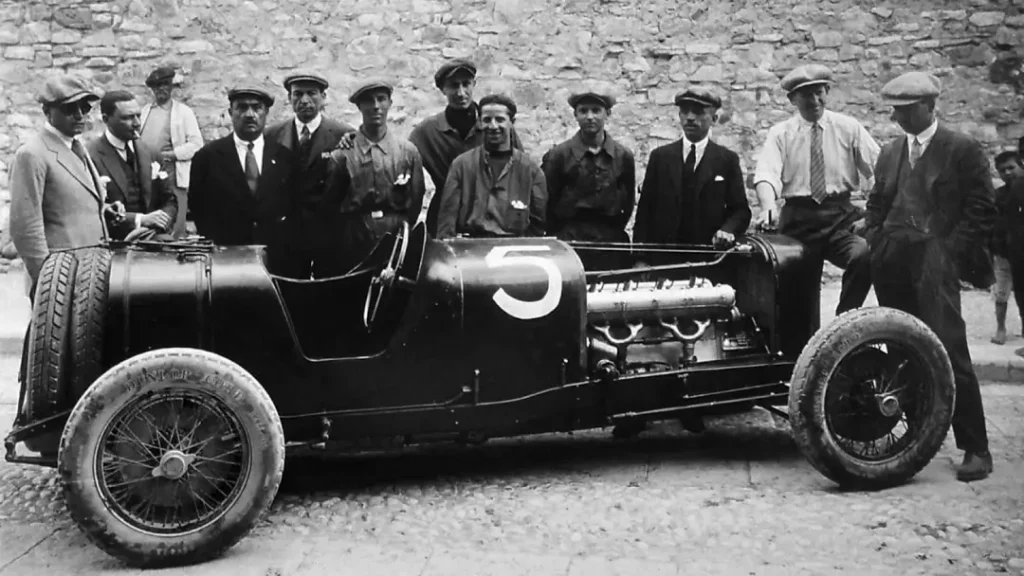
Bologna, Italy, 1914. The air is thick with the smell of motor oil and ambition.
Five brothers, the Maseratis, are tinkering away in their workshop, dreaming of speed and innovation.
Little did they know that their passion project would evolve into one of the most prestigious car brands in the world.
The thing is, they didn’t start out building cars from scratch.
Their first workshop was all about tuning and prepping race cars.
They did this for other big names.
They were the go-to lads for marques like Isotta Fraschini and Diatto.
Their reputation for wringing performance out of an engine was already legendary.
This background in pure competition is why their logo had to scream power.
But here’s the kicker – the Maserati logo we know and love today wasn’t born until 1926. Why the wait? Well, sometimes greatness takes time to simmer.
An Earlier Symbol: The Saetta
Before the world knew the Trident, there was another symbol.
The very first Maserati car had a different badge on its nose.
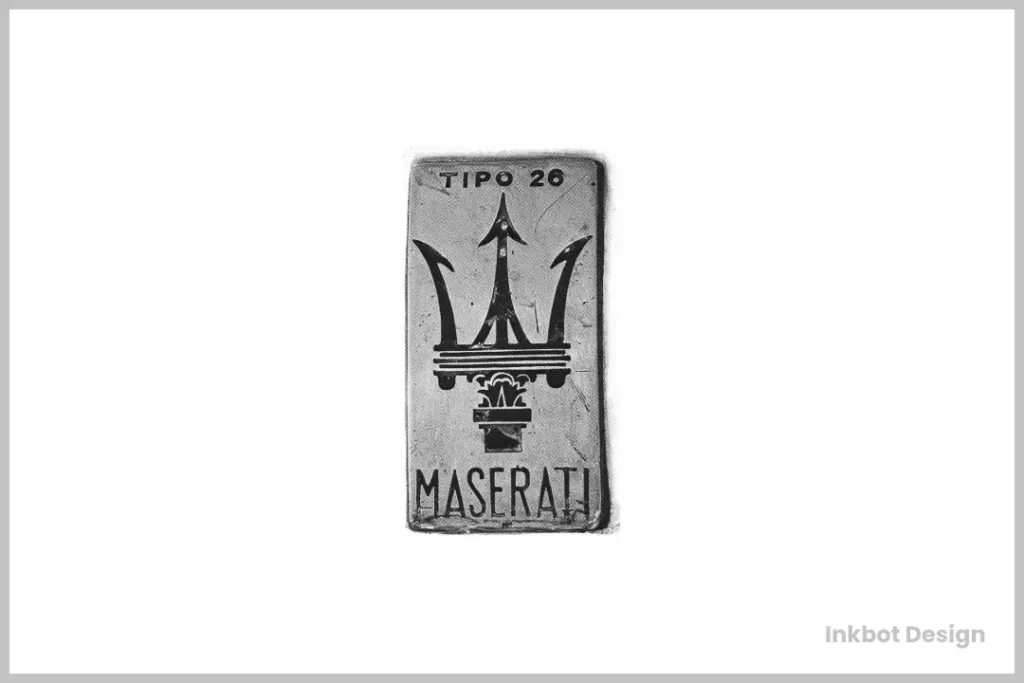
This was the Tipo 26, from 1926.
It was a simple silver rectangle with a stylised lightning bolt.
This was the “Saetta,” which means lightning in Italian.
Makes sense, right? A flash of speed for a racer.
But while it did the job, it didn’t have a story.
It lacked the deeper meaning the brothers were after.
They needed a symbol for their heritage and ambition.
That’s what sent Mario looking for inspiration in his own backyard.
Beyond the Workshop: The Giambologna Influence
The decision to use the Trident was not an engineering one, but a deep cultural homage.
Mario Maserati, the only brother not obsessed with internal combustion, was a painter and sculptor. When he looked for a symbol, he didn’t look at machines; he looked at the Fountain of Neptune in Bologna’s Piazza Maggiore.
The statue itself was completed in 1566 by the Flemish sculptor Giambologna (Jean de Boulogne). By choosing the Trident from this specific statue, Mario anchored the Maserati brand to the High Renaissance.
The three prongs on Giambologna’s statue represent the god’s power over the three types of water: seas, rivers, and lakes. For the Maserati brothers, this was adapted to represent their dominance across three domains:
- Speed (The road)
- Luxury (The cabin)
- Innovation (The engine)
By linking a car brand to a 16th-century masterpiece, Maserati positioned itself as “Moving Art,” a strategy that continues to influence their marketing in 2026.
Decoding the Design
The Anatomy of an Icon
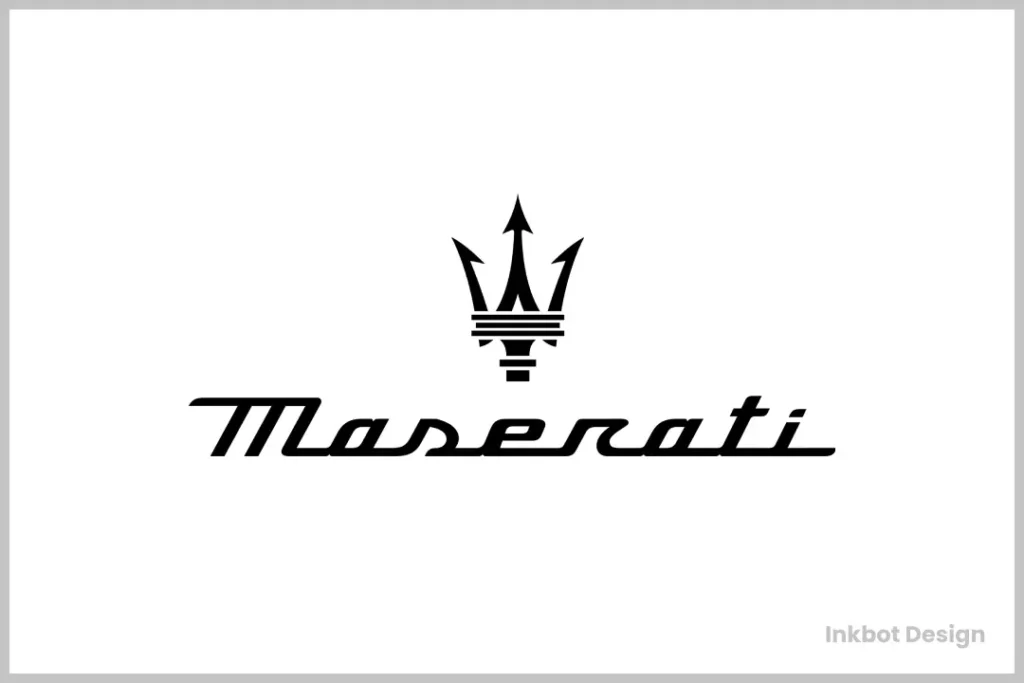
Let’s break it down, shall we? The Maserati logo isn’t just a pretty face – it’s a masterclass in symbolic design.
- The Trident: Three prongs, each representing a core value of the brand. Some say it’s power, luxury, and elegance. Others argue it’s excellence, design, and exclusivity. Either way, it’s a triple threat.
- The Oval: It encases the trident, representing wholeness and perfection. It’s like a hug for your eyes.
- The Colours: Typically rendered in black or chrome, the logo exudes sophistication. But the red and blue are the real heart of it. They’re a direct nod to Bologna’s official colours. This is where the Maserati brothers founded their company. It was a tribute to their home turf. After the company moved to Modena, the city’s blue and yellow were sometimes used. But Bologna’s iconic red and blue have always remained central. And when you see it on that iconic blue background? That’s when you know you’re looking at automotive royalty.
The Technical DNA: Typography and Colour Codes
While the Trident is the visual hero, the technical execution of the Maserati identity is governed by strict brand guidelines that have evolved for the high-definition digital era of 2026.
The Maserati Wordmark
The “Maserati” script is not a standard off-the-shelf font. It is a bespoke serif typeface that blends the elegance of Italian Renaissance calligraphy with modern industrial precision. It bears similarities to classical fonts like Bembo, but with modified kerning and sharpened serifs to imply aerodynamic speed.
In recent updates for the MC20 and Grecale launches, the wordmark was “flattened” for better legibility on mobile screens and digital dashboards.
Official Colour Palette
The brand relies on a specific “Maserati Blue” that distinguishes it from the brighter blues of Alpine or the darker tones of Bugatti.
| Element | Pantone Code | Hex Code | Meaning |
| Maserati Midnight Blue | 286 C | #003399 | Authority, Sea, Heritage |
| Bologna Red | 485 C | #E4002B | Passion, Performance, Fire |
| Maserati Silver | 877 C | #8E908F | Precision, Modernity |
When applying the logo for professional use, such as vehicle wraps or architectural signage, the “Safe Zone” around the trident must be at least 25% of the oval’s total width to maintain visual integrity against complex backgrounds.
Evolution Through the Ages
A logo this good would stay the same forever. But like a fine wine (or a well-tuned engine), the Maserati logo has evolved.
- 1926-1937: The original Tipo 26 logo was a functional silver rectangle. It stood upright, with the trident inside. The “MASERATI” name was printed below. It was stark, simple, and built for the racetrack.
- 1937-1951: After the company moved to Modena, the logo got its famous oval shape. The background was often blue with a red trident, honouring Bologna’s colours. The brand name was tucked inside this new border.
- 1952-1983: Things got cleaner. The oval stayed, but the trident became beefier and more stylised. On the cars, the “MASERATI” text was often dropped. This let the powerful trident-in-oval symbol do all the talking.
- 1983-2005: This period saw small refinements. The logo got a more three-dimensional look. After Fiat took over in 1997, the design was updated. It got a sleeker, narrower oval and a sharper trident.
- 2005-2020: A major refresh marked the start of the modern era. The red accent on the trident was toned down. The whole emblem was given a shiny, sculptural effect. The Maserati wordmark font was updated, too, becoming much cleaner.
- 2020-Present: With the MC20 supercar, the logo was simplified again. It’s now often split into two parts. You have the trident emblem and the wordmark. It’s often shown in a flat style, especially for digital use. The red is gone for a minimalist, classy look.
Each iteration tells a story of Maserati’s journey from racing upstart to luxury leader.
More Than Just a Pretty Face
The Psychology Behind the Logo
Here’s where it gets interesting. The Maserati logo isn’t just easy on the eyes – it’s playing mind games with us (in the best way possible).
- The trident shape? It triggers associations with power and mythology.
- That oval? It subconsciously represents perfection and completeness.
- The simplicity of the design? It screams confidence. Maserati doesn’t need bells and whistles to make an impact.
The logo whispers, “I’m legendary, and I know it.” And let’s be honest, we’re all ears.
A Badge of Honour
For Maserati owners, that logo isn’t just a brand identifier – it’s a statement. It’s like being part of an exclusive club where the password is “impeccable taste”, and the dress code is “effortlessly cool.”
But it’s not just about showing off (okay, maybe a little). The Maserati logo represents a commitment to quality, a passion for performance, and an appreciation for the finer things in life. It’s a conversation starter, a head-turner, and a dream-maker all rolled into one.
The Logo in Action
From Racetracks to Red Carpets
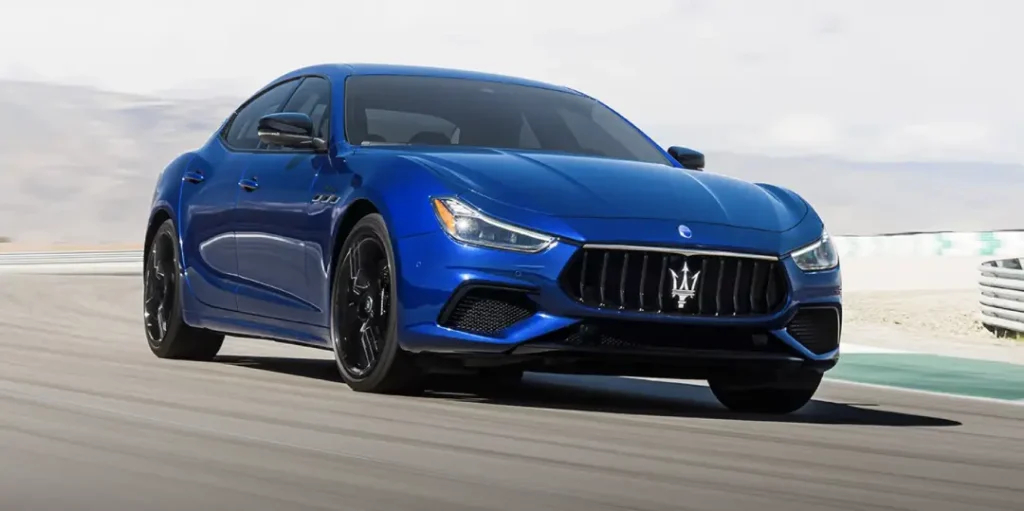
The Maserati logo has graced some of the most prestigious venues in the world:
- Formula One circuits, where it’s left competitors in its wake. We’re talking the absolute peak of motorsport. Think of the legendary Juan Manuel Fangio. He won the 1957 F1 World Championship in a Maserati 250F. Before that, the Trident conquered America. It won the Indy 500 back-to-back in 1939 and 1940. To this day, Maserati is the only Italian maker to win that race.
- Concours d’Elegance events, where it’s turned heads and dropped jaws
- Hollywood premieres, where it shares the spotlight with A-list celebrities
It’s a chameleon – equally at home in high-octane racing environments and swanky black-tie affairs.
A Design Icon Beyond Cars
Here’s a fun fact: the Maserati logo has transcended the automotive world. You’ll find it:
- On luxury watches, adding a touch of Italian flair to your wrist
- Adorning high-end accessories, from cufflinks to keychains
- Inspiring art and fashion, proving its status as a design classic
It’s not just a car logo – it’s a lifestyle emblem.
The Competition: Standing Out in a Sea of Badges
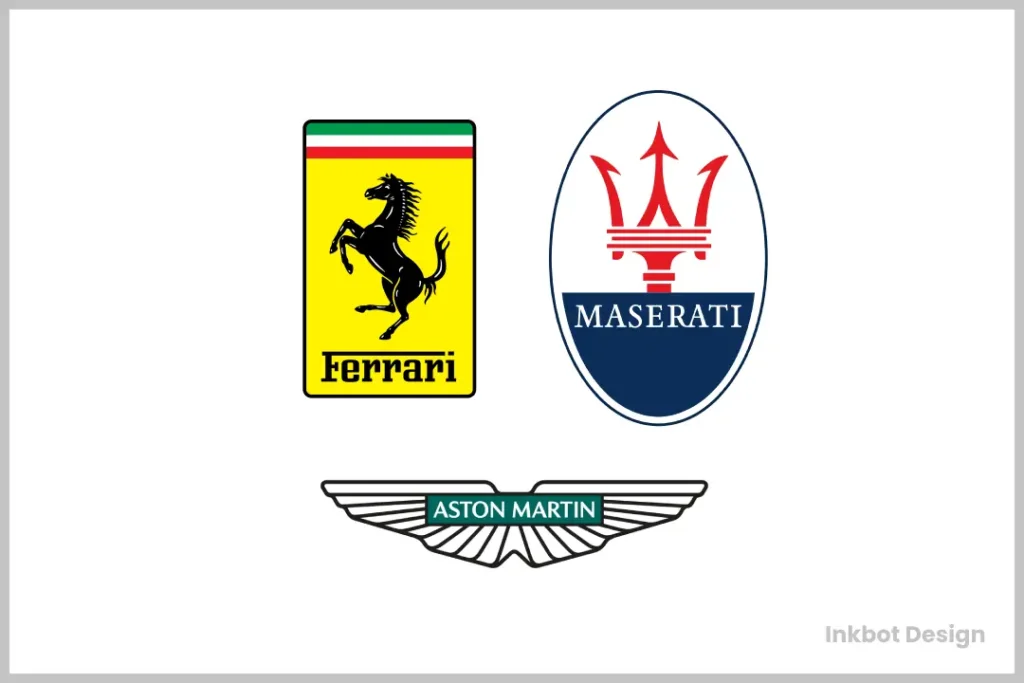
Luxury Car Logos: A Comparison
Let’s face it – the luxury car market is crowded with impressive logos. But how does Maserati stack up?
- Ferrari’s prancing horse? Energetic, but a bit busy.
- Lamborghini’s raging bull? Aggressive, but not as refined.
- Aston Martin’s wings? It’s elegant but lacks that mythological edge.
The Maserati Trident manages to be both simple and loaded with meaning. It’s like the strong, silent car logo – it doesn’t need to shout to make an impact.
The Italian Trifecta
Ferrari, Lamborghini, Maserati – the holy trinity of Italian supercars. Each has its distinct personality:
- Ferrari: Passionate and fiery
- Lamborghini: Bold and outrageous
- Maserati: Sophisticated and mysterious
The Maserati logo perfectly encapsulates this air of refined mystery. It’s not trying to be the loudest in the room – it knows its worth.
| Brand | Symbol | Primary Meaning | Design Philosophy |
| Maserati | Trident | Mythological Power (Neptune) | Sophisticated & Artistic |
| Ferrari | Prancing Horse | Heroism (Francesco Baracca) | Passionate & Aggressive |
| Lamborghini | Raging Bull | Zodiac / Strength (Ferruccio’s Sign) | Bold & Raw |
| Alfa Romeo | Biscione (Snake) | Milanese Heritage (Visconti Family) | Historical & Intricate |
The Logo’s Impact on Brand Identity
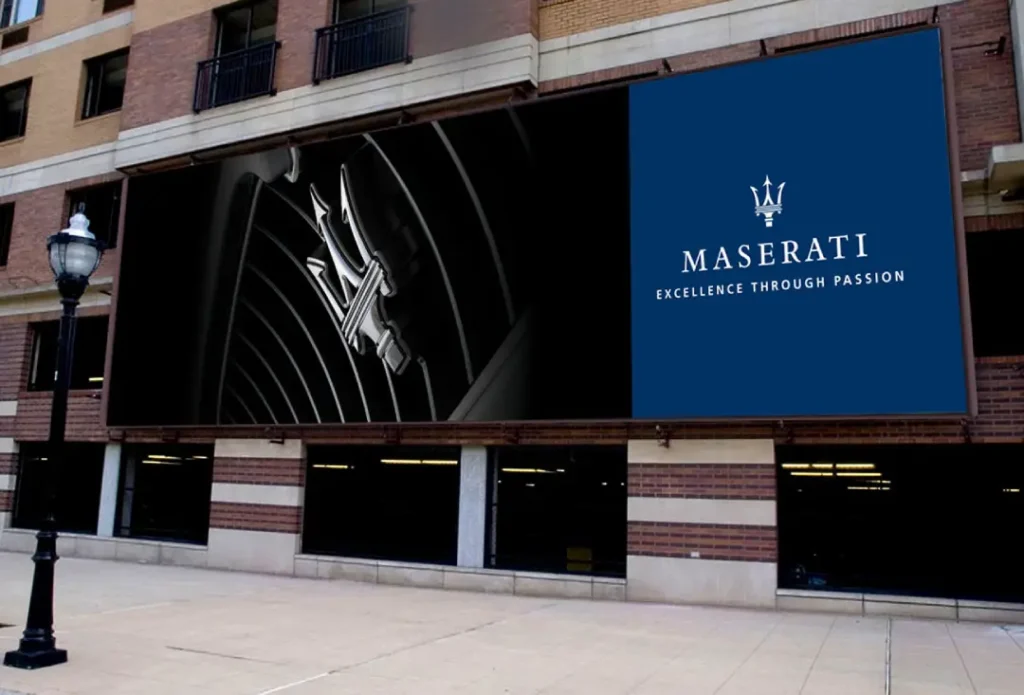
A Promise of Excellence
You’re not just looking at a pretty symbol when you see that trident. You’re seeing a promise:
- Of unparalleled craftsmanship
- Of thrilling performance
- Of turning heads wherever you go
It’s like a shorthand for “buckle up, you’re in for an experience.”
Building Brand Loyalty
Here’s the thing about iconic logos – they create emotional connections. Maserati enthusiasts don’t just love the cars; they love what the brand represents. That trident becomes a rallying point, a source of pride.
It’s not uncommon to hear Maserati owners talk about their cars as if they were beloved family members. “Oh, you mean Triton? Yeah, he’s parked outside.” (Some people name their Maseratis after Neptune’s son. Commitment, folks.)
What Does the Navy Blue Trident on the Maserati Logo Represent?
The navy blue trident found on the Maserati logo is more than a bold design choice. This striking symbol is deeply rooted in mythology and carries significant meaning.
- Connection to Neptune: The trident is a nod to Neptune, the Roman god of the sea. The choice of navy blue specifically highlights his dominion over the oceans, symbolising his powerful, unyielding nature.
- Source of Strength: Navy blue symbolises the sea, a wellspring of Neptune’s strength and authority. This colour choice imbues the brand with traits associated with Neptune—might, resilience, and grace.
In essence, the navy blue trident signifies a legacy of strength and excellence inspired by the mythological power of a sea god.
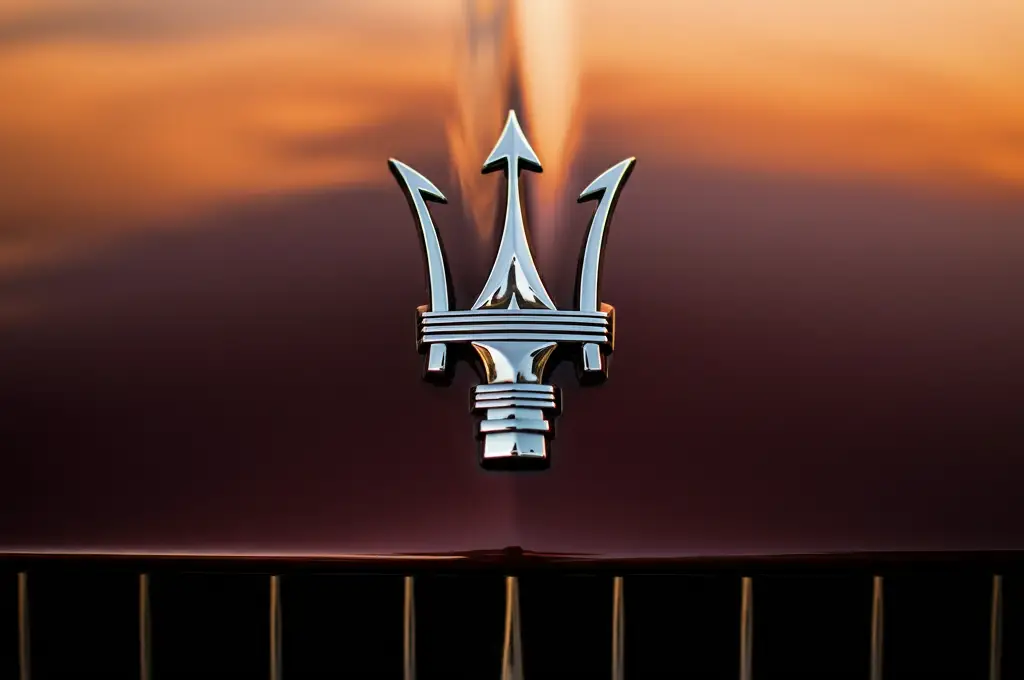
The Trident emblem, set against a white or silver backdrop, symbolises Maserati’s dominance on the road. This powerful icon draws inspiration from Neptune’s trident, conveying strength and agility.
Placed on a neutral field, the trident emphasises elegance and precision, reflecting the brand’s enduring legacy in automotive excellence.
The “Folgore” Transformation: A New Current
As Maserati transitions to a fully electric lineup by 2030, the logo has undergone its most significant semiotic shift in decades. The Maserati Folgore (Italian for “Lightning”) range introduces a specific aesthetic treatment for the Trident to signal sustainable performance.
On electric models like the GranTurismo Folgore, the traditional chrome or silver finish is replaced with Dark Copper (Rame Folgore) accents. This isn’t just a stylistic choice; copper is the primary conductor of electricity, and its use in the logo creates a direct semantic link between the brand’s heritage and its future powertrain.
Visual Differences in the EV Era:
- Illuminated Grille Tridents: For 2026 models, the front-mounted Trident often features “edge-lit” LED technology, keeping the symbol visible in total darkness.
- Textural Contrast: The background of the C-pillar badge on Folgore models often features a satin-finish matte texture, contrasting with the high-gloss polished trident.
- The “E” Integration: While some brands have added “e” prefixes to their logos, Maserati has resisted this, instead using the Saetta (lightning bolt) motif on the fender vents to denote electric status, keeping the Trident pure.
The Logo in Pop Culture
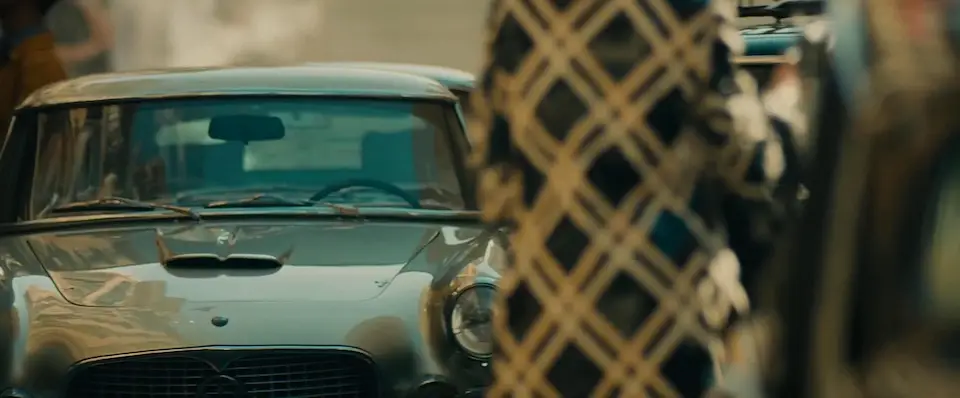
Maserati in the Movies
The Maserati logo has had its fair share of Hollywood moments. It’s like the George Clooney of car emblems – classy, distinguished, and always stealing the scene. Some notable appearances:
- “The Man from U.N.C.L.E.” (2015): Nothing says “spy chic” like a vintage Maserati.
- “Limitless” (2011): Only a Maserati will do when you’re superhuman.
- Countless music videos: It’s the go-to symbol for “I’ve made it” in the music world.
Each time that Trident flashes across the screen, it’s a moment of automotive poetry.
Social Media Stardom
In the age of Instagram and TikTok, the Maserati logo has found new life as a status symbol. It’s not uncommon to see:
- Close-up shots of the trident garnering thousands of likes
- Influencers posing next to the logo (often without showing the whole car – talk about brand power!)
- Memes and challenges centred around spotting Maserati logos in the wild
It’s become a social media treasure hunt, with car spotters and luxury enthusiasts always looking for that next Trident sighting.
The Iconic C-Pillar Badge
Maserati made a classy move by putting a badge on the C-pillar.
That’s the bit of bodywork behind the rear side windows.
This tradition kicked off with the 1963 Maserati 3500 GT.
It became a true signature with the first Quattroporte.
It’s a confident, subtle mark.
It lets you spot a Maserati from its side profile alone.
You’ll see different versions of it.
Sometimes it’s a trident in a small oval.
Other times, it’s a stylised “Saetta” version on cars like the Ghibli.
It’s become a huge part of Maserati’s design language.
Just as much as the massive grille on the front.
The Art of Logo Placement
Strategic Branding
Maserati doesn’t just slap its logo anywhere. The placement is as carefully considered as the design itself:
- Front and centre on the grille: A bold statement of identity
- Subtle touches on wheel centres: A reminder of craftsmanship in every detail
- Elegantly embossed on interiors: Luxury you can feel
It’s a masterclass in branding – present enough to be noticed, subtle enough to be classy.
Limited Editions and Special Models
For true Maserati fans, nothing gets the heart racing like a limited edition model. And you know what that means – unique logo treatments:
- Gold-plated tridents for anniversary editions
- Carbon fibre logos for performance models
- Bespoke colour schemes for collaborative designs with fashion houses
Each memorable edition logo becomes a collector’s item in its own right, a metallic manifestation of automotive history.
The Logo as a Design Inspiration

Beyond the Automotive World
The Maserati logo’s influence extends far beyond the realm of cars. Its elegant simplicity has inspired:
- Architectural elements in luxury homes
- High-end jewellery designs
- Corporate logos in various industries
It’s a testament to the power of good design – when something works, it works.
DIY Maserati: Logo-Inspired Creations
Here’s a fun trend: Maserati enthusiasts create their trident-inspired art and products. We’re talking:
- Hand-painted trident murals in home garages
- 3D-printed Maserati logo keychains and ornaments
- Custom trident-emblazoned clothing and accessories
It’s like a grassroots marketing campaign driven purely by passion. Maserati’s marketing team must be thrilled!
The Environmental Angle
Sustainable Branding
As the world becomes more eco-conscious, even luxury brands are pressured to go green. So, how does a logo associated with high-performance cars fit into this new landscape?
Maserati’s approach has been subtle but significant:
- Using recycled materials for physical logo badges
- Developing eco-friendly paints for logo applications
- Emphasising the logo’s connection to Neptune, the god of the sea, in marine conservation efforts
It’s a delicate balance between maintaining brand identity and embracing sustainability.
The Electric Future
With Maserati’s commitment to producing electric vehicles, the Trident logo is set to become a symbol of innovation once again. Imagine:
- Illuminated trident logos on electric Maserati grilles
- The logo is incorporated into the charging port designs
- Unique “electric blue” versions of the emblem, along with a clever twist. This is for their all-electric “Folgore” range. On these models, the trident badges are finished with dark copper accents. This colour is a slick visual cue for the electric powertrain. It shows how the trident is being adapted to mean a new kind of power. All without losing its soul.
The trident that once represented dominance in combustion engines could become a beacon of electric performance.
Collecting Maserati: The Logo as Memorabilia
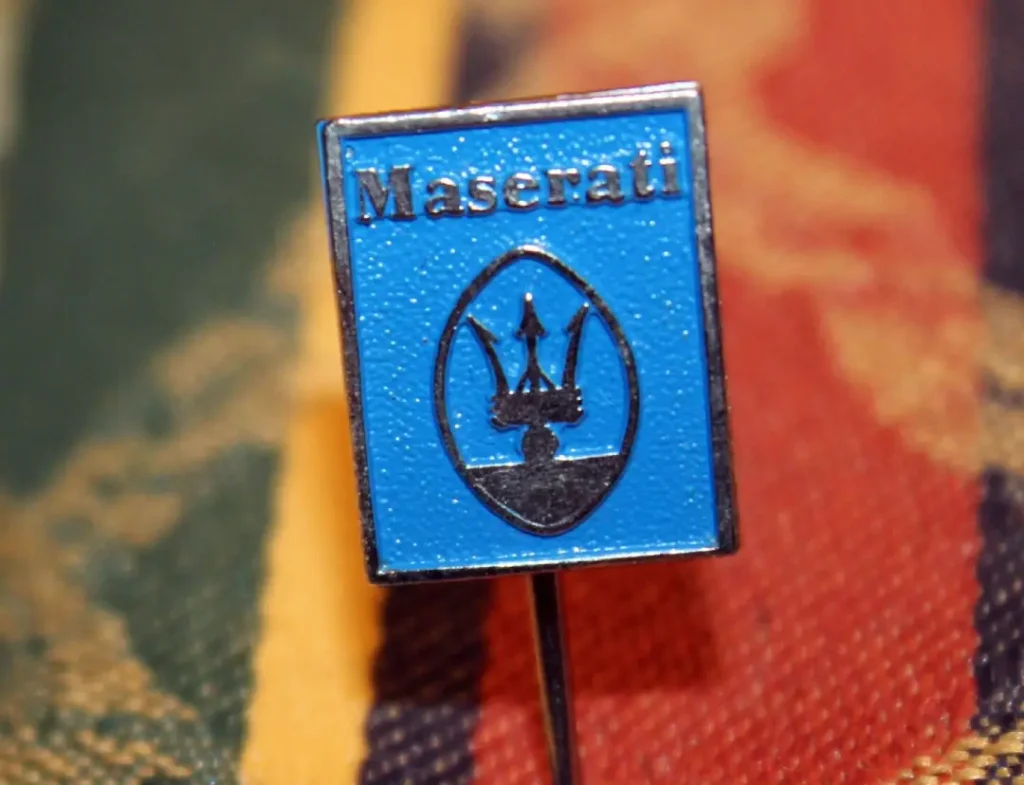
Vintage Value
For some, collecting cars is out of reach. But Maserati logos? That’s a more accessible hobby. Vintage Maserati emblems have become prized collectables:
- Original 1920s Trident badges can fetch thousands at auction
- Mid-century steering wheel centres with the logo are highly sought-after
- Even old Maserati dealership signs bearing the trident are valuable
It’s like owning a piece of automotive history you can hold in your hand.
Modern Merchandise
Maserati has capitalised on logo love with a range of official merchandise:
- Trident-embossed leather goods
- Logo-emblazoned clothing lines
- High-end office accessories featuring the emblem
It’s a way for fans to carry some Maserati magic with them, even if they don’t own a car (yet).
The Logo in Motorsport
Racing Heritage
The Maserati Trident has a storied history in motorsport. It’s been:
- A victory symbol in countless Grand Prix races
- A badge of honour on legendary race cars like the 250F
- A rallying point for Maserati racing teams and fans alike
Each appearance on the track cements the logo’s association with speed, precision, and victory.
Modern Competition
While Maserati’s current involvement in motorsport is limited, the logo still makes appearances:
- In the GT racing series, adorning high-performance race versions of road cars
- At classic car racing events, where vintage Maseratis still compete
- In virtual racing games, introducing a new generation to the brand
The trident continues to symbolise the thrill of competition, even as the nature of that competition evolves.
The Personal Touch: Custom Logos
Bespoke Branding
For the Maserati owner who truly wants to stand out, the brand offers customisation options:
- Personalised colour schemes for the Trident badge
- Unique materials like carbon fibre or precious metals for the emblem
- Unique placements of the logo in car interiors
It’s like getting a tailored suit for your car’s branding.
The Line Between Personalisation and Preservation
This trend raises an interesting question: How much can you alter an iconic logo before it loses its essence? Maserati walks a fine line:
- Encouraging personalisation within set parameters
- Maintaining strict control over the core design
- Offering “official” custom options to discourage unofficial modifications
It’s a balancing act between brand integrity and customer desires.
The Global Perspective
Cultural Interpretations
The Maserati logo means different things in different parts of the world:
- In Europe, it’s a symbol of long-standing automotive excellence
- In North America, it represents European luxury and exclusivity
- In Asia, it’s increasingly seen as a mark of success and status
These varied interpretations influence how Maserati markets itself globally.
Lost in Translation?
Interestingly, the mythological significance of the trident isn’t universally recognised. Maserati has had to educate consumers about the logo’s meaning and history in some markets.
It’s a reminder that even the most iconic symbols sometimes need a bit of explanation.
If you’re eager to delve deeper into the rich history of Maserati, there are several exciting avenues to explore:
Museum Visits
- Maserati Factory Tour: Venture to Modena, Italy, to explore the Maserati factory and museum. This offers a unique glimpse into the brand’s legendary past and innovative future.
- Automobile Museums: Museums like the Museo Enzo Ferrari often showcase classic Maserati models alongside other renowned Italian automobiles.
Books and Documentaries
- Books: Consider reading in-depth books like “Maserati: A Century of History”, which provide comprehensive insights into the brand’s evolution.
- Documentaries: Watch documentaries that chronicle the brand’s milestones, offering visual narratives paired with expert interviews.
Online Resources
- Official Maserati Archives: Visit the official website for archival materials, including historical timelines and detailed model histories.
- Automotive Forums and Enthusiast Sites: Engage with online communities where enthusiasts share historical insights, rare photos, and personal stories about their experiences with Maserati.
Events and Clubs
- Classic Car Events: Attend car shows and events where Maserati car clubs gather, allowing you to see historic models and chat with fellow aficionados.
- Owner’s Clubs: Join a Maserati owner’s club to access exclusive historical resources and discussions with passionate members.
By combining these methods, you can explore Maserati’s storied past in a comprehensive and engaging manner, gaining a thorough appreciation of its legacy.
The Collector’s Guide: Spotting a Genuine Maserati Trident
With the rise of “tribute cars” and third-party accessories, identifying an authentic Maserati badge is crucial for restorers and owners.
- The “Enamel” Test: Vintage Maserati badges (pre-1980s) were made using the cloisonné enamel process. If the surface is perfectly flat and feels like glass, it is likely authentic. Modern plastic or resin replicas often exhibit a slight “dome” or “wave” in their reflections.
- Weight and Material: A genuine front grille Trident for a modern Quattroporte or Levante is made of high-grade composite with a metallic coating or solid metal. If the badge feels light or “hollow” when tapped, it is likely a counterfeit.
- The Base Alignment: On authentic C-pillar badges, the “Saetta” (lightning bolt) line that underscores the trident must align perfectly with the car’s roofline rake.
- Serial Numbers: Most genuine replacement parts include a QR code hologram on the packaging (post-2022), which can be scanned with the Maserati Tridente App to verify provenance.
Conclusion: The Enduring Power of the Trident
As we’ve journeyed through the history, design, and cultural impact of the Maserati logo, one thing becomes clear: this isn’t just a car emblem. It’s a symbol that transcends its original purpose, becoming a cultural icon in its own right.
From the race tracks of the early 20th century to the digital screens of today, the Maserati Trident has remained a constant symbol of Italian craftsmanship, luxury, and performance. It’s weathered changing automotive trends, shifted with consumer preferences, and adapted to new technologies while maintaining its core identity.
The power of the Maserati logo lies in its simplicity and its story. Those three prongs represent not just Neptune’s might but the passion of the Maserati brothers, the dedication of generations of engineers and designers, and the dreams of car enthusiasts worldwide.
As we look to the future, with electric vehicles, autonomous driving, and other automotive innovations on the horizon, one thing seems inevitable: the Maserati Trident will continue to point the way forward, a timeless symbol of automotive excellence in an ever-changing world.
So the next time you spot that distinctive trident, whether on a sleek sports car, a vintage race photo, or even a luxury watch, take a moment to appreciate it. You’re not just looking at a logo – you’re looking at a piece of automotive history, a symbol of human ingenuity, and a promise of adventures yet to come.
The Maserati Trident: three prongs, countless stories, one enduring legacy.
FAQs
What is the name of the Maserati font?
The official Maserati font is a bespoke serif typeface designed specifically for the brand. It is not available for public download. For similar aesthetic vibes, designers often look at fonts like Bembo or Sabon, though they lack the custom sharpening of the Maserati serifs.
Why did Maserati change the logo in 2020?
The 2020 refresh, debuting with the MC20, was designed for the “Digital First” era. It removed the red accent for a cleaner, monochromatic look that works better on high-resolution screens and simplified the lines of the trident for better scalability.
Does the red trident still exist?
Yes, the red trident is still used strategically. Historically, it was reserved for the highest-performance models (like the Trofeo line), whereas the blue or black trident represents the core luxury range.
Where is the Maserati logo made?
Most physical Maserati badges are manufactured in Italy by specialised industrial artisans who work closely with the Modena headquarters to ensure the chrome and enamel finishes meet luxury standards.