7 International Marketing Strategies to Dominate Global Markets
Global expansion is the graveyard of arrogance.
Countless brands, flush with domestic success, march into foreign markets assuming their current logo, messaging, and pricing will work just as well in Tokyo as they do in Texas. They are wrong.
Real international marketing is not just about translating your website into French and hoping for the best. It is a forensic process of dismantling your brand and rebuilding it to fit a new cultural, legal, and economic reality.
If you ignore the nuance, you not only lose money but also damage your reputation permanently.
So, before you spend a penny on overseas ads, understand the battlefield.
- Start digital first: test market fit with localized SEO, PPC and marketplaces before committing capital to exports or FDI.
- Respect culture: transcreate messaging, use local copywriters, imagery, formats and payment methods—not literal translation.
- Choose entry mode strategically: balance risk and control (exporting, licensing, JV, FDI) based on political, legal and brand needs.
What is International Marketing?
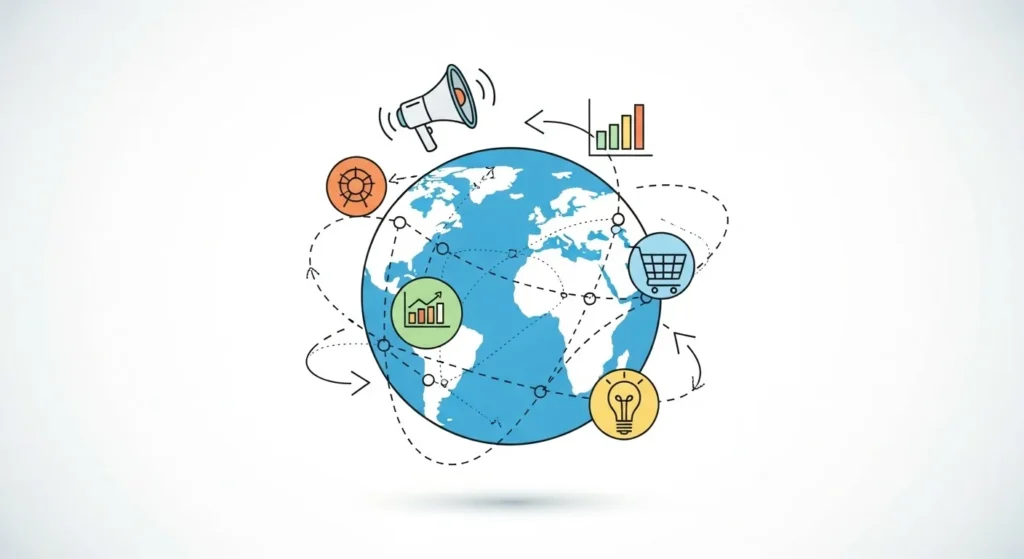
International marketing is the application of marketing principles to satisfy the varied needs and wants of people across national borders. It involves deciding which markets to target, how to enter them, and how to adapt your product, price, place, and promotion (the 4 Ps) to fit local conditions.
Unlike domestic marketing, where you operate within a single language and regulatory framework, international marketing requires you to navigate:
- Cultural nuances: Values, customs, and buying behaviours.
- Economic variance: Purchasing power and currency fluctuations.
- Political and legal barriers: Tariffs, trade agreements, and data privacy laws.
Simply put, it is the art of being “glocal”—maintaining global brand consistency while acting with local relevance.
The 7 Core International Marketing Strategies
Choosing the right entry mode involves striking a balance between risk and control. High-control strategies (like setting up your own office) cost more but protect your brand. Low-control strategies (like licensing) are cheaper but leave your reputation in someone else’s hands.
Here are the seven strategies you need to consider.
1. Exporting (Direct and Indirect)
Exporting is the most common entry point for Small to Medium-sized Businesses (SMBs). It requires the least capital investment and carries the lowest risk, but it also offers the least control over how your product is presented.
- Indirect Exporting: You sell to an intermediary (a trading company) in your own country, who then exports the product. You have zero control, but also zero logistical headache.
- Direct Exporting: You handle the paperwork, shipping, and foreign relationships yourself.
The Reality Check:
Many businesses view exporting as “shipping boxes.” It isn’t. It is a digital marketing challenge. If your distributor in Germany is listing your premium product on a discount site, your brand equity erodes instantly. You need strict contracts governing brand usage.
Note: Direct exporting often offers higher profit margins than indirect exporting, but the administrative burden of customs and compliance is significant.
2. Licensing

Licensing involves granting a foreign company (the licensee) the right to use your intellectual property (patents, trademarks, designs) in exchange for a royalty fee. This is common in manufacturing and fashion.
The Pro: You can expand rapidly with almost zero capital investment.
The Con: You are creating a potential competitor. If the licensee learns your process and launches a rival brand when the contract expires, you have funded your own demise.
Real-World Example:
Disney doesn’t own the factories that make Mickey Mouse t-shirts in Brazil. They license the imagery to local manufacturers who understand the local retail distribution channels better than Disney ever could.
3. Franchising
Franchising is essentially a more formal form of licensing, typically used for service-based businesses. You sell a “business in a box”—branding, operations, marketing collateral, and software.
The key here is standardisation. A McDonald’s burger must taste roughly the same in London as it does in New York. However, the menu must adapt. In India, you won’t find beef (due to cultural preferences), but the “Golden Arches” branding remains identical (for global consistency).
4. Joint Ventures (JV)
A Joint Venture is a partnership where two companies pool resources to create a third, separate entity. This is often politically necessary. In many countries (like China or parts of the Middle East), foreign ownership is restricted, making a local partner mandatory.
Why do it?
- Local Knowledge: Your partner knows who to bribe (metaphorically, or legally via lobbying) and how to navigate bureaucracy.
- Shared Risk: You split the financial burden.
The Danger:
Culture clashes. If your UK-based company values speed and transparency, partnering with a firm that values hierarchy and slow consensus can paralyse decision-making.
5. Foreign Direct Investment (FDI) / Wholly Owned Subsidiary

This is the “All In” strategy. You buy a building, hire local staff, and manufacture or sell directly in the foreign country. You own 100% of the operation.
The Upside: Total control. You protect your technology, your brand voice, and keep 100% of the profits.
The Downside: If the local government changes or the economy crashes, you are left holding the bag.
Strategic Insight:
Tesla typically uses this model. They don’t use dealerships (franchises); they own their showrooms and service centres globally to maintain strict control over the customer experience.
6. Strategic Alliances (Piggybacking)
Unlike a Joint Venture, a Strategic Alliance does not create a new legal entity. It is a handshake deal to help each other.
Example:
An airline alliance (like Star Alliance). United Airlines and Lufthansa coordinate schedules and share lounges, but they remain separate companies. For an SMB, this might look like a UK software company partnering with a US hardware company to bundle their products. You “piggyback” on their existing distribution network.
7. Digital-First Market Entry (The Modern SMB Approach)
This is the strategy most textbooks miss, yet it is the most relevant for 2026. Before you ship a single container, you enter the market digitally.
- Localised SEO: Create a sub-folder (https://site.com/de/) targeted at the new market.
- PPC Testing: Run Google Ads or Meta Ads in the target region to gauge interest and Cost Per Acquisition (CPA).
- Marketplaces: List on Amazon Japan or Mercado Libre (Latin America) to test logistics and returns.
This allows you to gather data on “Product-Market Fit” without the risk of FDI. If the data looks good, you upgrade to Exporting or Licensing.
Translation vs. Transcreation
If you take nothing else from this guide, remember this: Translation is not marketing.
Translation changes words from one language to another. Transcreation adapts the message to maintain the emotional intent.
The HSBC Failure
HSBC spent millions on a campaign with the slogan “Assume Nothing.” In many countries, this was translated directly into the local language. Unfortunately, in several markets, it translated to “Do Nothing.” The bank had to spend millions rebranding itself as “The World’s Local Bank” to repair the damage.

The Right Way (Inkbot Protocol)
We advise clients to hire local copywriters, not just translators. A translator ensures the grammar is correct. A copywriter ensures the product sells.
Comparison: Amateur vs. Pro Localisation
| Feature | The Amateur Approach | The Inkbot Design / Professional Approach |
| Language | Google Translate or a cheap agency. | Native copywriters using Transcreation. |
| Imagery | Stock photos of Western people. | Region-specific photography reflecting local demographics. |
| Colour | Brand standard colours everywhere. | Adjusted colours based on cultural semantics (e.g. White = Mourning in parts of Asia). |
| Dates/Units | US Format (MM/DD/YYYY) globally. | Local formats (DD/MM/YYYY), Metric vs Imperial, Local Currency. |
| Payment | Visa/Mastercard only. | Local wallets (Alipay, WeChat Pay, iDEAL, Boleto). |
The State of International Marketing in 2026
The landscape has shifted. We are seeing a move away from “Globalisation” (one product for everyone) toward “Hyper-Localisation.”
1. The Death of the “Universal” English Website
Data from CSA Research consistently shows that over 75% of consumers prefer to buy products in their native language. In 2026, relying on English as a crutch is a revenue cap. Browsers may auto-translate, but the nuances are lost, and conversion rates plummet.
2. AI-Driven Contextual Adaptation
Tools like DeepL and context-aware LLMs are making localisation faster, but they still lack cultural wit. The winning companies in 2026 are utilising AI for the heavy lifting of product descriptions, while relying on humans for slogans and value propositions.
3. Regulatory Fragmentation
The internet is splitting. GDPR in Europe, CCPA in the US, and the Great Firewall in China mean you cannot have a single data strategy. Your marketing stack must be compliant in every jurisdiction you enter, or you face fines that can exceed your revenue in that region.
The “Country of Origin” Effect

In our work at Inkbot Design, we often see clients ignoring the Country of Origin Effect. This is the psychological bias that consumers exhibit based on the origin of a product.
- German Engineering: Consumers pay a premium for German cars because they perceive them as reliable and of high quality.
- French Fashion: France is associated with the “luxury” attribute.
- Chinese Manufacturing: Historically associated with “cheap,” though this is rapidly changing to “high-tech.”
The Strategic Pivot:
If your country of origin has a negative perception in your target market, you must suppress it in your branding. If it has a positive perception, plaster it on the packaging.
We once collaborated with a high-end audio company from a country not typically known for its electronics industry. We advised them to focus entirely on their specific engineering patents and partner with a UK distributor to establish brand validity, rather than relying on their heritage.
It saved the launch.
If you are struggling to define your visual identity across borders, our branding services can help you align your aesthetic with local expectations.
The Verdict
International marketing is not a box-ticking exercise. It is a complex strategic decision that impacts your supply chain, your legal standing, and your brand equity.
The days of “plant a flag, and they will come” are over. To succeed, you must:
- Start Digital: Test the Waters Before Building the Factory.
- Respect Culture: Transcreate, don’t just translate.
- Choose the Right Mode: Don’t default to exporting if a Joint Venture offers better political cover.
If you are ready to stop guessing and start scaling, you need a partner who understands the terrain.
Would you like us to audit your current international SEO strategy to identify potential opportunities for improvement? Request a quote here.
Frequently Asked Questions (FAQ)
What is the difference between global marketing and international marketing?
Global marketing treats the world as one market with a standardised product (e.g., Apple). International marketing adapts the marketing strategy (price, product, promotion) to specific local markets. The former focuses on consistency; the latter on adaptation.
What is the most effective international market entry strategy for small businesses?
Direct Exporting or Digital-First entry is usually best for small businesses. They require lower capital investment compared to Joint Ventures or FDI. Using marketplaces like Amazon to test foreign demand significantly reduces risk.
Why is culture important in international marketing?
Culture dictates consumer behaviour. A colour, symbol, or phrase that is positive in one country may be offensive in another. Ignoring cultural dimensions (like individualism vs. collectivism) often leads to expensive product failures.
What is the “Country of Origin” effect?
It is the psychological influence that the manufacturer’s country has on a consumer’s perception of a product. For example, Swiss watches are perceived as high quality, while Italian leather is seen as luxurious. Brands leverage or hide this origin based on perception.
How does GDPR affect international marketing?
GDPR (General Data Protection Regulation) restricts how you collect and store data from EU citizens. If you market to Europe, you must have strict consent mechanisms (cookie banners, opt-outs), regardless of where your company is headquartered.
What is transcreation?
Transcreation is the process of adapting a message from one language to another while maintaining its intent, style, tone, and context. Unlike direct translation, it allows for significant changes to copy to ensure it resonates emotionally with the local audience.
Is franchising considered international marketing?
Yes. Franchising is a market entry strategy where you license your business model and brand to a local operator. It enables rapid expansion with minimal capital, but requires strict monitoring to maintain brand standards across borders.
What are the 4 Ps of international marketing?
They are Product (adapted for local regulations/tastes), Price (adjusted for currency/purchasing power), Place (distribution channels relevant to the region), and Promotion (culturally appropriate messaging and media channels).
Why do international marketing campaigns fail?
Most failures stem from a lack of cultural research. Brands often assume their domestic value proposition will work globally. Other causes include poor translation, ignoring local competition, and failing to adapt to local logistical challenges.
How do I choose a target market for expansion?
Conduct a PESTLE analysis (Political, Economic, Social, Technological, Legal, Environmental) for potential countries. Look for markets with high demand, low barriers to entry, and a legal framework that protects your intellectual property.