Why Your Human Audience Is No Longer the Priority
Yesterday, the New York Times dropped a piece that should make every Creative Director in the country reach for the Gaviscon.
Their thesis? Chatbots are the new influencers.
If you aren’t optimising your brand to be the “preferred choice” of a silicon-based agent, you’re essentially in a box that’s rapidly being sealed shut.
It’s a fair point, as far as it goes. But it’s also a terrifyingly narrow view of what branding actually is.
We’ve officially entered the era of the ‘Synthetic Middleman’.
Between your beautiful, hard-won brand identity and your customer stands an AI—probably running on Anthropic’s Claude 4.6 or Gemini 3—that decides whether you’re worth mentioning.
At Inkbot Design, we’re already seeing the fallout. It’s not just about SEO anymore; it’s about “Brand Vibe Alignment.” If the robots don’t “get” you, you don’t exist.
- Synthetic Middleman: AI agents like Claude 4.6 and Gemini 3 now mediate discovery, replacing direct human-brand emotional connections.
- Grey Goo Effect: Over-optimising for bots flattens uniqueness, producing bland, interchangeable brands and commoditised visual identity.
- Bimodal Brand Strategy: Combine bot-optimised utility (semantic data, structured assets) with human-only friction to preserve authenticity.
The Death of the Direct Link
For decades, the goal of design was to forge a direct, emotional connection between a business and a human. We used colour theory, typography, and “the big idea” to bypass the logical brain and hit people in the gut.
That direct line is being cut.
When a user asks their Siri-integrated ChatGPT agent to “find me a sustainable trainer that doesn’t look like a loaf of bread,” they aren’t looking at your carefully curated Instagram grid. They’re getting a verbal summary or a minimalist list generated by an LLM.
The NYT article correctly identifies that brands are now desperate to “woo” these bots. But they missed the “why it matters” for the designers in the room. This isn’t just a marketing shift; it’s a fundamental threat to visual differentiation.
If the bot is the one “seeing” your brand, does your choice of a bespoke serif typeface even matter?
Frankly, it’s a bit of a kick in the teeth for those of us who believe in the craft. We’re moving from a world of “Look at this!” to a world of “Please index this accurately.”
The stakes are higher than just losing a few clicks.
We’re talking about the total commoditisation of brand identity.
If everyone optimises for the same bot logic, every brand starts to feel like a white-label version of itself.
It’s the “AirSpace” of branding—that bland, millennial-pink, minimalist aesthetic that infected every coffee shop from Belfast to Brooklyn—but now, it’s being mandated by an algorithm.
From “Authenticity” to “Algorithmic Empathy”
The NYT piece treats bots like new versions of Kim Kardashian—entities to be bribed or influenced. That’s a lazy metaphor.
The fundamental shift is what some are calling Algorithmic Empathy. It’s the idea that AI influencers and search agents are becoming masters of mirroring human emotion to drive engagement.
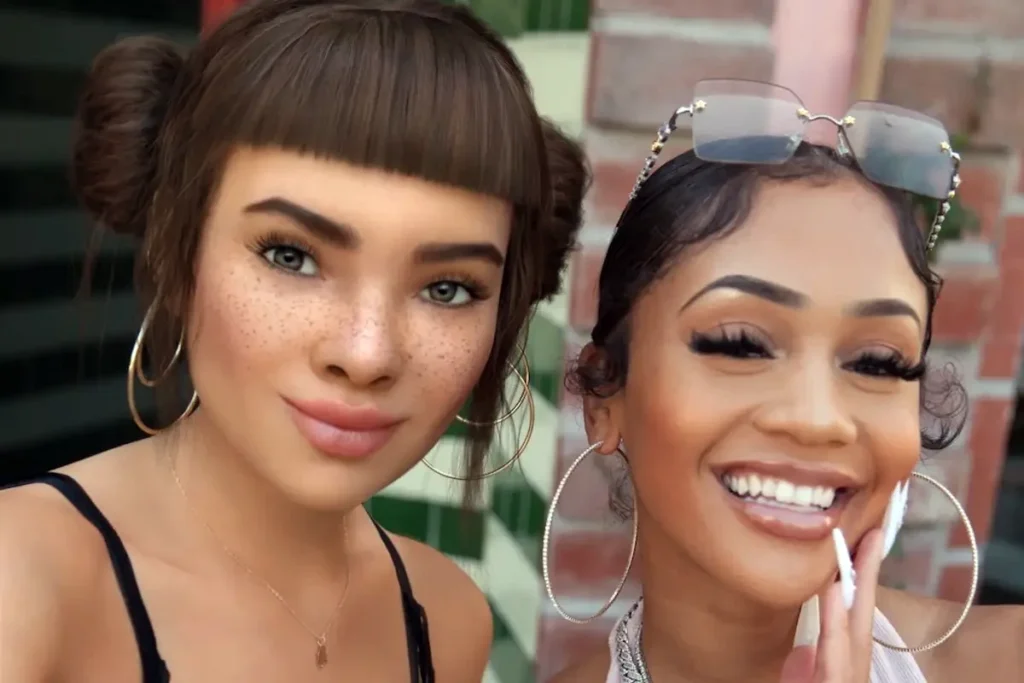
Look at Lu do Magalu or the 2025/2026 iteration of Lil Miquela. These aren’t just 3D models anymore. They’re powered by real-time agentic workflows that allow them to respond to cultural micro-shifts faster than any human marketing team could.
The Rise of the Synthetic Twin
We’re now seeing brands like H&M and Coca-Cola (with their recent AI-driven holiday campaigns) creating “Synthetic Twins” of their brand voice. They aren’t just making ads; they’re building living, breathing datasets that the big LLMs can ingest.
This is where the “Designer-vs-Business” tension gets spicy.
The business owner wants the bot to recommend them. The designer wants the brand to be unique. These two goals are now in direct conflict.
To be “recommendable,” you have to be categorisable. You have to fit the bot’s “context engineering” parameters. To be “unique,” you have to break the mould.
We’re seeing a massive surge in what I call “The Grey Goo Effect.” Brands are so scared of being misinterpreted by the AI that they’re stripping away any edges.
No more provocative copy. No more experimental layouts. Just clean, structured data that a robot can digest without getting a digital stomachache.
Vibe Coding and the 2026 Toolset
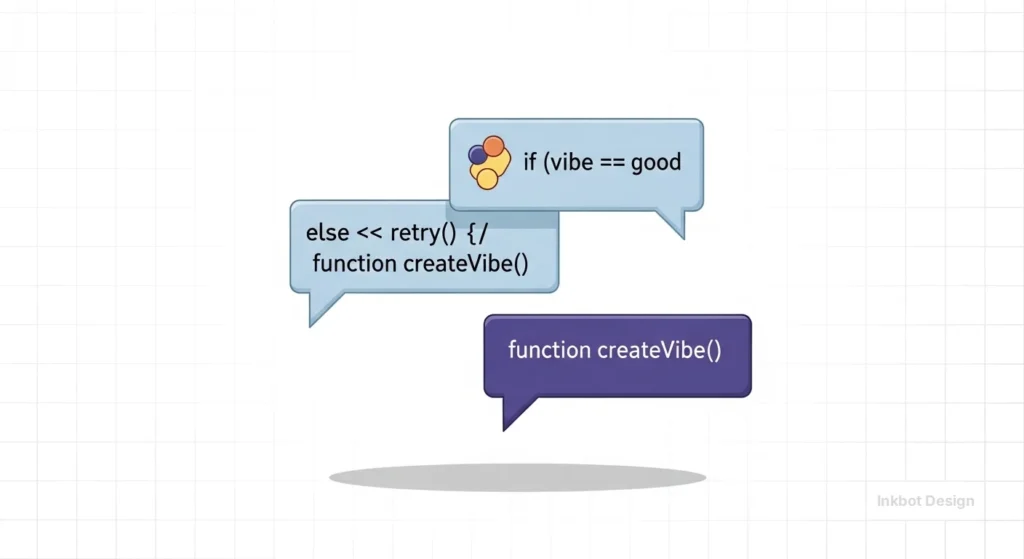
If you want to survive this, you have to master Context Engineering.
It’s not enough to have a brand book in a PDF anymore. You need a “Vector-Ready” brand identity. Tools like Figma’s AI suite and Adobe Firefly 2026 are now allowing us to bake “semantic meaning” directly into our design files.
We aren’t just choosing a hex code; we’re tagging that colour with a “vibe” that the AI understands. “This blue represents trust but with a hint of Northern Irish cynicism.” (Okay, maybe not that specific, but you get the point).
The Meta Andromeda ad system is already prioritising “creative signals” over traditional targeting. It’s looking for visual metaphors that resonate with the bot’s understanding of the user’s current mood.
If your design doesn’t have these signals, you’re invisible.
I Hate This (But We Have To Do It)
Designing for a robot feels dirty.
It’s the antithesis of the “Design as Art” philosophy. We used to care about the “human touch”—the slight imperfection in a hand-drawn logo or the weirdly specific tone of a niche zine.
Now, we’re essentially decorators for a giant database.
The NYT didn’t mention the psychological toll this takes on the creative industry. We’re becoming “Prompt Engineers” and “Data Curators.” It’s a bit soulless, isn’t it?
I’ve seen dozens of brilliant concepts killed recently because “the AI might not categorise that correctly.” It’s enough to make you want to go back to designing pub chalkboards with a piece of actual chalk.
How to Woo the Robot Without Losing Your Soul
So, what do we actually tell our clients at Inkbot Design when they come to us terrified by the latest NYT “bots are everything” headline?
The way I see it, you have to play a double game.
You need a Bimodal Brand Strategy.
One layer of your brand is “Bot-Optimised Utility.” This is your structured data, your clean, semantic HTML, and your predictable, high-contrast visual assets, all of which the AI can easily parse and recommend. This is your “table stakes” for existing in the 2026 economy.
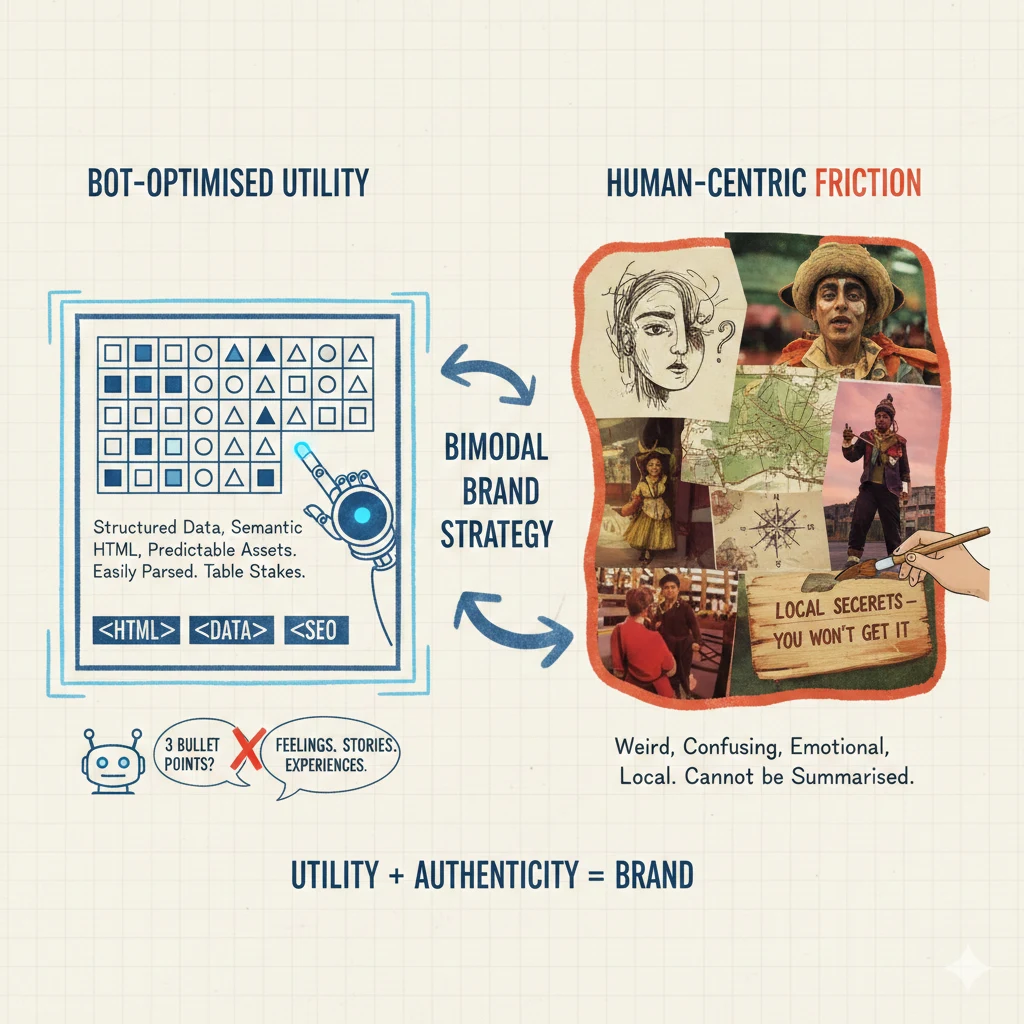
The second layer is “Human-Centric Friction.”
Friction is a good thing. It’s the stuff that a bot can’t replicate. It’s the weird, the confusing, the deeply emotional, and the intensely local.
If a bot can perfectly summarise your brand in three bullet points, you don’t have a brand—you have a product description.
An authentic brand is the stuff that can’t be summarised.
The Inkbot Methodology for 2026:
- Semantic Visual Systems: Use Adobe Firefly and Midjourney v7 to stress-test your visual assets. If you describe your brand to an AI and it spits out something that looks exactly like your competitors, you’ve failed. You need to find the “Visual Delta”—the gap between what the AI expects and what you provide.
- Voice-First Clarity: With the launch of Claude 4.6, conversational AI is getting scarily good at detecting tone. Your brand voice needs to be more than just “professional yet friendly.” It requires a “Persona Anchor.” Give the bot a specific archetype to latch onto.
- The Anti-AI Easter Egg: Start building elements into your design that are explicitly for humans. Small details, hidden meanings, or physical-world experiences that “break” when digitised.
We recently worked on a rebrand for a Belfast-based tech firm, using a specific printing technique that creates a moiré pattern when photographed or scanned by AI.
To the bot, it’s noise. To the human holding the card, it’s a tactile, shifting piece of art.
That’s how you win. You give the robot what it needs to function, but you save the “good stuff” for the people who actually sign the cheques.
Strategic Takeaways
Graphic Designers: Stop worrying about “AI taking your job” and start worrying about “AI taking your style”—learn Context Engineering to ensure your unique visual language is indexed correctly, not averaged out.
Business Owners: If your brand feels “easy” for a bot to understand, it’s probably too dull to build a real community; invest in “brand friction” to stay memorable in a sea of synthetic perfection.
FAQs for a Human Audience
Should I change my logo so it’s easier for AI to ‘read’?
No. If your logo is so complicated that an AI can’t recognise it, you probably have a bad logo anyway. But don’t simplify it just for the sake of a machine. A logo’s job is to be a distinct mental mark for humans, not a QR code for robots.
What is ‘Context Engineering’ in design?
It’s the practice of structuring your brand assets (metadata, Alt-text, semantic HTML, and visual ‘vibes’) so that AI models can accurately categorise your brand’s personality and values without human intervention.
Is human influencer marketing dead?
Hardly. But it’s changing. Human influencers are now “Trust Brokers.” They aren’t there for reach—AI bots handle reach. Humans are there to provide the “Proof of Humanity” that people crave more than ever in 2026.
Will AI ever be able to ‘do’ branding?
It can produce branding—the logos, the colours, the copy. But it can’t do the strategy because it doesn’t have a stake in the real world. It doesn’t know what it feels like to walk into a shop and feel “at home.”
How do I know if my brand has ‘Grey Goo’ syndrome?
Ask an AI to describe your brand based on your website. Then ask it to tell your three biggest competitors. If the descriptions are interchangeable, you’ve got the goo. Get it sorted.
What’s the deal with the new Anthropic Claude 4.6?
It’s a massive leap in “computer use” and “instruction following.” It means AI agents can now navigate your brand’s digital ecosystem much more effectively. If your site is a mess, the bot will just leave—and take your customer with it.
Is “authenticity” still a thing?
“Authenticity” is becoming a bit of a buzzword that means nothing. In 2026, we talk about “Integrity.” Does the brand do what it says it will? Is the human behind the screen actually there? That’s what matters.
Should I use an AI influencer for my brand?
Only if it makes sense for your audience. If you’re a high-end, bespoke tailoring business, a digital avatar is a terrible idea. If you’re a gaming peripheral company, it’s practically mandatory.