A 4,000-Year History of Branding: How to Win the Next Decade
I’ve sat through too many “brand strategy” meetings that were just a collection of buzzwords. “Authenticity,” “synergy,” “disruption”—it’s all noise.
Most entrepreneurs I meet are obsessed with the future, but they have zero understanding of the past. And that’s precisely why they continue to make the same mistakes.
The history of branding isn’t some dusty, academic subject for a pub quiz. It’s a 4,000-year-old playbook of human psychology, commerce, and trust.
Understanding it is the single best way to avoid wasting tens of thousands of pounds on a brand that falls flat.
You’re an entrepreneur. Your time is your most valuable asset. So, this isn’t a history lesson.
This is an arsenal. We’re not just looking at what happened; we’re digging into why it worked and how you can steal these principles for your own business today.
- Branding began as marks of ownership and quality; prove origin to build trust (ancient potter’s mark analogy).
- Differentiation turned marks into trademarks and packaging; avoid becoming a price-only commodity (Industrial Revolution).
- Brands sell identity and narrative, not just features; craft a single, compelling story that customers buy into (Mad Men era).
- Digital age made branding experiential and two‑way; your product and UX are your most powerful brand channels.
- Modern branding demands purpose and consistent action; authenticity is proven by behaviour, not performative gestures.
What Are We Even Talking About?

Most founders are confused. They use “logo,” “brand,” and “brand identity” interchangeably. This is a critical and costly mistake.
- A logo is a mark. A symbol. It’s a visual shortcut.
- A brand is the gut feeling someone has about your business. It’s the sum total of every single interaction—your product, your customer service, your price, your smell, your logo. It’s the reputation you earn.
- A brand identity is the strategic toolkit you create to influence that gut feeling. It’s the logo, yes, but it’s also the colour palette, the typography, the tone of voice, the photo style.
Understanding the history of branding is understanding how these three elements came together, split apart, and evolved. It’s the story of how we moved from a simple mark of ownership to a complex system for managing reputation.
Building a comprehensive brand identity is the strategic work that bridges the gap between your logo and your brand.
Let’s dig in.
Chapter 1: The Ancient World (Circa 2700 BC – 500 AD)

The Core Principle: Ownership, Origin, and Quality
Thousands of years ago, the problem was simple: “How do I prove this is mine?” and “How do I prove I made this?”
The word “brand” itself originates from the Old Norse “brandr,” meaning “to burn.” This was quite literal.
Farmers used a hot iron to burn a mark onto their livestock. This wasn’t about “lifestyle” or “emotional connection.” It was a blunt instrument for “This cow is mine. Don’t steal it.”
But a more subtle form was already emerging.
- Potter’s Marks: Archaeologists discover 4,000-year-old pottery from the Indus Valley bearing the potter’s personal seal.
- Roman Signacula: Roman brick-makers stamped their signaculum (a small seal) into their bricks. This wasn’t just pride. It was accountability. If a Roman aqueduct collapsed, the authorities could trace the shoddy bricks right back to the maker.
- Egyptian Masons: Even the stones of the pyramids were marked with symbols indicating the work gang that had quarried them.
The Modern Takeaway for Entrepreneurs:
This is the absolute bedrock of branding: Accountability and Origin.
In an era of anonymous dropshippers and AI-generated content, proving you’re a real person who stands behind your product is a significant advantage.
Your “About Us” page isn’t fluff; it’s the modern-day potter’s mark. Your personal guarantee, your “Made in Manchester” stamp, your signature on a thank-you card—this is ancient branding in practice.
Before you have a “brand,” you must have a mark. A sign that you were here, and you’re not afraid to put your name on your work. It’s the foundation of trust.
Chapter 2: The Industrial Revolution (1760s – 1900s)
The Core Principle: Differentiation in a Sea of Sameness
For centuries, this “mark of origin” was enough. You bought your flour from the local miller, your beer from the local brewer. You knew them by name.
Then, everything changed.
The Industrial Revolution brought mass production. Suddenly, goods were being made in factories, not by artisans. They were shipped hundreds of miles away and sold in general stores by people who had never met the maker.
This created a massive new problem: choice paralysis and mistrust.
Imagine walking into a store in 1880. There are ten identical barrels of soap, all looking, smelling, and feeling the same. They are “commodities.” How do you choose?
This is where branding exploded.
Canny business owners realised they needed to differentiate. They started packaging their goods in unique containers. They gave them names. They registered trademarks to protect those names and logos from copycats.
- Pears Soap (1789): Andrew Pears didn’t just sell soap. He sold Pears soap. He stamped his name on it, used transparent packaging (a radical idea), and associated it with purity and high society.
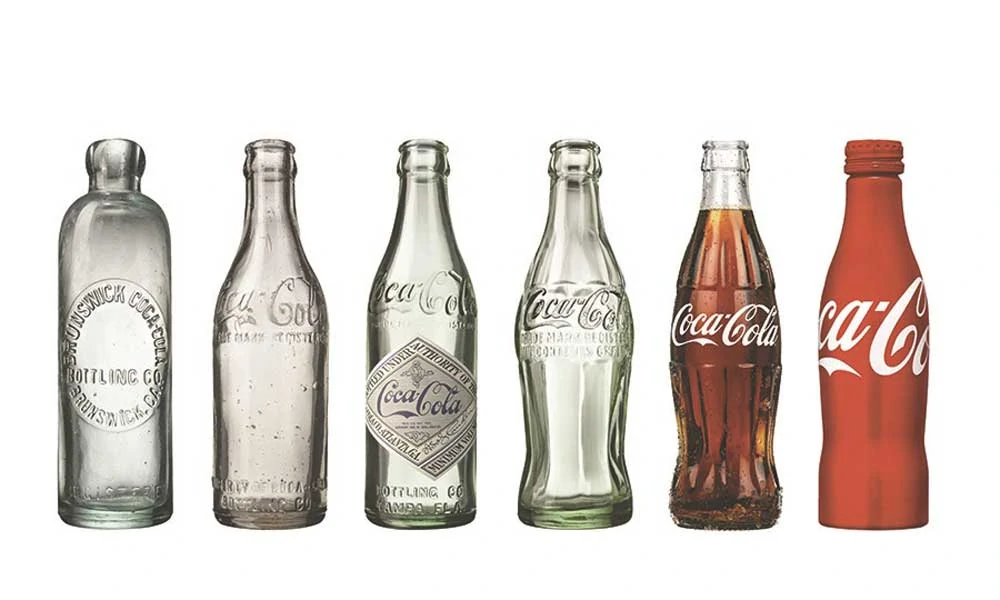
- Coca-Cola (1886): Not just “soda.” It was Coca-Cola, with a unique script logo and, later, that iconic, patented contour bottle you could recognise in the dark, even when broken.
- Quaker Oats (1877): The first registered trademark for a breakfast cereal. They chose the “Quaker Man” image to project values of honesty, integrity, and purity—something a commodity bag of oats could never do.

This era cemented the brand as a tool for consistency and trust at scale. The name “Heinz” on a bottle of ketchup wasn’t just a name; it was a promise. It promised that the ketchup you bought in London would be the exact same quality as the one you bought in New York.
The Modern Takeaway for Entrepreneurs:
If your product or service is indistinguishable from your competitors, you are not a brand. You are a commodity. And as a commodity, you can only ever compete on one thing: price.
This is the trap so many small businesses fall into. They think “marketing” is just shouting about features. No. Branding is the art of not being a commodity. What is your “contour bottle?” What is your “Quaker Man?” What part of your service, packaging, or process is so uniquely you that it cannot be easily copied?
The Brand vs. Identity vs. Logo Breakdown
I have this conversation daily. Here’s a table to print out and stick on your wall.
| Concept | What It Is | Primary Function | An Analogy |
| Logo | A visual symbol. | Recognition. | Your face. |
| Brand Identity | The toolkit of assets. | Expression. | Your clothes, your voice, your haircut, your business card. |
| Brand | The reputation. | Perception. | What people say about you when you’re not in the room. |
You control your logo and your identity. You can only influence your brand. The Industrial Revolution was the first time businesses had to manage all three systematically.
Chapter 3: The Mid-Century Mad Men (1950s – 1980s)
The Core Principle: Branding as Psychology and Narrative
After two world wars, the Western world entered a new age of prosperity. Mass production had been perfected. The market was flooded with good-quality products.
The old promise—”Our product is consistent and reliable”—was no longer a differentiator. It was the baseline.
The new problem wasn’t “Which one can I trust?” but “Which one is for me?”
This is the “Mad Men” era. Advertising agencies on Madison Avenue realised they weren’t just selling products; they were selling lifestyles. Branding shifted from focusing on the product’s features to catering to the customer’s emotions.
- Volkswagen (1959): The “Think Small” campaign. While other car ads showed flashy, powerful land yachts, VW celebrated being small, simple, and reliable. It didn’t sell a car; it sold a counter-culture identity. It was for the smart, practical, unpretentious consumer.
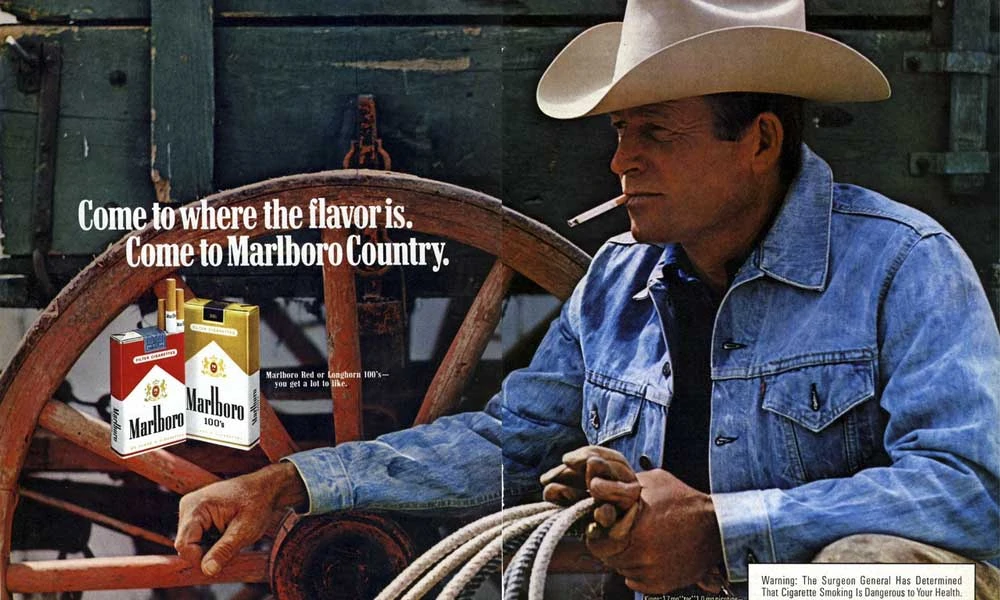
- Marlboro Man (1954): Marlboro cigarettes were originally marketed to women. The brand was failing. They repositioned it using the “Marlboro Man”—the rugged, individualistic cowboy. Sales skyrocketed 3000%. They weren’t selling tobacco; they were selling a potent fantasy of American masculinity.
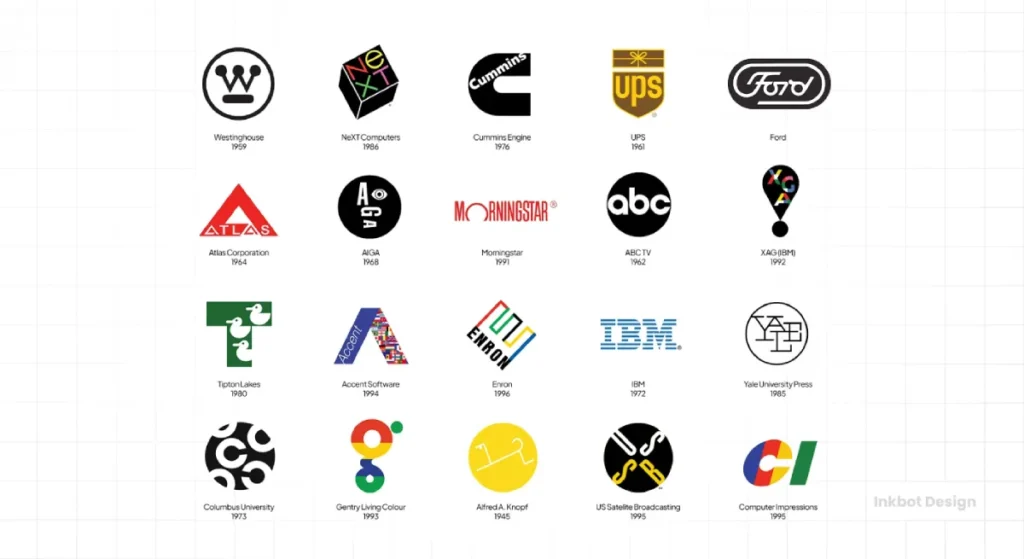
- The Rise of Corporate Identity: This is when design legends like Paul Rand (IBM, UPS, ABC) and Saul Bass (AT&T, Minolta) emerged. They understood that a company’s logo, stationery, packaging, and advertisements should all convey a single, unified voice.
This era shifted branding from a sales function (product differentiation) to a marketing function (emotional connection). The brand became a story, a narrative, a personality.
The Modern Takeaway for Entrepreneurs:
Features are easy to copy. A story is not.
Your customers aren’t just buying your product; they’re buying a better version of themselves. What story are you telling them? Does your brand make them feel smarter? More secure? More adventurous? More sophisticated?
If you can’t answer the question “What does my brand stand for?” in a single, compelling sentence, you’re stuck in the 1920s. The mid-century masters taught us that you’re not selling what you make; you’re selling what you stand for. You’re selling why it matters.
The Evolution of Branding (A Timeline)
Here’s the entire journey in a nutshell. Notice how the core business impact shifts from the tangible to the intangible.
| Era | Key Principle | Key Tools | Core Business Impact |
| Ancient | Ownership & Origin | Seals, Stamps, Symbols | Accountability & Legal Protection |
| Industrial | Differentiation & Trust | Trademarks, Packaging, Logos | Building Trust at Scale |
| Mid-Century | Psychology & Narrative | Advertising, Corporate Identity | Emotional Connection & Loyalty |
| Digital | Interaction & Experience | Websites, Social Media, UX | Building Communities & 24/7-Access |
| Modern | Purpose & Transparency | Values, Action, Co-Creation | Proving Authenticity & Values |
Chapter 4: The Digital Revolution (1990s – 2010s)

The Core Principle: Branding as a Two-Way Conversation
And then, just as corporations had perfected their slick, top-down broadcast messages, the internet shattered the whole model.
The Digital Revolution handed the megaphone to the consumer.
Suddenly, your “brand” wasn’t what your multi-million-pound TV advert said it was. Your brand was:
- A scathing 1-star review on Amazon.
- A viral video of your product failing.
- A “rant” page set up by a disgruntled customer.
- Your clunky, slow-loading, 1998-era website.
- How long did it take your “support” team to reply to an email (or if they even did)?
Branding ceased to be a monologue and became a dialogue. Or, more accurately, a chaotic, 24/7/365, global shouting match.
Companies like Amazon and Google didn’t build their brands on clever ads. They built them on utility and experience. Amazon’s brand is one-click ordering and fast delivery. Google’s brand is a clean, white page that instantly provides the right answer. Their brand is the service itself.
This is also the era in which your visual identity must work harder than ever. Your logo didn’t just sit on a letterhead. It had to be a tiny 16×16 pixel favicon in a browser tab. It had to be an app icon on a phone screen. It had to be a profile picture on Twitter.
This demanded simplicity, scalability, and instant recognition. The “responsive logo” was born—a mark that could adapt from a giant billboard to a tiny smartwatch screen.
The Modern Takeaway for Entrepreneurs:
Your brand is no longer what you say it is. Your brand is what you do.
Your customer’s experience is your most important marketing channel. You can have the most beautiful logo in the world, designed by the most expensive agency. However, if your website is difficult to use, your customer service is unprofessional, and your shipping is slow, that is your brand.
In the digital age, your brand is the user experience. Period. This is where professional branding services become critical, ensuring every single touchpoint—from your website’s UI to your automated email signature—is consistent, professional, and works.
Chapter 5: The “Purpose” Era (2010s – Today)
The Core Principle: Branding as Values and Action
Which brings us to today.
We’ve reached “peak stuff.” Consumers aren’t just overwhelmed with choice; they’re overwhelmed with noise. They are cynical. They’ve seen every marketing trick. They’ve heard every empty promise.
Now, the defining question is: “Why should I care?”
This is the era of “Purpose-Led” branding. Consumers, especially younger ones, don’t just want to buy from you; they want to buy into you. They want to know what you stand for.
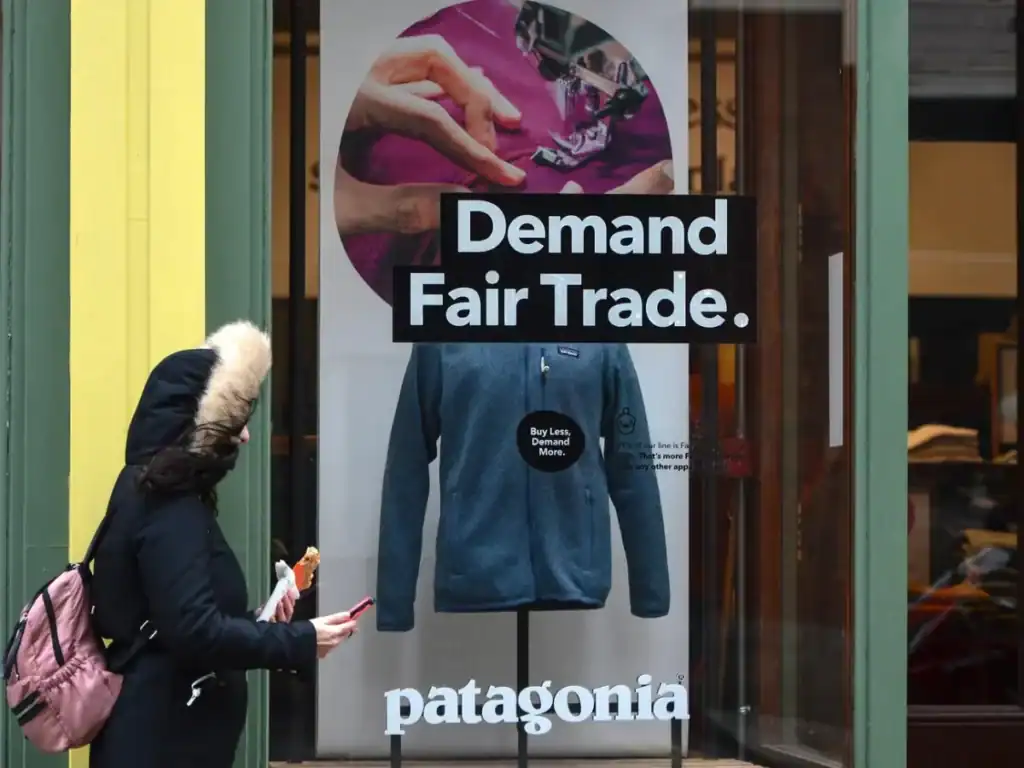
- Patagonia: The gold standard. Their brand isn’t “we sell jackets.” Their brand is “We’re in business to save our home planet.” They back it up by donating 1% for the planet, suing the government to protect public lands, and running “Don’t Buy This Jacket” campaigns. Their actions are their brand.
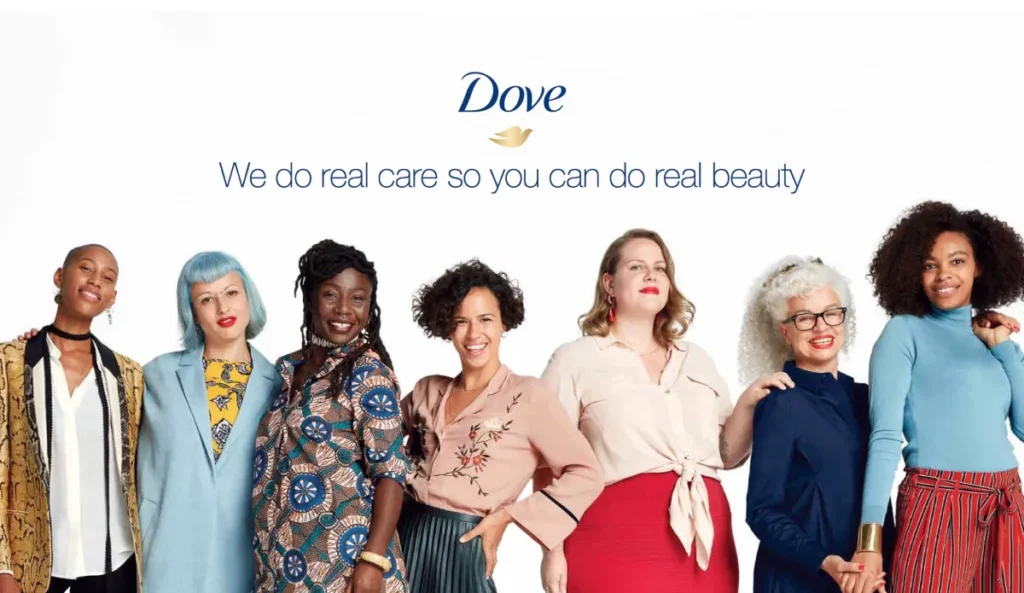
- Dove: The “Real Beauty” campaign was a masterstroke. It shifted the conversation from the product (soap) to a powerful social mission (challenging toxic beauty standards).
But this is also the era of the “Authenticity Trap.”
“Authenticity” has become the most inauthentic word in marketing. Companies try to “perform” authenticity. They slap a rainbow flag on their logo for one month a year or post a black square on Instagram, then revert to their old ways.
Consumers can smell this from a mile away. It’s called brand washing, and it can damage your reputation just as quickly as a poor product.
I once worked with a founder who insisted his company’s archives—old photos, the original founder’s letters—were just “clutter.” I spent a day digging through them. We found the original company mission, written on a typewriter in 1953, which stated, “To provide an honest product at an honest price.
We didn’t need to invent a “purpose.” It was right there. We just had to clean it off and put it back at the centre of the business. That is real authenticity. It’s not something you invent; it’s something you excavate.
The Modern Takeaway for Entrepreneurs:
Stop trying to be authentic. Just be consistent and be clear.
You don’t need to “save the planet” to have a purpose. Your purpose can be “making the most ridiculously reliable accounting software for freelancers.” Your purpose can be “running the cleanest, friendliest coffee shop in this postcode.”
Your “purpose” is the answer to three questions:
- What do we do?
- Who do we do it for?
- Why does it matter to them?
Don’t tell people your values. Show them. Live them. Embed them in your service, your hiring, your products. The rest will follow.
So, What Have We Learned? (A Summary for the Busy Founder)
The history of branding isn’t a straight line. It’s a spiral. We keep revisiting the same core human needs with new technology.
- It starts with Ownership & Quality. (Ancient potters)
- It scales with Consistency & Trust. (Industrial Revolution)
- It deepens with Psychology & Story. (Mad Men Era)
- It becomes Interactive & Experiential. (Digital Age)
- It solidifies with Purpose & Action. (Today)
Your small business has to do all five of these, all at once.
You need a clear mark (your logo). You need consistency (your brand identity). You need a story (your marketing). You need a seamless experience (your website and service). And you need a reason for existing (your purpose).
That’s the job. It’s big, it’s complex, and it’s never “done.”
This history is your blueprint. Don’t get obsessed with the 2025 “purpose” stuff if you haven’t even nailed the 1880s “consistency” part. Don’t try to tell a 1960s “story” if your 2000s “website experience” is a disaster.
Start from the beginning. Build a solid foundation. And for God’s sake, don’t just copy your competitors. Dig into your own history. Find your own purpose.
Your Next Move
Frankly, most business owners are too close to their own “brand” to see it clearly. They’re bogged down in the day-to-day, and they can’t see the historical patterns. They’re still making 19th-century mistakes in the 21st century.
If you’ve read this far, you’ve just done a 4,000-year deep-dive. You probably see gaps in your own strategy. That’s a good thing. It’s the first step.
The next step is deciding what to do about it. Smart founders know when to stop doing it themselves and bring in a specialist who has seen this all before.
If you’re ready to turn your “mark” into a “brand” and your “brand” into a coherent, powerful brand identity that actually works, let’s talk. At Inkbot Design, we build brands from the ground up, based on strategy, not just pretty pictures.
Explore our branding services to view the toolkit. If you’re ready to get started, request a quote, and we’ll initiate the conversation.
Branding History: Frequently Asked Questions
What is the simplest definition of branding?
It’s the art of managing reputation. It’s the deliberate effort to shape the public’s perception of your business.
Who invented branding?
No single person. It’s an ancient, evolved practice. You could thank the first farmer who burned a mark on his cattle, or the first potter who stamped her seal on a vase.
What’s the difference between a brand and a logo?
A logo is a visual mark (like your face). A brand is the reputation you have (what people say about you). Your logo is a tool to help people remember your brand.
Why did branding become so important during the Industrial Revolution?
Mass production. For the first time, identical, competing products flooded the market. A “brand” (like Pears Soap) was the only way for a consumer to distinguish between them and trust the quality.
What is a “brand identity”?
How did the “Mad Men” era change branding?
It shifted the focus from the product’s features to the customer’s feelings. Branding became about selling a lifestyle, a story, and an emotional connection (e.g., the Marlboro Man).
How did the internet change branding?
It turned branding from a one-way broadcast (a TV ad) into a two-way conversation (a customer review). Your brand became your user’s experience—your website, your support, your social media replies.
What is “purpose-led” branding?
It’s a modern strategy where a brand is built around a central mission or set of values (e.g., sustainability, social justice) beyond just making a profit. It’s about what you stand for.
Why do so many startups fail at branding?
They confuse it with just a logo. They lack a clear strategy, are inconsistent, and attempt to copy larger, established brands instead of finding their own unique voice.
What is the most important branding principle from history?
Trust. Every single era, from a potter’s mark to a corporate purpose, is just a different mechanism for building and scaling trust with a customer.
Is “authenticity” important in branding?
Yes, but “authenticity” is just a buzzword for consistency. You are “authentic” when your actions consistently match your promises. Don’t say you’re authentic; just be consistent.
Where should I start with my own brand?
Start with strategy, not design. Answer these questions: 1) What do I do? 2) Who is it for? 3) Why should they care? Only then should you start thinking about logos.