Sustainability Branding: Build an Identity That Survives Scrutiny
Most sustainability branding advice stops at earthy colours and vague promises. That approach now carries regulatory risk. Sustainability branding is a claims-governance problem expressed through design: the identity must make a genuine environmental choice specific, comprehensible and verifiable. This guide shows UK professional services leaders how to build one that survives scrutiny.


On this page7 min left
Picture the moment a rebrand goes wrong, because it always looks the same.
A firm signs off on a green wordmark and a line like “responsible by design,” and nobody in the room asks what “responsible” refers to or who could verify it.
The visual is confident. The claim underneath it is empty. That gap: a strong cue resting on an unproven claim, is now the most expensive mistake in sustainability branding, and the one most rebrands make first.
In an EU-wide screening of 344 environmental claims, consumer-protection authorities found that 57.5% did not provide enough information to assess their accuracy, and 59% lacked easily accessible evidence or qualification.
Read that as a design brief, not a compliance statistic.
Most of those claims failed not because the businesses were dishonest, but because the identity conveyed more confidence than the evidence supporting it could sustain.
Sustainability branding, done properly, is one of the disciplines a serious brand operating system has to govern, because the brand's claims are now held to the standard your firm sells to its own clients.
What Sustainability Branding Actually Is
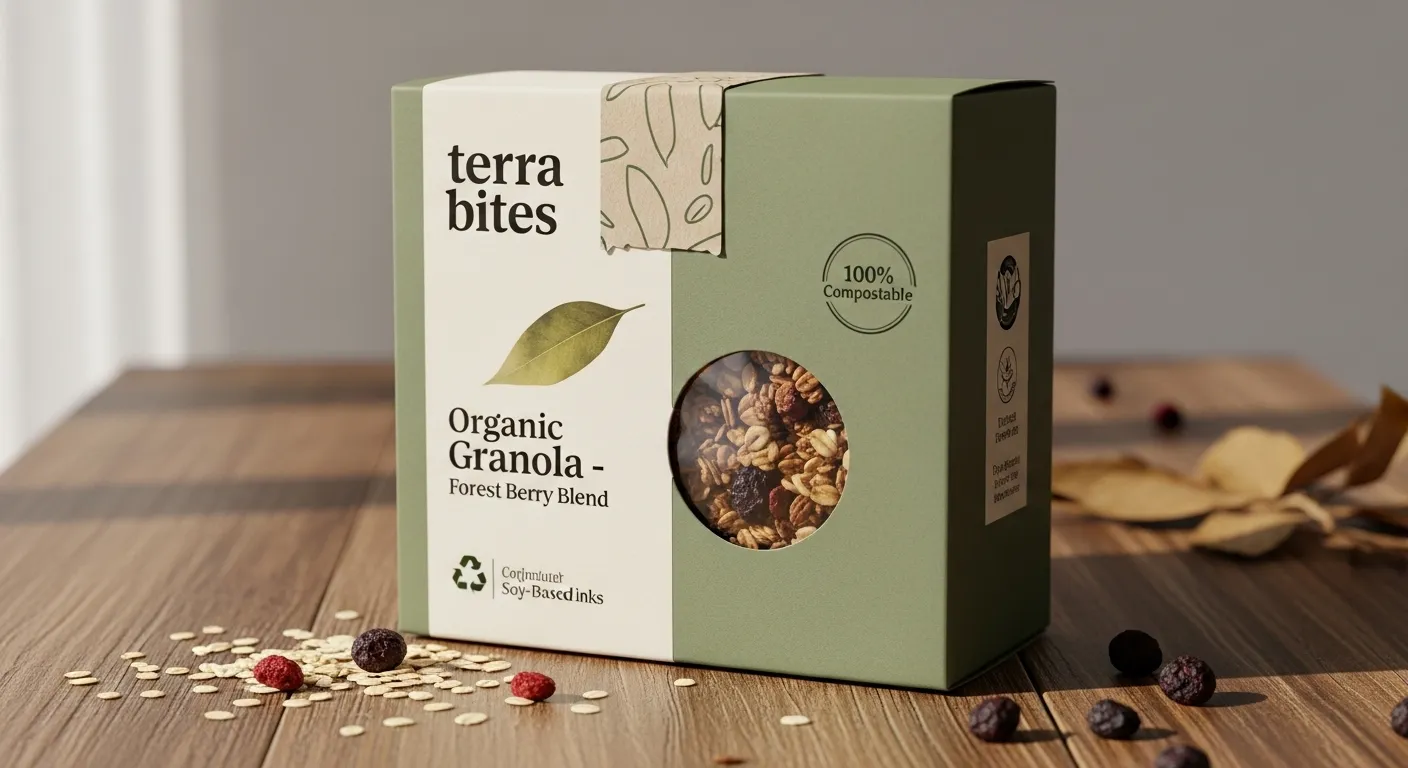
Sustainability branding is the practice of making a brand's real environmental choices specific, comprehensible and verifiable through its identity. It is not a visual style. It is a claims-governance problem expressed through design, and the design succeeds only when a sceptical reader can understand and check what is being claimed.
- It must reflect a genuine operational choice, not an aspiration dressed as fact.
- It must make that choice specific enough to be understood without a footnote.
- It must avoid implying more environmental virtue than the evidence can carry.
Sustainability branding is the practice of making a brand's real environmental choices specific, comprehensible and verifiable through its identity — not merely making it look green.
Why the “Green Look” Is the Weakest Part of Your Identity
Intelligent designers reach for the green aesthetic for a good reason: it reads instantly.
Earthy palette, leaf motif, recycled-paper texture — the audience decodes “environmental” in under a second, and for a consumer product on a shelf, that shorthand has real commercial value.
The instinct is sound. The problem is what the shorthand now triggers.
A single green logo or a phrase like “better for the planet” can leave a far stronger impression than the business has actually proven. That is precisely where regulators are looking.
In June 2026, the UK Advertising Standards Authority (ASA), the body that regulates advertising claims, reported that environmental claims appeared in only around 1% of the advertisements it analysed — but the claims that did appear were often absolute or insufficiently qualified.
The risk is not that brands say too much. It is that a small visual or verbal cue implies far more than the evidence supports.
For a professional services firm, the exposure is sharper because you sell judgement.
A 90-partner consultancy that lets a vague “sustainable” badge onto its tender documents is making an unverified claim in the exact register clients pay it to get right.
The green look does not just fail to help — it invites the one scrutiny a firm in a growth or acquisition phase cannot afford.
This is the same failure mode that sits behind most accusations of greenwashing: not a lie, but a cue that outruns its proof.
The 3 Tests a Sustainable Identity Has to Pass
Every element of a sustainable identity — a claim, a badge, a colour, a strapline — should pass three tests before it ships. Miss the sequence, and you get a cosmetic result that looks credible until someone asks a question.
Test one: Is it a real operational choice?
Before the identity says anything, the choice behind it has to exist.
Audit what the firm actually does — energy, travel policy, supplier standards, the things already true — and build the claim on those, not on intent.
A claim with no operational fact underlying it is the failure of the EU sweep, measured as confidence without substantiation.
Test two: Is the claim specific and comprehensible?
“Sustainable” is not a claim; it is a category. The Carbon Trust, the carbon-measurement body, published research in March 2026, finding that 66% of consumers said carbon-footprint labelling is good for consumer choice, and 60% said they were more likely to trust a product carrying a carbon-footprint label than one without.
Describe those as Carbon Trust survey findings rather than universal behaviour — but the direction is clear. People increasingly trust the measurable statement over the decorative one.
The design job is making invisible information visible: what is measured, for which service, verified by whom.
Test three: Does the identity imply only what the evidence supports?
This is the test; the green aesthetic fails. A badge, a colour, a masterbrand strapline all imply — and the more complex the offering, the more dangerous a broad implication becomes.
The ASA's December 2025 review of travel-agent advertising found that only 1% of travel agents made environmental claims. Still, of those that did, 67% appeared likely to be non-compliant — usually because vague language failed to explain the boundaries of the claim.
A firm operating across many services carries the same trap: one unqualified claim over a complex reality.
The Default Approach | What It Costs | The Better Approach | Why |
|---|---|---|---|
Choose a green palette first | Implies a position the firm can't prove | Audit the operational fact first | The claim rests on something real |
“Sustainable” as a strapline | Category, not claim — invites scrutiny | Name the specific measure | Specific claims are verifiable |
One masterbrand green badge | Implies virtue across every service | Qualify per service where it applies | Matches claim to evidence |
Design system, then claims | Compliance risk discovered late | Claims system, then the visual system | Governance leads design |
What Changes and What to Design For Now
The next stage of sustainable branding will be shaped as much by compliance as by creativity.
The European Union's Empowering Consumers for the Green Transition Directive applies from 27 September 2026, and it raises the bar on consumer-facing environmental claims and sustainability labels — requiring clearer substantiation and more credible verification.
It reaches existing packaging and materials already in the market, not only newly designed ones.
A sustainable identity now needs a claims system, not just a visual system: brand teams have to know which statements are ambitions, which are factual claims, and which require third-party verification.
That does not mean sustainability is losing commercial weight.
Brand Finance, the brand-valuation consultancy, reported in March 2026 that sustainability's influence on consumer choice had stabilised after declining across several industries in 2025 — evidence of limits to the ESG backlash rather than the disappearance of sustainability as a brand concern.
The credible reading sits between the two slogans: not “everyone now demands sustainable brands,” and not “nobody cares any more.” Influence varies by sector and buyer, and scepticism of broad promises is rising.
For a professional services firm, the move is to stop presenting sustainability as a standalone moral badge and tie it to what the client already buys — lower risk, resilience, continuity of delivery.
Demonstrably lower operational risk” does more work in a consultancy's pitch than “responsible” does, for the same reason a specific claim beats a category: it names something the buyer was already paying to be sure of.
You would object that a services firm has few hard environmental metrics to label. Correct — so the discipline for you is subtraction. Make fewer claims, qualify each one, cut every cue you can't stand behind.
The Verdict
The green palette was never the point, and treating it as such now creates risk.
A sustainable brand identity earns its place by making a genuine choice specific, comprehensible and verifiable — and by implying nothing the evidence cannot carry.
Do that, and the identity survives the tender questionnaire, the due diligence review, and the regulator. Skip it, and a single confident cue does the damage.
Start with one action today: take every environmental claim and cue in your current brand — every badge, strapline and green flourish — and sort each into ambition, factual claim, or verified claim. The ones that fit none of those categories are the ones to cut first.
If you want that done rigorously before your rebrand goes live, request a free Brand Equity Audit™. This structured diagnostic identifies exactly where the brand is losing commercial ground, and which claims won't survive scrutiny.
Frequently asked questions
What is sustainability branding?
Sustainability branding is the practice of making a brand's real environmental choices specific, comprehensible and verifiable through its identity. It is a claims-governance discipline, not a visual style — the design succeeds only when a sceptical reader can understand and check what is being claimed, rather than simply recognising the brand as “green.”
Is using the colour green in branding greenwashing?
No — a green palette is not greenwashing by itself. It becomes a risk when the colour or an accompanying cue implies an environmental claim that the business cannot substantiate. The ASA's concern in 2026 was not aesthetics but claims that were absolute or insufficiently qualified relative to the evidence behind them.
How is sustainability branding different from a green rebrand?
A green rebrand changes how a brand looks; sustainability branding changes what a brand can credibly claim. The first is a visual exercise. The second starts from a real operational choice, makes that choice specific, and ensures the identity implies only what the evidence supports, which is why claims work should precede design work.
Does the EU green claims directive affect UK firms?
Yes, where they market to EU consumers. The Empowering Consumers for the Green Transition Directive applies from 27 September 2026, sets stricter substantiation and verification requirements for environmental claims and labels, and covers existing packaging already in the market, not only newly designed products and materials.
Do consumers still care about sustainability in 2026?
Yes, though less uniformly than before. Brand Finance reported in March 2026 that the influence of sustainability on consumer choice had stabilised after declining in 2025 — evidence against a total ESG backlash. Influence now varies by sector and buyer, and audiences are more sceptical of broad, unqualified promises.