
How to Run a Competitive Positioning Analysis That Survives a Fast Follower
Six weeks after a mid-market consultancy launches its “we’re the boutique alternative to the Big Four” positioning, a genuinely larger competitor runs the same line in a pitch – and does it with more logos.
The position was real. It simply wasn’t defended.
That is the failure mode most competitive positioning analysis produces: a claim that is true on the day you make it and worthless the moment a rival with a bigger balance sheet decides to say the same thing.
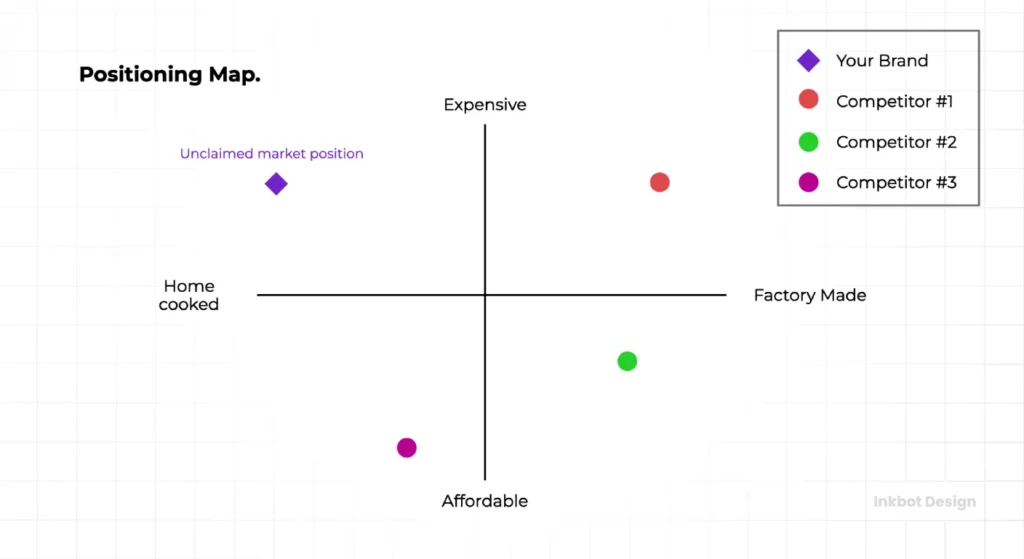
The reason is sequence. Most analysis starts by mapping competitor features, hunts for a gap nobody occupies, and plants a flag there.
But a gap nobody occupies is usually a gap nobody can defend – and for professional services firms, where the “product” is trust and named partners rather than a feature set, an undefended position is a liability dressed as a strategy.
The fix is to change what you map, and in what order. This connects directly to the broader discipline of brand positioning, of which competitive analysis is one facet.
- Map the buyer's current workaround from recorded buyer transcripts, not competitor features.
- Name the specific emotional friction that makes changing the workaround feel risky; address it in first impressions.
- Define compound defensibility: stack evidence, narrative and operational commitments rivals cannot cheaply copy.
- Choose the position last and commit operationally; a claim without proof will be copied by a fast follower.
How a Competitive Positioning Analysis That Holds Is Achieved
A competitive positioning analysis that survives a fast follower is achieved in three stages: mapping the buyer’s current workaround, identifying the emotional friction that keeps that workaround sticky, and defining the firm’s compound defensibility – the stacked commitments a rival cannot cheaply copy. The chosen position comes last, not first.
- Stage one establishes what buyers currently do instead of hiring a firm like yours – the real competitor is often inertia, not a named rival.
- Stage two names why that workaround persists emotionally, because friction, not features, is what a position must overcome.
- Stage three defines defensibility as a stack of evidence, narrative, and operational commitment, not a single differentiating claim.
Competitive positioning analysis is the process of mapping buyer behaviour, rival claims, and defensibility to choose a market position that rivals cannot cheaply copy.
What You Need in Place Before You Start
You need three things before a single competitor is mapped, and most firms skip all three.
First, access to actual buyers – not your account managers’ impressions of buyers, but recorded words from won and lost pitches.
Second, honesty about who the real alternative is.
Forrester’s 2026 State of Business Buying, drawn from more than 17,500 global buyers, reports that the average buying decision now involves 13 internal stakeholders and 9 external participants, with procurement acting as a decision-maker 53% of the time.
Your competitor is rarely one rival firm. It is a committee weighing risk.
Third, you need to accept that buyers will not take your positioning on faith. Forrester’s 2026 research found that 94% of business buyers use AI during the buying process but validate its output against trusted external sources.
A position asserted without proof is now checked within minutes. Enter this exercise ready to evidence every claim, or do not enter it.
Stage One: Map the Buyer’s Current Workaround
The first thing to map is not a competitor – it is what the buyer does today instead of hiring you.
A £30m engineering consultancy losing pitches to “no decision” is not competing against another consultancy; it is competing against the client’s internal team that is muddying through.
Get this wrong, and every downstream choice targets the wrong opponent.
You know this stage is done when you can state, in the buyer’s own words, the specific workaround they defend.
Gartner, from a survey of 632 B2B buyers conducted in August–September 2024, reported that 61% of B2B buyers prefer a rep-free buying experience – meaning the workaround increasingly is self-service evaluation, not a conversation you control.
The failure mode here is mapping the workaround you wish existed. If your notes describe the buyer’s behaviour in your language rather than theirs, you have recorded a hope, not a finding.
Stage Two: Name the Emotional Friction That Makes It Sticky

A workaround persists because changing it feels risky, not because buyers haven’t heard of you. This is the layer that feature-led analysis misses entirely.
The £30m consultancy’s prospect keeps muddling through internally because hiring an external firm means admitting to their board they couldn’t solve it in-house – that is the friction, and no feature list dissolves it.
You know this stage is done when the friction is emotional and specific, not logistical. “Too expensive” is rarely the real friction; “I’ll look like I wasted budget if this fails” usually is.
Gartner also found that 73% of B2B buyers actively avoid suppliers who send irrelevant outreach, and 69% report inconsistencies between website information and what sellers tell them.
Friction compounds when your own signals contradict each other.
The failure mode is treating friction as an objection to overcome in a pitch rather than a truth your positioning must speak to from the first impression.
“Buyers do not resist your firm because they misunderstand your services. They resist because switching from what they do today carries a personal risk that your positioning has never once acknowledged. Name that risk in your position, and you stop selling against features you were never really competing with.”
Stage Three: Define Compound Defensibility, Not a Single Claim
Defensibility is a stack, not a sentence. A single differentiating claim – “most senior team,” “fastest turnaround” – is copied by lunchtime.
Compound defensibility means the position rests on commitments a rival would have to restructure their firm to match: a named partner on every engagement and a published methodology, and a fee model that assumes it.
Each is copyable alone. Stacked, they are not.
You know this stage is done when copying your position would require a competitor to change how they actually operate, not just how they market.
Interbrand’s Best Global Brands 2025 reported the top 100 brands reached $3.6 trillion in total value, up $150 billion year on year, and applies a brand-strength threshold of 50 or above – brand value treated as a measurable asset, not a creative preference.
The professional services are parallel: defensibility is what turns a claim into an asset. The failure mode is to stop at one clever line and call it a position.
The Judgement Layer: Where the Method Stops Being Mechanical
Three stages sound like a checklist. They are not, and the difference is judgment.
Deciding which friction is the friction – the one worth building a whole position around – cannot be done by tallying interview mentions.
Two buyers name the same friction; one is describing a passing irritation, the other a board-level fear. Reading is the work.
In 17 years of brand work, the pattern I see most often is firms that map all three layers correctly and then lose their nerve at the commitment stage – they define a defensible position and refuse to make the operational changes that would defend it.
The Step Everyone Gets Wrong: Choosing the Position First
Intelligent practitioners choose the position first because it feels efficient – you scan the market, spot an unclaimed space, and move.
That instinct is defensible: speed matters, and white-space hunting produces a clear answer fast. The four-step “market, audience, competitor, SWOT” model taught almost everywhere reinforces it.
But choosing first inverts the logic.
A position chosen before the buyer-truth map is a guess about what buyers will value, and Edelman’s 2026 Trust Barometer found that 70% of respondents are unwilling or hesitant to trust people or institutions whose values, facts, or approaches differ from their own.
Trust now hinges on familiarity and demonstrated understanding, which you cannot demonstrate about a buyer you mapped last.
Firms escaping the commodity trap in accountancy and professional services do it by earning the position through evidence, not claiming it through positioning workshops.
The replacement directive: map the three buyer truths first, then choose the single position all three can defend. The position becomes a conclusion, not a hypothesis.
This is the practical meaning of genuine brand differentiation – differentiation that a competitor cannot replicate by editing their homepage.
The Verdict
Competitive positioning analysis fails not because firms pick the wrong space, but because they pick a space before they understand the buyer well enough to defend it.
Map the workaround, name the friction, stack the defensibility – then choose.
Run in that order, the position that emerges is one a fast follower would have to rebuild their firm to copy, because it rests on commitments they have not made and buyer truths they never mapped.
The evidence carries the point. Buying committees have grown to 22 people between internal and external participants; procurement decides more than half the time; 94% of buyers validate your claims against external sources within minutes.
A position that is merely clever does not survive that scrutiny. A position built on three layers of buyer truth does so because each layer is evidenced, narrated, and operationally backed rather than asserted.
If you are preparing to rebrand ahead of a growth phase or acquisition, the first action today is not a positioning workshop.
It is pulling the transcripts of your last 10 won and lost pitches and reading them to identify the workaround your buyers defend.
Request a free Brand Equity Audit™ and Inkbot Design will map exactly where your current position is undefended – and what commitments would make it hold.
Frequently Asked Questions
What is a competitive positioning analysis?
Competitive positioning analysis is the process of mapping buyer behaviour, rival claims, and your firm’s defensibility to choose a market position that competitors cannot cheaply copy. Effective analysis maps three buyer truths – current workaround, emotional friction, and compound defensibility – before selecting the position itself.
How is competitive positioning analysis different from SWOT?
SWOT catalogues internal strengths and external threats in the abstract. Competitive positioning analysis is behavioural: it starts with what buyers actually do when they hire you, then defines a defensible position. SWOT describes positioning analysis. Most firms run SWOT and mistake it for positioning.
Why does our positioning keep getting copied by competitors?
Because it rests on a single claim rather than stacked commitments, a differentiating line – “most senior team,” “fastest delivery” – is copied within a quarter. Compound defensibility stacks evidence, narrative, and operational commitment so that copying your position would force a rival to restructure their firm.
When should a firm run a competitive positioning analysis?
Run it before any rebrand, acquisition, or repositioning – never after. The analysis determines whether the position you are about to invest in is defensible. Firms that rebrand first and analyse second frequently reposition into a space a larger rival already occupies or can cheaply claim.
Is it true that white-space positioning is a mistake?
Yes – when the white space is undefended. An unoccupied market gap is often unoccupied because no firm can hold it. White-space hunting produces a fast answer but a fragile one. Map buyer truths first; then a defensible position within reach becomes visible.
How do you map a buyer’s current workaround?
Read recorded words from won and lost pitches and identify what the buyer does instead of hiring a firm like yours – often internal muddling-through rather than a named rival. The workaround is mapped correctly only when stated in the buyer’s language, not yours.
What is emotional friction in positioning?
Emotional friction is the personal risk a buyer feels in changing their current workaround – for example, admitting to a board they couldn’t solve a problem in-house. It is rarely priced. Positioning that names this friction converts, because it speaks to the real reason buyers hesitate.
What does compound defensibility mean?
Compound defensibility is a stack of commitments – evidence, narrative, and operations – that a competitor cannot replicate without restructuring their firm. A named partner on every engagement, a published method, and a fee model assuming both are copyable alone but defensible when combined.
How many stakeholders are involved in a B2B buying decision?
Forrester’s 2026 State of Business Buying reports the average business buying decision involves 13 internal stakeholders and 9 external participants, with buying groups for AI-featured purchases potentially doubling. Positioning must therefore speak to a committee weighing risk and governance, not a single champion.
Does AI change how buyers evaluate positioning?
Yes – Forrester’s 2026 research found that 94% of business buyers use AI during the buying process but validate its output against trusted external sources. A positioning claim asserted without proof is now checked within minutes, which makes evidenced, defensible positioning more valuable than clever positioning.
Why does procurement matter to positioning now?
Forrester reports procurement acts as a decision-maker 53% of the time in the average business buying cycle. Positioning that speaks only to product appeal ignores the participant who is most focused on risk and price. A defensible position addresses governance and risk, not just differentiation.
Can a small firm out-position a larger competitor?
Yes – through compound defensibility, a larger firm won’t match. Bigger competitors can easily copy single claims but resist operational commitments that don’t scale, such as having a named senior partner on every engagement. A smaller firm’s structural willingness to commit is itself a defensible position.
