Brand Workshop Guide: Exercises, Tools & Strategy
Most businesses treat branding as a logo design contest. They skip the strategy, ignore the internal politics, and wonder why their expensive new visual identity fails to connect with an audience six months later.
The solution isn’t “more design.” It is a better alignment.
A brand workshop is the firewall between a vanity project and a commercial asset. It is the specific point in the timeline where subjective opinions (“I like blue”) are converted into an objective strategy (“Blue signals trust in the fintech sector”).
However, if you walk into a room without a plan, you will be eaten alive by strong personalities and vague objectives. I have sat in enough boardrooms to see what happens when a facilitator loses control: the loudest voice wins, and the brand becomes a reflection of the CEO’s ego rather than the customer’s needs.
This guide is not a list of ice-breakers. It is a forensic breakdown of how to conduct a brand workshop that generates usable data, defines your brand strategy, and secures the buy-in necessary to scale your business.
- Brand workshops convert subjective opinions into an objective strategy, aligning stakeholders around customer-focused positioning.
- Keep attendance small (5–7): include CEO, sales/support, product expert, creative to ensure decisive, cross-functional input.
- Use focused pre-reads and exercises (Kill the Company, Archetypes, 20‑Year Roadmap) to expose gaps and force strategic clarity.
- Translate strategy into tangible visual/verbal parameters (This‑Not‑That spectrums, Funeral eulogy) to define values and tone.
- Facilitate tightly (Parking Lot, Note & Vote), digitise outputs immediately, and produce a Brand Strategy Document as the single source of truth.
What is a Brand Workshop?
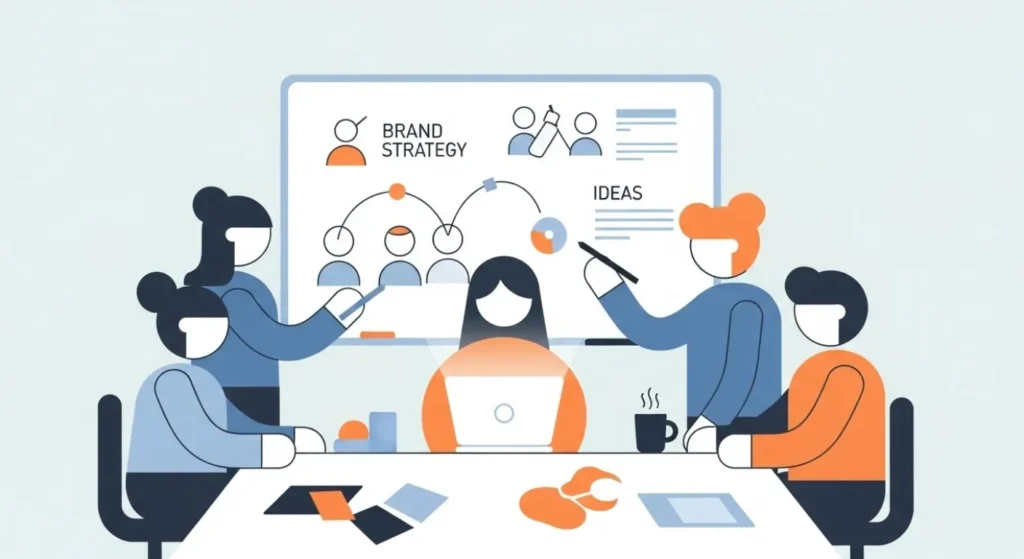
A Brand Workshop is a collaborative, strategic session designed to extract a company’s DNA from its key stakeholders and translate it into a coherent market position. It is not a design review; it is a data-gathering and consensus-building event.
The Core Components of a Successful Workshop:
- Discovery: A Brand discovery workshop is for unearthing the raw truths about the business, the audience, and the competition.
- Alignment: Getting the C-Suite, Marketing, and Sales teams to agree on a single narrative.
- Definition: establishing the concrete elements of the brand (Values, Personality, Proposition).
If you skip this step, you risk. And in the current economic climate, guessing is expensive.
The Pre-Game: Logistics and Politics
Before you even touch a sticky note, you must design the room. The success of a workshop is determined 48 hours before it starts.
1. The Guest List (Who Needs to Be There?)
The most common mistake is inviting too many people. This is not a town hall meeting. It is a surgical procedure.
You need a cross-section of the business, not just the marketing department. Marketing teams live in a bubble; you need the people who actually talk to customers.
- The Decision Maker (CEO/Founder): Essential. If they aren’t there to sign off on the direction, the workshop is a waste of time.
- The Customer Voice (Sales/Support Lead): The person who hears the complaints and the objections daily.
- The Product Expert: The person who knows what the thing actually does.
- The Creative (Designer/Copywriter): To interpret the abstract ideas into visual or verbal concepts.
Maximum Capacity: 5-7 people. Any more than that, and you reach a point of diminishing returns where cognitive load increases and decision-making quality decreases.
2. The Pre-Read (Asynchronous Work)
Do not waste valuable workshop hours on basic fact-finding. Distribute a questionnaire one week prior. This triggers the “priming effect,” prompting participants to think about the brand before they enter.
Ask these three questions in the email:
- Why does this company exist beyond making money?
- If we closed our doors tomorrow, what would the world miss?
- Which competitor are you most afraid of, and why?
Their answers will often be wildly different. That gap in understanding is exactly where your workshop begins.
Phase 1: The Strategic Exercises (The Meat)
These exercises are chosen to force difficult conversations. We are not here to pat each other on the back; we are here to find the edge.
Exercise 1: The “Kill the Company” Session
Goal: Risk Assessment and Differentiation.
This is a favourite of ours at Inkbot Design because it strips away arrogance.
The Setup:
Break the room into two groups.
- Group A (The Competitor): Give them 15 minutes to design a new company that would put your brand out of business. They have an unlimited budget and zero legacy tech debt. How do they steal your customers?
- Group B (The Defence): Ask them to list your brand’s unassailable moats. What do you have that cannot be copied?
The Outcome:
Group A usually wins. This highlights your weaknesses and shows you exactly where your brand positioning is vulnerable. If your only defence is “we have been around for 20 years,” you are in trouble.
Exercise 2: Brand Archetypes (The Correct Way)
Goal: Personality Definition.
Most people use archetypes (such as The Hero, The Jester, and The Caregiver) like a horoscope. They pick one because it sounds cool. That is useless.

The Method:
Do not ask “Who are we?” Ask “Who is the customer?”
If your customer is terrified of complexity (e.g., tax software), your Archetype must be the Sage (The Expert) or the Magician (Making it disappear). If you try to be the Jester (The Joker) in a serious industry, you erode trust.
Use a matrix plotting your competitors on a graph of Chaos vs Order and Individual vs Community. Find the white space. If everyone else is the “Safe, Corporate Blue Sage,” maybe there is room for a “Rebellious Outlaw.”
Consultant’s Note: I once audited a B2B law firm that wanted to be “The Jester” to seem approachable. We had to explain that nobody wants a comedian defending them in court. Context is everything.
Exercise 3: The 20-Year Roadmap (The “Vision” Test)
Goal: Vision Statement vs Mission Statement Clarity.
It is easy to plan for next quarter. It is hard to plan for a decade.
Draw a timeline on the whiteboard: Now, 5 Years, 10 Years, 20 Years.
Ask the stakeholders to place sticky notes on the timeline for:
- Product expansion.
- Geographic reach.
- Revenue goals.
- Cultural impact.
The Insight:
If the CEO sees a global empire in 5 years, and the Product Lead sees a niche boutique service, you have a fundamental disconnect in the brand purpose. You cannot build a visual identity until this roadmap aligns.
Phase 2: Visual & Verbal Translation
Once the heavy strategic lifting is done, you move to the tangible elements. This is where you define how the brand looks and speaks.
Exercise 4: This, Not That (The Spectrum)
Goal: Visual Parameters.
Words are subjective. “Modern” to a 20-year-old designer means minimalism and neon. “Modern” to a 60-year-old CEO might just mean “not using Times New Roman.”
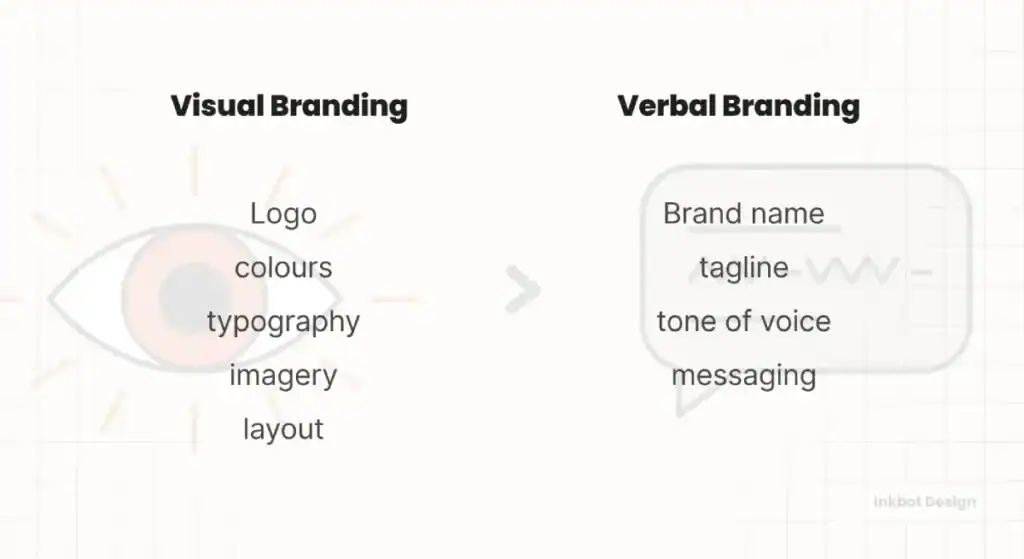
Create a series of spectrums on the wall:
- Luxury <——————–> Accessible
- Playful <——————–> Serious
- Technical <——————–> Human
- Revolutionary <——————–> Evolutionary
Give everyone a dot sticker. They must vote silently.
The Result:
You will see clusters. If the dots are spread across the entire line, you have no consensus. Discuss the outliers. Why does the Sales Director think you are “Luxury” while the Founder thinks you are “Accessible”? This exercise saves endless rounds of design revisions later.
Exercise 5: The “Funeral” Eulogy
Goal: Core Brand Values.
This is morbid, but effective.
The Prompt:
“The brand has died. It is 50 years in the future. We are at the funeral. What does the eulogy say?”
Ask them to write down what people remember.
- Did they make the most money? (Nobody cares).
- Did they change how the industry works?
- Did they treat their staff well?
This separates the brand promise from the sales pitch. It reveals the legacy the founders actually want to leave, which forms the bedrock of your values.
Tools of the Trade: Analogue vs. Digital
In 2026, we often operate in hybrid environments. However, the tool should never get in the way of the thinking.
| Feature | The Analogue Way (In-Person) | The Digital Way (Remote/Hybrid) | The Verdict |
| Ideation Speed | High. Scribbling on a Post-it is instant. | Medium. Typing and dragging boxes in software takes cognitive effort. | Analogue Wins. For raw speed, paper is king. |
| Documentation | Low. Someone has to type up the handwriting later. | High. Everything is digitised instantly. | Digital Wins. No lost data. |
| Group Dynamics | High. You can read body language and tension. | Low. People hide behind cameras or multitask. | Analogue Wins. FaceTime builds trust. |
| Tools | Sharpies, 3M Post-its, Whiteboard. | Miro, Mural, FigJam. | Context Dependent. |
Recent shifts in remote work technology have led to “Workshop Fatigue.” Data suggests that online engagement drops significantly after 90 minutes. If you are running a remote session using Miro or FigJam, you must break the workshop into 2-hour sprints over two days, rather than a single 8-hour marathon. The “Zoom Drain” is real and can significantly impact your creative output.
Facilitation Strategy: Managing the Room
The exercises are easy. People are hard. As the facilitator (or branding strategist), your job is to manage the energy and the egos of the participants.
1. The “Parking Lot” Technique
When a senior stakeholder goes off on a tangent about a specific campaign idea or a personal grievance, do not argue.
Say: “That is a valid point, but it is tactical, not strategic. I’m going to put that in the Parking Lot to discuss later.”
Write it down on a separate board. This makes them feel heard without derailing the agenda.
2. The “HiPPO” Containment Strategy
The HiPPO (Highest-Paid Person’s Opinion) can stifle innovation. If the CEO speaks first, everyone else will subconsciously align with them.
The Fix: Use “Note and Vote.”
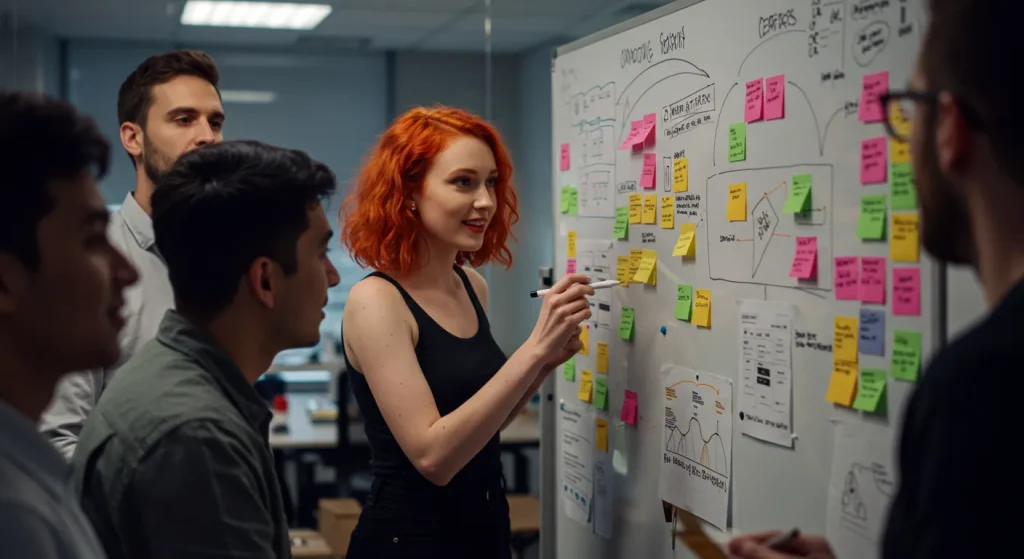
Ask everyone to write their ideas silently on post-its before discussing them. Then, have everyone stick them on the wall simultaneously. This anonymises the ideas initially and prevents the group from anchoring to the leader’s opinion.
3. Decoupling Problem from Solution
Clients love to suggest solutions. “We need a mobile app.”
Your job is to ask: “What problem are we solving?”
If the problem is “Customer retention,” an app might be the wrong answer. Keep the workshop focused on the Why and What, not the How.
The Output: Turning Noise into Signal
A workshop without a report is just a nice chat. You must synthesise the mess of sticky notes into a Brand Strategy Document.
The Synthesis Process:
- Digitise immediately: Take photos of every wall. Transcribe them within 24 hours while the context is fresh.
- Identify Patterns: Look for the words that came up repeatedly (e.g., “Reliable,” “Fast,” “Partner”).
- Draft the Essence: Combine the findings into a clear brand essence statement.
- Replay it: Present the findings back to the stakeholders. “We heard you say X, which means the strategy is Y.”
This document becomes the “Bible” for the brand identity design phase. When a client later says, “I don’t like this red colour,” you can point to the document and say, “We agreed that the brand needs to signal ‘Urgency’ and ‘Power’, and the data shows red is the most effective colour for that.” It removes subjectivity.
The Verdict
Branding is not magic; it is logic applied to emotion.
A brand workshop is the crucible where that logic is forged. It requires preparation, tough questions, and a facilitator willing to challenge the status quo. If you treat it as a box-ticking exercise, you will end up with a generic brand that looks like everyone else.
But if you commit to the process—if you are willing to kill the company, eulogise the brand, and argue about the true definition of “quality”—you will emerge with something far more valuable than a logo. You will have a belief system.
If you are ready to stop playing games and start building a market-leading brand, it is time to get serious.
Frequently Asked Questions (FAQ)
How long should a brand workshop last?
A comprehensive brand strategy workshop typically lasts between half a day (4 hours) to a full day (8 hours). For complex global organisations, it may be split over two days. Remote workshops should be broken into 90-minute sprints to maintain focus.
Who should attend a brand identity workshop?
Limit attendance to 5-7 key decision-makers. This typically includes the CEO/Founder, Marketing Director, Head of Sales, Product Lead, and Customer Support representative. Too many voices lead to a lack of focus and “design by committee.”
What is the difference between a brand strategy workshop and a design sprint?
A brand strategy workshop focuses on the “Why” and “Who”—defining values, audience, and positioning. A design sprint focuses on the “How”—prototyping visual solutions, logos, or user interfaces. Strategy must always precede design.
How much does a professional brand workshop cost?
Costs vary significantly based on the agency’s expertise. Freelance facilitators may charge £1,500–£3,000, while top-tier branding agencies can charge £10,000–£25,000 or more for a full strategic phase, including the workshop, research, and strategy deliverables.
Can you run a brand workshop remotely?
Yes, using tools like Miro, Mural, or FigJam. However, remote sessions require stricter time management and more structured facilitation to prevent multitasking by participants. Hybrid models (some in-room, some remote) are generally discouraged due to communication imbalances.
What are the best exercises for defining brand values?
The “Funeral/Eulogy” exercise helps define legacy and long-term impact. The “Mars Group” (who would you send to Mars to represent the company?) is excellent for identifying authentic cultural values versus aspirational ones.
How do you handle a CEO who dominates the workshop?
Use “Note and Vote” techniques where participants write ideas silently before sharing. This democratises the input. The facilitator must also establish “The Parking Lot” early on to divert non-strategic tangents without causing offence.
What deliverables come out of a brand workshop?
The immediate output is raw data (notes, sketches, consensus). The formal deliverable is a Brand Strategy Document, which includes the Brand Core (Purpose, Vision, Mission, and Values), User Personas, Competitor Analysis, and Brand Personality guidelines.
Why do brand workshops fail?
They fail due to unclear objectives, inviting the wrong people (or too many), and poor facilitation that lets the loudest voice win. Failure also occurs if the output is not documented and not acted upon immediately.
Do I need a professional facilitator?
While you can run one internally, an external branding strategist brings objectivity. They can challenge the CEO and ask “stupid questions” that internal employees are too afraid to ask, which often leads to the biggest breakthroughs.