Rebranding Cost UK: Why the Logo Is Never What Makes It Expensive
A UK rebrand can cost anywhere from £2,000 to £100,000 or more, and that spread tells you the question is wrong.
Firms don’t pay for a rebrand. They pay for the cost of making a new commercial position usable across the entire business – and the logo is the cheapest part of that.
If you’re pricing a rebrand ahead of a growth phase or an acquisition, the number that lands in your inbox has almost nothing to do with how good the designer is. It has everything to do with how much friction sits inside your firm.
A three-partner litigation practice in Leeds and a 180-person consultancy can commission the same deliverable and pay ten times as much. Same logo. Same guidelines. Wildly different invoice.
Before you brief anyone, it’s worth being clear on when to rebrand at all – because the trigger for the change usually predicts the cost of it.
- Rebrand costs vary from £2,000 to £100,000+, driven by the scale of commercial change required, not the visual or logo design alone.
- The biggest drivers are internal friction: decision-making delays, accumulated legacy complexity, and the sheer number of touchpoints to update.
- Statutory costs like Companies House name changes and trademark filings exist, but are small compared with rollout, implementation and governance expenses.
- Read quotes by asking what commercial friction they remove, how many touchpoints must change, whether strategy is needed, and the rollout sequence.
What Does a Rebranding Cost in the UK?

A UK rebrand costs between £2,000 and £100,000+, with most strategically grounded rebrands for established professional services firms starting in the five figures. The price is set less by design hours than by the scale of commercial change the business needs to make usable across every touchpoint.
- A basic visual refresh – new logo and light guidelines – sits in the low thousands and rarely shifts commercial ground.
- A full SME rebrand with strategy, identity and website typically runs £10,000–£40,000, rising to £30,000–£60,000+ with rollout.
- A multi-site or post-acquisition programme with name change, trademark work and internal transition can exceed £100,000.
UK rebranding costs range from £2,000 for a basic refresh to over £100,000 for a full transformation, driven mainly by business complexity rather than design.
This post sits within Inkbot Design’s broader rebranding services work, and the pricing logic below applies whether you’re refreshing or replacing.
Why Every Published Rebrand Price Is Different
Search “rebranding cost uk”, and you’ll get a different number on every page – and that inconsistency is the most honest data point available.
One UK guide puts a full SME rebrand at £10,000–£40,000, rising to £30,000–£60,000+ with a website and rollout; another quotes a broad £2,000–£100,000+.
Neither is wrong. They’re describing different businesses and calling them the same thing.
The price-band model most agencies publish – freelancer, boutique studio, agency, London consultancy – is genuinely useful, and intelligent buyers rely on it for a reason. It maps cost to overhead and experience, which is real.
A sole freelancer carries no studio rent; a Soho consultancy carries a lot of it, and you pay for that in the quote. So far, so rational.
The model breaks the moment you notice that two firms hiring the same studio for the same scope still land on prices multiples apart – and any agency that’s quoted widely will tell you this off the record.
The reason is that a studio doesn’t price a deliverable; it prices the effort of getting that deliverable agreed and implemented inside your specific firm.
A sole-owner practice signs off in the morning. A twelve-partner firm signs off after four meetings and a compromise. Same studio, same logo, entirely different job.
The tier tells you the studio’s floor. It tells you almost nothing about your number.
The wider market makes a single “average” even less credible.
The Office for National Statistics estimates UK businesses invested a record £32.7 billion in branding in 2023, up 3.6% year on year – though that figure measures all branding investment, purchased and in-house, not rebranding programmes specifically.
At the same time, UK trademark filings reached a record 203,194 applications in 2025, 17.3% higher than the year before, which matters to your budget directly.
A more contested register means a new name is more likely to collide with an existing mark, and clearance you assumed was a formality becomes legal work you have to pay for.
More money is going into brand assets, and names are getting harder to claim. For a firm changing its identity, that means the cost is rarely just creative work.
What Drives Your Rebrand Cost Up
The single biggest cost driver in a UK rebrand is not design – it’s the volume of decisions your firm has to make and the number of places the decision has to land.
Design time is a rounding error next to it. This is the section worth reading twice.
1 – Decision-Making
Start with decision-making. In a partnership, every meaningful brand choice is a negotiation.
When Inkbot Design has worked with professional services firms, the pattern repeats: three partners describe the firm three different ways in the same pitch, and the disagreement they’ve buried for years surfaces the moment someone proposes a new position.
That disagreement is not a design problem. It’s a business problem the rebrand exposes, and resolving it costs strategy time, workshop time, and often a few rounds nobody budgeted for.
A firm with clear leadership and one decision-maker moves fast and pays less. A twelve-partner firm with no consensus pays for the consensus-building, whether the invoice itemises it or not.
2 – Complexity
Then complexity, which is really just a count of how much you’ve accumulated.
A 15-year-old firm has a name people recognise, a stack of legacy templates nobody’s audited, and a website with hundreds of indexed pages – and every one of those is something the rebrand has to touch or deliberately kill.
The Brand Finance estimate that the UK’s 250 most valuable brands were worth a combined £399.9 billion in 2025, down 3% year on year, makes the uncomfortable point: an established name is an asset with a book value, and retiring it means writing down recognition you paid years to build.
The design fee doesn’t show that write-down. Your firm still pays it.
3 – Touchpoints
Then touchpoints. This is where budgets detonate.
The brand doesn’t live in a logo file. It lives on the website, the pitch decks, the email signatures, the office signage, the templated reports every associate sends daily, the tender documents, and the recruitment pages.
Each is a place where the new position has to be made usable.
A firm with a single-page brochure site and a five-page rebrand is cheap to change.
A firm with 400 indexed pages, a document library, and three regional offices is not because the design is harder, but because there is simply more surface to convert.
“A rebrand is priced by friction, not by fonts. The firms that pay the most are rarely buying more design. They’re paying to unwind years of accumulated inconsistency, retire recognition they built at cost, and push one agreed position into every corner of a business that had been telling several different stories at once.”
4 – Implementation
Implementation is the last multiplier, and the most underestimated.
IPA Bellwether data for Q4 2025 showed no net change in total UK marketing budgets, with 57.4% of firms holding budgets flat, which suggests rollout money is being scrutinised hard right now.
Within that, the same IPA panel showed positive net revisions only for PR, events and other online advertising, while direct marketing and other categories were cut.
The practical lesson: you cannot treat every touchpoint as equally urgent. Sequence the rollout, or the implementation bill writes itself.
The Fixed Costs Nobody Quotes You
Some rebrand costs are statutory and unavoidable, and they sit entirely outside the agency fee, which is exactly why quotes rarely mention them. If your rebrand involves a new name, these land on your desk regardless of who does the creative work.
| Cost | Charged by | Fee | When it applies |
| Company name change (online) | Companies House | £20 (£85 same-day) | Changing your registered legal entity name |
| Trade-mark application (online) | Intellectual Property Office | £170 one class, +£50 per extra class | Protecting a new name or mark |
| Trade-mark application (paper) | Intellectual Property Office | £200 for one class | Filing on paper rather than online |
| Data-protection fee (annual) | Information Commissioner’s Office | £52–£3,763 (most pay £52 or £78) | Only if the rebrand changes data processing or marketing operations |
Look at what that ordering reveals. Companies House charges £20 to change your registered name online, or £85 for same-day service – the legal act of becoming a new entity is nearly free.
Everything expensive about a rebrand is the commercial work of making that new name mean something, which is this entire article compressed into one line item.
The Intellectual Property Office charges £170 for a standard online trademark application in one class, plus £50 for each additional class; a paper application is £200.
Real money, but a fraction of the programme.
Budget these separately, and never let an agency quote imply they’re included – they aren’t theirs to charge.
How to Read a Rebrand Quote Properly
The right way to interrogate a rebrand quote is to stop asking “why does the logo cost this much?” and start asking “what friction is this price actually removing?”
A quote you can’t map to a specific commercial gap is a quote you can’t judge. This reframe is the most useful tool in the article, so here’s the framework.
Ask what strategic change the business genuinely needs.
A firm repositioning to escape a commoditised comparison needs deep strategy work; a firm whose position is sound and whose look is simply dated needs far less.
If the quote is heavy on strategy but your position is already clear, you’re overpaying – and this is precisely the moment to be honest about rebranding versus a brand refresh, because buying the wrong one is the most common way firms waste the budget.
Ask how many touchpoints must genuinely change, and in what order. A quote that treats all touchpoints as equally urgent hasn’t been sequenced, and an unsequenced rollout is where the number balloons.
Ask whether the deliverables leave your team able to operate independently afterwards – a rebrand that requires the agency for every future asset is a subscription, not a purchase. The strongest quotes tie the brief to specific commercial outcomes rather than a deliverable checklist.
If you want to pressure-test whether the spend is justified at all before you commission anything, the honest place to start is the business case for rebranding and a clear-eyed read of the risks of getting a rebrand wrong.
Two objections a sharp reader raises here.
- First: “Isn’t this just an agency talking up strategy to inflate fees?” Fair – and the test is simple. A strategy that can be tied to a named commercial gap earns its fee; a strategy sold as a vague virtue does not.
- Second: “We just need it to look current.” Sometimes true. But “outdated image” is the most abused reason to rebrand, and if that’s genuinely all you need, you should be paying refresh prices, not transformation prices.
How Inkbot Design Prices a Rebrand
Inkbot Design prices the expensive part of a rebrand (the strategy) as a fixed fee, then scopes implementation based on your actual touchpoint count — the honest version of what every agency is really doing behind a custom quote.
The Brand Equity Blueprint™ is £7,500 for the complete positioning, verbal identity and visual system.
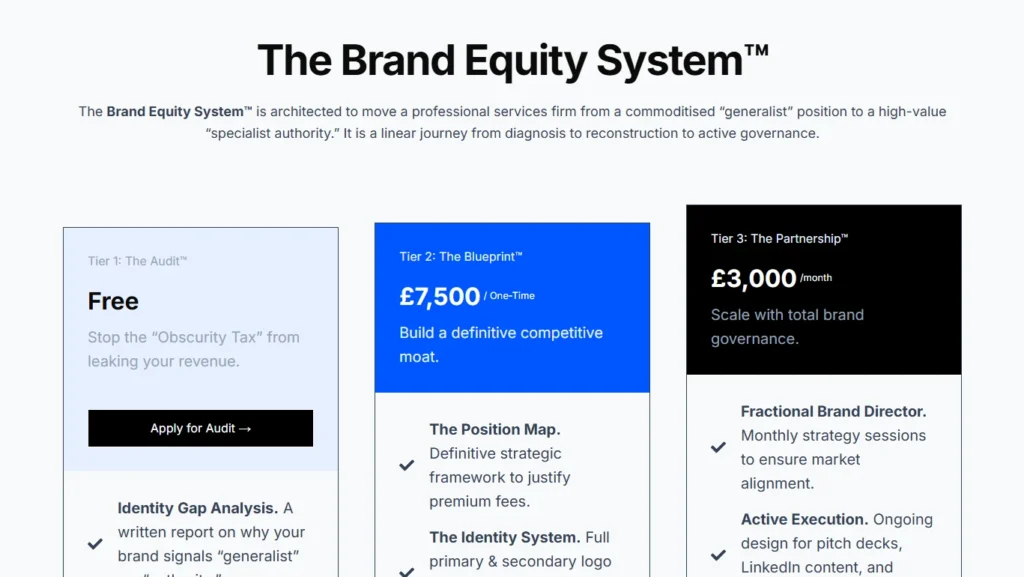
The Brand Equity Partnership™ is £3,000 per month for ongoing governance and rollout. Both begin with a free Brand Equity Audit™, delivered in writing within 48 hours, with no sales call.
That structure is a direct answer to the friction problem described in this article. The Blueprint fixes the strategy cost — the decision-making, positioning and consensus-building that balloons unpredictably at most agencies — at a published number, so the part of the rebrand that usually has no ceiling has one.
What varies after that is implementation, and it varies for the reason the article already gave: how many touchpoints must genuinely change.
A firm with a five-page site and a 400-page document library pays different implementation costs, correctly, because it has different amounts of surface area to convert.
The value gap against typical UK agencies is not that £7,500 is cheap.
It’s that most agencies quote a custom five-figure strategy fee whose number you cannot interrogate, because the pricing logic is never shown.
Inkbot Design publishes the fee, refuses hourly billing, and does not scale the quote to what it thinks a firm can afford, which removes the single most common place a rebrand budget gets quietly padded.
Stuart Crawford has led brand identity projects for professional services firms across 21 countries for over 17 years, and fixed-scope pricing is the discipline that keeps the strategy honest: a firm cannot inflate a fee it has already published.
What This Looked Like in Practice
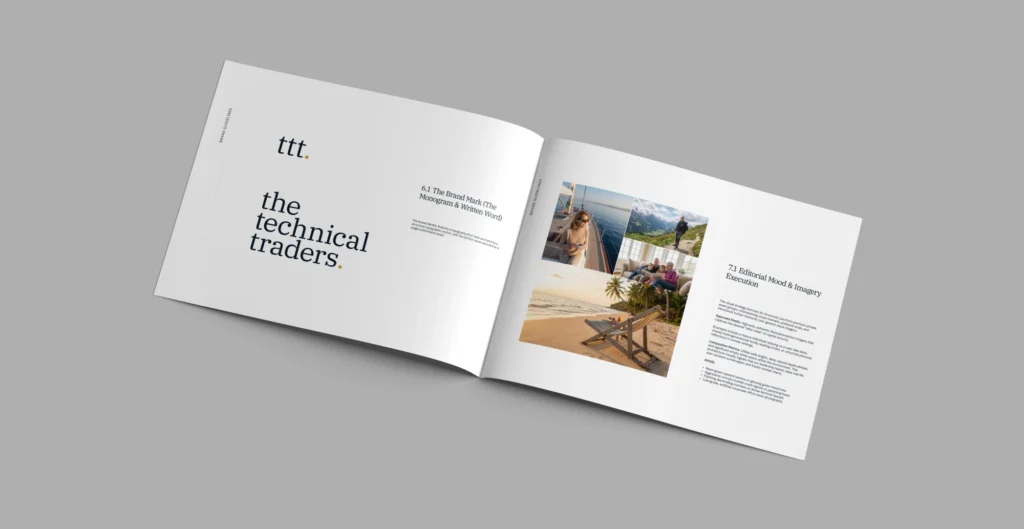
I’ll give you a real one. When we rebranded The Technical Traders, the company wasn’t buying a logo – it was moving from a retail trading methodology into a premium wealth stewardship brand, and the cost lived almost entirely in making that shift usable.
The expensive work wasn’t visual. It was claiming a new strategic category – “Asset Revesting” – and shifting the entire brand archetype from retail speculation to what we called warm institutionalism, to reach a $1M–$10M private wealth demographic.
That meant rebuilding the language from the ground up: replacing anxiety-inducing transactional jargon like “drawdown,” “alpha”, and “volatility” with messaging built around lost years and peace of mind.
Every one of those changes had to propagate across the site, the communications, the collateral.
The visual identity itself was deliberately restrained – a typography-first logo in IBM Plex Serif and Sans, anchored in Midnight Navy and Antique Cream with Metallic Gold reserved strictly as a structural accent.
The design was the quiet part. The repositioning was the cost.
The lesson for any professional services firm pricing a rebrand: the friction of moving a market position is the line item, and it never appears as “logo.”
The Verdict – You’re Not Buying a Logo
The £2,000-to-£100,000 spread isn’t agency inconsistency. It’s an honest reflection of a simple truth: you are not paying for a rebrand, you are paying to remove the commercial, organisational and operational friction that made the rebrand necessary.
The logo is the least expensive item in the quote.
Decision-making, complexity and implementation are what you’re actually buying, and they’re priced by your business, not the studio’s.
So stop asking what a rebrand costs. Ask what change your firm needs to make usable, across how many touchpoints, and against how much internal disagreement.
That number is your rebrand cost – and it’s knowable before you brief anyone.
If you want that number made concrete, request a free Brand Equity Audit™ – a structured diagnostic that identifies exactly where your brand is losing commercial ground and what to do about it.
FAQs
How much does a rebrand cost for a UK professional services firm?
Most strategically grounded rebrands for established UK firms start in the five figures, typically £10,000–£40,000, rising to £30,000–£60,000+ once website and rollout are included. Larger multi-site or post-acquisition programmes can exceed £100,000. The final number is driven by business complexity, not design hours.
Why do rebranding quotes vary so much in the UK?
Quotes vary because the same deliverable costs vastly different amounts depending on the firm’s internal friction – the number of decision-makers, legacy assets to retire, and touchpoints to convert. The agency tier sets a floor for the price but explains almost none of the variation across businesses.
What’s the difference between the logo cost and the total rebrand cost?
The logo and visual identity are usually the smallest line item. The bulk of a rebrand cost is strategy, decision-making across stakeholders, and implementation across every touchpoint – website, collateral, signage, internal communications. Costing the logo alone routinely underestimates the total by an order of magnitude.
How much does it cost to change a company name in the UK legally?
Companies House charges £20 to file an online company name change, or £85 for same-day service. A trademark application through the Intellectual Property Office costs £170 online for one class. The legal name change is cheap; the commercial rebrand around it is where the money goes.
Is it true that a rebrand can’t deliver measurable ROI?
No – a rebrand delivers return when strategy precedes design, the brief is tied to specific commercial outcomes, and the final guidelines let your team operate independently. Rebrands that buy only visuals without a clear positioning strategy are the ones that fail to make commercial ground.
When should I pay for a full rebrand versus a refresh?
Pay for a full rebrand when your commercial position itself is changing – repositioning, merger, or entering a new market. Pay refresh prices when your position is sound and only the visual expression is dated. Paying transformation prices for a cosmetic problem is the most common budgeting error.
