Vision Statement vs Mission Statement: The Difference
If I had a pound for every time a client handed me a “brand book” where the vision and mission were identical, interchangeable, or simply nonsense, I’d have retired to the Cotswolds years ago.
Most entrepreneurs treat these statements as marketing fluff—something to slap on the “About Us” page because a template told them to. This is a fundamental error.
In the chaotic reality of running a business, where cash flow is tight and competition is ruthless, these two sentences are not poetry. They are governance tools.
A lack of clarity here leads to “strategic drift.” Without a clear mission, your daily operations become less efficient. Without a clear vision, you have no metric for long-term success. You end up busy, but you don't actually move anywhere.
This guide isn't about “inspiring” you. It is about the mechanics of brand strategy. We are going to dissect the vision statement vs mission statement dynamic, strip away the corporate jargon, and look at how high-performing companies use these tools to print money and dominate markets.
- Mission = present-focused, operational: defines what you do, who you serve, and how, guiding daily decisions and excluding distractions.
- Vision = future-focused, aspirational: describes the desired long-term impact, motivates staff, and provides strategic direction for expansion.
- Both are distinct but complementary: mission supplies force (execution), vision supplies direction; both must be specific, authentic and periodically reviewed.
The Simple Answer: What is the Difference?
If you are skimming for a quick definition before a board meeting, here it is.
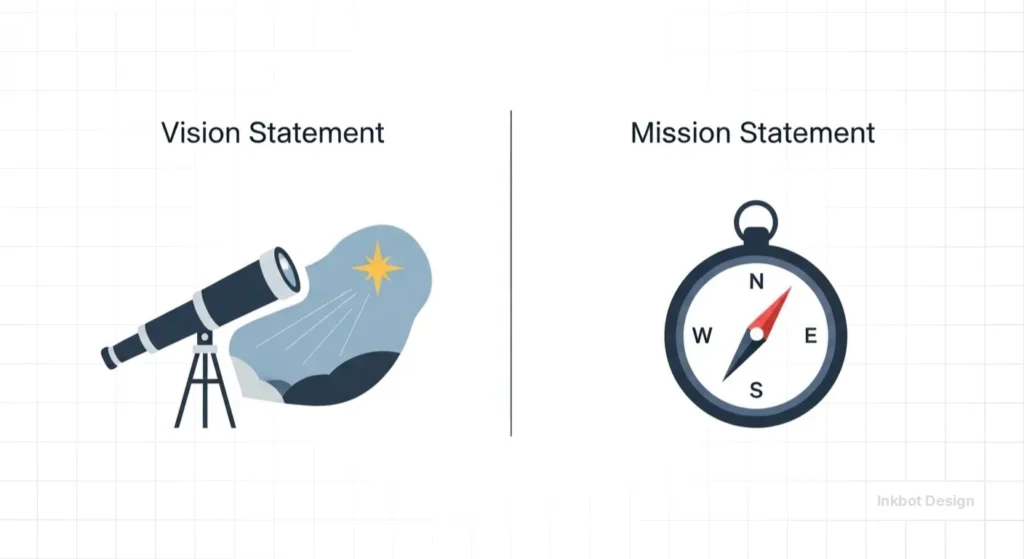
The Mission Statement defines the business you are in right now. It articulates what you do, who you do it for, and how you do it effectively. It is operational, present-tense, and centres on the customer. It answers the question: “Why do we exist today?”
The Vision Statement defines the future you intend to create. It describes the world as it will look if you succeed in your mission. It is aspirational, future-tense, and centres on the impact. It answers the question: “Where are we going?”
Key Components at a Glance
- Mission:
- Focus: The Present (Daily Operations).
- Function: Clarifies the core business offering.
- Audience: Employees, Customers, Suppliers.
- Key Metric: Operational Excellence.
- Vision:
- Focus: The Future (5–10+ Years).
- Function: Provides direction and inspiration.
- Audience: Investors, Leadership, Talent Acquisition.
- Key Metric: Long-term Growth and Innovation.
1. The Mission Statement: The Engine of the Brand
Your mission statement is your operational anchor. It is the filter through which you make most of your daily decisions. If a new opportunity arises—such as a partnership or a product line extension—you review the mission statement. If the opportunity doesn't fit the mission, you kill it.
A weak mission statement is vague. “We want to provide the best service” is not a mission; it is a platitude. A strong mission statement has teeth. It limits what you do just as much as it defines it.
The Anatomy of a Functional Mission
To write a mission that works, you need three specific elements. If you miss one, you just have a slogan.
- The Core Contribution (The “What”): This is the tangible product or service you provide. Be specific. If you sell software, say you build software. If you sell coffee, say you roast beans.
- The Target Audience (The “Who”): Who is paying the invoice? You cannot serve “everyone.” Defining your audience excludes those who are not a fit, which saves your sales team time.
- The Distinctive Competence (The “How”): This is your Unique Selling Proposition (USP). Why you? Is it speed? Quality? Sustainability? Price?
Real-World Analysis: Patagonia
Mission: “We’re in business to save our home planet.”

This is a fascinating evolution. Patagonia used to have a longer, more descriptive mission about building the best product and causing no unnecessary harm. They shifted to this aggressive, absolute statement.
- Why it works: It is a governance tool. If a supply chain manager at Patagonia discovers a cheaper fabric that harms the environment, this mission statement empowers them to reject it. It aligns operations with brand purpose. It tells the customer exactly where their money is going.
The Cost of a Bad Mission
When a mission is unclear, you get “Mission Creep.” This is where a company starts chasing revenue streams that they have no right to be in.
Consider the decline of major high street retailers. Many forgot they were in the business of “curating affordable fashion for the working family” and tried to become luxury boutiques or generic department stores. They lost their core customer because they forgot their core mission. The result isn't just confusion; it's bankruptcy.
2. The Vision Statement: The Destination
If the mission is the engine, the vision is the coordinates in the GPS.
A vision statement is a picture of a desired future state. It should be “impossibly ambitious” but strictly achievable. Jim Collins and Jerry Porras, in their seminal work Built to Last, referred to this as the BHAG (Big Hairy Audacious Goal).
The purpose of a vision is to prevent short-termism. It stops you from optimising for this quarter's profits at the expense of the next decade's relevance.
The Characteristics of a Strong Vision
- Visualisable: You must be able to “see” the outcome. “To be the best” is not visual. “A computer on every desk and in every home” (Microsoft's original vision) is a highly visual concept.
- Future-Oriented: It must project 5, 10, or even 20 years into the future.
- Inspirational (Internally): It needs to motivate your staff. Why are they grinding out long hours? It's not for your profit margin; it's to build that future.
Real-World Analysis: Tesla
Vision: “To accelerate the world’s transition to sustainable energy.”

Notice the specific wording. It doesn't say “Make electric cars.” Cars are just the mission (the current method). The vision is the transition of global energy infrastructure.
- Why it works: This allows Tesla to expand into batteries (Powerwall), solar panels, and trucking without confusing the market. If their vision was just “Build the best electric sports car,” entering the solar roof market would make no strategic sense. The vision gives them permission to pivot and expand.
The “Hallucination” Trap
There is a fine line between a vision and a hallucination. A vision statement must be tethered to reality.
I once audited a client, a small local logistics firm in Leeds with three vans. Their vision was “To dominate global interstellar freight.”
That is not a vision; that is a joke. It alienates staff because they know it isn't true. A vision must be a stretch, but it must be one that your current trajectory could hit if you execute perfectly. A better vision for them would have been: “To become the most reliable same-day courier network in Northern England.” That is ambitious, measurable, and motivating.
Vision Statement vs Mission Statement (Technical Differences)
Let's look at the mechanical differences. When we build brand identity systems, we use the following parameters to separate the two.
| Feature | Mission Statement | Vision Statement |
| Timeframe | The Present (Today/Now) | The Future (Someday) |
| Primary Question | What do we do? | Where are we going? |
| Change Frequency | Rare (Pivot only) | Rare (Only when achieved) |
| Length | Short, punchy, memorable | Can be slightly longer, descriptive |
| Tone | Functional, Informative | Inspirational, Emotional |
| Internal Goal | Alignment & Efficiency | Motivation & Retention |
| External Goal | Customer Clarity | Investor Confidence |
The Interaction: How They Work Together
Think of your business strategy as a vector.
- Mission provides the magnitude (the force/effort).
- Vision provides the direction.
Force without direction is wasted energy. Direction without force is just a daydream. You need both to generate momentum.
Brand Strategy Health Check
Do you have a robust brand strategy, or just a nice logo? Answer 8 questions to get your Brand Health Score and find out where your business needs focus.
Question…
The “Inverted Pyramid” of Brand Strategy
To understand where these statements fit, you need to examine the hierarchy of brand strategy. Many businesses try to write these in a vacuum, but they rely on your core values.
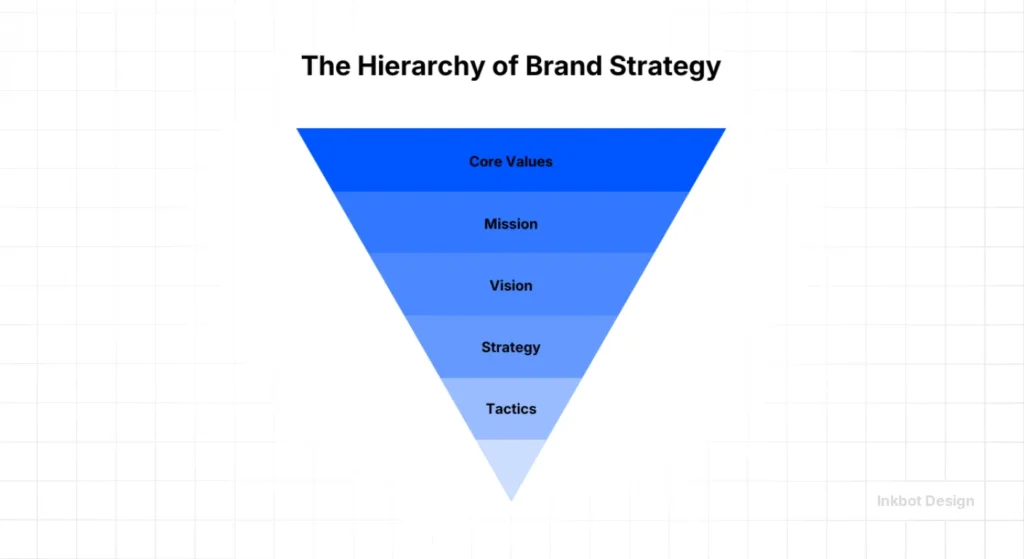
- Core Values: The non-negotiable beliefs (The DNA).
- Mission: The operational vehicle (The Engine).
- Vision: The destination (The Focus).
- Strategy: The route map (The Plan).
- Tactics: The driving (The Daily Work).
If you attempt to write a vision statement before defining your core brand values, you will likely fail to achieve a clear and effective one. You cannot know where you want to go if you don't know who you are.
The Data on Strategic Alignment
The cost of getting this wrong is measurable. According to research by Gallup, only 41% of employees strongly agree that they know what their company stands for and what makes its brand different.
This alignment gap is expensive. When employees don't understand the mission, they disengage. Disengaged employees have 37% higher absenteeism, 18% lower productivity, and 15% lower profitability. Translating that into British pounds, a lack of clarity in your mission and vision is a direct tax on your bottom line.
Furthermore, a study by Bain & Company on management tools consistently ranks “Mission and Vision Statements” as one of the most widely used tools; however, satisfaction rates vary widely. The data suggests the tool isn't the problem; the implementation is.
How to Write Them (The Anti-Fluff Framework)
Do not brainstorm. Brainstorming leads to compromise, and compromise leads to mediocrity. Drafting these statements is a forensic process.
Step 1: The Mission Audit
Look at what you actually do. Ask your team these three questions:
- What is the physical thing we deliver? (Be literal).
- Who actually writes the cheque?
- What pain are we removing from their lives?
Drafting Template:
We [Action Verb] [Target Audience] by providing [Product/Service] so that they can [Benefit/Outcome].
- Bad: We empower solutions for tomorrow. (Meaningless).
- Good: We help Manchester-based startups automate their accounting, allowing them to focus on growth. (Specific, clear).
Step 2: The Vision Projection
Close your eyes. Imagine it is 10 years from now. You have won. The competition is gone. The market loves you.
- What does the industry look like?
- What problem have you solved permanently?
- How has the world changed because your company exists?
Drafting Template:
Our vision is a world where [Problem] no longer exists because of [Our Solution]. OR To become the [Superlative] source of [Value] for [Audience].
Step 3: The Stress Test
Once you have drafts, run them through the “bullshit detector.”
- Can a competitor say the exact same thing? If yes, delete it.
- Is it easy to memorise? If it’s a paragraph, cut it.
- Does it scare you a little? (Vision only). If it feels too safe, it’s not a vision.
You might want to consult a branding strategist at this stage. Sometimes you are too close to the bottle to read the label.
Case Studies: Success vs Failure
Let's look at historical evidence.
Success: Microsoft (The Pivot)
Original Vision (1975): “A computer on every desk and in every home.”
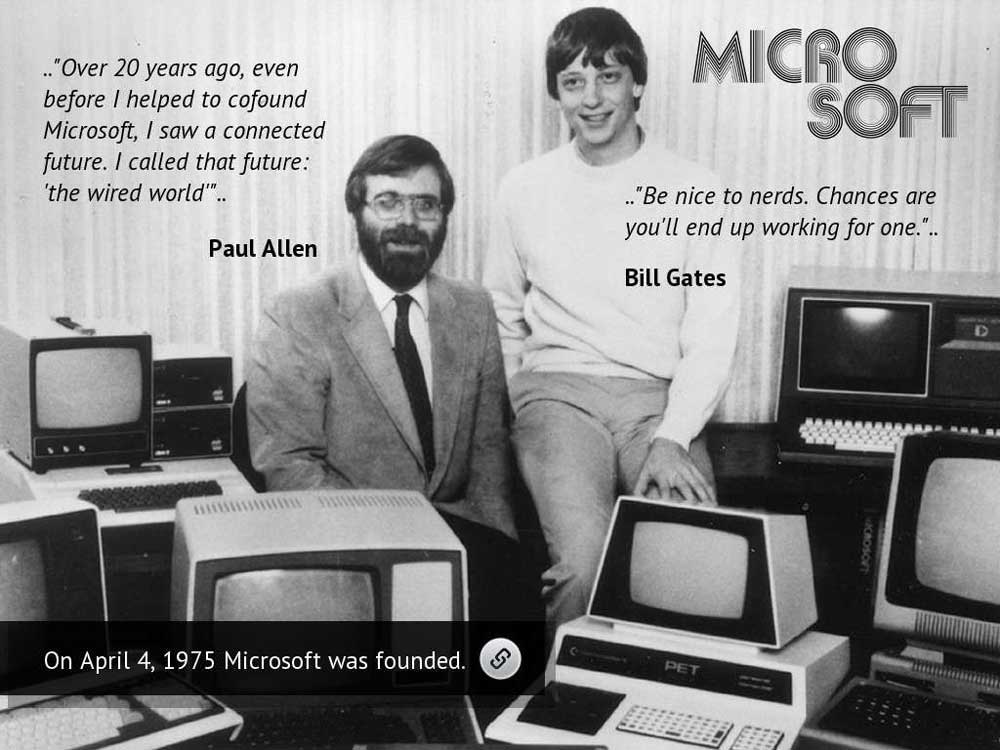
This was brilliant. It was clear, visual, and at the time, audacious. It drove them for 30 years.
The Problem: By the mid-2000s, they had achieved it. They continued to run on the old vision, resulting in the stagnant “Ballmer years,” during which they missed mobile (Zune vs. iPod) and search (Bing vs. Google).
The Fix: Satya Nadella shifted the mission to: “To empower every person and every organisation on the planet to achieve more.” This pivot from “hardware on desks” to “empowerment via cloud/AI” revitalised the company, driving their stock to record highs.
Failure: Kodak
The Missing Vision: Kodak invented the digital camera. They owned the patent. But their “mission” was implicitly defined as “selling film,” not “capturing memories.”

Because their internal narrative was tied to the mechanism (film chemicals) rather than the outcome (images), they viewed digital as a threat to their mission rather than an evolution of their vision.
The Result: They went bankrupt, while Instagram—a company that arguably fulfilled Kodak's true potential—sold for a billion dollars with 13 employees.
Success: IKEA
Vision: “To create a better everyday life for the many people.”
Mission: “Offer a wide range of well-designed, functional home furnishing products at prices so low that as many people as possible will be able to afford them.”

This is the gold standard.
- The Vision is broad and emotional (“better everyday life”).
- The Mission is ruthless and mechanical (“prices so low”).
- This alignment dictates their entire supply chain. Why do you have to build the furniture yourself? Because the mission demands low prices. The mission creates the constraint; the vision sells the dream.
The State of Vision & Mission in 2026
The landscape is shifting. Over the last 18 months, we have witnessed a significant consolidation in how companies present themselves. The rise of AI and automation has made “human-centric” missions more critical than ever.
The “Purpose” Shift
Following the pandemic, employees and consumers have become increasingly cynical. The era of “Corporate Social Responsibility” (CSR) as a side project is dead. We are witnessing a shift towards integrating brand promise.
Companies are no longer writing visions about “being the market leader.” That is egocentric. Modern visions are about “community impact” or “sustainability.”
- Old School: To be the #1 provider of plastic widgets.
- 2026 Standard: To eliminate plastic waste from the widget supply chain.
The “Living” Document
Historically, these statements were carved in stone. Today, with agile methodologies dominating the business landscape, we see “rolling” missions. While the Vision (the 10-year goal) remains static, the Mission (the current method) is being reviewed every 12–24 months to ensure it aligns with rapid technological changes.
If your mission statement mentions a technology that is now obsolete (e.g., “We sell the best DVDs”), you are signalling your own irrelevance.
A Reality Check
Here is the uncomfortable truth I see in my fieldwork.
Most founders write a vision statement to impress investors, not to guide their team. They use words like “synergy,” “paradigm,” and “world-class.”
I once worked with a SaaS company that had the vision: “To leverage synergistic solutions for a dynamic global landscape.”
I asked the CEO, “What does that mean?”
He couldn't answer.
I asked the Sales Director, “How does this help you sell?”
He laughed.
If your staff cannot recite your mission statement without referring to a card, you don't have a clear mission statement. You have text on a wall.
The “T-Shirt Test”
If you printed your mission on a T-shirt, would your staff wear it to the pub? Or would they be embarrassed?
- Patagonia staff wear the gear.
- SpaceX staff wear the gear.
- Do your staff wear yours?
If the answer is no, it’s because your statement lacks authenticity. It lacks the “edge” of reality. You are trying to sound like a corporation instead of sounding like you.
Common Myths Debunked
Myth 1: “Shorter is Always Better”
Marketing gurus often advise, “Keep it to 5 words.” This is false. Clarity beats brevity. If you need 20 words to be precise, use 20 words. IKEA’s mission is 26 words long, and it is perfect because it contains the instruction manual for the business (“prices so low”).
Myth 2: “The Vision is for Customers”
Wrong. The vision is primarily for your employees and investors. Customers rarely buy your “10-year plan.” They buy your current product (Mission). Your employees need a clear vision to know that their career has a future with you.
Myth 3: “Profits Can't Be a Mission”
While “making money” is a terrible vision (it's not inspiring), financial stability is often part of a mission. However, profit is usually the result of a mission well executed, not the mission itself. As Peter Drucker famously said, “Profit is not the purpose of a business, but the test of its validity.”
The Verdict
The difference between a vision statement and a mission statement is not just semantic. It is the difference between the map and the compass.
- Your Mission Statement is your compass. It tells you if you are on track for the day. It governs your quality, your hiring, and your product development.
- Your Vision Statement is your destination on the map. It tells you where all this hard work is leading.
You cannot build a legacy brand without both. If you operate without them, you are merely reacting to the market rather than shaping it.
Stop treating these as administrative tasks. Sit down with your leadership team. Be honest about your flaws. Be aggressive about your goals. Write statements that scare you.
Because if your vision doesn't scare you, it isn't big enough.
Frequently Asked Questions (FAQ)
Can a vision statement and a mission statement be the same thing?
No. Combining them usually dilutes both. A mission is about today's execution, while a vision is about tomorrow's ambition. Merging them creates confusion regarding whether the team should focus on current operations or future innovation.
How often should we update our mission statement?
You should review your mission statement whenever your business model undergoes significant changes or market conditions shift drastically. However, for stable companies, a review every 3–5 years is standard to ensure it remains relevant.
What comes first, the mission or the vision?
Generally, the vision comes first in the founding stage. You have an idea of the future you want to create (Vision), and then you define the vehicle to get there (Mission). However, existing businesses often refine their mission first to fix operational issues.
Should our mission statement mention profit?
Usually, no. Profit is a result, not a purpose. Missions focused solely on profit rarely inspire employees or attract loyal customers. Focus on the value you create; the profit will follow.
How long should a mission statement be?
There is no strict word count, but it should be concise enough to be memorised. Ideally, between one and three sentences. Focus on clarity and precision rather than brevity for brevity's sake.
Who should write the vision statement?
The vision statement must originate from the leadership or founders. It requires the authority of those who set the strategic direction. However, refining it should involve key stakeholders to ensure buy-in.
Is a tagline the same as a mission statement?
No. A tagline (e.g., “Just Do It”) is a marketing slogan designed to appeal to customers. A mission statement is a strategic tool designed for the organisation. They are related, but they serve different functions.
Can a small business have a “global” vision?
Absolutely. Your size today does not dictate your ambition. A local bakery can have a vision to “Redefine the standard of sourdough in the UK.” Ambition attracts talent and investment.
What is a “BHAG”?
BHAG stands for “Big Hairy Audacious Goal.” Coined by Collins and Porras, it refers to a vision statement that is bold, compelling, and acts as a unifying focal point of effort, like NASA's goal to put a man on the moon.
Why do my employees ignore our mission statement?
Likely because it is generic, untrue, or disconnected from their daily work. If you claim to value “excellence” but reward speed over quality, employees will spot the hypocrisy and ignore the statement.
What is the difference between Purpose and Mission?
Purpose is your “Why” (philosophical reason for being). Mission is your “What” and “How” (operational execution). Purpose is the soul; Mission is the muscle. See more on brand purpose.
Does a vision statement need to be realistic?
It needs to be achievable, but not easily. It should sit in the “Zone of Proximal Development”—just beyond your current reach, forcing you to stretch and innovate to hit it. If it is 100% realistic today, it is just a to-do list.