
How to Copyright a Logo: The 5-Stage Rights Check Every Rebrand Needs
A firm can pay £30,000 for a rebrand, file a copyright registration, register a trademark, launch the new identity across every touchpoint — and still not own it.
That is the outcome DIY guidance never warns you about, because it treats logo protection as a form-filling exercise.
Copyright the artwork, trademark the name, done. That advice is not wrong. It is just answering a smaller question than the one a rebrand actually asks.
The question a rebrand asks is: who owns what, whether the identity is legally clear to use, and which protection applies to each asset?
Copyright is one line in that answer.
Getting the copyright registration right while the source files still sit on a freelancer’s hard drive, unassigned, is the professional-services equivalent of insuring a house you do not hold the deeds to.
You reach a defensible position through logo design that is built to be owned from the first brief — not retrofitted with legal filings after launch.
- Move name clearance and rights assignment to the start of every rebrand; clear names and secure ownership before design begins.
- Obtain a written assignment and editable source files; paying a designer does not transfer copyright under UK law.
- Map each asset to the right protection: copyright for artwork, trademark for the name, and audit fonts, icons and licences for logo use.
How You Actually Copyright a Logo and Name

Securing a logo and name is achieved in five stages: (1) separate copyright from trademark and apply each to the right asset; (2) establish chain of title so you own the design outright; (3) clear the name before the design is finalised; (4) file the appropriate registrations; (5) audit the embedded third-party assets — fonts, stock, icons — that can quietly sink the whole thing.
- Copyright protects the original artwork in a logo. It never protects a business name, slogan or short phrase.
- A trademark protects the name and mark as a source identifier — the thing that stops a competitor from trading under a confusingly similar identity.
- Ownership is separate from both. Registering copyright does not make you the author; a written assignment does.
Copyright protects the original artwork in a logo, but never protects a business name; a name is secured through trademark registration instead.
The Entry Conditions Most Guides Skip
Before any filing, three things need to exist: a final logo you can point to as a fixed work, a written record of who created each element, and a shortlist of the exact name and mark you intend to protect.
Skip these, and every later stage inherits the gap.
Most rebrands begin the conversation about protection after the design is signed off. By then, the name is chosen, the freelancer is paid, and the font is in use — three decisions that should each have been rights-checked first, and each is now expensive to reopen.
The UK Intellectual Property Office received a record 203,194 trademark applications in 2025, a 17.3% increase on 2024 and the first year the annual total passed 200,000. That is a more crowded register to clear a name against, and clearing it after launch is the costly way round.
Stage 1 — Apply Copyright and Trademark to the Right Asset
Copyright and trademark protect different things, and confusing them is the single most common error in brand protection.
Copyright covers original creative expression — the artwork of a logo. A trademark covers brand identifiers that signal a commercial source — the name and the mark in use.
The By Design Law Firm’s guidance is blunt about the consequences: protecting only the logo will not stop a competitor from using a confusingly similar name, and protecting only the name will not stop someone from copying the design.
How to know it is done right: you can name, for each asset, which system protects it. Wordmark and symbol as artwork → copyright may apply if there is sufficient original authorship. The name as a trading identity → trademark. If you find yourself trying to “copyright the company name,” stop — the US Copyright Office states plainly that copyright does not protect names, titles, slogans or short phrases.
The failure mode at this stage: filing a copyright registration for the logo and assuming the name travels with it. It does not. The name is unprotected until a trademark exists, and a copyright certificate offers no defence against a competitor who adopts your name with a different graphic.
Stage 2 — Establish Chain of Title Before You Own Nothing
You do not own a logo simply because you paid for it. In UK law, the default position is that the person who creates a work owns the copyright in it unless there is an agreement to the contrary, which means a freelance designer, absent a written assignment, can retain rights in the identity you commissioned.
This is a chain of title, and it is where rebrands lose ownership without ever noticing.
The distinction that catches firms out is employee versus contractor. Work created by an employee in the course of employment generally vests in the employer.
Work created by an external freelancer or agency does not transfer automatically; it requires an express written assignment of rights. A verbal “yes, it’s all yours” is worth exactly nothing when the designer’s estate, or a future dispute, tests it.
“A brand you commissioned but never had assigned to you in writing is a brand you licensed by accident. You can use it until the day someone with the paperwork decides you cannot. The assignment is not admin. It is the deed to the entire identity, and it is the one document a rebrand cannot afford to leave as a handshake.”
How to know it is done right: you hold a signed assignment naming the works, the editable source files are in your possession, and nothing about the arrangement depends on goodwill.
The failure mode: discovering at an acquisition due diligence stage that the agency that built your identity six years ago still technically owns it.
Stage 3 — Clear the Name Before the Design Is Finalised

Clearance is a search, and it belongs at the start of a rebrand, not the end.
A clearance search checks the intended name against existing registered and unregistered marks to establish whether it is free to use before you invest in a full identity system around it.
Run it late, and you risk discovering, after the letterhead is printed, that the name is taken.
The sequence error is the expensive one. In the United States, applicants filed more than 824,000 new trademark classes in the US fiscal year 2025, up 7.4% year on year — a volume that explains why a name looking free in a casual web search may still collide with a registered mark on a proper review.
The UK register is equally busy. A name that survives a Google check has not been cleared; it has merely not obviously failed.
How to know it is done right: a documented search across the relevant classes, ideally reviewed by someone who reads trademark risk for a living, completed before the design work locks in the name.
The failure mode: finalising an identity, then commissioning clearance as a formality, only to have to unpick a launched brand because the name was never actually available.
Stage 4 — File the Registrations That Fit Each Asset
Registration is where the strategy becomes a legal record, and the two filings serve different ends. Copyright registration strengthens enforcement and provides documented proof of ownership of the artwork.
Trademark registration secures the name and mark as a protected source identifier; the mechanics of trademarking a logo run to their own sequence of clearance, classes and examiner response. They are complementary, not interchangeable, and a defensible identity usually needs both.
Cost and complexity have risen, which rewards preparation. The USPTO moved to a single base application fee of $350 per class effective 18 January 2025, with additional charges for incomplete information or free-form descriptions of goods and services.
Poorly defined goods and services now cost money directly. A firm that has done Stage 3 properly — clear classes, precise descriptions — files a cheaper, stronger application than one improvising at the filing screen.
How to know it is done right: each asset maps to a filing, the trademark classes reflect not just today’s services but the firm’s realistic expansion, and the applications are complete on submission.
The failure mode: filing narrowly for the current service line, only to find the brand exposed the moment the firm moves into an adjacent practice area.
Stage 5 — Audit the Assets Hidden Inside the Logo

A logo is rarely a single original creation; it is often an assembly, and every embedded element carries its own rights. The typeface may be licensed for desktop use but not for embedding in a logo.
An icon may be lifted from a stock library with terms that exclude trademark use. A background texture may be someone else’s copyrighted work. You can own the arrangement and still not have the right to use the parts.
This is the audit almost no guide mentions, and it is where ownership feels secure but is not. A font licence that permits document use does not automatically permit use of that font’s letterforms inside a registered logo — many foundries treat logo use as a separate, paid licence.
If the designer used a stock icon under a standard licence, that licence frequently prohibits trademarking the result.
The identity can look owned and audited and still contain a rights gap the size of the whole mark.
How to know it is done right: every element in the final logo has a documented licence that explicitly covers commercial and logo use, and the designer has supplied a written statement of what was original versus sourced.
The failure mode: trademarking a logo built on a font or icon you were never licensed to use that way, and inheriting the foundry’s or library’s claim along with your registration.
The Judgement Layer: Where This Stops Being a Checklist
The five stages are sequenceable, but two decisions inside them need judgment rather than a form. The first is scope: how many trademark classes to file, weighing today’s cost against tomorrow’s exposure.
File too narrowly, and a competitor can occupy an adjacent class you will later want; file too broadly, and you pay for protection you cannot defend through genuine use. There is no correct number — only the right number for this firm’s growth plan.
The second is the assignment itself. A well-drafted assignment names the specific works, transfers rights fully rather than partially, and closes the moral-rights question that a freelancer can otherwise retain.
The pattern I see most often is a firm that has the logo, loves the logo, uses the logo everywhere, and cannot produce a single document proving it may.
AI, Records and the New Ownership Gap
AI tools now generate a usable logo in minutes, and that speed has quietly reopened the ownership question.
In January 2025, the US Copyright Office published Part 2 of its report on copyright and artificial intelligence, concluding that copyright may protect human-authored expression, creative arrangement or modification within an AI-assisted work, but not purely AI-generated material — and that writing a prompt alone is not sufficient authorship.
That is a nuanced position, not a ban: human contribution can make the difference.
For a rebrand, this reopens the chain-of-title problem in a modern form. A firm commissioning an identity in 2026 should know whether AI tools were used, which parts of the final logo were human-created or modified, whether the tool’s terms permit commercial use, and whether the designer can supply editable source files with a clear rights statement. An identity that cannot answer those questions may contain elements no one owns.
The wider register keeps growing. WIPO estimated approximately 11.7 million trademark applications worldwide in 2024, alongside 93.2 million active registrations across 155 IP offices — a slight increase, not a surge, but a reminder that a name clear in one market is not clear everywhere.
And IP is not only defensive: a 2025 study by the EUIPO and the European Patent Office reported that firms owning IP rights had, on average, 28% higher revenue per employee and 20% higher average wages than firms without IP rights.
That is a correlation, not proof that registration creates the premium — but it places brand rights on the asset register rather than the legal-housekeeping list.
“We Paid For It, So We Own It” — and Other Things That Aren’t True
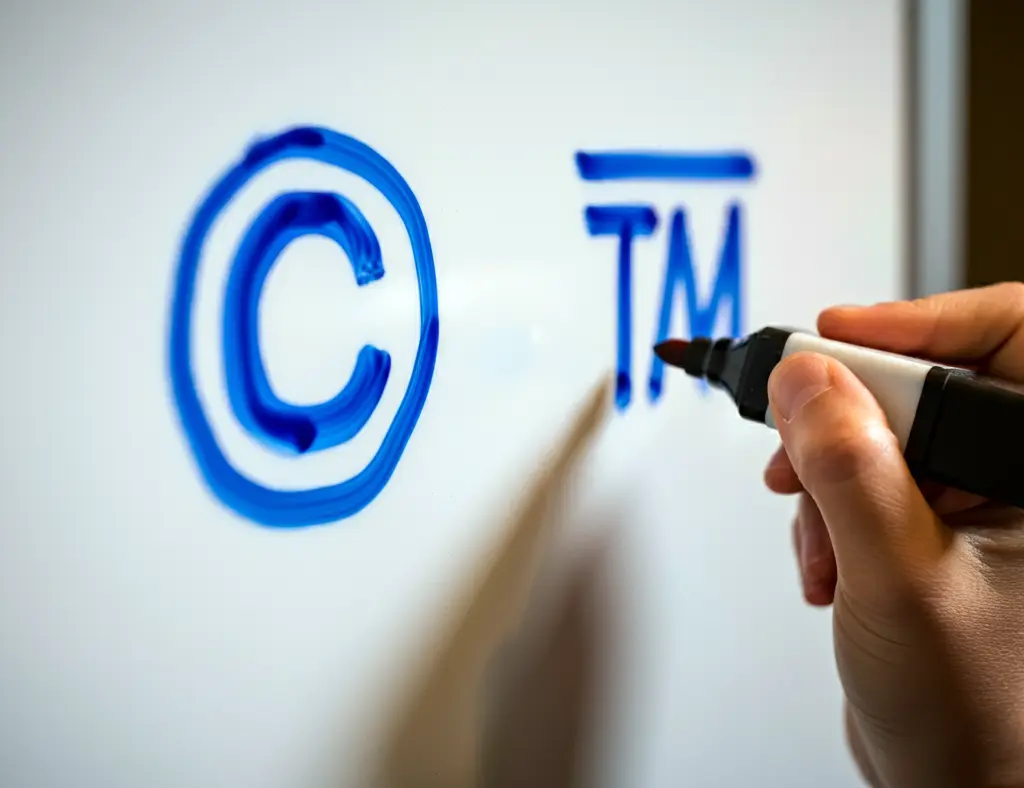
Two objections come up every time a firm hears this. The first: we paid the agency, so obviously we own the work. Payment buys the deliverable; it does not, under UK copyright’s default, transfer authorship.
Ownership of commissioned creative work moves only by written assignment. A paid invoice and a delivered file are not the same as holding the rights, and the gap between them is invisible until someone tests it.
The second: this is over-lawyering a logo. That objection holds right up until the logo stops being the point. The asset is the identity, and for a professional services firm heading into a growth phase or a sale, that identity is often the most valuable intangible on the books.
The consensus that treats protection as two forms to file secures the filings and leaves the handoffs — designer to client, sourced asset to commercial use, name to register — as the exact points where ownership fails.
| The Default Approach | What It Costs | The Better Approach | Why It Holds |
| Copyright the logo, assume the name is covered | Name legally unprotected; competitor can adopt it | File copyright for artwork and trademark for the name | Each asset protected by the system that fits it |
| Pay the designer, assume ownership transfers | Rights may remain with the freelancer | Signed assignment naming the works, source files delivered | Ownership moves only in writing under UK law |
| Clear the name after design sign-off | Rework, or a launched brand you must unpick | Clearance search before the design locks the name | The 203,194 UK applications in 2025 make a crowded register |
| File for today’s single service line | Exposure the moment the firm expands | File classes that reflect the realistic growth plan | Adjacent classes are hard to reclaim once taken |
| Trust that the logo’s fonts and icons are fine | Foundry or stock claim inherited with your mark | Audit every embedded asset’s licence for logo use | You can own the arrangement and not the parts |
The One Step Everyone Does Too Late
Here is the sequence correction that the whole guide has been building toward. Almost every rebrand runs the same order: choose the name, commission the design, launch, then handle the legal protection.
The correct order inverts the first and last moves.
Clearance and the ownership agreement belong at the start — before the name is emotionally locked in and before the designer begins — because those are the two decisions that determine whether anything downstream can actually be owned.
Steelman the common order first, because intelligent people follow it. Protection feels like a closing task: you secure what exists, so you wait until the identity is in place. The design is the exciting part, the filings are the admin, and the admin goes last.
That logic is coherent, and it is wrong, because the two things that must happen early — name clearance and rights assignment — are precisely the two that become expensive or impossible to fix late.
“Protection is not the last step of a rebrand. It is the frame in which you build the rebrand. Clear the name before you fall in love with it, and agree on the ownership before the first sketch, and every filing afterwards is a formality. Reverse that order, and the filings become damage control — securing an identity you may already have lost the right to hold.”
The replacement directive is simple: move clearance and assignment to the front of the brief. A defensible identity is not a design with legal filings bolted on afterwards. It is a rights position — a stack of owned, cleared, licensed assets — that a design is then built to occupy.
The Verdict
You do not copyright a brand. You build a defensible rights stack around it, asset by asset, and copyright is one layer of five.
The logo’s artwork is under copyright; the name is under trademark; ownership of both is under a written assignment; the freedom to use it is under clearance; and the embedded fonts and icons are under their own licences.
Miss any layer and a firm that believes it owns its identity may own considerably less than it thinks.
That is the difference between the DIY answer and the real one. The US Copyright Office and the UK IPO have made filing straightforward; the forms were never the hard part.
What no certificate repairs is a handoff that was never made — and for a firm heading into a sale, an intangible you cannot prove you own is a discount waiting to be found in due diligence.
The single action to take today: before the next rebrand brief goes out, write down every element of your current identity and, beside each, the one document that proves you own or may use it. The gaps in that list are your real IP problem.
If the list is uncomfortable, a free Brand Equity Audit™ will show you exactly where the brand is losing commercial ground — starting with the assets you thought were already yours.
Frequently Asked Questions
Can you copyright a logo and a business name together?
No, copyright can protect the original artwork in a logo, but it never protects a business name. The US Copyright Office excludes names, titles, slogans and short phrases from copyright. A name is protected through trademark registration, a separate filing that addresses the name’s role as a commercial source identifier.
How do I know if I actually own the logo my agency designed?
You own it only if you hold a written assignment of rights. Under the UK copyright’s default position, the creator owns the work unless an agreement transfers it, so a freelancer or agency can retain rights even after you have paid. A signed assignment naming the works, plus delivered source files, is the proof.
What is the difference between copyright, trademark and a design right for a logo?
Copyright protects the original artwork automatically on creation. A trademark protects the name and mark as a source identifier and requires federal or national registration to be enforceable. Design rights can protect the appearance of a product. For a logo, copyright and trademark are the two that matter most and cover different assets.
Do I need to register copyright if it exists automatically?
Registration is not required for copyright to exist, but it strengthens enforcement and provides documented proof of ownership. In the US, the Copyright Office offers registration of logo artwork under the visual arts category. Automatic copyright is real; registered copyright is enforceable with far less argument about who owns what and when.
Is it true that AI-generated logos cannot be copyrighted?
No — the position is more nuanced. The US Copyright Office’s 2025 report concluded that copyright may protect human-authored expression, arrangement or modification within an AI-assisted work, but not purely AI-generated material. A prompt alone is not enough authorship. The human contribution to the final logo is what determines protectability.
When should I run a trademark clearance search?
Before the design is finalised, not after, a clearance search checks your intended name against existing registered and unregistered marks to confirm it is free to use. Running it after launch risks discovering the name is taken once you have already invested in the full identity, forcing costly rework or a rebrand of the rebrand.
Why isn’t a logo copyright enough to protect my brand?
Because copyright protects only the artwork, not the name, and not the embedded fonts or icons inside the logo, a competitor can adopt a confusingly similar name with a different graphic, and your copyright offers no defence. Full protection requires a trademark for the name, an assignment of ownership, and licence checks for embedded assets.
How much does it cost to trademark a logo and name?
In the US, the USPTO base application fee is $350 per class as of 18 January 2025, with surcharges for incomplete information or free-form descriptions of goods and services. Costs multiply across classes, so precise class selection and complete applications directly reduce what you pay and strengthen the filing.
What happens if the font in my logo wasn’t licensed for that use?
You may not legally own the right to use your own logo. Many font foundries treat logo use as a separate, paid licence distinct from document use, and some stock icon licences prohibit trademarking the result. Auditing every embedded asset’s licence before you file is the only way to close this gap.
Does trademark registration guarantee no one can use my brand?
No registration gives you a stronger legal basis to challenge infringement, but it does not physically prevent use. Enforcement still requires you to act. A record 203,194 UK trademark applications were filed in 2025, so registers are crowded; registration establishes your priority and rights, which is what you rely on if a dispute arises.
Can I copyright a logo in the UK the same way as in the US?
The principle is similar, but the systems differ. UK copyright arises automatically upon creation, without a registration system, whereas the US requires formal copyright registration. Trademark registration exists in both the UK IPO and the USPTO. A brand operating in both markets needs to secure rights in each separately.
Why does the chain of title matter specifically for a rebrand?
Because a rebrand replaces an existing identity, both the old and the new carry ownership questions. If a previous agency was never made to assign rights, that legacy identity may not be yours to retire cleanly, and the new one repeats the risk unless the assignment is handled. Due diligence in a sale surfaces exactly these gaps.
