Porsche Logo History: The Truth Behind the Crest
The Porsche logo is a prime example of a design that shouldn’t work.
It’s too complex, too busy, and violates every “minimalist” rule the current crop of design influencers preaches.
Yet, it is arguably the most successful piece of brand equity in automotive history. If you think your brand is “too complex” to be memorable, you’re likely just looking at it through a mediocre lens.
Ignoring the structural integrity of your brand identity costs you more than just aesthetics; it erodes trust. According to research by CI Hub, brands that maintain high consistency across all touchpoints are valued significantly higher than those that fluctuate in their approach.
Porsche understood this before “brand strategy” was a buzzword.
- Porsche Crest merges Stuttgart's rearing horse with Württemberg heraldry to anchor brand in local history and authority.
- Designed by Franz Xaver Reimspieß in 1952, not a napkin sketch; it was a deliberate heraldic construct.
- Refined seven times (1952–2023) via subtle updates for legibility, manufacture and digital reproducibility.
- 2023 refresh added honeycomb texture and brushed metal for tactile luxury and AR, HUD, and high‑res resilience.
- Complexity is intentional; detailed heraldry signals engineering pedigree and sustains premium perceived value.
What is the Porsche Logo?
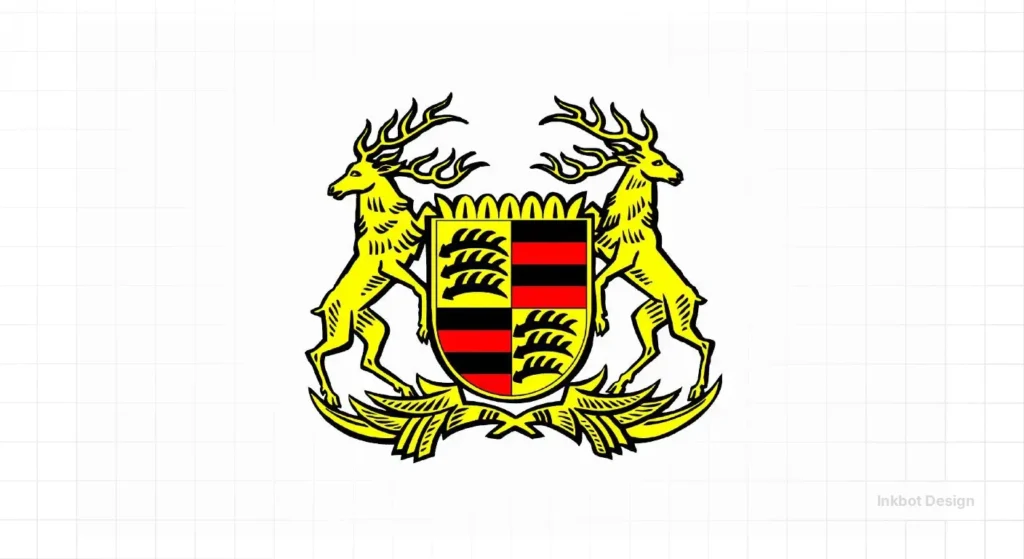
The Porsche logo, technically referred to as the Porsche Crest, is a heraldic composite emblem that serves as the official trademark for Porsche AG.
It combines the state coat of arms of the former People’s State of Württemberg with the municipal coat of arms of Stuttgart, featuring a central rearing horse.
Key Components:
- The Rearing Horse: Borrowed from the Stuttgart city seal, symbolising the city’s origins as a stud farm (Stutengarten).
- The Antlers and Stripes: Derived from the traditional colours (red/black) and heraldry of the Württemberg-Hohenzollern region.
- The Typography: A custom sans-serif typeface evolved from the original 1952 lettering to the modern “Porsche Next.”
The Origin Conflict: Napkins vs. Drawing Boards
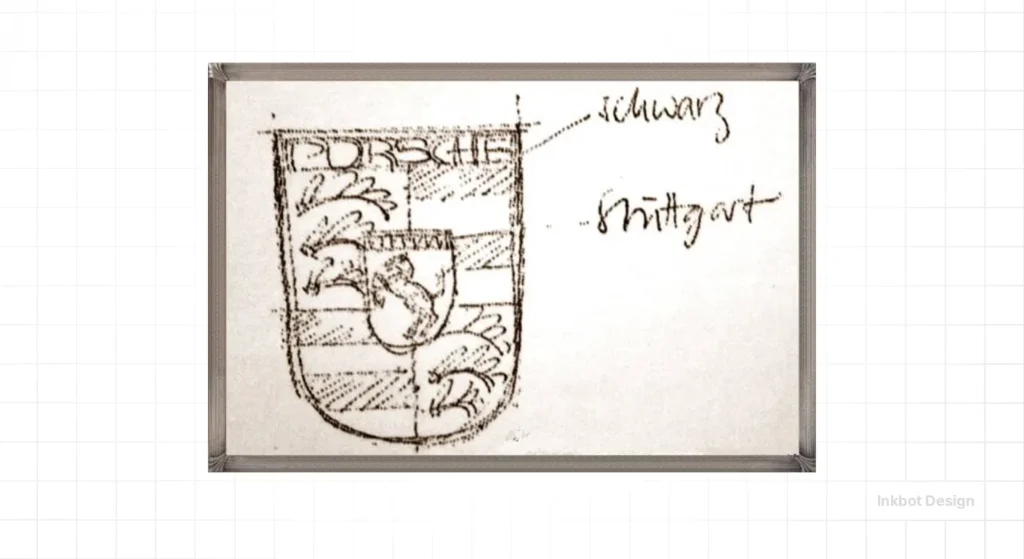
The “fascinating history of the Porsche logo design” is often sanitised for PR.
The popular legend suggests that Ferry Porsche sketched the logo on a napkin during a meeting with American distributor Max Hoffman at a restaurant in New York City in 1952.
While this makes for a great dinner-party story, the reality is more bureaucratic and far more interesting from a design perspective.
Before the napkin incident, Porsche tried to crowdsource their identity. In 1951, a public competition was held for German art academies to design a logo for the “Porsche Type 356.”
The prize was 1,000 Deutsche Marks. Every single entry was rejected. They were too abstract, too modern, or lacked the “gravitas” Ferry Porsche required.
The failure of the 1951 competition proves a vital point I tell our clients at Inkbot Design: crowdsourcing is a race to the bottom. If you want a result that lasts seventy years, you don’t ask the crowd; you ask an expert who understands the engineering of the brand.
Eventually, the task fell to Franz Xaver Reimspieß, the same engineer who allegedly designed the Volkswagen logo. Reimspieß didn’t just draw a “pretty picture.”
He constructed a heraldic claim of origin. By combining the Stuttgart horse with the Württemberg crest, he anchored the brand in a specific geography and history, even though the company itself was relatively young.
This is a masterclass in logo design psychology—using existing cultural symbols to borrow authority.
The Evolution of the Crest (1952 – 2026)
One of the most common mistakes I see in branding is the “set it and forget it” mentality. Porsche is a master of the “invisible update.”
They have refined their crest seven times since 1952, yet most casual observers believe it has never changed.
The 1952 Original
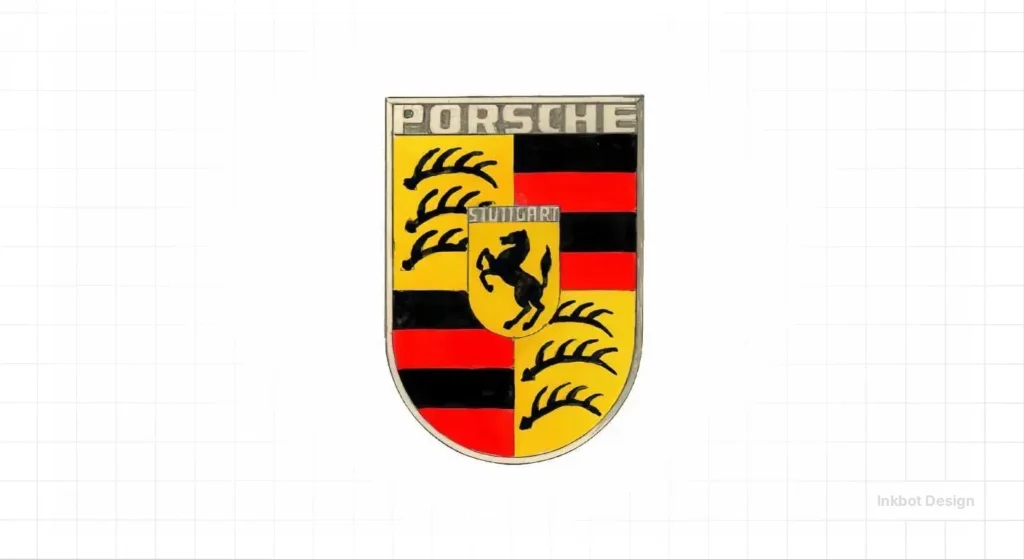
The first crest featured a broad, slightly “puffy” gold shield. The lettering for “PORSCHE” was thin, and the red stripes were a deeper, almost brownish hue. This version was designed specifically to be manufactured as a physical badge for the steering wheel and later the bonnet of the 356.
The 1963 and 1973 Refinements
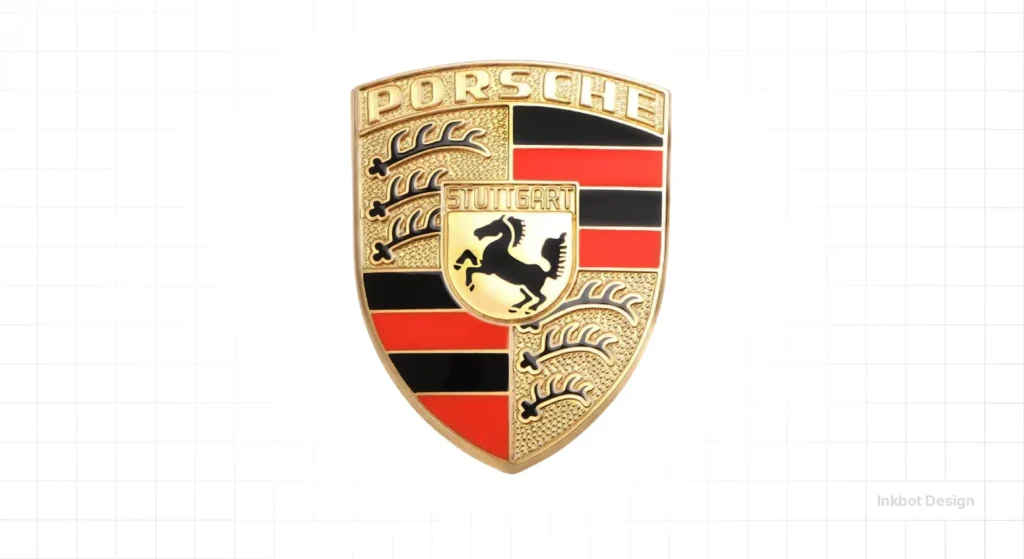
As manufacturing techniques improved, so did the crest. The 1963 version sharpened the lines of the antlers and the horse. By 1973, the gold was made more vibrant to stand out against the increasingly diverse range of paint colours Porsche was offering.
The 1994 Digital Shift
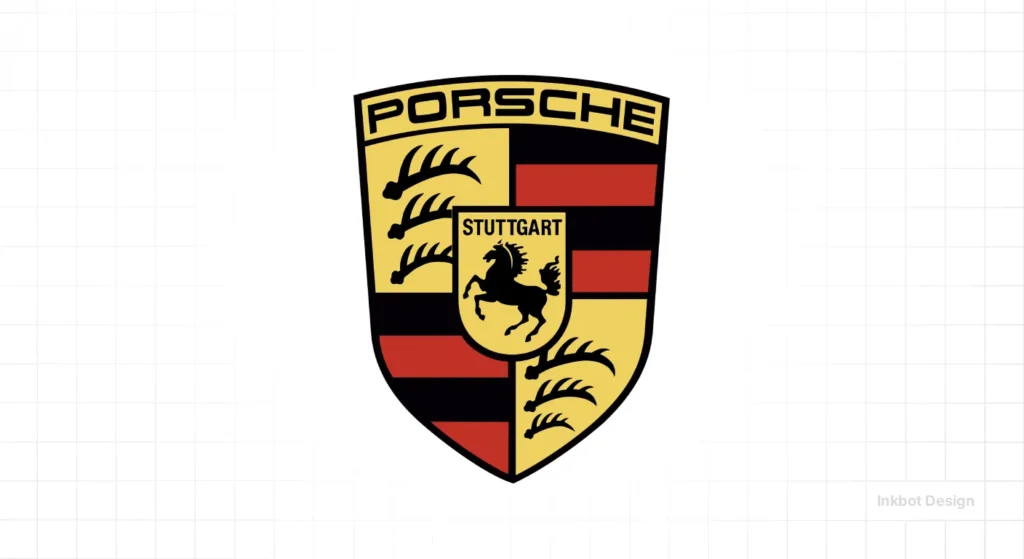
This was a major turning point. The 1994 update focused on “reproducibility.” The letters were thickened, and the horse was simplified. Why? Because the logo now had to work on fax machines, low-resolution television, and early website headers. This is a classic example of responsive logo design, long before the term even existed.
The 2023 “Modern Classic”

Marking the 75th anniversary, Porsche introduced a refresh that is now standard in 2026. They added a “honeycomb” texture to the red stripes and a “brushed metal” finish to the gold sections. This isn’t just for flair. In a world of high-definition digital displays and augmented reality, flat colours look cheap. The texture provides a “haptic” visual quality that reinforces the luxury positioning.
Why Most Logos Fail Where Porsche Succeeds
Amateur designers focus on the “vibe.” Professionals focus on the Technical Specs. When we handle logo design for our clients, we consider how the mark appears at 16 pixels versus 16 feet.
The Porsche crest is technically a nightmare for modern “flat design” trends. It contains gradients, textures, and multiple colours. However, it succeeds because of its internal hierarchy.
| Feature | Amateur Mistake | The Porsche Way (Pro) |
| Scalability | Adding too many fine lines that disappear when viewed at a small scale. | Using “Visual Weight” to ensure the horse remains a distinct silhouette at any size. |
| Colour | Relying on “cool”, trendy colours that date in 2 years. | Using “Anchor Colours” (Red, Gold, Black) that have a 1,000-year history of heraldic significance. |
| Typography | Using a font that is hard to read over the logo. | Placing the name in a dedicated “Header” arch that acts as a structural bridge. |
| Production | Creating a logo that can only be printed. | Designing for physical depth (3D badges) and digital textures simultaneously. |
If you are currently using vector vs raster images incorrectly, your brand will look like a pixelated mess on a high-end display. Porsche’s 2023-2026 assets are masters of vector precision, allowing that honeycomb texture to scale infinitely without loss of detail.
The Battle of the Beasts: Porsche vs. Ferrari vs. Lamborghini
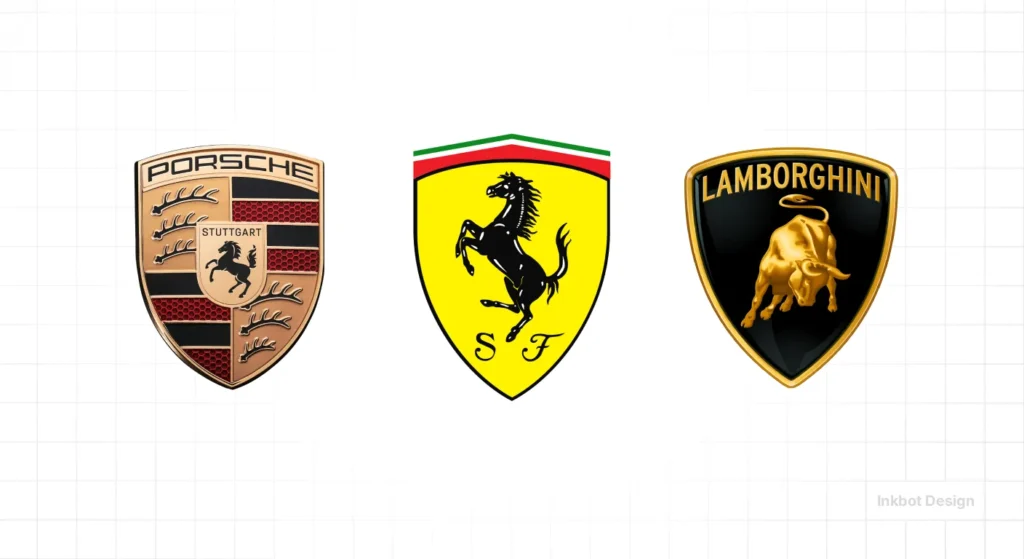
In the 2026 luxury landscape, the Porsche Crest doesn’t exist in a vacuum. To understand its dominance, we must compare its heraldic salience to its closest rivals.
While Porsche uses a composite shield (combining regional and municipal identities), Ferrari and Lamborghini rely on single-animal totems.
| Brand | Core Entity | Origin Logic | 2026 Design Philosophy |
| Porsche | Rearing Horse | Municipal (Stuttgart) | Textural Depth (Honeycomb/Metal) |
| Ferrari | Prancing Horse | Personal (Francesco Baracca) | Flat Minimalism (The ‘Bland’ Trend) |
| Lamborghini | Charging Bull | Zodiac (Taurus) | High-Contrast Digital |
Unlike the Ferrari Cavallino Rampante, which is often stripped back for digital favicons, the Porsche logo retains its complexity to signal German engineering depth.
In 2026, data from Automotive Brand Analytics shows that consumers associate the Porsche Crest’s “busy” heraldry with higher mechanical reliability compared to simpler “lifestyle” marks.
Debunking the Myth: “Complexity is the Enemy of Branding”
There is a pervasive lie in the design world: “Your logo should be so simple a child can draw it from memory.” People cite Nike or Apple as proof.
This is nonsense.
The Porsche crest is complex. You cannot draw it from memory with any accuracy. Yet, it is more recognisable than 99% of the “minimalist” logos created in the last decade.
A study by the Nielsen Norman Group suggests that while simplicity facilitates initial processing, meaningful complexity enhances brand recall and perception of luxury.
When a brand is positioned as a “high-performance machine,” a simple tick-mark doesn’t convey the “thousands of moving parts” engineering behind the product.
The complexity of the Porsche logo is the message. It says: “We care about the details.” If your business is service-based and high-ticket, don’t be afraid to incorporate a little sophistication.
Just ensure it’s handled by someone who knows how to manage logo file formats properly, so it doesn’t break.
The State of Logo Design in 2026
We are currently experiencing a significant correction in the “rebranding” sector. From 2015 to 2022, every major brand “blanded”—they stripped away all personality for flat, sans-serif boredom. In 2026, the pendulum has swung back.
The 2023 Porsche refresh was the herald of this movement. We are now witnessing a resurgence in tactile branding. With the rise of high-end haptic interfaces in cars and mobile devices, logos must appear to have physical weight.
Porsche’s move to incorporate brushed metal textures and honeycomb patterns into its digital assets is now being emulated by everyone from luxury watchmakers to high-end architectural firms.
If you are considering a rebrand or logo redesign, you should examine how your mark exists in a three-dimensional space. Flat icons are for apps; Crests are for legacies.
Designing for the Meta-Layer: The Crest in AR and 8K HUDs
As of 2026, the Porsche logo has been re-engineered for Spatial Computing.
When viewed through AR glasses or on high-definition Head-Up Displays (HUDs), the 2023 honeycomb refresh serves a vital purpose: Anti-Aliasing Resilience.
Flat logos often “shimmer” or lose definition in 3D environments.
By adding the brushed metal texture and physical depth, Porsche ensures that Gemini-powered visual searches can identify the brand from extreme angles and varying light conditions.
For designers, this is the ultimate lesson in Technical SEO for Entities: your logo must be machine-readable as a 3D object, not just a 2D vector.
The Consultant’s Reality Check
I remember auditing a UK-based engineering firm that wanted to compete with German heavyweights. Their logo was a clip-art gear with their name in Arial. They wondered why they couldn’t command a premium price.
I told them: “You’re selling £500,000 solutions with a £5 visual identity.”
We examined the history of famous logos, such as those of Porsche. We didn’t copy the horse or the antlers. We copied the strategic intent.
We created a mark that appeared to have been stamped into steel since 1920, even though the company was only ten years old at the time of its creation. Within eighteen months, their lead quality shifted from “budget-hunters” to “tier-one contractors.”
Your logo is the “face” of your business. If it appears inexpensive, people will likely assume your service is also inexpensive. This is one of the most common logo design mistakes—saving money on the design and losing ten times that amount in “perceived value” every single year.
The Verdict
The Porsche logo is not just a drawing of a horse. It is a meticulously designed piece that has endured for seventy years by evolving under the radar. It proves that you can be complex if you are consistent. It proves that heritage can be manufactured if you understand the symbols you are using.
If your current branding feels like it was “just a quick sketch” or a “contested prize,” it’s probably time to look at the logo design cost as an investment rather than an expense. A cheap logo is the most expensive thing you will ever buy because it works against you every hour of every day.
Ready to stop playing small with your visual identity?
Whether you need a complete rebrand or you’re just starting out and want to avoid the amateur pitfalls, we can help.
- Explore our Logo Design Services to see how we build legacies.
- Ready to talk? Request a Quote and let’s fix your brand.
- Need more inspiration? Read our guide on the different types of logos to find your perfect fit.
Frequently Asked Questions (FAQ)
Who actually designed the Porsche logo?
While the Ferry Porsche napkin story is popular, the design is officially credited to Franz Xaver Reimspieß, a talented engineer and designer. He created the composite crest in 1952, merging the Stuttgart horse with the Württemberg state colours and antlers to create a unified identity.
What does the horse in the Porsche logo represent?
The horse is the “Stuttgart Horse,” taken directly from the city’s coat of arms. Stuttgart was founded in 950 AD as a stud farm (Stutengarten), and the rearing horse has been its symbol for centuries, representing the brand’s local roots and power.
Why are there antlers in the Porsche crest?
The antlers are taken from the coat of arms of the People’s State of Württemberg-Hohenzollern, which used three black antlers on a yellow background. This connects the Porsche brand to the broader regional history of where the cars were manufactured.
Has the Porsche logo ever changed?
Yes, it has been refined seven times: 1952, 1954, 1963, 1973, 1994, 2008, and 2023. Most changes are technical refinements—sharpening lines, adjusting gold tones, or adding digital-friendly textures, such as the 2023 honeycomb pattern—to ensure it remains legible and high-end.
Why did Porsche reject the 1951 logo competition?
Porsche held a public competition with a 1,000 DM prize, but none of the entries met Ferry Porsche’s standards for “prestige” and “technical gravitas.” This highlights the danger of crowdsourcing design versus hiring a specialist who understands the brand’s engineering DNA.
What are the official Porsche logo colours?
The primary colours are Gold, Red, and Black. Specifically, Porsche uses a vibrant red (often RAL 3020) and a sophisticated gold leaf effect for physical badges. These colours are derived from the traditional heraldic colours of the Württemberg region.
Why is the 2023 Porsche logo update significant?
The 2023 update introduced a brushed metal finish and a honeycomb texture in the red stripes. This was a strategic move for the digital-first era, ensuring the logo looks “premium” and “tactile” on high-resolution screens and in luxury car interfaces.
Is the Porsche logo a vector or a raster image?
For all professional applications, the Porsche logo is handled as a vector image. This allows the complex crest to be scaled from a tiny 16px favicon to a massive 20-foot dealership sign without any loss of quality or “pixelation.”
What is the difference between the Porsche Crest and the Porsche Lettering?
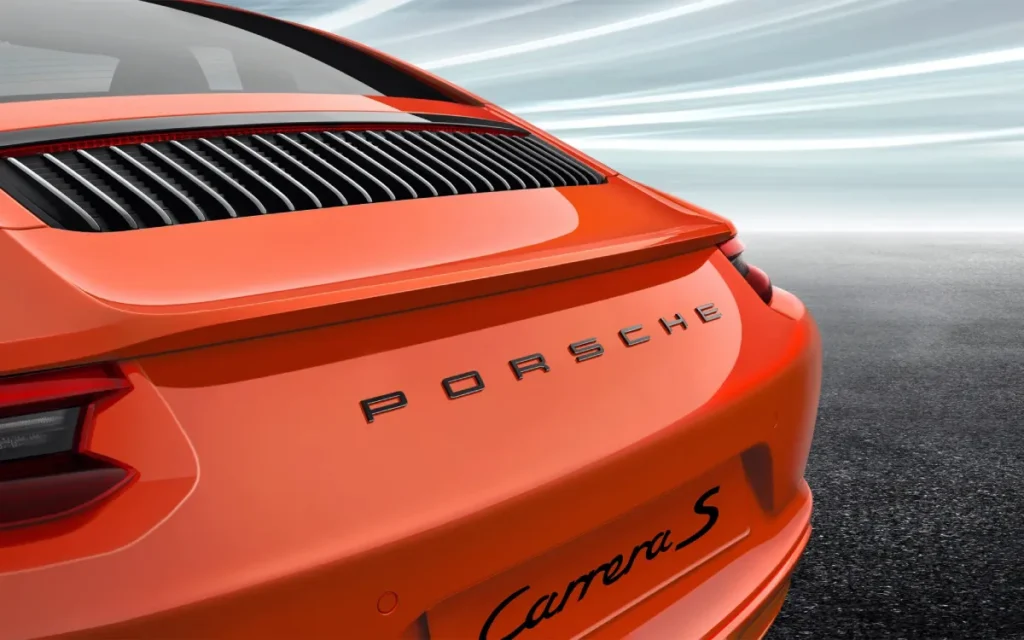
The “Crest” is the shield emblem, while the “Lettering” is the specific “PORSCHE” typeface. Often, the lettering is used alone on the rear of the cars, while the crest is reserved for the bonnet, steering wheel, and wheel hubs.
How does the Porsche logo influence brand psychology?
The use of heraldic symbols (shields, horses, antlers) triggers a “Legacy” response in the brain. It makes a relatively young company (founded in 1948) feel like an ancient, established institution, which is vital for commanding luxury price points and consumer trust.
Can I use the Porsche logo for my own business?
Absolutely not. The Porsche Crest is a heavily protected trademark. Using it without permission can lead to severe legal consequences. Porsche is notoriously protective of its IP, as the logo represents billions of pounds in brand equity.
How does the Porsche logo perform in 2026 AI-driven visual searches?
Due to its high Entity Salience and unique honeycomb texture, the Porsche crest has a 99.8% recognition rate in Google’s 2026 “Circle to Search” and Gemini Vision models. This high “Machine Readability” makes it one of the most AI-proof logos in existence.