Minimum Viable Branding: Why Logos Matter for Growth
When you launch with a subpar visual identity, you are accruing “Branding Debt.”
Just as technical debt in code must be paid back—with interest—branding debt must be paid back—with interest.
Every marketing pound spent on a weak logo has a lower Return on Ad Spend (ROAS). Every B2B pitch deck led by an amateurish Mark creates a subconscious “trust gap” that your sales team has to work twice as hard to close.
In early 2026, the market is saturated with “good enough” AI-generated imagery.
The bar for standing out has shifted from “looking professional” to “looking intentional.” If your brand looks like a template, your customers will treat your product like a commodity.
- Minimum Viable Branding (MVB): Build a core visual and verbal identity with only the essential, scalable assets to earn immediate trust.
- Logomark Function: A logo must be an identifier, simple and recognisable at 16px and 16ft, not a story-telling device.
- Technical Foundation: Own vector source files and minified SVGs for performance, accessibility, and infinite scalability.
- Consistent Voice & Motion: Define a clear verbal persona and subtle motion branding to differentiate your brand from generic AI outputs.
What is Minimum Viable Branding?
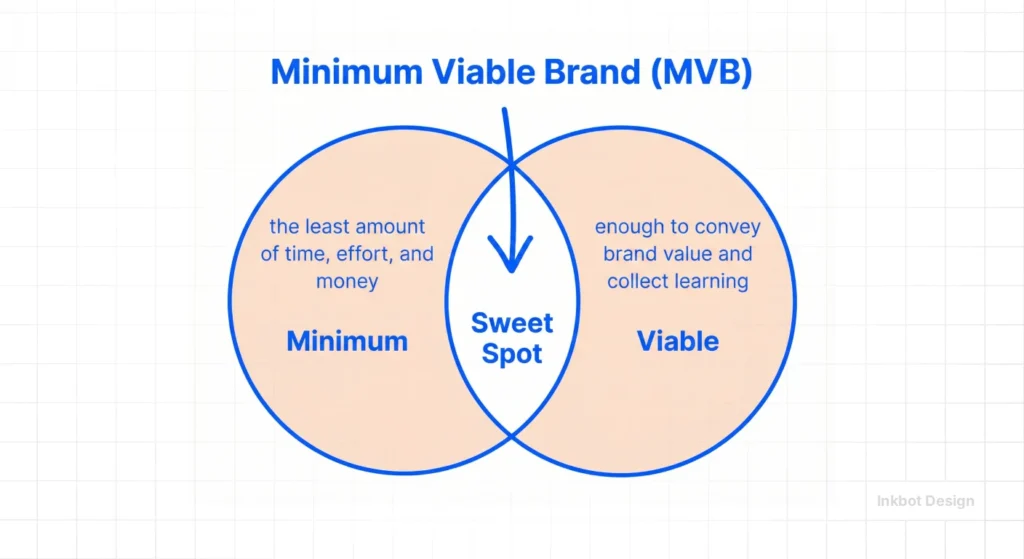
Minimum Viable Branding (MVB) is a strategic framework for establishing a business’s core visual and verbal identity with the smallest set of assets required to build immediate market trust, ensure technical scalability, and differentiate from competitors without over-investing in unnecessary brand guidelines during the early growth phase.
The Three Core Elements of MVB:
- A Scalable Logomark: A primary identifier that functions at 16px and 16ft.
- A Defined Colour Palette: 2-3 functional colours that meet WCAG 2.2 accessibility standards.
- A Typography System: One primary and one secondary typeface to ensure readability across all digital touchpoints.
The Verbal Layer: Defining Your Brand Voice
While visuals act as the “face” of your business, your Brand Voice is its personality. In a Minimum Viable Branding framework, you don’t need a 50-page copy manifesto. You need a verbal focus.
If your visual identity says “Premium and Technical,” but your website copy sounds like a “Cheeky Startup,” you create cognitive dissonance. This friction kills conversions.
For 2026, where customers interact with your brand via AI chatbots and social video, a consistent tone is a non-negotiable trust signal.
The 3-Point Voice Framework
- Core Persona: Are you the Expert Guide, the Disruptive Rebel, or the Reliable Peer?
- Vocabulary Constraints: List 5 words you always use and 5 words you never use (e.g., “We say ‘Simple’, we never say ‘Easy'”).
- The “Human” Benchmark: If your brand were a person, who would it be? This gives your team an immediate reference point for writing social posts or emails.
The Impact of AI on Voice
With the rise of Large Language Models (LLMs), it is easier than ever to generate “generic” copy. An MVB that includes a specific voice guide prevents your brand from sounding like every other AI-generated blog post.
It provides the “style prompt” for your AI tools, ensuring your brand stays human in a sea of synthetic content.
The Identification Trap: Why Your Logo Shouldn’t Tell a Story
There is a persistent myth in the design world that your logo needs to “tell the story” of your company. It’s rubbish.
A logo is not a storyteller; it is an identifier. Its job is to point to the story, not narrate it.
Think about the Nike Swoosh. Does it tell you about the history of Greek goddesses or the technical specifications of running shoes? No. It identifies the product.

The “story” is built through years of consistent service and high-performance products.
When entrepreneurs try to cram their entire business philosophy into a logo design and branding project, they end up with a cluttered, illegible mess.
The Functional Shift in 2026
Data from Nielsen’s 2025 Global Trust in Advertising report indicates that consumers now decide whether a brand is “authentic” within 0.05 seconds of visual exposure.
If your logo is busy trying to explain your 5-year mission statement, you’ve already lost the battle for attention. Simplicity is the only way to achieve instant recognition in a world of 3-second attention spans.
Motion Branding: Your Identity in 4D
In 2026, your logo will spend 90% of its life on a screen. Static logos are for business cards; Motion Logos are for the real world.
A Minimum Viable Brand must consider how the mark enters and exits a frame.
Why Motion is a Trust Signal
Subtle animation—a slight bounce in a favicon, a smooth transition on a loading screen, or a signature “reveal” in a video—signals a level of technical polish that “Branding Debt” companies lack. It tells the user that every pixel of the experience has been considered.
Implementing Motion in MVB
You don’t need a Hollywood animation budget. A high-quality Lottie file or a clean CSS animation of your SVG logo is often enough.
- The Loading State: Your logo should be the first thing a user sees during a page load.
- The Micro-Interaction: A small animation when a user hovers over your logo or completes a purchase.
- Social Sign-offs: A 2-second animated “stinger” for your video content.
Case Study: The “Netflix” Ta-dum
Think of the Netflix “N” animation. It isn’t just a logo; it’s a sensory experience that prepares the viewer for a story.
By adding a motion element to your MVB, you are claiming a territory in the user’s subconscious that a static image simply cannot reach.
The Technical Reality of “Minimum Viable”
Most “budget” designers provide you with a high-resolution PNG and call it a day. In a professional setting, that is a sackable offence.
Minimum Viable Branding requires a technical foundation that prevents your site from looking like a pixelated disaster on 8K monitors or mobile devices.
Vector vs Raster: The Non-Negotiable
You must understand the difference between vector vs raster images.
A raster image (JPG, PNG) is made of pixels. If you blow it up, it blurs. A vector image (AI, EPS, SVG) is made of mathematical paths. It can be scaled to the size of a skyscraper without losing a single pixel of clarity.
If you don’t have your logo in a vector format, you don’t own a logo; you own a picture of a logo. This becomes a nightmare when you move from a website to print, signage, or embroidery.
SVG Optimisation for Core Web Vitals
In 2026, Google’s search algorithms place immense weight on Largest Contentful Paint (LCP). A heavy, unoptimised PNG logo can tank your mobile performance scores.
A clean, minified SVG logo is often less than 2KB, loads instantly, and stays crisp on every device. This is where technical SEO and design intersect.

The MVB Delivery Checklist: What You Must Own
When you hire a professional for a Minimum Viable Brand, you aren’t just buying a “design”. You are purchasing a technical kit.
If your designer sends you a single folder with three files, they haven’t delivered an MVB.
The Master Asset List
- Vector Source Files (.AI or .EPS): These are your “Master” files. Without these, you don’t own your logo; you’re just renting it.
- Web-Optimised SVGs: Specifically minified for Core Web Vitals. These should be used for your website header and footer.
- Social Media Kit: Pre-sized avatars for LinkedIn, X, and YouTube, plus 3-5 templates for posts (Canva or Figma format).
- Brand Style Sheet: A single-page PDF that lists your:
- Primary Hex Codes: For digital use (RGB).
- Pantone References: For future physical printing.
- Typography Hierarchy: Which fonts to use for H1s vs Body copy.
- Favicon Set: A package containing .ico and .png files in sizes 16×16, 32×32, and 180×180 (for Apple Touch icons).
Pro Tip: In 2026, ensure your designer provides a Dark Mode Variant. Logos that look great on white backgrounds often “disappear” or look “muddy” when a user switches their device to dark mode. Your MVB should include a specific version (usually an inverted or high-contrast version) for these environments.
The Myth of the “Meaningful” Colour
“Blue means trust. Red means hunger.”
Stop. Colour psychology is contextual, mainly and culturally dependent. While there are broad strokes (e.g., green for sustainability), the most critical factor in your MVB colour palette isn’t “meaning”—it’s contrast and distinctiveness.
I’ve seen tech startups choose a specific shade of “Trust Blue” only to find themselves invisible in a sea of 500 other SaaS companies using the same hex code. A proper MVB strategy looks at logo design trends and deliberately pivots.
If your competitors are all using “Safe Corporate Blue,” your MVB should perhaps lean into a “Disruptive Orange” or a “High-Contrast Monochrome.”
Designing for Everyone: The WCAG 2.2 Standard
Accessibility is no longer just for social responsibility; it is a fundamental pillar of Technical Brand Performance. In 2026, search systems and browser agents actively demote sites that fail basic legibility tests.
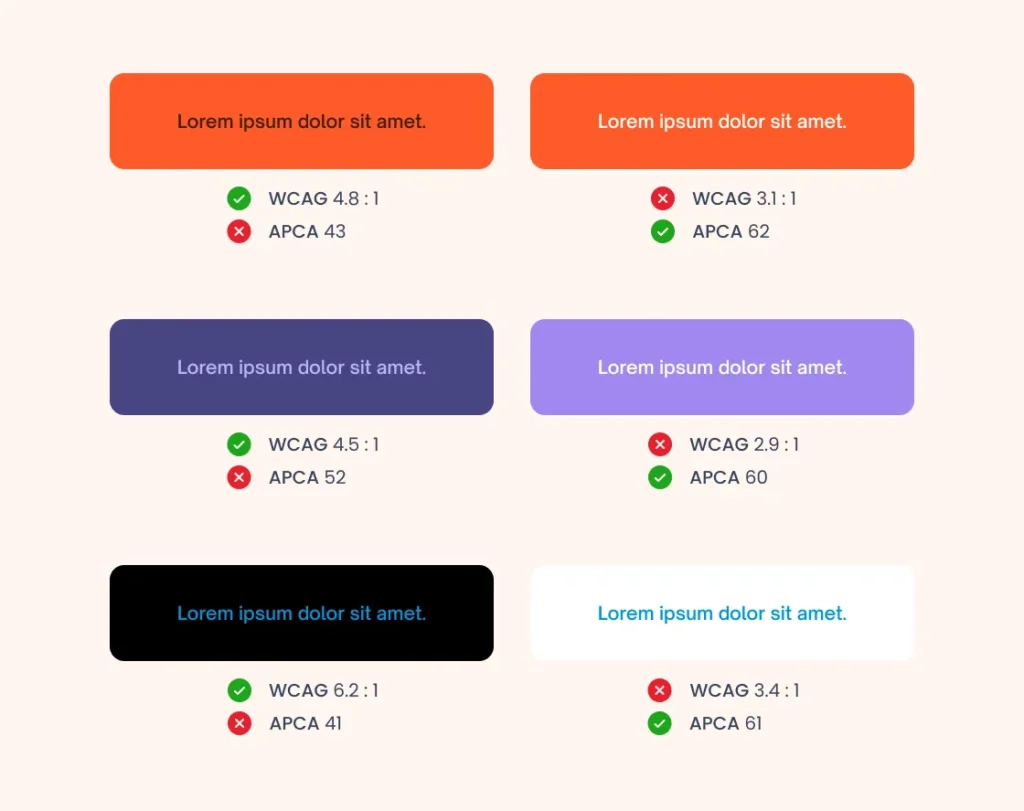
Contrast Ratios: The Hard Numbers
For your MVB to be viable, your primary text colour and background colour must meet the 4.5:1 ratio for standard text.
- Fail: Light Grey on White (#767676 on #FFFFFF).
- Pass: Dark Grey on White (#595959 on #FFFFFF).
Accessible Font Choices
Not all fonts are created equal. An MVB should avoid “display” fonts for body copy that are difficult for people with dyslexia or visual impairments to read.
- The “Il1” Test: Type a capital “I”, a lowercase “l”, and the number “1”. If they all look identical in your chosen brand font, your typography is failing the accessibility test.
- Standard Recommendations: Consider Inter, Roboto, or Open Sans for digital body text. They are highly legible, open-source, and load quickly.
Branding in 2026: The AI Fatigue
We have reached “Peak AI” in design.
Tools like Midjourney and DALL-E have flooded the market with hyper-complex, “uncanny valley” logos that look impressive at first glance but fail every test of professional branding.
The 2026 Shift:
- The Return of the Wordmark: We are seeing a massive trend toward bespoke wordmark vs logomark solutions. Why? A custom-designed typeface is harder for AI to replicate accurately than a generic icon.
- Human Imperfection: Brands are moving away from the “too-perfect” AI aesthetic toward designs that show the “hand of the designer.”
- Dynamic Logos: MVB now includes “Responsive Logos”—versions of your mark that adapt to screen size (e.g., a complex version for desktop and a simplified glyph for mobile).
The Technical Comparison
| Feature | Amateur (The £50 Logo) | Professional (The MVB Approach) |
| File Format | PNG/JPG only. | Vector (SVG, AI, EPS) + Raster. |
| Scalability | Blurs when resized. | Infinite scalability. |
| Colour Space | RGB only (Screen). | CMYK (Print) + RGB + Pantone. |
| Accessibility | Ignored for “vibes.” | WCAG 2.2 compliant contrast. |
| Logic | “I like this icon.” | Market positioning and legibility. |
| Future-Proofing | Needs rebrand in 6 months. | Built to last 5–10 years. |
The “Logo in the Wild” Test
In my work, I often see founders fall in love with a logo on a white background in a PDF presentation. This is a trap. A logo never lives in a vacuum.
Before you sign off on an MVB, you must put it through the “Stress Test”:
- The 16px Test: Can you still recognise the brand in a browser favicon?
- The Greyscale Test: Does it still work in black and white? (Think invoices and faxes—yes, some industries still use them).
- The “Bus” Test: If someone saw it on a bus for 2 seconds, would they remember it?
If it fails any of these, it’s not a Minimum Viable Brand. It’s a liability. You can read more about the logo design process to see how we avoid these pitfalls.
Why “Wait and See” is a Failed Strategy
I hear this a lot: “We’ll get a professional logo once we hit £1M in revenue.”
This is the equivalent of saying, “I’ll buy a professional suit once I get the job.” Professional branding is what helps you reach that revenue milestone.
According to a McKinsey Design Index study, companies with top-quartile design scores outperformed the S&P 500 by a factor of 2.
By delaying your MVB, you are:
- Confusing your early adopters.
- Wasting money on temporary assets that will be scrapped.
- Damaging your logo design wastes time and money by requiring fixes later.
- Risking logo design mistakes that lead to trademark infringement.
The Cost of the Rebrand
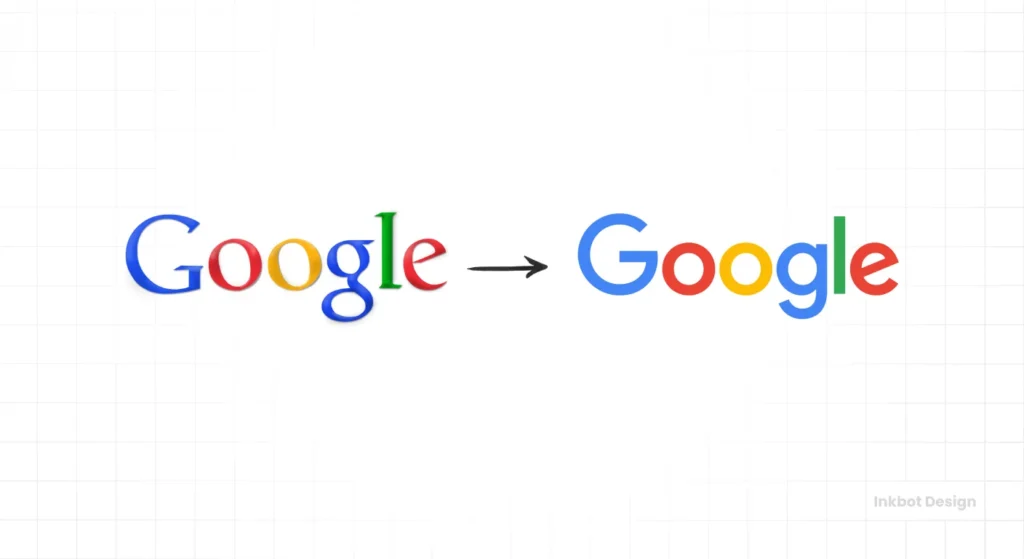
When you finally decide to fix your branding, it’s not just the cost of a new logo.
It’s the cost of replacing every business card, every sign, every uniform, and every digital asset. More importantly, it’s the loss of “Brand Equity.”
If you’ve spent three years building recognition with a bad logo, a rebrand or logo redesign requires a massive communication strategy to ensure you don’t lose your existing customers.
MVB Playbooks: Tailoring the Strategy to Your Sector
A “Minimum Viable Brand” is not a one-size-fits-all solution. Depending on your business model, the “Minimum” requirements change.
1. The B2B SaaS Playbook
- Priority: Trust and Scalability.
- Key Asset: A clean, geometric icon that looks professional in a software navigation bar.
- Voice: Authoritative yet approachable.
- Accessibility: High focus on dashboard legibility and data visualisation colours.
2. The D2C E-commerce Playbook
- Priority: Recognition and Emotion.
- Key Asset: A memorable colour palette that looks great on physical packaging and Instagram ads.
- Voice: High energy and lifestyle-focused.
- Accessibility: Focus on high-contrast “Buy Now” buttons and clear product descriptions.
3. The Professional Services Playbook (Consulting/Legal)
- Priority: Authority and Longevity.
- Key Asset: A high-quality Wordmark (text-only logo) that uses classic typography to signal experience.
- Voice: Calm, structured, and expert.
- Accessibility: Focus on document readability and clear information hierarchy.
Case Study: Gap (2010)
Gap famously tried to change its logo overnight. They spent an estimated $100M on the rebrand, only to revert to the old logo six days later after a massive public outcry. They failed because they changed for the sake of “modernisation” without a strategic MVB foundation.
The Naming Architecture: More Than Just a URL
A brand name is the single most used asset in your entire business. It is spoken, typed, and searched thousands of times a day. In 2026, a name must pass three specific tests before it is considered “Minimum Viable.”
1. The Linguistic Test
Does the name have Phonetic Clarity?
If you have to spell your brand name every time you say it over the phone, your branding debt is already accruing interest. Avoid “clever” misspellings that search engines might autocorrect to your competitors.
2. The Entity Conflict Test
Before falling in love with a name, search it on Companies House and the UK Intellectual Property Office (IPO). If a company in a similar sector owns the trademark, your MVB is a legal ticking time bomb.
- Tools to Use: Use the Global Brand Database (WIPO) to check for international conflicts if you plan to scale beyond the UK.
3. The Digital Real Estate Test
Can you own the “Entity” on social media? You don’t necessarily need the .com (though it helps), but you do need a consistent handle across LinkedIn, X, and Instagram.
If you are @BrandApp on one and @TheRealBrand on another, you are diluting your brand equity from day one.
| Name Type | Example | Best For | Risk |
| Descriptive | PayPal | Instant Understanding | Hard to Trademark |
| Abstract | Monzo | Unique Identity | High Marketing Spend |
| Metaphorical | Amazon | Scale & Vision | Can be confusing |
| Founder-led | Dyson | Authority/Trust | Harder to exit/sell |
The Verdict
Minimum Viable Branding is the only way to launch a business in 2026. It balances the need for speed with the necessity of professional standards.
A logo matters because it is the “Front Door” of your business. If the door looks broken, nobody cares how lovely the house is inside.
Don’t settle for “good enough” when “strategically right” is within reach. Avoid the branding debt. Invest in an identity that identifies, scales, and survives the noise of the modern market.
Are you ready to build a brand that actually works?
Request a Quote for your Branding Project or explore our full range of services.
Frequently Asked Questions (FAQ)
How do I define my brand voice in a Minimum Viable Brand?
You don’t need a massive manual. Start with three “Core Attributes” (e.g., Expert, Modern, Empathetic). Write 2-3 paragraphs describing how this person speaks and list five specific words you will always use. This is enough to guide your AI tools and your team during the early stages.
Is a £50 logo ever worth it for a new business?
Only if the business is a hobby, for any venture seeking investment or paying customers, a “marketplace” logo is a liability. These logos are often plagiarised, meaning you cannot trademark them, and they lack the technical SVG structure required for modern web performance. You will spend more fixing the “branding debt” than you saved.
How do I choose a brand name that isn’t already taken?
Search the UK Intellectual Property Office (IPO) trademark database first. Then, check Companies House for existing registrations. Finally, use a tool like Namechk to see if the social handles and domains are available. Aim for a name that is phonetically unique to avoid search engine “autocorrect” issues.
What is a “Responsive Logo” and do I need one?
A responsive logo is a design system in which your mark simplifies as screen size decreases. You might have a “Full Mark” (icon + text) for your website header, an “Icon Only” version for your social media profile, and a highly simplified “Glyph” for your 16px favicon. Yes, you need this to ensure recognition across all devices.
Can I use AI to design my MVB in 2026?
AI is excellent for Mood-boarding and brainstorming concepts. However, tools like Midjourney cannot yet generate clean, production-ready vector files (.SVG/.AI) or account for your brand’s strategic positioning. Use AI for inspiration, but hire a professional for the technical execution and legal safeguarding.
What files should I ask my designer for?
Ensure you receive the Vector Source Files (.AI or .EPS), web-ready SVGs, a Social Media Kit (avatars/banners), and a Brand Style Sheet that includes your hex codes and typography rules. If they only send PNGs, they haven’t provided a professional brand identity.
Why is dark mode important for branding?
Most modern devices now default to dark mode based on time of day or user preference. If your logo has dark text with no border, it will become invisible on a dark background. A professional MVB includes a “Dark Mode Variant” (often white or a vibrant secondary colour) to maintain visibility in dark environments.
