Brand Strategy Roadmap: Planning Your First Year
Most entrepreneurs treat branding like a coat of paint.
They build the house—the product, the logistics, the sales team—and then slap a logo on the front door the week before launch.
This is why 20% of small businesses fail in their first year.
They don’t have a brand problem; they have a sequencing problem.
They view branding as a visual garnish rather than the strategic infrastructure that dictates how the market perceives value.
If you are reading this, you likely understand that a logo is not a strategy.
A brand strategy roadmap is the operational document that bridges the gap between your business goals and your customers’ experience over time. It is not a marketing calendar. It is a governance plan.
During my time at Inkbot Design, I have witnessed brilliant products fail to thrive because the founders prioritised sales activation (short-term conversion) over building brand equity (long-term demand).
This guide is the antidote to that chaos. It is a structured, quarterly breakdown of exactly what you need to do in your first 12 months to build a brand that survives.
- Prioritise Phase 1: research-led positioning before any design to avoid costly pivots and ensure strategic clarity.
- Translate strategy into comprehensive visual and verbal systems (logo suite, tone, messaging) for consistent touchpoints.
- Defend consistency at launch with internal alignment, governance protocols, and simultaneous channel execution.
- Measure brand health (share of search, NPS, sentiment) and iterate annually rather than chasing short-term sales spikes.
What is a Brand Strategy Roadmap?
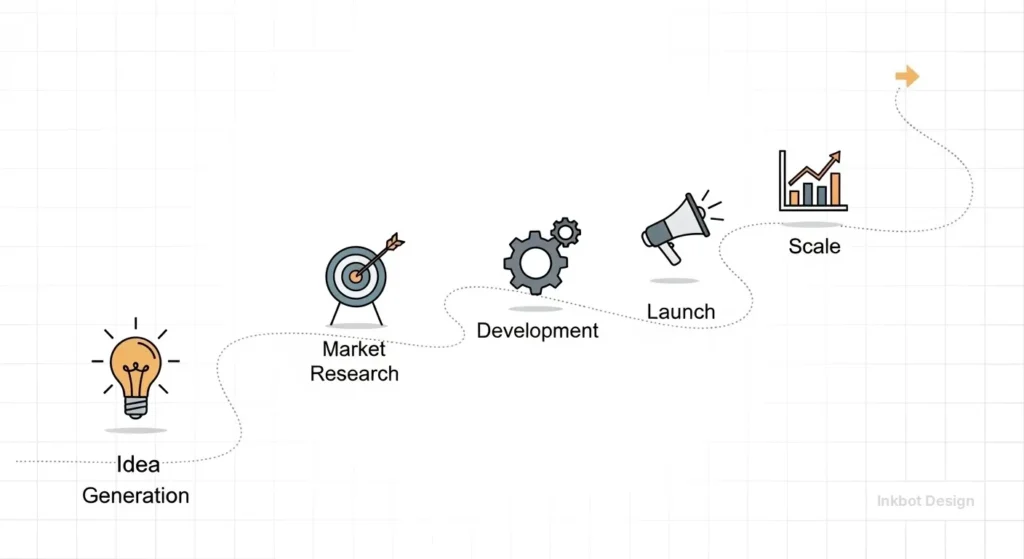
A brand strategy roadmap is a chronological plan that outlines how a business will define, build, launch, and govern its brand equity over a specific period, typically 12 to 18 months. Unlike a marketing plan, which focuses on channels and campaigns, the brand roadmap focuses on positioning, consistency, and perception.
Core Components:
- Foundational Discovery: Defining the ‘Why’ and the ‘Who’ (Positioning).
- Visual & Verbal Identity: Creating the assets (Logo, Voice, Messaging).
- Touchpoint Activation: Applying the brand to customer interfaces (Web, Packaging).
- Governance & Evolution: Rules for maintaining consistency as the business scales.
Phase 1: The Foundation (Months 1-3)
Diagnosis and Definition
You cannot build a house on a swamp. The first quarter of your roadmap is not about output; it is about input. This is the “Internal Phase.” If you launch a website in Month 1 without a clear positioning strategy, you will likely need to redesign it by Month 6.

1. The Brand Audit & Market Research
Before you spend a penny on design, you must understand the terrain. This involves a brutal assessment of your competitors. Do not just look at their logos. Look at their gaps.
- Competitor Analysis: Identify the top 5 competitors. What is their Brand Promise? Where are they failing their customers?
- Audience Personas: Move beyond “Males, 25-40.” You need psychographics. What keeps them awake at night? What are their prejudices against your industry?
Consultant’s Note: I often see clients skip research because they “know the industry.” This is dangerous arrogance. McKinsey & Company data consistently shows that companies in the top quartile for design intensity (which includes research-led strategy) outperform industry benchmark growth by as much as two to one.
Brand Strategy Health Check
Do you have a robust brand strategy, or just a nice logo? Answer 8 questions to get your Brand Health Score and find out where your business needs focus.
Question…
2. Core Strategy Definition
This is where you define the DNA of the business. You need to document these elements formally.
- Brand Purpose: Why do you exist beyond making money?
- Core Brand Values: What lines will you not cross?
- Positioning Statement: “For [Target Audience], [Brand Name] is the [Category] that [Benefit] because [Proof].”
3. Naming and Architecture
If you are a new entity, this is when your name is established. If you are an existing entity, this is when you verify that your name still suits you. Ensure your trademark checks are done here. Do not wait until Month 4 to find out your name is taken in your primary territory.
Key Deliverable: By the end of Month 3, you should have a “Brand Strategy Deck”—a PDF document that contains no visuals, only the strategic logic of the brand.
Phase 2: The Translation (Months 4-6)
Identity Design and Asset Creation
Now that the logic is solid, you apply the magic. This phase translates the strategy into tangible assets. This is where most people start, which is why they fail. Because you completed Phase 1, Phase 2 will be faster and more cost-effective, as your branding strategist won’t be making assumptions.

1. Visual Identity System
This goes beyond the logo. You are building a toolkit.
- Logo Suite: Primary, secondary, and sub-marks.
- Typography: Primary headlines and functional body copy.
- Colour Palette: Primary brand colours and utility colours for UI/UX.
- Imagery Style: Photography direction or illustration style.
2. Verbal Identity
How does the brand speak? If you are a B2B legal firm, you might choose “Authoritative and Precise.” If you are a D2C cereal brand, you might choose “Playful and Nostalgic.”
- Tone of Voice Guidelines: Examples of “Sound like this, not like that.”
- Key Messaging Matrix: Headlines for different audiences.
3. The “Touchpoint” Build
You need to apply the identity to the places where customers actually interact with you.
- Website: The most critical asset. It must embody the positioning defined in Phase 1.
- Sales Collateral: Decks, brochures, business cards.
- Packaging: If you sell physical goods, this is your 24/7 salesman.
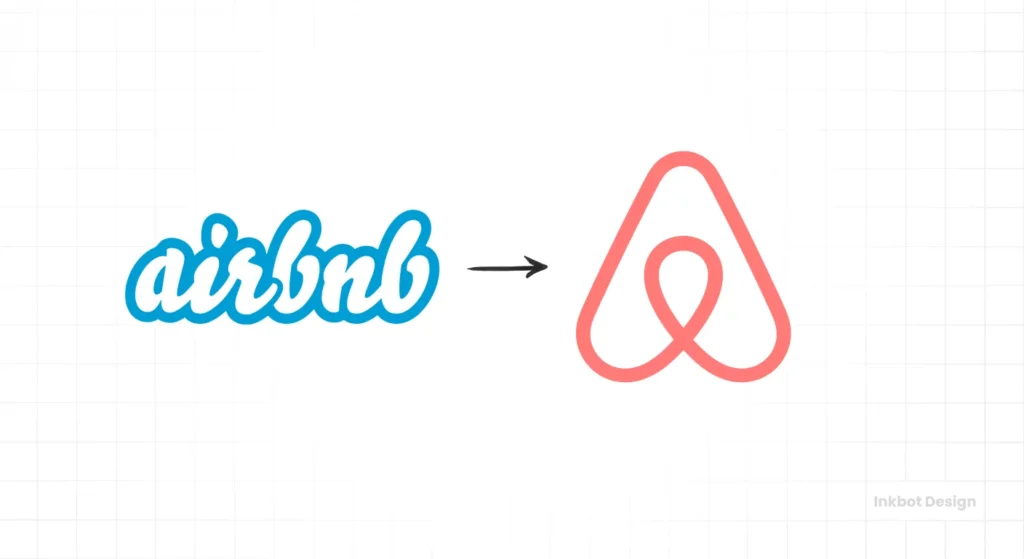
Real-World Example: Consider Airbnb. Their rebrand in 2014 was not just a logo change; it was a shift in strategy from “cheap rooms” to “belong anywhere.” The “Bélo” symbol was initially mocked, but because the strategy behind it (community and belonging) was robust, it allowed them to unify a previously disjointed global marketplace. The visual identity served the strategy, not the other way around.
Phase 3: The Launch & Governance (Months 7-9)
The “Panic Pivot” Danger Zone
This is the most dangerous period in the brand strategy roadmap. You have launched. You have spent money. And perhaps, sales aren’t skyrocketing immediately.
New founders often panic here. They think, “The branding isn’t working,” and they try to change the message, discount the price, or swap the colours. Do not do this.
1. Internal Brand Alignment
Before you market to the world, market to your team. Your employees are your brand ambassadors. If they don’t understand the Brand Essence, they cannot communicate it to customers.
- Brand Workshops: Train staff on how to use the new voice and visuals.
- Brand Guidelines: Distribute the “Bible” of how the brand looks and acts.
2. External Launch
Execute the go-to-market plan. Ensure that every channel launches simultaneously with the new identity. Inconsistency here breeds distrust.
3. The Governance Protocol
You need a system to manage and protect your brand.
- Approval Processes: Who Approves Creative Assets?
- Template Libraries: Provide your sales team with locked templates so they don’t compromise your typography with Comic Sans.
The Myth of “Instant ROI”
There is a pervasive myth that brand building delivers instant sales. It does not. Sales activation delivers sales. Branding delivers pricing power and retention.
Data Point: According to Les Binet and Peter Field’s research for the IPA (Institute of Practitioners in Advertising), the optimal balance for growth is a 60/40 split: 60% of budget on long-term brand building and 40% on short-term sales activation. If you spend 100% on activation (PPC, discounts) in Months 7-9, you will see a spike, followed by a plateau that becomes increasingly expensive to maintain.
Phase 4: Review and Evolution (Months 10-12)
Measurement and Optimisation
You have survived the first year. Now you look at the data. However, you must examine the correct data. Do not measure brand success solely by this week’s revenue.
1. Brand Health Tracking
- Share of Search: Are more people searching for your brand name on Google? This is a proxy for market share.
- Net Promoter Score (NPS): Are customers recommending you? This validates your Brand Promise.
- Sentiment Analysis: What are people saying on social media?
2. The Annual Audit
Look at all the assets created in the last year.
- Did we stay consistent?
- Did the website convert as expected?
- Does the visual identity scale to new product lines?
If you find that your “Premium” brand is being forced to offer 50% discounts to close sales, your positioning is misaligned with the market reality. You may need to refine your value proposition.
| Feature | The Amateur Approach (Fail) | The Pro Approach (Scale) |
| Budgeting | Spending 90% on logo, 10% on strategy. | Spending 40% on strategy, 60% on execution. |
| Timeline | “We need it yesterday.” | “We need it right for the next 5 years.” |
| Consistency | Changes colours based on personal mood. | Adheres to guidelines even when they are boring. |
| Focus | Visuals (Logo, Colours). | Value (Promise, Experience). |
| Reaction | Pivots strategy after one bad month. | Trusts the data and plays the long game. |
Brand Strategy in Three Steps
This book focuses on creating an authentic and consistent brand strategy by aligning it with your company’s core values. The author, Jay Mandel, argues that companies that skip essential steps risk appearing inauthentic and out of touch with consumers.
As an Amazon Partner, when you buy through our links, we may earn a commission.
The State of Brand Strategy in 2026: The AI Factor
We cannot discuss a roadmap for the coming year without addressing Artificial Intelligence. By 2026, the barrier to creating “average” branding has dropped to zero. Anyone can generate a logo in Midjourney or a mission statement in ChatGPT.
This creates a paradox: Because average is free, distinctiveness is priceless.
In your roadmap, you must account for the “Sea of Sameness.” If you use AI to generate your strategy, you will sound exactly like your competitors who used the same prompt. Utilise AI for efficiency (such as summarising research and generating mood board concepts), but refrain from using it for core strategy or final execution.
The brands that win in 2026 will be the ones that feel undeniably human. Hand-drawn elements, idiosyncratic tone of voice, and high-touch customer service will become premium differentiators in an automated world.
The Founder’s Bias
I recently audited a tech startup in London. They had spent £50,000 on a rebrand. The logo was beautiful. The website was slick. But six months in, they were bleeding cash.
Why? Because the founder refused to accept the research from Phase 1. The research showed customers wanted “reliability and speed.” The founder wanted the brand to be “edgy and disruptive.”
They built a brand for the founder’s ego, not for the customer’s needs.
Your brand strategy roadmap must be objective. It is not a canvas for your personal artistic expression. It is a business tool designed to solve a commercial problem. If you find yourself saying, “I just don’t like that shade of blue,” ask yourself: “Does the customer like it? Does it differentiate us on the shelf?”
If you cannot separate your personal taste from strategic necessity, you need an external partner to facilitate the process. That is usually where we come in.
The Verdict
A brand strategy roadmap is not administrative paperwork. It is the script for your business’s survival.
- Months 1-3: define the truth.
- Months 4-6: Design the symbols of that truth.
- Months 7-9: Defend the consistency of that truth.
- Months 10-12: Measure the impact of that truth.
If you skip the first phase, the rest is decoration. If you skip the third phase, the rest is wasted money.
The market is noisy. Without a map, you are just another voice shouting in the dark. Plan your year, stick to the strategy, and build something that lasts longer than a Facebook ad cycle.
Frequently Asked Questions (FAQ)
What is the difference between brand strategy and marketing strategy?
Brand strategy defines who you are and why you exist (long-term). Marketing strategy defines how you communicate that to sell products (short-term). Brand is the culture; marketing is the tactic. You need the brand strategy first to guide the marketing plan.
How long does it take to create a brand strategy roadmap?
A comprehensive roadmap creation process typically takes 4–6 weeks of research and definition before execution begins. However, the roadmap itself covers the execution over 12–18 months. Rushing the initial strategy phase usually leads to expensive pivots later.
Do I need a brand strategy if I am a small business?
Yes. In fact, SMBs need it more than corporations. Large companies can survive mistakes with massive advertising budgets. Small businesses rely on trust and distinctiveness to compete. A clear strategy ensures you don’t waste your limited budget targeting the wrong audience.
What is a brand audit, and why is it necessary?
A brand audit is a health check of your current brand position. It analyses your visual consistency, messaging, and competitor standing. It is necessary to identify gaps between how you think you are perceived and how the market actually perceives you.
How much should I budget for branding in my first year?
While variable, a common benchmark for serious startups is 5-15% of projected revenue. This includes strategy, identity design, website development, and launch assets. Allocating too little here often results in a “cheap” perception that hinders pricing power.
Can I change my brand strategy later?
You can, but it is costly. This is called “repositioning.” It involves changing your promise and often your identity. While evolution is natural (e.g., refreshing a logo), changing the core strategy (e.g., shifting from “Luxury” to “Budget”) can confuse existing customers and should only be done if the business model itself undergoes a significant change.
What is the role of a Brand Strategist?
A branding strategist acts as an architect. They research the market, interview stakeholders, and synthesise the data into a clear plan. They ensure the creative work (design) aligns with the business goals (revenue/growth), preventing subjective design choices.
Why is consistency important in a brand roadmap?
Consistency builds memory structures. Customers need to see the same codes (colours, tone, logo) repeatedly to remember you. If you change your look every three months, you essentially reset that memory, burning the money you spent on previous marketing efforts.
How do I measure the success of my brand strategy?
Success is measured through Brand Equity metrics: Brand Awareness (do they recognise you?), Brand Salience (do they think of you at the moment of purchase?), and Brand Sentiment (do they like you?). Financial metrics include reduced price sensitivity and lower cost of customer acquisition over time.
Should I use AI for my brand strategy?
Use AI for research summarisation and ideation, but not for final strategy or design. AI relies on existing patterns, meaning it produces “average” results. Effective branding requires differentiation, which often comes from human insight and counterintuitive creative leaps that AI cannot replicate.
