Brand Management vs Brand Strategy: The Guide for SMBs
Most entrepreneurs treat their brand like a rotisserie chicken. They set it, forget it, and hope it stays hot.
They spend thousands on a “Brand Strategy”—a glossy PDF full of archetypes, mission statements, and mood boards—and assume the work is done.
Six months later, the sales team is using the wrong logo, the social media manager has deviated from the tone of voice, and the website resembles a ransom note.
This is not a failure of strategy. It is a failure of brand management.
If you do not understand the difference between brand management vs brand strategy, you are not building a brand; you are just burning cash on graphic design.
Strategy is the logic; management is the logistics. Strategy is the map; management is the driving. One defines who you are; the other proves it, every single day, forever.
In this guide, we will strip away the marketing fluff. We will look at the operational realities of maintaining a brand, why most SMBs fail at the “management” phase, and how to stop your business identity from drifting into irrelevance.
- Brand strategy defines the logic—positioning, audience, and identity—while brand management enforces and operationalises it daily.
- Without governance, DAM, and a Brand Guardian, "brand drift" occurs, eroding consistency, trust, and revenue.
- Measure and evolve: audit assets regularly, track equity (NPS, awareness), and balance creation with ongoing maintenance.
What is Brand Management vs Brand Strategy? (The Difference)
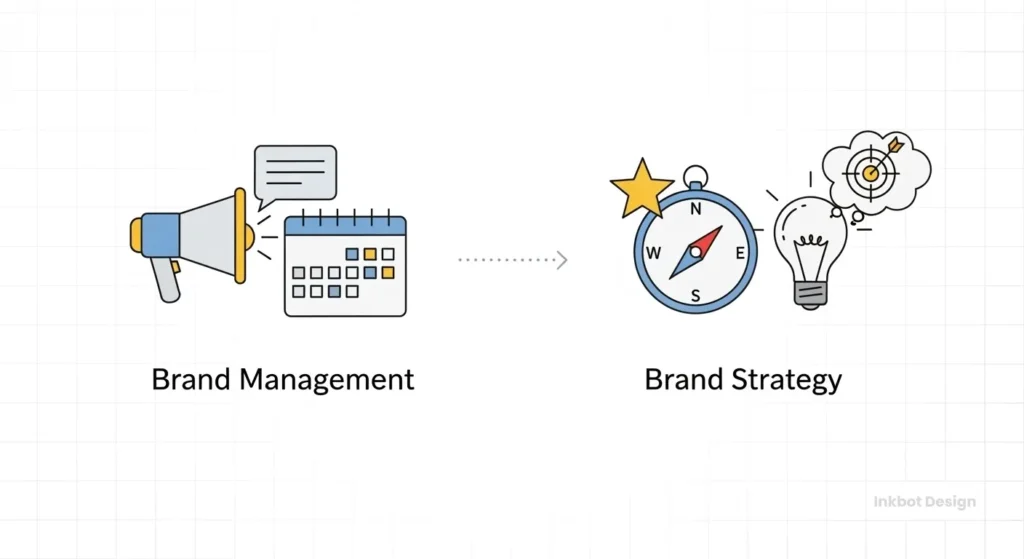
To fix the problem, we must first define the terms with forensic accuracy. These are not synonyms. They are two distinct phases of the same lifecycle.
What is Brand Strategy?
Brand Strategy is the foundational logic behind your business’s existence. It is a defined plan that outlines how you will differentiate yourself from competitors, who you are talking to, and why they should care. It is usually a finite project with a clear beginning and end (though it should be reviewed annually).
Key Components:
- Positioning: Where you sit in the market relative to competitors.
- Target Audience: The psychographics and demographics of your ideal buyer.
- Brand Core: Purpose, Mission, Vision, and Values.
- Visual & Verbal Identity: The logo, colour palette, typography, and tone of voice.
What is Brand Management?
Brand management is the continuous act of governing, measuring, and maintaining that strategy over time. It is an operational function. It ensures that the promise made by the strategy is kept across every touchpoint, from your invoices to your Instagram stories.
Key Components:
- Governance: Policing the usage of assets to ensure consistency.
- Equity Measurement: Tracking the tangible value of the brand (NPS, awareness, loyalty).
- Asset Management: Organising files so teams can find the right SVG, not a pixelated JPEG.
- Evolution: Making micro-adjustments to keep the brand fresh without breaking the strategy.
The Consultant’s Rule: Strategy is the Promise. Management is the Proof.
The Anatomy of Brand Strategy (The Blueprint)
Before you can manage anything, you need something to manage. Brand strategy is the blueprint. You cannot hire a contractor to build a house if you haven’t consulted an architect.
1. Market Positioning and Differentiation
Strategy begins with a hard look at the mirror and the market. We analyse where the gaps are. If every competitor in the fintech space is using blue serif fonts and talking about “trust,” a strategic pivot might be to use green sans-serif and talk about “speed.”
This involves “Zero-Based Thinking.” If you were building this company today, with the knowledge you have now, would you build it the same way? If the answer is no, your strategy needs work.
2. The Brand Architecture
This is often ignored by SMBs until it is too late. Brand architecture defines the relationship between your company and its products.
- Branded House: Google (Google Maps, Google Drive, Google Photos).
- House of Brands: Unilever (Dove, Axe, Hellmann’s).
- Hybrid: Coca-Cola (Coca-Cola, Diet Coke, but also Sprite).
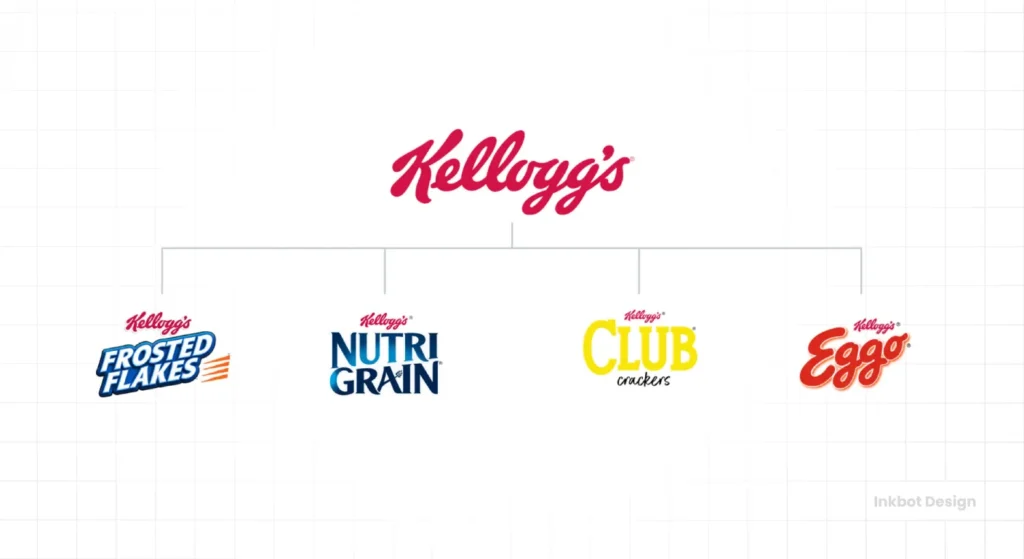
Defining this is a strategic decision. If you launch a new product next year, will it have its own logo, or will it be part of the master brand? Deciding this ad hoc creates confusion. Deciding it strategically creates equity.
3. The Visual and Verbal DNA
This is what most people think branding is. It includes the Brand Identity Services that agencies like ours provide.
- Visual: Logo, typography, colour psychology, photography style.
- Verbal: Taglines, manifesto, vocabulary, and the “Don’t Say” list.
The output of Strategy:
The tangible output of the strategy phase is typically a set of Brand Guidelines (also known as a Brand Bible). This document is the law. But laws are useless without a police force. That is where management comes in.
The Mechanics of Brand Management (The Construction)
Strategy is sexy. It involves creative meetings, mood boards, and big ideas. Brand management is unsexy. It involves file naming conventions, policing junior designers, and saying “no” to the sales director who wants to make the logo bigger.
But this is where the money is made.
1. Brand Governance and Guardianship
Brand governance is the system you establish to ensure compliance. Without governance, “Brand Drift” occurs. This is the gradual erosion of your identity as different departments tweak assets to suit their immediate needs.
The Symptoms of Poor Governance:
- The sales team is using a logo from 2018 in their PowerPoint decks.
- The company’s email signature has six different variations.
- The tone of voice on LinkedIn is professional, but on Twitter and X, it’s chaotic.
The Solution:
You need a “Brand Guardian.” In a large corporation, this role is typically filled by a dedicated Brand Manager. In an SMB, this might be the Marketing Director or a founder who refuses to compromise. Their job is to review creative output against the guidelines.
2. Digital Asset Management (DAM)
You cannot manage a brand if your assets are scattered across three different Google Drive folders, a Dropbox, and the CEO’s desktop.
Brand management requires a Single Source of Truth. A DAM system is a centralised repository where only approved assets are available. If a team member downloads a logo, they get the correct hex code and the correct file format. If you update the logo, it updates everywhere.
Why this matters:
Consistency builds trust. Trust builds equity. According to data from Marq (formerly Lucidpress), a consistent brand presentation across all platforms can increase revenue by up to 23%. You are leaving money on the table because you are too disorganised to file your SVGs correctly.
3. Brand Equity Measurement
Strategy assumes the brand will be valuable. Management measures if it actually is.
You cannot improve what you do not measure. Brand management involves tracking metrics that indicate the health of the brand.
- Brand Awareness: Do people know you exist? (Share of Search).
- Brand Associations: What words do people link to your brand? (If you are a luxury brand, but people associate you with “cheap,” your management has failed.)
- Net Promoter Score (NPS): Are your customers becoming advocates?
4. The Internal Brand Launch
External marketing brings customers in; internal branding keeps them there. Brand management is heavily focused on employees. Do your staff understand the brand values?
If your strategy claims to be “Innovation-Led,” but your internal IT systems date back to 2005, and your management style is hierarchical, your employees will become cynical. They will leak that cynicism to your customers. Brand management ensures that the culture aligns with the commercials.
The “Drift” – Why Strategy Fails Without Management
Let’s talk about entropy. In physics, entropy is the measure of disorder in a system. The Second Law of Thermodynamics states that as time progresses, entropy (a measure of disorder) increases.
The same applies to branding.
The day you launch your new brand strategy is the day of maximum orders. Everyone is excited, the guidelines are fresh, and the assets are perfect. From that day forward, the natural tendency of the universe is to tear your brand apart.
The Sources of Brand Drift:
- New Hires: A new marketing assistant joins. They prefer the font Open Sans over your corporate font, Helvetica. They make one social post with it. Nobody corrects them. Three months later, half your Instagram is in Open Sans.
- Agency Fragmentation: You hire an SEO agency, a PPC agency, and a web dev agency. None of them talks to each other. Each interprets your guidelines slightly differently.
- The “Boredom” Factor: Your internal creative team gets bored with using the same blue layout. They decide to “spice it up” with orange.
The Management Fix:
Brand management fights entropy. It requires constant energy input to maintain order. This means regular audits. We recommend a “Quarterly Brand Audit.”
- Print out your last 10 emails, your homepage, your brochure, and your latest social posts.
- Lay them on a table.
- Do they appear to be from the same company?
- If not, find the source of the drift and eliminate it.
Real-World Failures and Successes
We can learn more from a crash than from a smooth landing. Let’s examine historical examples where a disconnect between strategy and management led to chaos.
Failure: Tropicana (2009)
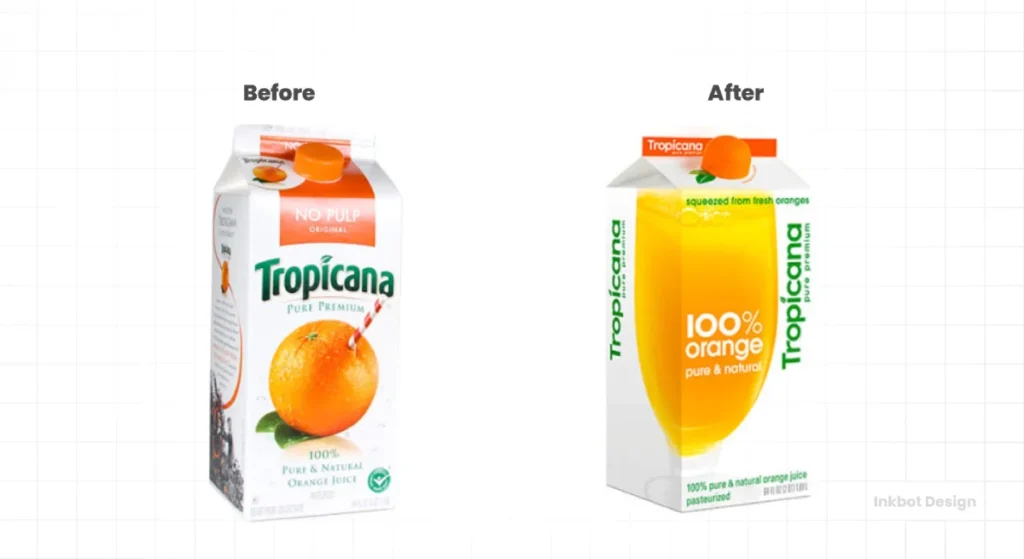
The Context: Tropicana, owned by PepsiCo, decided to refresh its packaging.
The Strategy: To modernise the brand and make it look “premium” and “pure.”
The Failure: The management team ignored the core distinctive assets that made the brand recognisable—the orange with the straw in it. They replaced it with a generic glass of orange juice.
The Result: Consumers literally could not find the product on the shelf. Sales plummeted by 20% in two months, resulting in a loss of over £25 million to the company. They reverted to the old packaging immediately.
The Lesson: Brand management means protecting your “Distinctive Brand Assets.” You can change the strategy, but you must manage the transition without blinding your customers.
Success: Intel (The “Intel Inside” Era)
The Context: Intel sells computer chips. A boring, invisible component.
The Strategy: To make an ingredient product essential to the consumer.
The Execution: They didn’t just run an ad. They managed a rigorous “co-op” program where computer manufacturers (Dell, HP) got money back if they placed the “Intel Inside” logo on their machines and packaging.
The Result: Strict management of that logo placement turned a commodity component into a mark of quality. Even today, people look for the sticker. That is operational genius, not just creative flair.
The Wrong Way vs The Right Way
Here is a breakdown of how amateurs handle these concepts versus how professionals do it.
| Feature | The Amateur Approach | The Professional Approach |
| Guidelines | A one-page PDF buried in an email chain. | A live, cloud-based Design System (e.g., Zeroheight). |
| Asset Access | “Just Google the logo and use that.” | A centralised DAM with permission controls. |
| Tone of Voice | Depends on who is writing the post. | Defined vocabulary lists and A/B tested copy. |
| Reaction to Market | Panic pivots every 6 months. | Measured evolution based on long-term data. |
| Budget | 100% on Creation, 0% on Maintenance. | 40% on Creation, 60% on Maintenance/Activation. |
| Responsibility | “Everyone owns the brand.” (So, no one). | A dedicated Brand Guardian or Agency Partner. |
The State of Brand Management in 2026
We are entering an era where brand management is becoming increasingly automated. Over the last 18 months, we have witnessed a significant shift in how AI influences brand governance.
The Rise of Algorithmic Guardianship:
New tools are emerging that can scan your creative assets before they go live. Platforms integrated with Adobe Creative Cloud can now flag a design if it uses the wrong hex code or if the copy violates the brand’s sentiment analysis parameters.
Generative AI and the “Sea of Sameness”:
As more companies utilise Midjourney and ChatGPT to create content, brands are beginning to look and sound increasingly similar. The “Strategy” for 2026 is hyper-humanisation. The “Management” challenge is preventing your team from using generic AI outputs that dilute your proprietary voice.
If you are not governing how your team uses AI, you are effectively outsourcing your brand personality to a large language model. That is a strategic suicide mission.
The Consultant’s Reality Check
I have audited hundreds of businesses. I often walk into a boardroom, and the CEO proudly shows me their “Brand Strategy.” It’s beautiful. It cost them £50,000. It’s bound in leather.
Then I ask to see their last five sales invoices. They are ugly, formatted in Excel default fonts, with a pixelated logo stretched horizontally at the top.
I ask to see their recruitment ads. They use stock photos of people high-fiving that bear no resemblance to their actual culture.
This is the reality check: Your brand is not what is in the leather-bound book. Your brand is the invoice.
Your brand is the 404 error page on your website. It is the way your receptionist answers the phone. It is the packaging tape on your boxes.
Entrepreneurs love Strategy because it feels like a possibility. They hate Management because it feels like work. But if you want to build an asset that can be sold for a multiple of revenue, you need to fall in love with the work.
If you are tired of your brand looking inconsistent, or if you feel like you’ve lost the plot since your initial launch, it might be time to stop strategising and start managing. Or, perhaps, you need a partner who can do both.
The Verdict
Do not confuse the map with the terrain.
- Brand Strategy is the decision to climb Everest. It involves selecting the route, checking the weather, and purchasing the necessary gear.
- Brand Management is the climb itself. It checks your oxygen levels, ensuring you don’t fall into a crevasse, and helps you put one foot in front of the other when you are exhausted.
You can have the best strategy in the world, but if your management fails, you die on the mountain. Conversely, you can manage a bad strategy perfectly and simply arrive at the wrong destination very efficiently. You need both.
Start by auditing your assets today. Look for the drift. If you find it, don’t just fix the asset—fix the system that allowed it to happen.
Ready to stop the drift?
If your brand has become a mess of conflicting visuals and confused messaging, we can help you regain control. From rigid Brand Identity creation to ongoing guardianship, we ensure your business looks as professional as it is. Request a Quote today, and let’s fix this.
Frequently Asked Questions (FAQ)
What is the main difference between brand management and brand strategy?
Brand strategy is the initial plan defining your positioning, audience, and identity (the “why” and “what”). Brand management is the ongoing execution, governance, and maintenance of that plan over time (the “how” and “when”).
Can I manage a brand without a brand strategy?
No. Managing without a strategy is just aimless administration. You need a defined standard (strategy) to measure your performance against. Without a strategy, you are just making random aesthetic choices.
How often should I update my brand strategy?
Review your strategy annually to ensure it remains aligned with current market conditions. However, a full strategic overhaul (rebrand) should only happen every 5–10 years or during major business pivots.
What are the best tools for brand management?
Digital Asset Management (DAM) systems, such as Brandfolder or Bynder, are essential for managing digital assets. For smaller businesses, a well-organised cloud drive with strict permissions and a cloud-based brand guideline tool, such as Zeroheight, works well.
Who is responsible for brand management in an SMB?
Ideally, a Marketing Manager or Brand Manager. In smaller teams, the Founder must act as the “Brand Guardian,” enforcing consistency until a dedicated role can be hired.
What is “Brand Drift”?
Brand Drift is the gradual inconsistency that creeps into a brand over time due to a lack of governance. It occurs when different teams or agencies tweak brand assets, diluting the core identity.
How does brand management affect brand equity?
Consistent brand management builds trust and recognition. This accumulates into brand equity (value). Inconsistent management confuses customers, eroding trust and lowering the brand’s financial value.
Is a logo refresh considered a strategic or management decision?
It is usually part of a strategic update. However, rolling out the new logo across thousands of assets and ensuring the old one is never used again is a crucial task in brand management.
Why does brand consistency matter for revenue?
Consistency aids recall. If a customer sees the same visual cues across social media, email, and your website, they are more likely to trust and make a purchase. Research suggests consistency can increase revenue by over 20%.
What is a Brand Guardian?
A Brand Guardian is a person or agency designated to approve or reject creative work based on the brand guidelines. They act as the “police” to prevent off-brand content from going live.