The Best Camera for YouTube: A Guide for Business Owners
I’ve been in a studio with a CEO who had just dropped £8,000 on a RED Cinema camera package. He wanted to “dominate” YouTube.
Six months later, his channel had three videos. Why? Because the camera was so complex, it required a dedicated technician just to turn it on and off. He bought a Ferrari to drive to the corner shop.
Most “best camera for YouTube” guides are written by gear-heads for gear-heads. They obsess over frame rates and “cinematic bokeh” whilst ignoring the only metric that matters to you: Return on Investment (ROI).
If your gear setup takes two hours to build, you will stop making videos. If the files are too large for your laptop to edit, you will stop making videos.
Ignoring your video setup costs you money.
In a digital-first economy, your video quality is your digital storefront. A grainy, poorly lit video doesn’t just look “indie”—it looks amateur.
Gartner reports that 80% of B2B sales interactions will happen via digital channels by 2026. If your “storefront” looks like a basement, don’t be surprised when clients walk away.
- Prioritise workflow efficiency over highest specs to ensure consistent content creation and strong ROI.
- Ensure reliable autofocus, external audio input, and at least 60 minutes thermal stability.
- Invest in good lenses and lighting; optics and illumination improve perceived quality more than sensor size.
- Audio matters half of the perceived quality; use lavalier or wireless systems and avoid onboard mics.
What is the Best Camera for YouTube?
The best camera for YouTube is a digital imaging device that strikes a balance between technical output (resolution and colour depth) and operational efficiency to facilitate consistent video content marketing. It must offer reliable autofocus, external audio inputs, and a workflow that matches your editing capabilities.
- Reliable Autofocus: The camera must track your face without “hunting” or blurring.
- Audio Connectivity: A dedicated 3.5mm or XLR input is a non-negotiable requirement.
- Thermal Stability: It must record for at least 60 minutes without overheating.
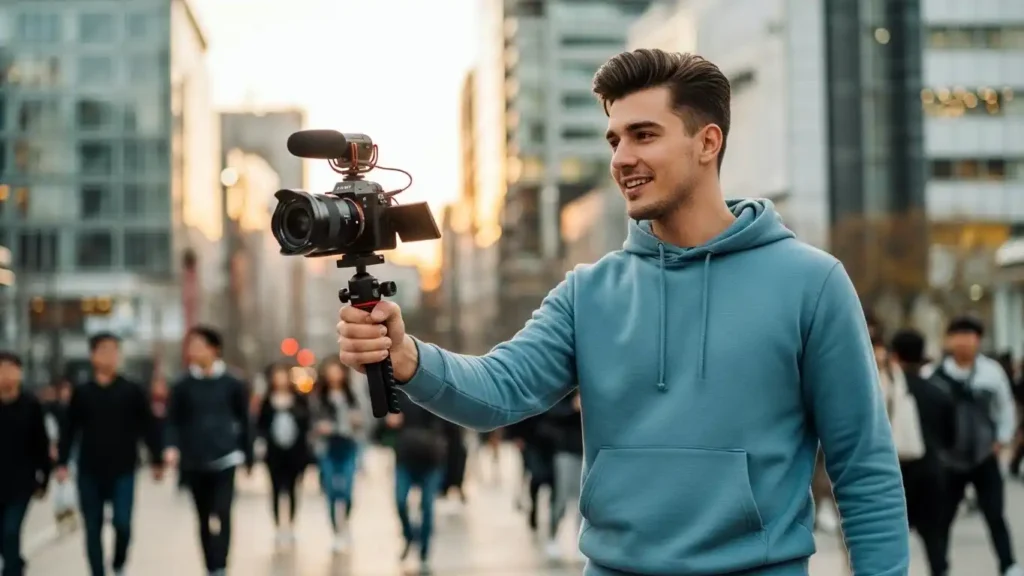
The Hierarchy of Video Needs: Beyond the Sensor
Before reviewing a spec sheet, you must understand where your money actually goes. Entrepreneurs often suffer from “Sensor Obsession.” They believe a larger sensor solves all problems. It doesn’t.
1. The Optics (Lenses)
The camera body is a computer that depreciates faster than a cut cabbage. The lens, however, is an investment. A “kit lens” (the one that comes in the box) usually has a variable aperture, meaning your video will flicker or get dark as you zoom. For YouTube, you need a lens with a wide aperture (f/1.8 or f/2.8) to create that professional separation between you and the background.
2. Bitrate and Codecs
This is where the amateurs get caught out. A camera might claim to shoot “4K,” but if the bitrate is low (e.g., 50 Mbps), the footage will appear “muddy” when uploaded to YouTube. YouTube’s compression algorithm is brutal. You need a camera that shoots at least 100 Mbps in an efficient codec, such as H.264 or H.265, to ensure your visual content remains sharp after the platform’s processing.
3. The “Flop-Out” Screen
If you are filming yourself, you need to see your framing. Without a fully articulating screen, you are flying blind. I’ve seen hours of “perfect” content ruined because the speaker’s head was chopped off or the focus was on the bookshelf behind them.
The Professional vs. The Amateur Setup
| Feature | The Amateur (Spec-Chaser) | The Professional (Result-Oriented) |
| Resolution | Obsesses over 8K (unnecessary) | Standardises on 4K or high-bitrate 1080p |
| Audio | Uses the built-in camera mic | Uses an external shotgun or lavalier mic |
| Lighting | Relies on “natural light” (inconsistent) | Uses a 3-point LED key light setup |
| Storage | Cheap, slow SD cards (causes crashes) | V30 or V60 rated high-speed cards |
| Focus | Manual focus (misses the mark) | Phase-detection eye-tracking AF |
Choosing Your Weapon: Categorised by Business Goal
The “Thought Leader” (Mirrorless Systems)
If you are an entrepreneur filming talking-head videos, you need a mirrorless camera. The Sony ZV-E10 II or the Canon EOS R10 are the current benchmarks. They offer “Product Showcase” modes that intelligently switch focus between your face and an object you hold up. This is vital for content repurposing, as these clips can easily be sliced into LinkedIn or TikTok snippets.
Sony ZV-E10M2 Mirrorless Vlogging Camera
You’re tired of the “smartphone look” and ready to produce content that actually competes with top-tier YouTubers. This is the fix. The Sony ZV-E10 II isn’t just a camera; it is a dedicated production hub designed to bridge the gap between amateur vlogging and professional cinematography.
As an Amazon Partner, when you buy through our links, we may earn a commission.
The “Field Expert” (Action and Compacts)
If your business involves travel, construction, or on-site visits, a bulky mirrorless camera is a liability. The DJI Osmo Pocket 3 has disrupted this space. It features a built-in mechanical gimbal, meaning you get perfectly smooth footage whilst walking. Its 1-inch sensor is large enough to handle low-light environments, making it a “vlogging” powerhouse for SMB owners who are always on the move.
DJI Osmo Pocket 3
You’re tired of carrying heavy gimbals and bulky cameras, but you aren’t willing to sacrifice professional image quality. This is the fix. The DJI Osmo Pocket 3 is a 1-inch sensor powerhouse that fits in your palm, offering a level of stabilisation and colour depth that was previously reserved for professional cinema rigs.
As an Amazon Partner, when you buy through our links, we may earn a commission.
The “Studio Pro” (Cinema Line)
For those building a dedicated media room, look at the Sony FX3 or Canon EOS R5 C. These are “Cinema” cameras. They include internal cooling fans, meaning they will never shut down during a two-hour podcast recording. They also record in 10-bit colour, allowing your editor to match the brand colours of your digital marketing services with surgical precision.
Sony FX3
You are looking at the bridge between high-end Hollywood production and independent filmmaking. This is it. The Sony FX3 is the smallest member of Sony’s prestigious Cinema Line, taking the legendary sensor technology from the A7S III and repackaging it into a “cage-free” body built specifically for the rigours of a movie set.
As an Amazon Partner, when you buy through our links, we may earn a commission.
I Once Audited a Client.
In 2023, I was called in to consult for a mid-sized tech firm in Belfast. They had spent £15,000 on a “studio”, but their YouTube engagement was tanking.
The issue wasn’t the cameras. It was the friction.
They had purchased high-end Blackmagic cameras that lacked autofocus. Every time the CEO leaned forward to make a point, he went out of focus. The “fix” was a 40-page manual on how to set manual focus points. Unsurprisingly, the CEO stopped attending shoots.
We swapped the gear for Sony mirrorless cameras with world-class eye-tracking. The “technical” quality technically went down (from RAW video to compressed MP4), but their output increased by 400%.
The lesson: Efficiency beats “specs” every day of the week. If you’re unsure how to start, check our editorial guidelines for guidance on how we approach high-quality output without unnecessary fluff.
The State of YouTube Gear in 2026
We are entering the era of AI-Integrated Sensors. Within the last 18 months, Sony and Blackmagic have begun implementing “AI Processing Units” directly into the camera body.
What does this mean for you?
- Human Pose Estimation: The camera can now “guess” where your head is, even if you turn your back to the lens.
- Auto-Framing: The camera can digitally crop into a 4K image and “follow” you around the room as if you have a cameraman.
- Real-Time Noise Reduction: Smarter ISO management means you can film in a poorly lit office and the AI will scrub the grain in real-time.
When buying a camera today, ensure it has a dedicated AI autofocus chip. Buying “old” tech now is a recipe for obsolescence by next Christmas.
Why Audio is 50% of the Best YouTube Camera
It is a physiological fact: audiences will tolerate poor video, but they will turn off immediately if the audio is bad. Pew Research Center data on media consumption suggests that “clarity of message” is the primary driver of educational content retention.
If your “best camera” doesn’t have a way to get a microphone close to your mouth, it’s a paperweight. Avoid using “shotgun” microphones mounted on top of the camera if you are more than six feet away. Use a wireless system, such as the Rode Wireless PRO or DJI Mic 2. These systems record a backup copy of the audio inside the transmitter itself—a lifesaver when the wireless signal drops out.
Rode Wireless PRO
You’ve experienced the heartbreak of a perfect interview ruined by distorted, peaking audio or a signal dropout. This is the fix. The RØDE Wireless PRO is the most powerful compact microphone system ever created, designed to ensure that you literally cannot fail to capture high-quality sound.
As an Amazon Partner, when you buy through our links, we may earn a commission.
The Technical Argument for 10-bit Video
Most consumer cameras shoot in 8-bit. This means they can record about 16.7 million colours. Sounds like a lot, right? It isn’t. When you try to “grade” or fix the lighting in post-production, 8-bit footage “breaks.” You get “banding” in the sky or on the walls behind you.
Professional cameras now shoot in 10-bit, which records over 1 billion colours. For a business, this isn’t about being “fancy.” It’s about storytelling in marketing. If your brand colours are a specific shade of navy, an 8-bit video might turn them a muddy purple. 10-bit ensures your brand integrity remains intact.
The Verdict
Choosing the best camera for YouTube isn’t an exercise in spending the most money; it’s about finding the right balance between quality and affordability. It is an exercise in identifying your “Content Friction Points.”
- If you dislike editing, consider purchasing a camera with exceptional “SOOC” (Straight Out Of Camera) colour science, such as the Fujifilm X-S20.
- If you plan to film alone, consider purchasing a camera with the best autofocus, such as the Sony ZV-E1.
- If you are on a budget, use your iPhone with a dedicated app like Blackmagic Cam and allocate your budget to lighting.
Stop over-analysing. The market doesn’t wait for people who are still reading spec sheets. Select a tool that suits your workflow, ensure your audio is clear, and begin establishing your authority.
If you’re overwhelmed by the technical requirements of modern video, you aren’t alone. We help brands navigate this exact video content marketing minefield every day.
Ready to stop guessing and start growing? Request a quote from Inkbot Design today, or read our guide on blogging and post-writing to see how video and text work together to dominate search results.
Frequently Asked Questions
Is a DSLR still good for YouTube in 2026?
No. DSLRs are a legacy technology. The moving mirror mechanism is unnecessary for video and limits autofocus performance. Mirrorless cameras have become the industry standard, offering superior video features, faster autofocus, and more compact designs.
Do I really need 4K for my business videos?
Technically, no. 1080p is sufficient for most viewers. However, filming in 4K allows you to “crop in” during editing to create a second shot (a “close-up”) without losing quality. This makes your videos more dynamic.
What is the best budget camera for a beginner?
The Sony ZV-1F or a high-end smartphone. If you use a phone, invest £100 in a decent microphone and £50 in a ring light. This setup will outperform a £1,000 camera used poorly.
How much should I spend on my first YouTube camera?
For a professional SMB setup, expect to spend between £800 and £1,500. This should include the camera body, a versatile lens, a basic microphone, and a tripod.
Why is my camera overheating when I record?
Many compact cameras aren’t designed for long-form video. To fix this, pull the LCD screen away from the body, use a faster SD card to reduce processing heat, or record in 1080p instead of 4K.
Can I use my camera as a webcam for live streaming?
Yes, provided it has “Clean HDMI” output. Most modern cameras from Sony, Canon, and Nikon now feature a “USB Streaming” mode that allows you to connect them directly to your computer via USB-C.
Which lens is best for “blurry backgrounds”?
Look for a “Prime” lens (one that doesn’t zoom) with a low f-number, such as a 35mm f/1.8 or a 50mm f/1.8. The lower the number, the more blur (bokeh) you can achieve.
Do I need an external monitor?
Only if your camera screen is too small to see or doesn’t flip around. For most entrepreneurs, the built-in articulating screen is enough to get started.
What is “Log” recording, and do I need it?
“Log” (like S-Log or C-Log) is a flat colour profile that preserves more detail in highlights and shadows. It requires colour grading in editing. If you don’t have an editor, avoid Log and use a “Standard” or “Portrait” profile.
Is Sony better than Canon for creating YouTube content?
Currently, Sony leads in autofocus and lens variety, whilst Canon is often praised for its “Skin Tones” and user-friendly menu systems. Both are excellent; the choice usually comes down to personal preference.
How do I improve my video quality without buying a new camera?
Lighting. Even an expensive camera can produce unflattering results in poor lighting. Buy a large “Softbox” light and place it at a 45-degree angle to your face. This will do more for your image than a new sensor.
What SD card speed is required for 4K?
Look for the “V” rating. For 4K video, use a card with a V30 rating or higher. If you are shooting high-bitrate or slow-motion video, a V60 or V90 card is required to prevent recording errors.